Maunaloa Elementary on Molokai enrolled 59 students last year and operated on a budget of roughly $900,000. That is about $350,000 short of the $1.38 million that principals say a small elementary school needs to staff basic operations. Maunaloa is not an outlier. Thirty-four Hawaii public schools now enroll fewer than 250 students, the threshold the Department of Education considers the minimum for adequate funding, according to Civil Beat reporting.
The problem is not that a few rural campuses are shrinking. The problem is that a decade of statewide enrollment decline has hollowed out school after school until a third of the conversation about Hawaii public education is now about whether buildings should remain open at all.
The trajectory that built the crisis
Hawaii's public school system peaked at 186,850 students in 2013-14. By 2024-25, enrollment had fallen to 167,076, a loss of 19,774 students, or 10.6%. The decline has been nearly unbroken: only one year since 2014 (2018-19, when enrollment ticked up by 441) interrupted the slide.
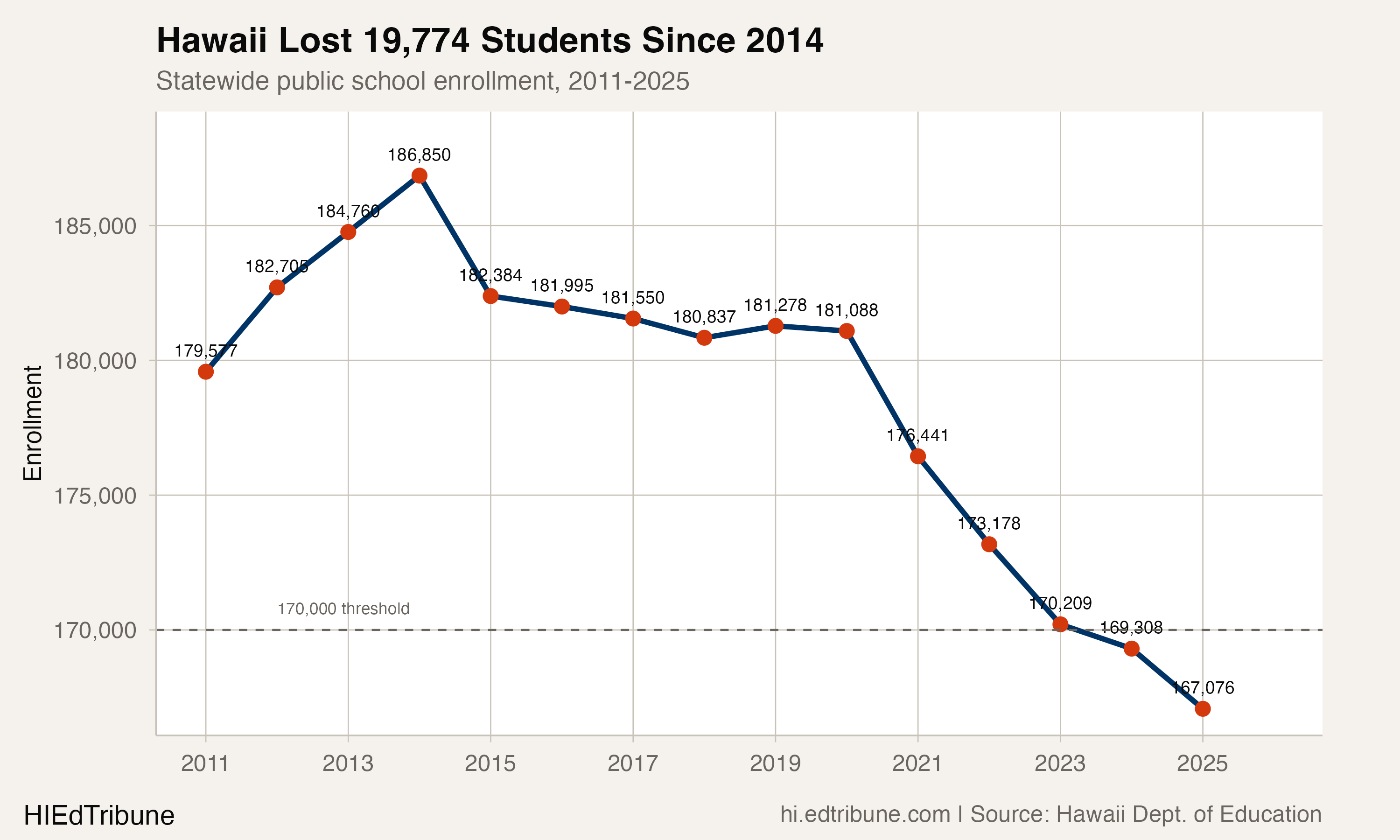
The pace has been uneven. The kindergarten eligibility change in 2015, when Act 76 shifted the birthday cutoff from December 31 to July 31, yanked 5,631 students out of kindergarten in a single year, a 34.0% drop. COVID then accelerated the structural decline: the state lost 4,647 students in 2020-21 alone, nearly matching the Act 76 shock. Since 2020, the system has lost 14,012 students, 7.7% of its pre-pandemic total, with no year of recovery.
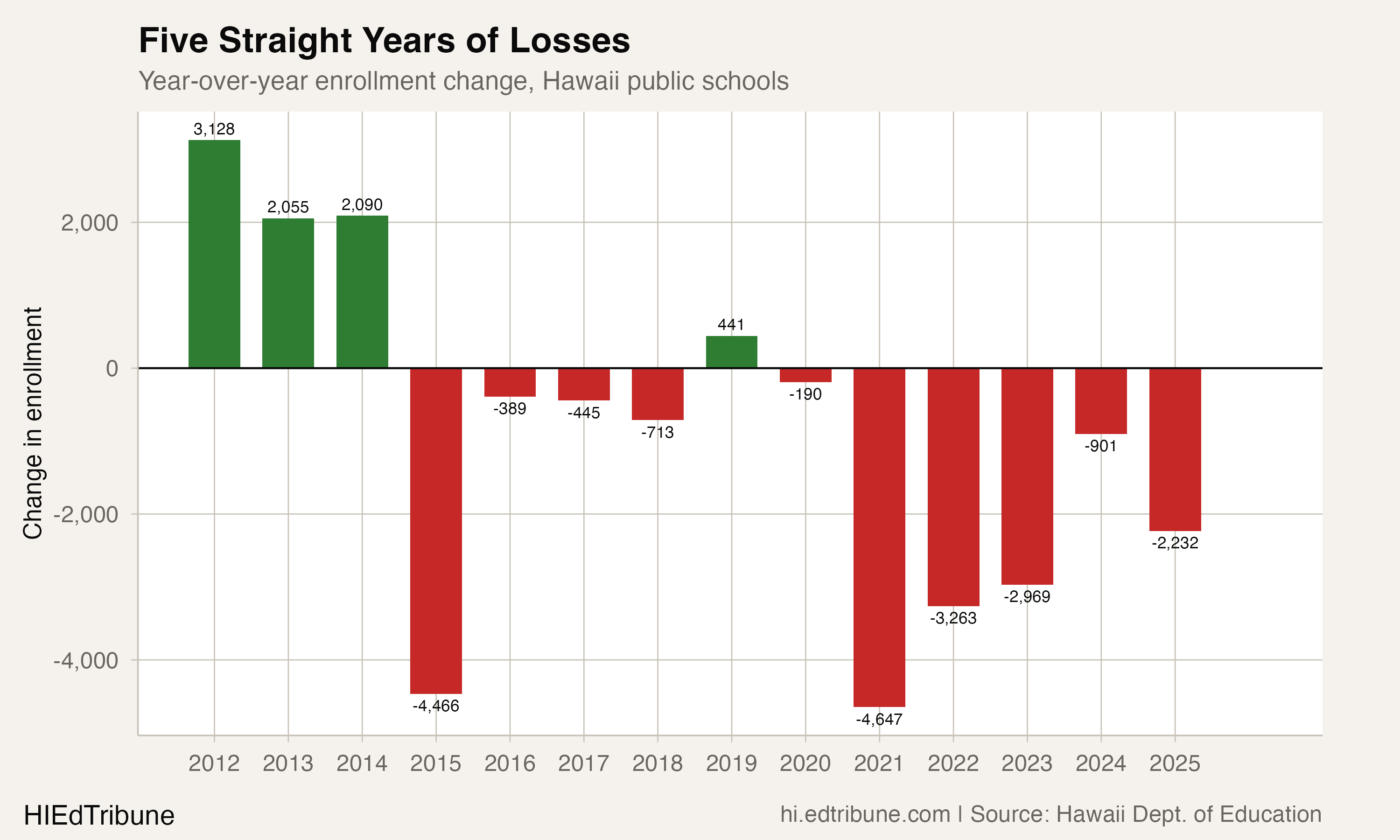
The five consecutive years of losses since 2021 average 2,802 students per year. At that rate, the state would cross below 160,000 before the end of the decade.
Where the students disappeared
Honolulu↗ET accounts for a staggering 92.1% of the statewide peak-to-current decline. The county has lost 18,210 students since 2014, a 14.9% drop, shrinking its share of total state enrollment from 65.4% to 62.2%. Maui↗ET lost 2,800 (13.0%), Kauai↗ET lost 1,010 (10.6%), and Hawaii County↗ET lost 1,077 (4.5%).
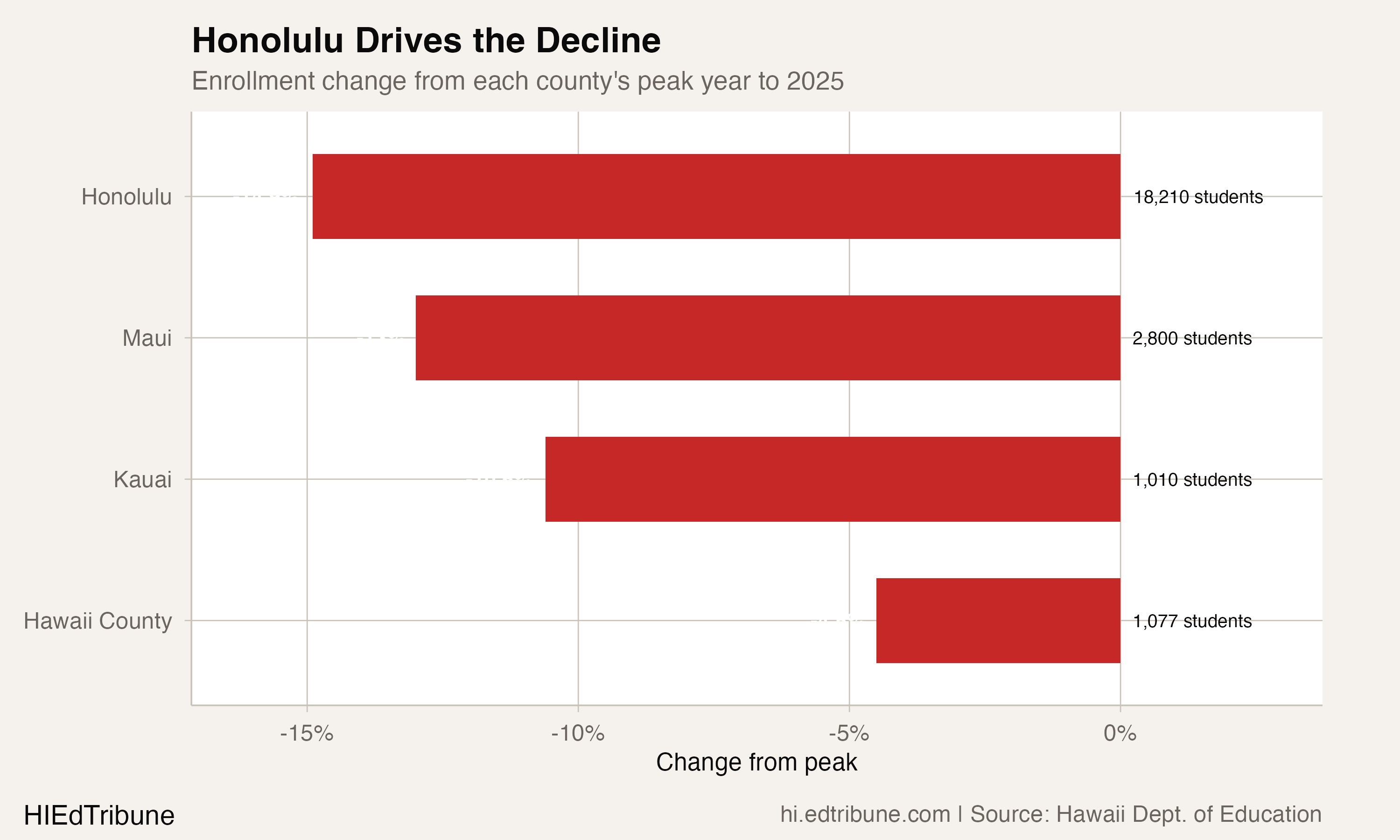
Honolulu's outsized losses reflect the economic squeeze on families in the state's most expensive housing market. A January 2025 report from Aloha United Way found that 85% of families considering leaving Hawaii cited cost of living, and 73% specifically named housing costs. The state has lost a net 22,500 residents since 2020, with domestic outmigration of 8,876 people in the most recent year alone.
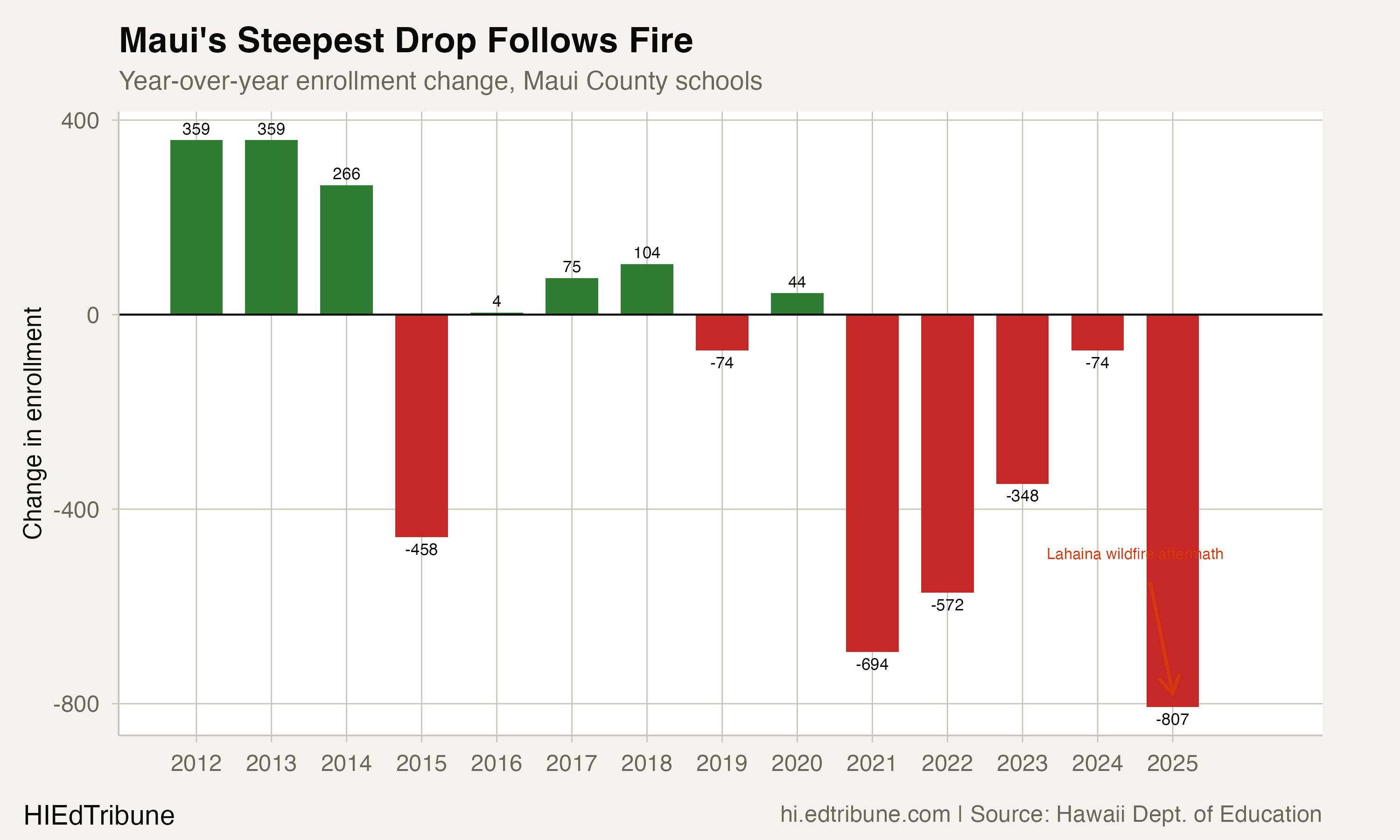
Maui's 2025 loss of 807 students, its steepest single-year drop on record, carries a specific cause. The August 2023 Lahaina wildfire displaced roughly 3,000 students, and many never returned. Lahainaluna High School's enrollment fell from 1,012 the day before the fire to 813 two school years later, a 20% decline. Forty-six students relocated off-island entirely.
The pipeline warning
Beneath the aggregate decline, a structural shift is reshaping who enters and exits Hawaii's schools. In 2024-25, for the first time in the data, Hawaii enrolled more 12th graders (11,905) than kindergartners (11,746). The kindergarten-to-12th-grade ratio fell to 98.7, crossing below 100.
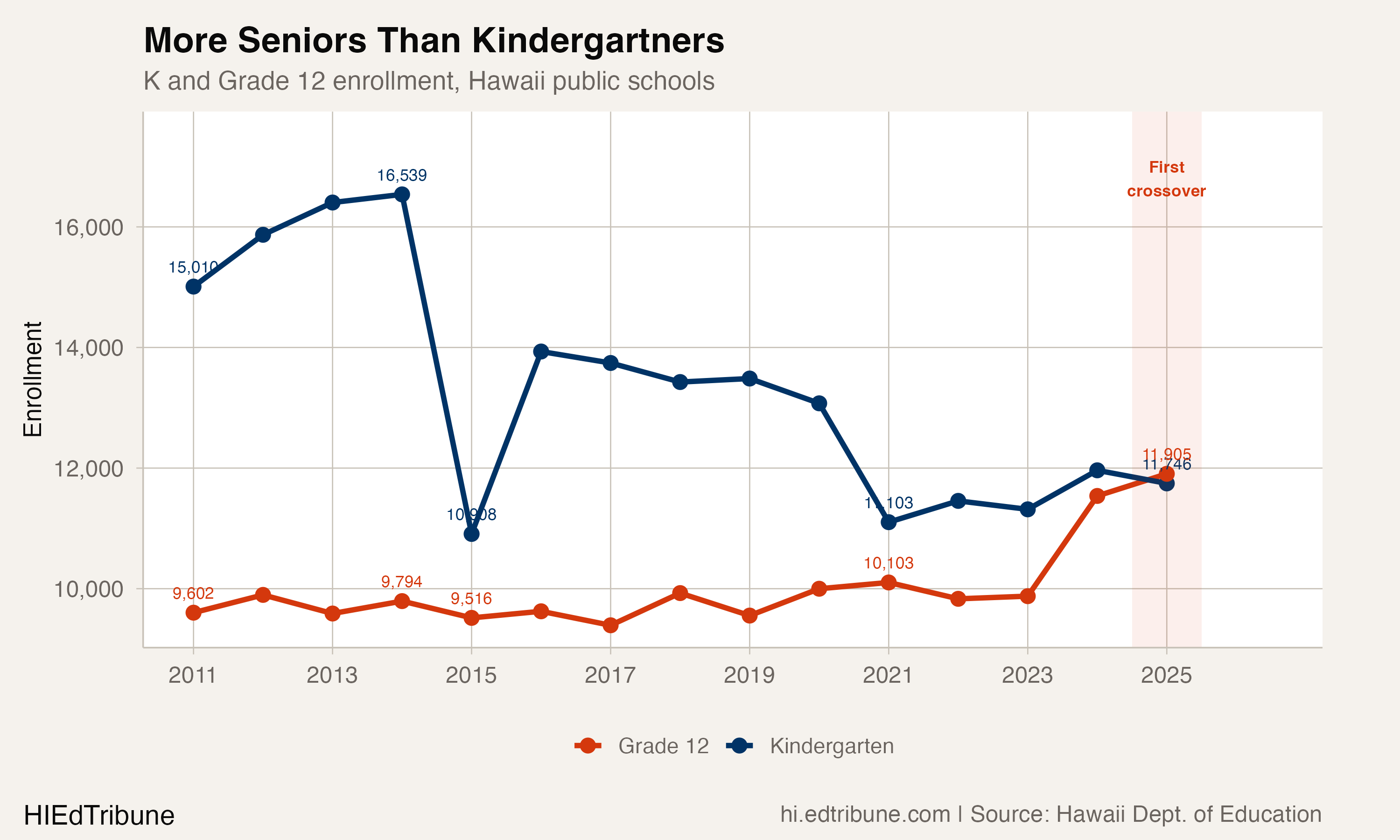
Kindergarten enrollment has never recovered from the Act 76 shock. Before the cutoff change, Hawaii enrolled 16,539 kindergartners (2013-14). A decade later, it enrolls 11,746, a 29.0% decline. Meanwhile, 12th-grade enrollment has risen 21.6% over the same period, from 9,794 to 11,905, as the larger pre-Act 76 cohorts work their way through high school.
This inversion is temporary in the sense that the large senior classes will graduate. It is permanent in the sense that no kindergarten class in the post-Act 76 era has come close to replacing the cohorts leaving. Each graduating class that exits the system is larger than the kindergarten class that enters it. The 34 schools below the viability threshold in 2024-25 will have even fewer students later if the pipeline keeps narrowing.
Redistricting before closure
The DOE's initial response was to study school closures directly. Board of Education Chair Roy Takumi acknowledged the stakes: "Closing a school isn't like closing your neighborhood Starbucks," he told Civil Beat in March 2025. After community pushback, the department pivoted to "district optimization" in September 2025, prioritizing redistricting over immediate closures.
"As a result of the feedback received, the Department will be revising its approach to addressing shifts in enrollment and adjusting the timeline accordingly." -- Deputy Superintendent Tammi Oyadomari-Chun, Honolulu Civil Beat, September 2025
The revised timeline pushes redistricting changes to the 2026-27 school year, with consolidation studies beginning in 2027 and no closure decisions until spring 2028. The logic is that rebalancing attendance zones can move students from overcrowded campuses in growing areas like Ewa and Kapolei into underutilized schools nearby, buying time before outright closures.
A 2017 capacity study found that Hawaii has enough school capacity statewide, just not in the right places. Redistricting addresses that mismatch. But it does not address the underlying arithmetic: when the total number of students falls by 2,800 per year, redistricting rearranges a shrinking pie.
The question redistricting cannot answer
The 34 schools below the viability threshold are concentrated in rural and neighbor-island communities where "redistricting" has limited meaning. On Molokai, there is no nearby school to absorb Maunaloa's 59 students. On Lanai, enrollment is projected to drop by as much as 25% by decade's end. For these campuses, the $250,000 annual supplement the DOE provides to critically small schools is a bridge to an uncertain destination.
The timeline buys the department two more years before closure votes. In those two years, if the current pace holds, Hawaii will lose another 5,600 students. The 34 schools below the viability threshold will become 40 or more. The fiscal math of operating a campus for fewer students than a large elementary school puts in a single grade will only get harder.
The question is whether redistricting and delay are strategy or avoidance. By spring 2028, when the first consolidation decisions could arrive, Hawaii's total enrollment may sit near 161,000, some 26,000 students below its peak. The kindergarten classes entering those schools will be smaller still.
Detailed code that reproduces the analysis and figures in this article is available exclusively to EdTribune subscribers.
Discussion
Sign in to join the discussion.
Loading comments...