In 2020-21, with campuses shuttered and families rethinking their options, Hawaii's charter schools added 329 students. Traditional public schools lost 4,976. That single year cracked open a divergence that has not closed since.
By 2024-25, the charter sector reached 13,094 students, an all-time high, a 56.5% increase from 8,367 in 2010-11. Traditional schools, measured as the combined enrollment across Hawaii's four counties, fell to 153,982, their lowest mark in the 15-year dataset. For roughly every four students traditional schools lost, charter schools gained one.
Two sectors, two trajectories
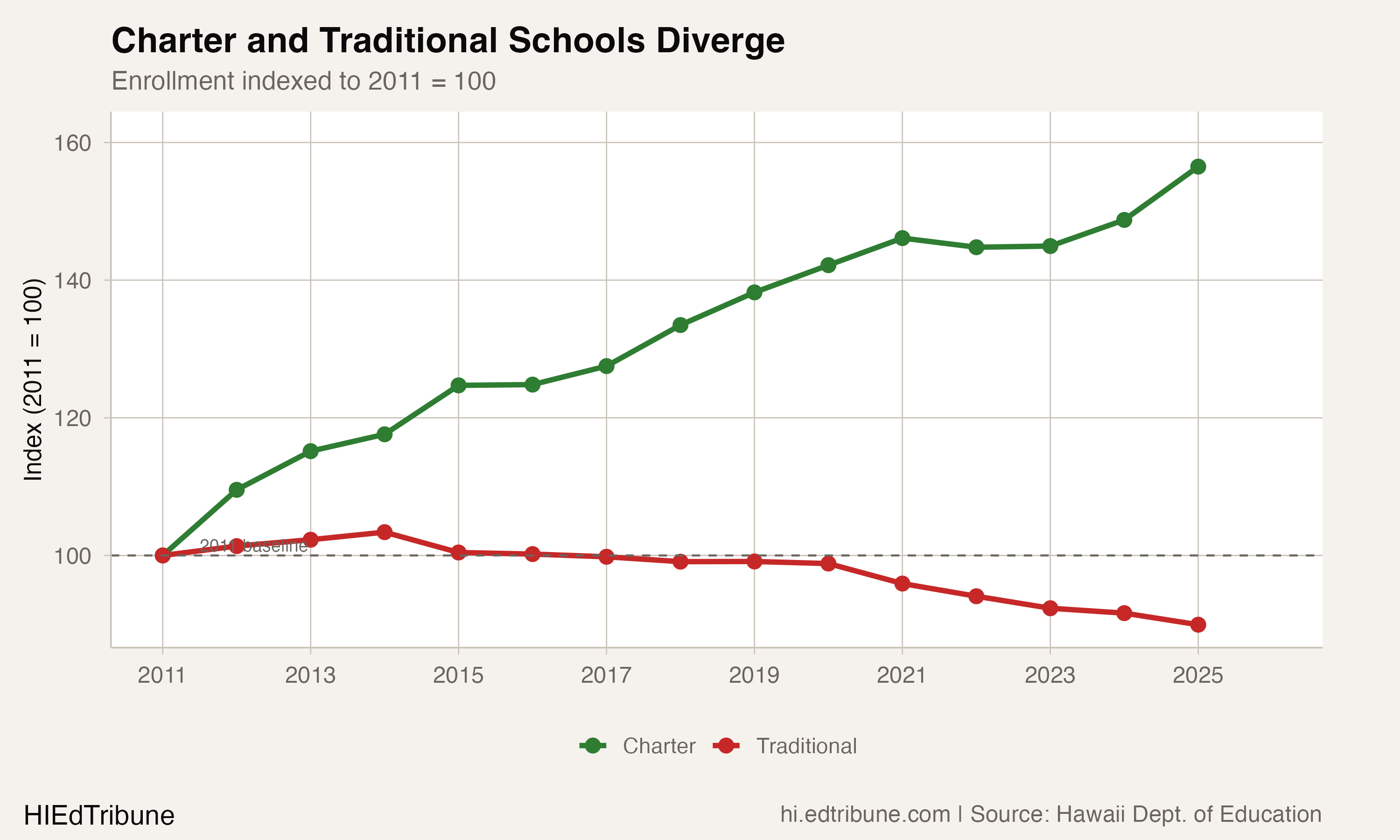
The numbers tell a clean story of inversion. From 2010-11 through 2013-14, both sectors grew. Traditional schools peaked at 177,010 in 2013-14 and have declined in 10 of the 11 years since, losing 23,028 students, a 13.0% drop. Charter schools have grown in 13 of 14 years, stumbling only in 2021-22 when they dipped by 111 students before resuming growth.
The charter sector's 4,727-student gain since 2010-11 absorbed 27.4% of the traditional sector's 17,228-student loss over the same period. The remaining 72.6%, roughly 12,500 students, left the public system entirely, a pattern consistent with Hawaii's sustained population outmigration and declining birth rates.
The most recent year accelerated the split. Charter enrollment grew by 648 students in 2024-25, a 5.2% jump and the sector's largest single-year gain since 2011-12. Traditional schools lost 2,880, their steepest annual decline outside the pandemic year and the 2014-15 kindergarten age-cutoff change.
Charter share doubles, but from a small base
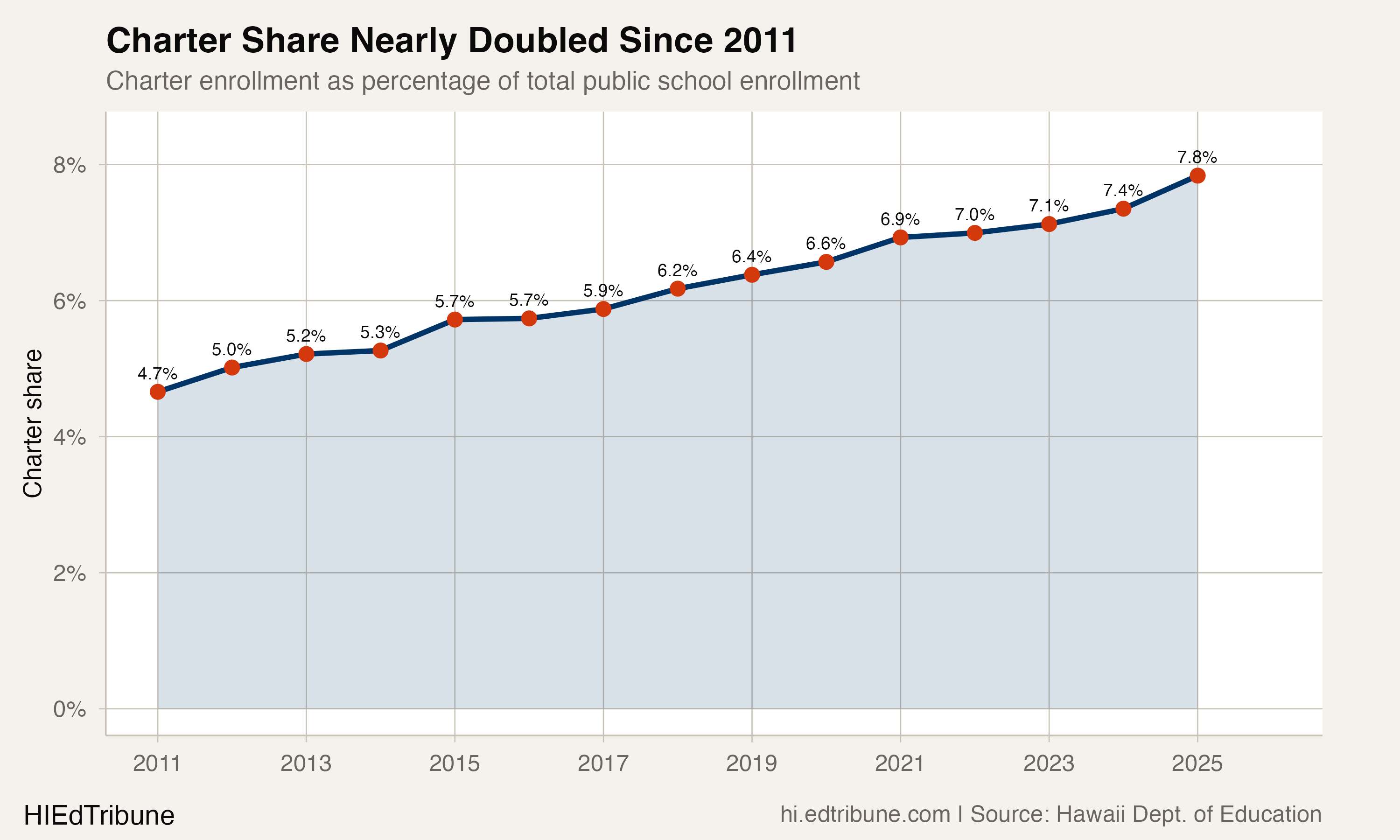
Charter schools' share of total public enrollment rose from 4.7% in 2010-11 to 7.8% in 2024-25. That growth, while steady, keeps Hawaii well below the national average for states with mature charter sectors. The Hawaii State Public Charter School Commission noted that charters have seen "nearly a 10% jump in enrollment since 2020," making them the only sector of Hawaii's public education system to report continued growth since the pandemic.
The share gain came roughly equally from two sources: charter enrollment growing in absolute terms, and the total denominator shrinking as traditional schools lost students. From 2019-20 to 2024-25, charters gained 1,198 students while the total system lost 14,012. Had the total held constant, charter share would be 7.2% instead of 7.8%.
Where charters concentrate, and where they don't
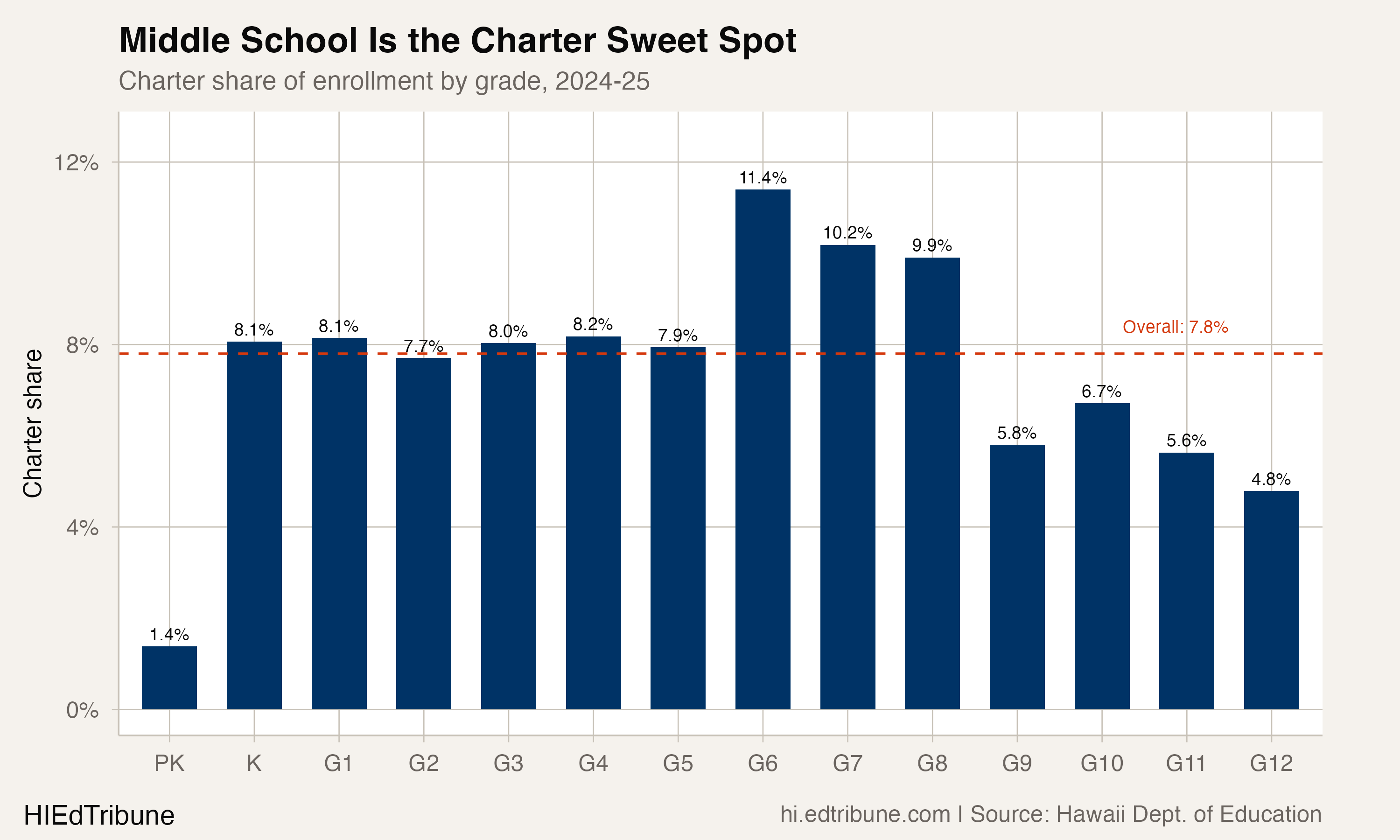
Middle school is where Hawaii's charter sector punches hardest. In sixth grade, charter schools enroll 11.4% of all public school students, nearly 50% above the statewide average of 7.8%. Seventh and eighth grade follow at 10.2% and 9.9%. The pattern inverts sharply in high school: by 12th grade, charter share falls to 4.8%, suggesting that families who choose charters for middle school often return to traditional schools for high school, where course variety, athletics, and college-prep infrastructure favor larger campuses.
The elementary grades hover near the average, with K through fifth ranging from 7.7% to 8.2%. Pre-K is nearly absent from the charter sector at 1.4%, though the Charter Commission reports growth in that segment with 287 students enrolled in charter pre-K programs and a new Kapolei campus opening in January.
Honolulu drives 79% of traditional losses
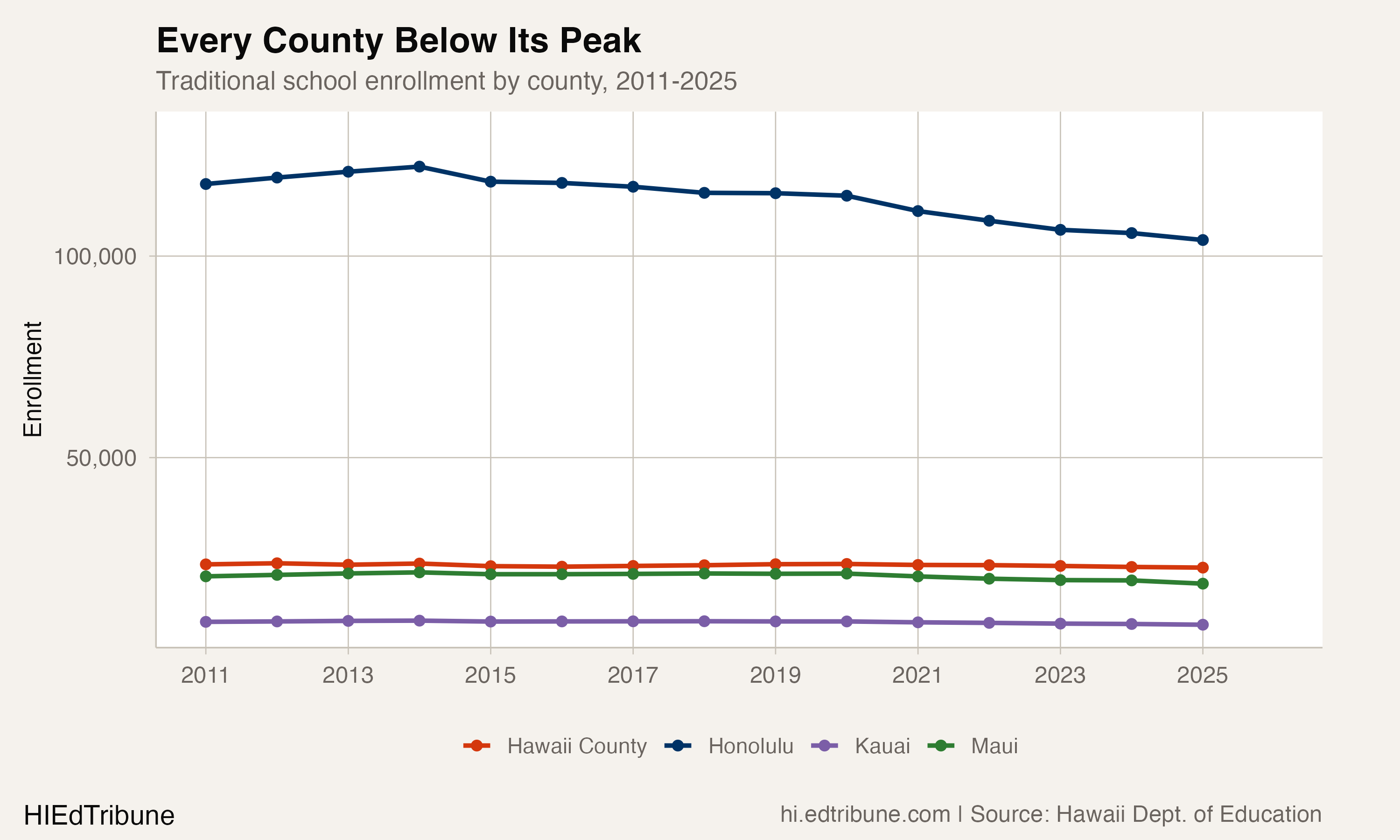
The traditional sector's decline is not evenly distributed. Honolulu↗ET accounts for 18,210 of the 23,028 students lost since the 2013-14 peak, or 79.1%. The county fell from 122,195 to 103,985, a 14.9% decline. Hawaii's most expensive housing market, where the median single-family home sold for $1.16 million in March 2025, is losing families faster than any other county.
Maui↗ET saw its steepest single-year drop in the dataset, losing 807 students between 2023-24 and 2024-25, a 4.1% decline. The timing aligns with the August 2023 Lahaina wildfire, which displaced hundreds of families and reduced enrollment in the Lahaina school complex by roughly 10%. Lahainaluna High School principal Richard Carosso told Maui Now that students left "going back to the mainland, back to the countries that their families are from."
Hawaii County↗ET and Kauai↗ET have followed quieter, steadier declines: Hawaii County is down 4.5% from its 2011-12 peak, and Kauai is down 10.6% from its 2013-14 peak.
The facilities paradox
The two sectors' diverging enrollment has created an unusual tension. Traditional schools are emptying. A 2019 DOE report found a net surplus of nearly 10,000 classroom seats across the system. Meanwhile, charter schools spend 15% to 30% of their budgets on facilities, operating out of leased commercial buildings, converted warehouses, and in some cases tents.
"The power of a charter school is to offer what isn't being offered." -- Kapua Chandler, Namahana founder, Honolulu Civil Beat, Dec. 2025
The logical solution, sharing underused DOE space with growing charter schools, has not materialized. A 2025 state survey found that no state agencies, including the DOE, reported facilities suitable for charter use. The DOE has historically resisted sharing its campuses, arguing that charter openings could further reduce traditional school enrollment, a concern that the data now validates: charter growth has absorbed more than a quarter of traditional losses.
The year-over-year pattern
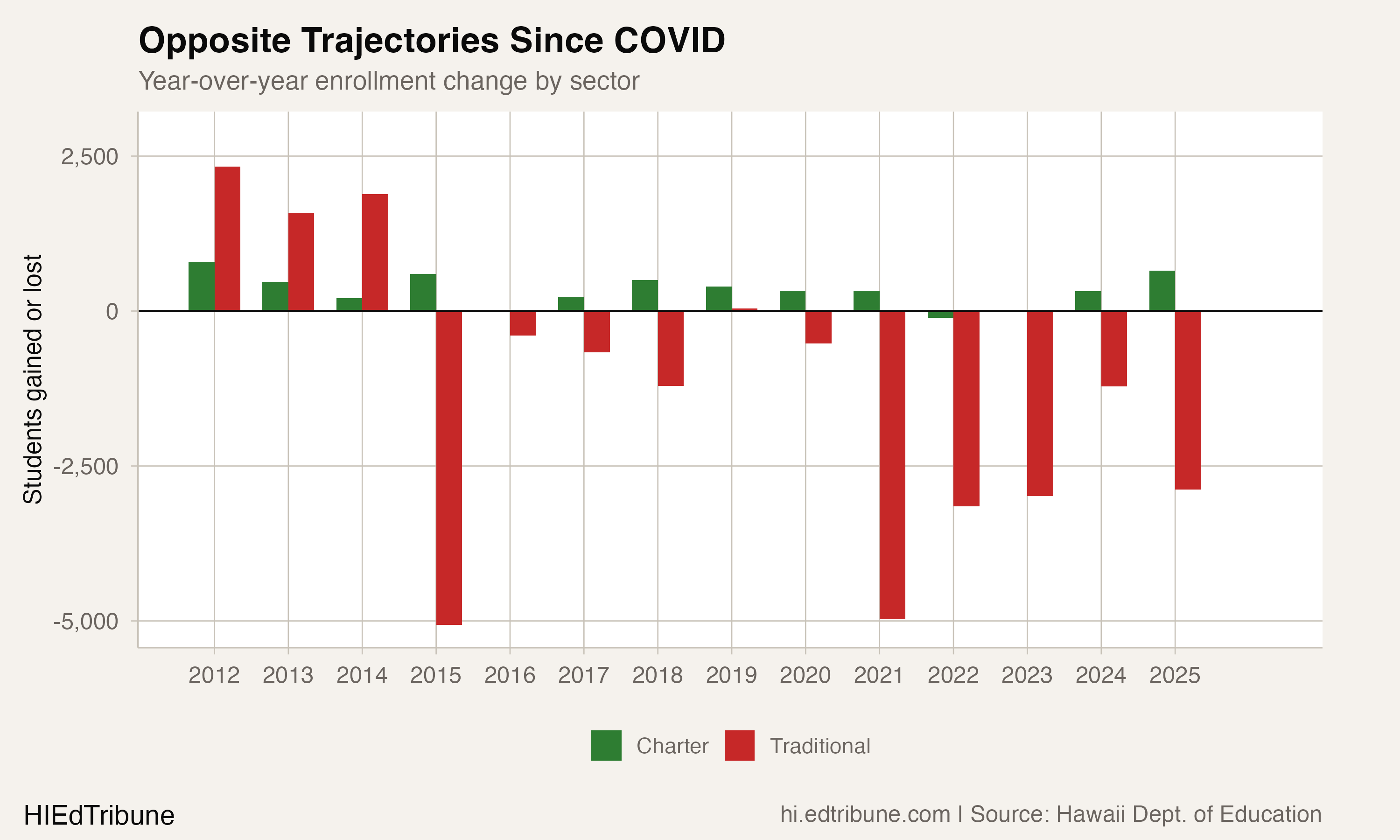
The year-over-year chart reveals three distinct eras. From 2011-12 through 2013-14, both sectors grew together, with traditional schools adding 1,585 to 2,330 students annually while charters added 205 to 798. The 2014-15 kindergarten age-cutoff shift (Hawaii moved its birthday deadline from December 31 to July 31, per Act 76 of 2014) created a one-time shock that hit traditional schools harder than charters: traditional enrollment dropped 5,061 while charter enrollment actually grew by 595.
From 2015-16 through 2019-20, traditional enrollment drifted slowly downward while charters grew at a moderate pace. Then COVID fractured the pattern. Since 2020-21, traditional schools have lost students every year, averaging 3,042 annually. Charters, after a single-year dip in 2021-22, have added students in three of the last four years, with the most recent year's gain of 648 the largest of the post-COVID era.
What happens when 34 schools are too small
The DOE's response to shrinking traditional enrollment initially focused on school closures. In March 2025, officials identified 34 schools enrolling fewer than 250 students, the estimated minimum for adequate per-pupil funding. Board of Education Chair Roy Takumi acknowledged the difficulty: "Closing a school isn't like closing your neighborhood Starbucks."
By September 2025, the DOE pivoted to "district optimization" through redistricting, postponing consolidation studies until spring 2028. The department projects an additional 14,600 students lost by the end of the decade. If charter schools continue absorbing a quarter of those losses while traditional schools bear the rest, the question is not whether small schools close but which ones and when. The last school closure in the state was Queen Liliuokalani Elementary in 2011.
Meanwhile, charter schools are testing whether the sector can keep growing without a facilities solution. Hawaiʻi Technology Academy, the state's largest charter with 1,924 students, grew 67% over five years. Alakai O Kauai has a waitlist of 180 students for 240 seats. As traditional campuses empty and charters turn families away, the two sectors' trajectories pose a straightforward question for the DOE: is it better to maintain surplus seats in schools families are leaving, or to share those seats with schools families are choosing?
Detailed code that reproduces the analysis and figures in this article is available exclusively to EdTribune subscribers.
Discussion
Sign in to join the discussion.
Loading comments...