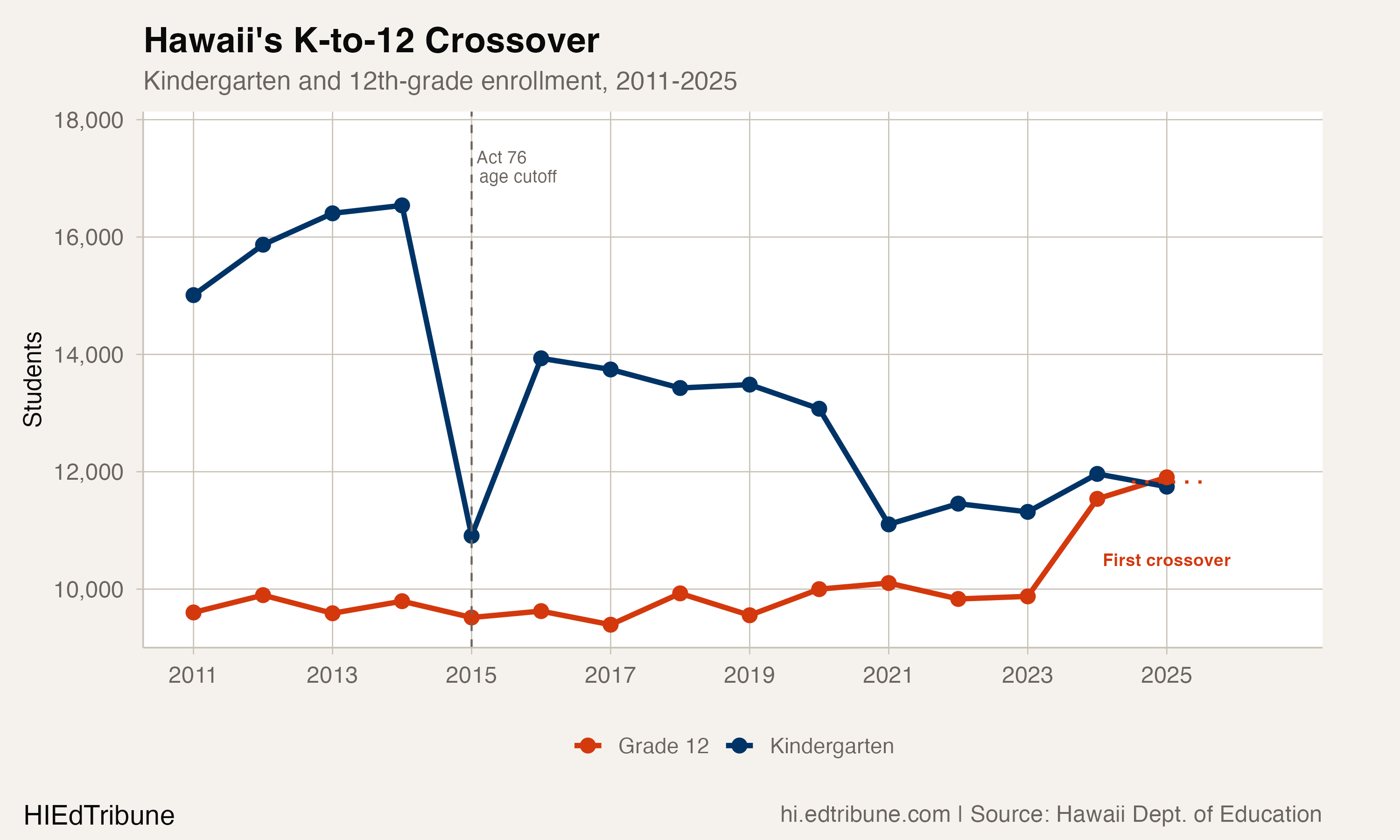
In the 2024-25 school year, Hawaii's public schools enrolled 11,905 seniors and 11,746 kindergartners. It is the first time in the state's data history that 12th graders outnumbered kindergartners. The gap is 159 students, small enough to reverse in a single year, but the trajectory behind it has been building for a decade.
As recently as 2014, Hawaii enrolled 169 kindergartners for every 100 seniors. That ratio dropped to 98.7% in 2025. The collapse is not a gradual demographic shift. It has a specific origin: a 2014 law that moved the kindergarten age cutoff from December 31 to July 31, permanently shrinking every incoming class since.
A policy decision with a 10-year tail
Act 76, signed in 2012 and effective for the 2014-15 school year, moved Hawaii's kindergarten entry cutoff five months earlier. The immediate effect was stark: kindergarten enrollment fell from 16,539 to 10,908, a 34.0% single-year drop. Approximately 5,800 children were barred from public kindergarten that year. Ninety-five kindergarten teachers were reassigned.
The drop was supposed to be temporary. The first year caught children born between August and December in a one-time gap. But kindergarten enrollment never recovered to pre-Act 76 levels. The highest post-cutoff K enrollment was 13,933 in 2016, still 15.8% below the 2014 peak. By 2025, K enrollment had fallen further to 11,746, down 29.0% from 2014.
The reason kindergarten stayed low: the age cutoff change coincided with Hawaii's declining birth rate. Hawaii births fell from 16,810 in 2019 to 14,820 in 2023, an 11.8% decline. With fewer children being born each year, the kindergarten pipeline has no demographic recovery in sight.
The ratio's long descent
The K-to-G12 ratio tracks the balance between the system's entrance and exit. When the ratio is above 100%, more students are entering than leaving. When it falls below, the system is shrinking from the bottom.
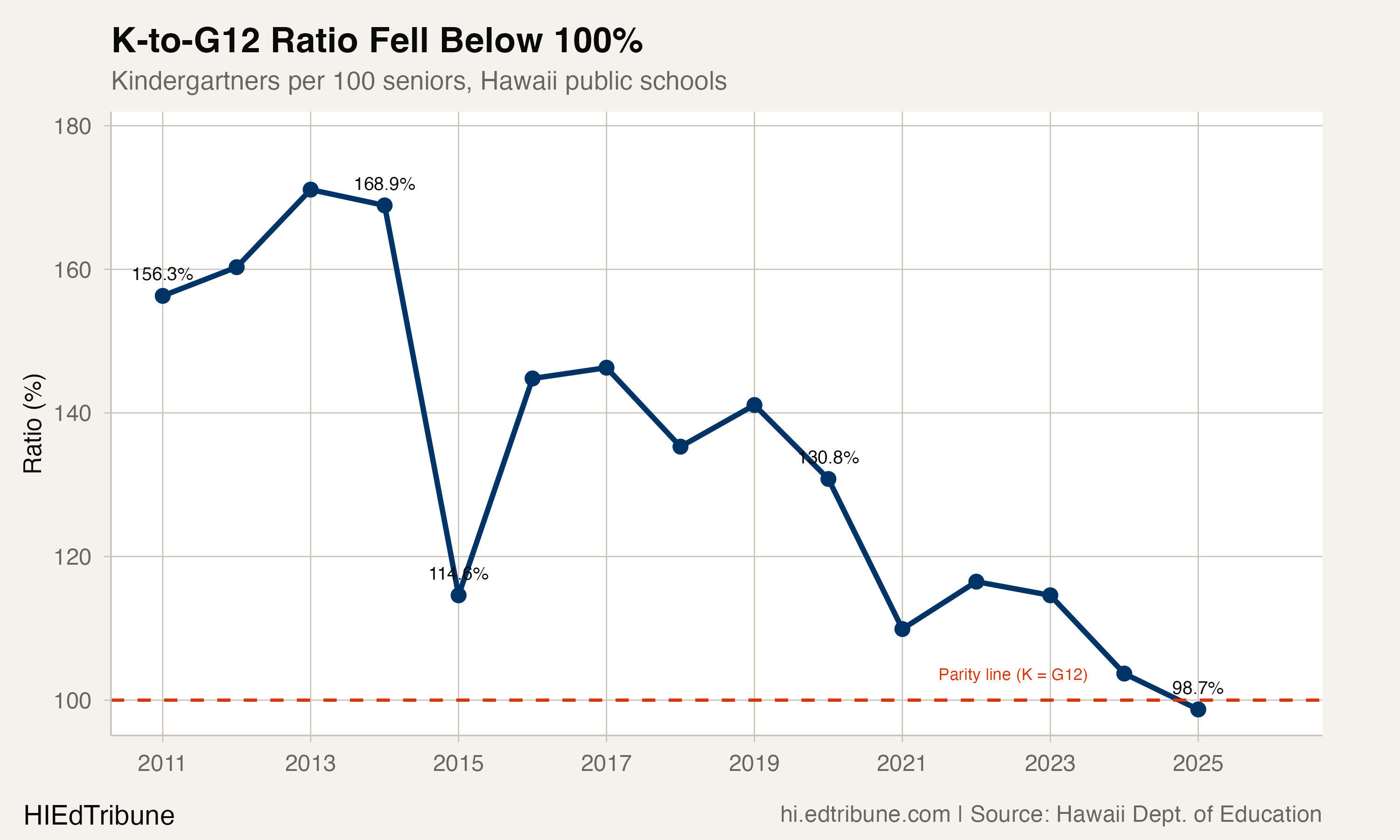
Hawaii's ratio stood at 168.9% in 2014, the last year before Act 76 took effect. The cutoff change drove it down to 114.6% in 2015. It partially recovered as the one-time gap resolved, reaching 146.3% in 2017, then began a steady decline as birth rate effects compounded the smaller cohort sizes.
The ratio's fall below 100% in 2025 reflects two forces converging. Kindergarten classes shrank because fewer children are being born and the age cutoff permanently excluded a slice of each cohort. Twelfth-grade classes grew because the larger, pre-cutoff cohorts are now graduating. The 2025 senior class was the kindergarten class of 2014, the last group to enter under the old December 31 cutoff.
One important caveat: Hawaii reported special education students as a separate "grade" category through 2023, averaging about 18,000 students per year. In 2024, these students were folded into regular K-12 grade counts. This reclassification inflated individual grade counts across the 2023-to-2024 boundary. However, the 2025 K-to-G12 comparison is internally consistent because both grades include their special education students.
What the pipeline looks like now
The 2025 grade-level enrollment reveals a system where every grade from first through ninth enrolls more students than kindergarten.
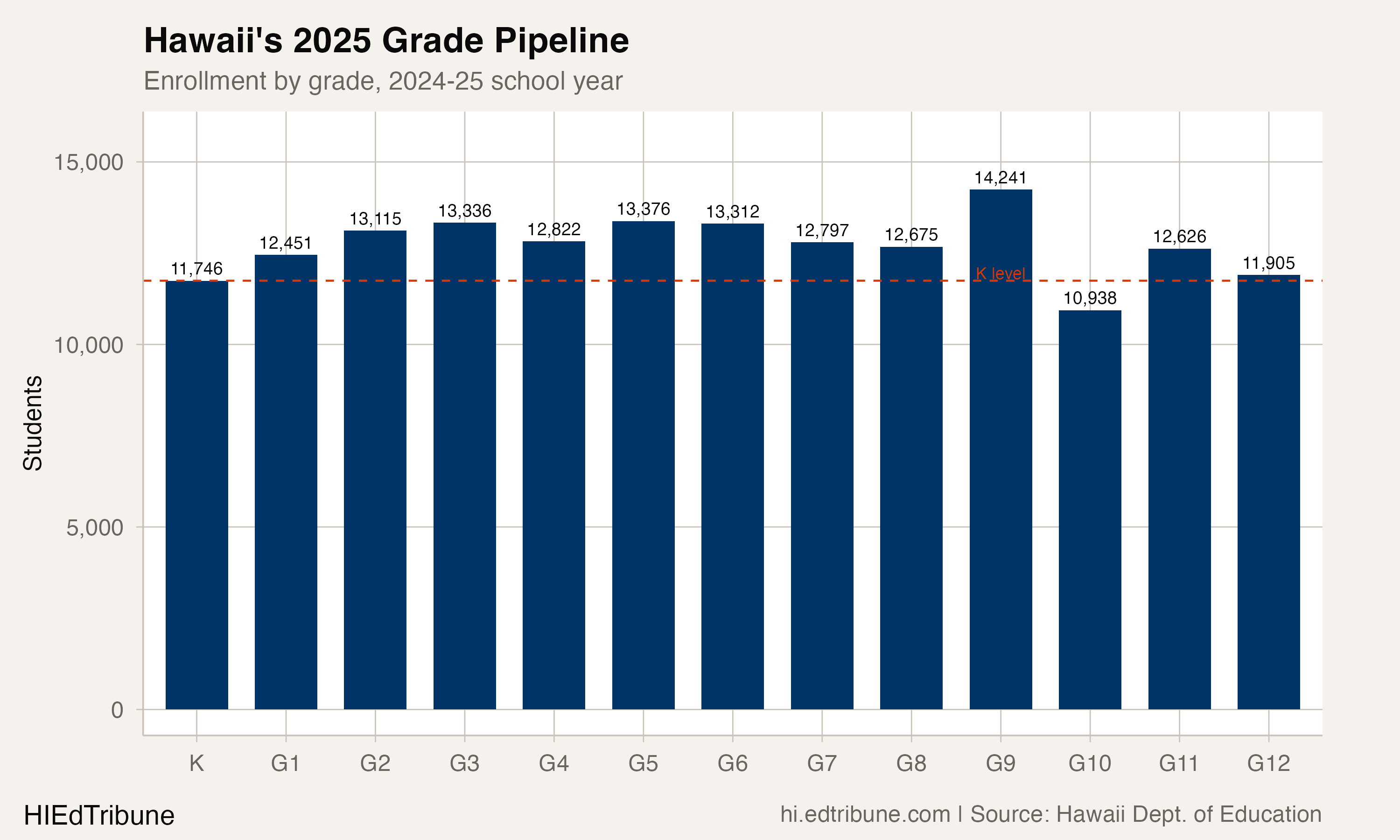
Ninth grade is the largest at 14,241, 21.2% more students than kindergarten. The bulge at ninth grade partly reflects Hawaii's 2024 special education reclassification and typical ninth-grade retention patterns. Tenth grade, at 10,938, is the only grade smaller than kindergarten, consistent with students transferring to private schools or leaving the state after ninth grade.
The pipeline shape carries a straightforward implication. As smaller classes at the bottom replace larger classes at the top, total enrollment will continue to fall even if kindergarten enrollment holds steady. The Department of Education projects an additional loss of 14,600 students by decade's end.
19,774 students gone since the peak
Hawaii's total enrollment peaked at 186,850 in 2014 and has fallen to 167,076, a decline of 19,774 students, or 10.6%. The state has lost students in 10 of the 14 years since 2011, and the losses have accelerated since the pandemic.
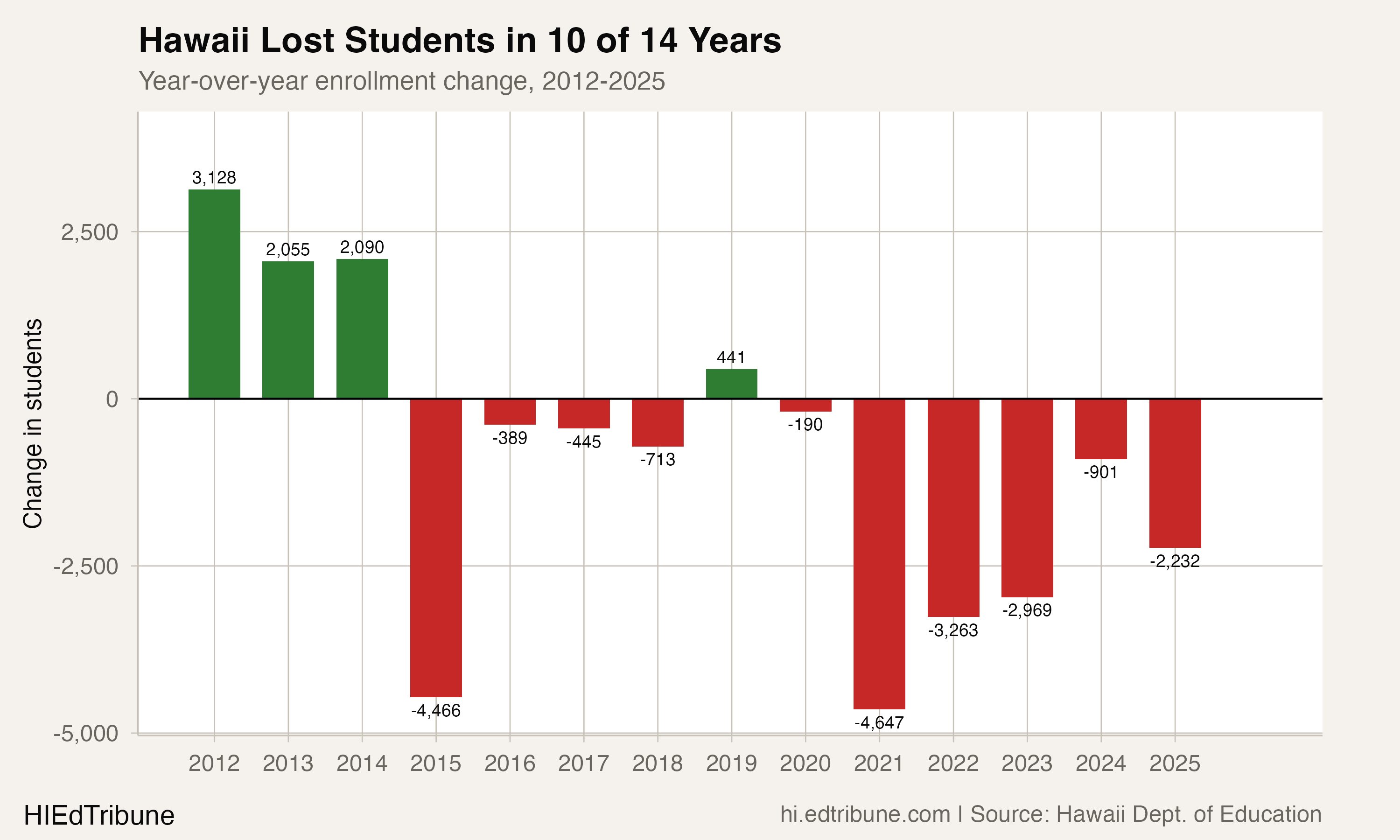
The pandemic year of 2020-21 produced the single largest annual loss: 4,647 students. But the four post-pandemic years combined (2021-2025) have been worse, with a cumulative loss of 9,365 students. That post-pandemic decline is double the single-year COVID shock.
Honolulu↗ET has absorbed the majority of the pain. The county has lost 18,210 students since its 2014 peak, a 14.9% decline. Maui↗ET County, hit by both the statewide demographic trend and the August 2023 Lahaina wildfire, lost 807 students in 2025 alone after enrollment in Lahaina schools plummeted more than 20% since the fire. Hawaii County↗ET has been the most resilient, losing just 4.5% from its peak.
Charter schools grow while the system contracts
One sector has consistently gained while the overall system shrank. Charter schools enrolled 13,094 students in 2025, up 56.5% from 8,367 in 2011. Their market share has grown from 4.7% to 7.8%. Traditional schools lost 17,228 students over the same period, a 10.1% decline.
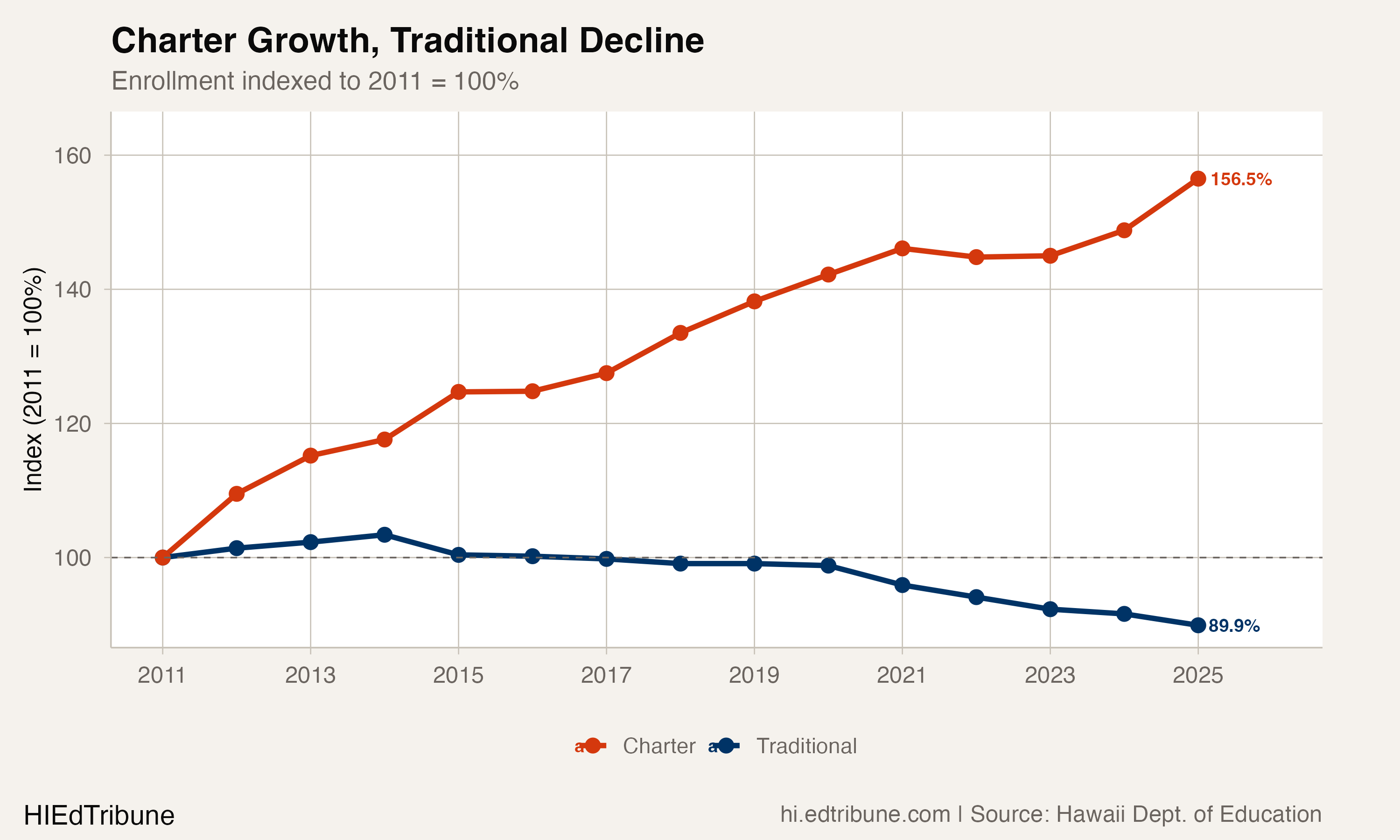
The Hawaii State Public Charter School Commission reported that charter enrollment rose 5.17% in 2024-25, the third consecutive year of growth. The state's 38 charter schools added 643 students at a time when the overall system lost 2,232.
Charter growth does not fully explain traditional school losses. Traditional schools lost 17,228 students since 2011 while charters gained 4,727. The net system loss of 12,501 students reflects families leaving the public system entirely or leaving the state, not just shifting sectors.
The cost of living as an enrollment policy
Hawaii's net population loss of nearly 22,500 residents since 2020 has a direct enrollment consequence. In fiscal year 2025, 8,876 more people moved from Hawaii to the mainland than moved the other direction, according to the Census Bureau. Housing costs are a plausible driver: the median single-family home on Oahu sold for $1.17 million in October 2025, creating pressure on families who need more space.
The DOE has begun planning for a smaller system. Thirty-four schools currently enroll fewer than 250 students, the estimated minimum for adequate funding. Rather than closing schools outright, the department has shifted to a "district optimization" approach that prioritizes redistricting over closures, with changes expected for the 2026-27 school year.
The emotional stakes are high. As community stakeholder Elizabeth Higashi told Civil Beat, "people within the community have very strong connections to their school." That attachment helps explain why no Hawaii public school has been closed since Queen Liliuokalani Elementary in 2011.
What comes next
The K-to-G12 inversion may not persist every year. Typical 11th-to-12th-grade attrition of about 10% means the 2026-27 graduating class, drawn from the current 12,626 eleventh graders, would likely be smaller than the 2025-26 class of 11,905 seniors. That could push the ratio back above 100% temporarily. But the long-term trajectory is set by kindergarten, which depends on births that have already happened, or not happened.
The question is whether Hawaii's pipeline will stabilize at a permanently lower level or continue contracting. If kindergarten enrollment follows the birth rate decline and holds near 11,000 to 12,000, total enrollment will settle somewhere around 150,000 by decade's end. If outmigration accelerates, that floor could be lower. The K-to-G12 crossover is a milestone. What matters is what comes after it.
Detailed code that reproduces the analysis and figures in this article is available exclusively to EdTribune subscribers.
Discussion
Sign in to join the discussion.
Loading comments...