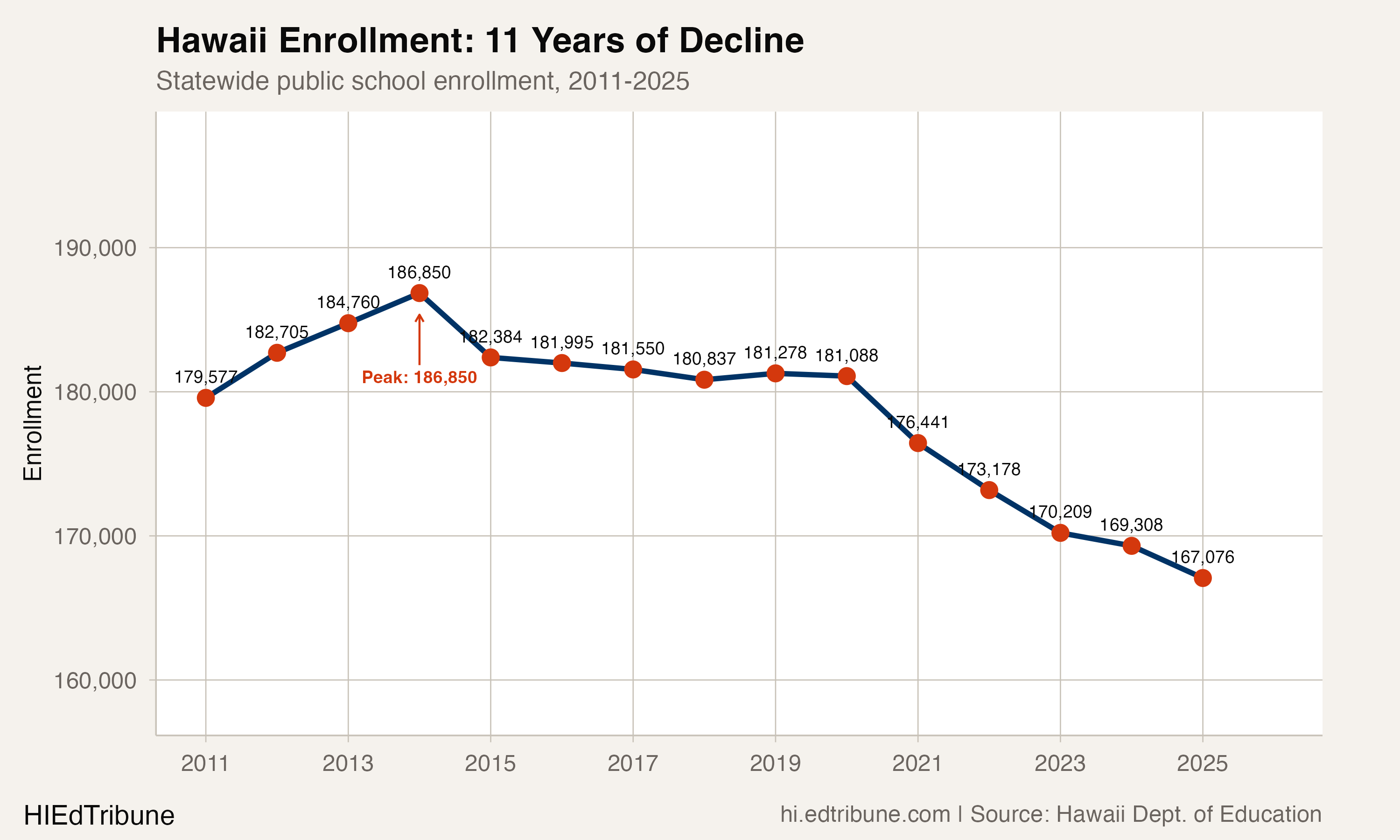
In 2014, Hawaii's public schools enrolled 186,850 students. In the eleven years since, only one (2018-19, when enrollment ticked up by 441) briefly interrupted the trajectory. The state closed the 2024-25 school year at 167,076, a loss of 19,774 students, or 10.6%. That is roughly the entire enrollment of Maui County, gone.
The decline was not sudden. It arrived in two phases: a slow leak from 2016 to 2020 that averaged roughly 260 fewer students per year (excluding the one-time kindergarten cutoff shock of 2015), then a COVID-era acceleration that increased annual losses tenfold. Since 2020, the state has shed 14,012 students at an average of 2,800 per year. The pace has not returned to its pre-pandemic baseline.
Two shocks, one direction
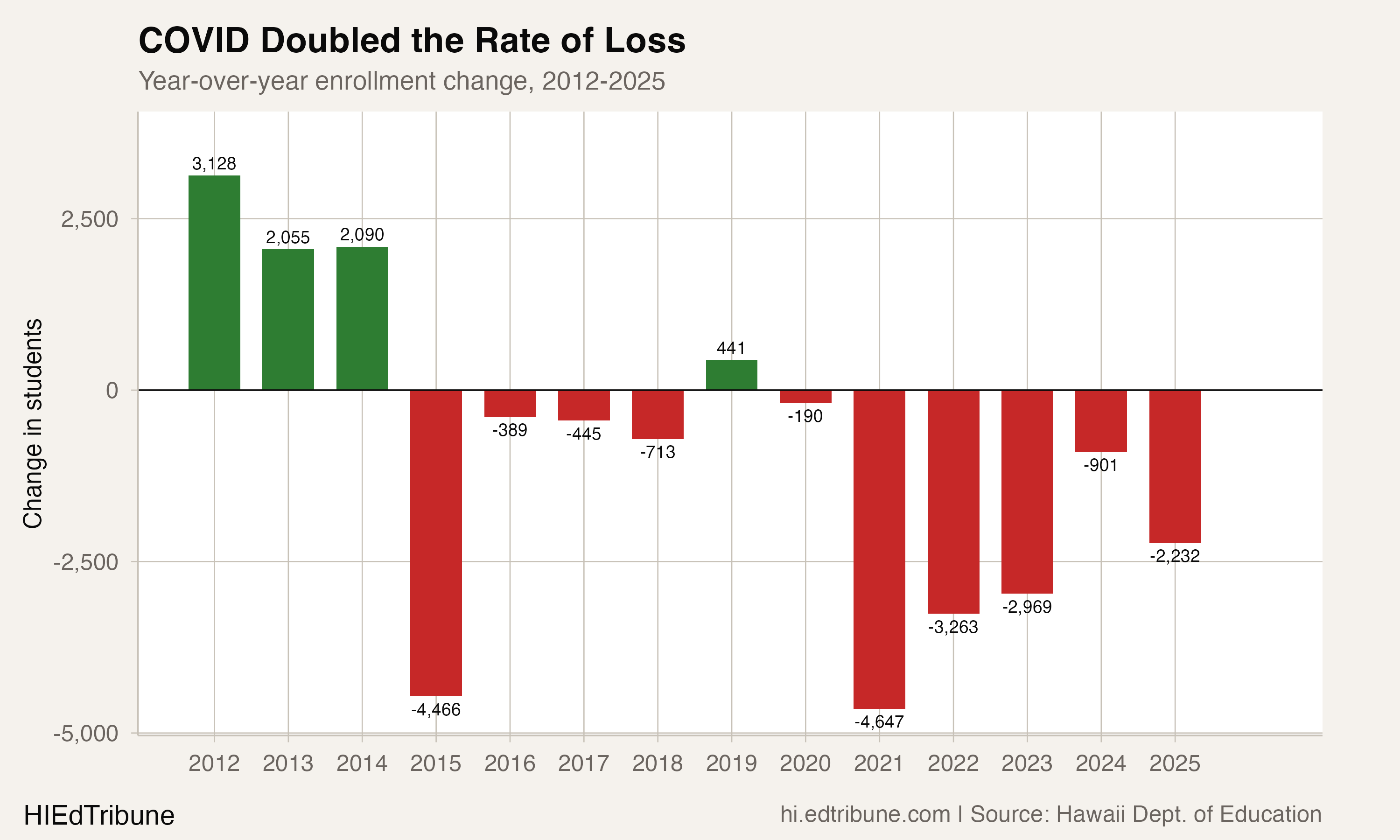
The year-over-year pattern reveals two distinct disruptions punctuating an otherwise steady slide. In 2015, enrollment dropped 4,466 in a single year after the state moved the kindergarten age cutoff from December 31 to July 31 under Act 76 of 2014. That policy permanently shrank each incoming cohort. The second shock came in 2021, when COVID drove an even larger one-year loss of 4,647. Between those two events, enrollment barely moved, declining just 0.5% over five years. The 2019 school year even posted a small gain of 441 students, the only uptick since the peak.
What separates the current period from the pre-COVID drift is the absence of recovery. The state has lost students in every year since 2020, totaling 14,012, a 7.7% decline in five years. The compound annual growth rate over that period is -1.6%.
Honolulu is the story
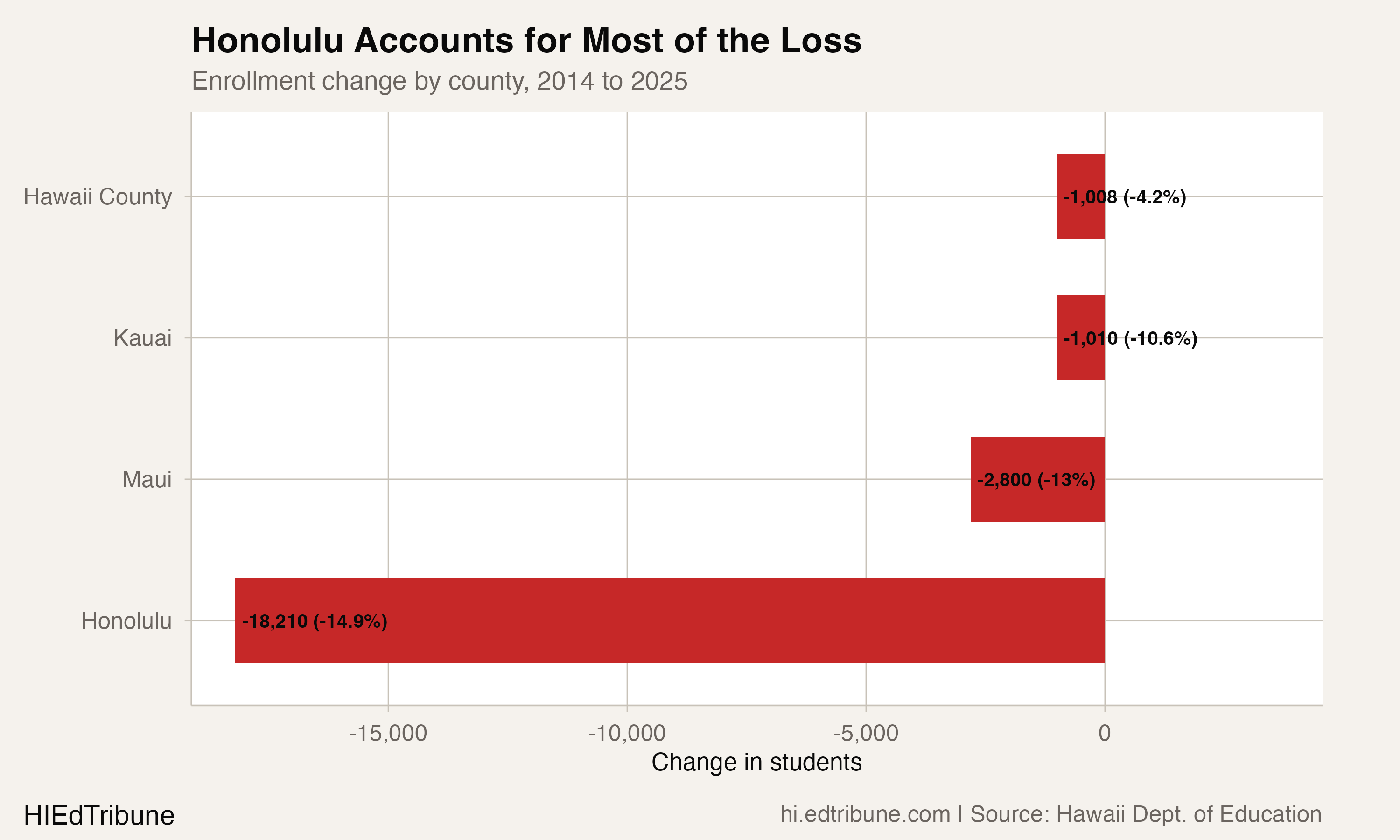
Honolulu↗ET accounts for 92.1% of the statewide loss since the 2014 peak: 18,210 students gone from a system that once enrolled 122,195. The county's 14.9% decline dwarfs the losses in the three neighbor island counties, each of which has also hit an all-time low. Maui↗ET is down 2,800 (-13.0%), Kauai↗ET 1,010 (-10.6%), and Hawaii County↗ET 1,008 (-4.2% from 2014, though its peak came in 2012).
The geographic concentration matters because it reflects Honolulu's specific cost-of-living pressures. The median single-family home on Oahu reached $1.16 million in March 2025, and fast-growing communities like Ewa and Kapolei face overcrowded schools even as urban Honolulu campuses empty out. Enrollment dropped more than 20% at 38 campuses statewide over five years, with some of the steepest losses concentrated in Honolulu's urban core.
Families priced out, births declining
The most likely driver of sustained enrollment loss is domestic outmigration. From July 2020 to July 2024, Hawaii experienced a net migration loss of approximately 20,000 people, with domestic departures far exceeding foreign arrivals. An Aloha United Way report found that one in three Hawaii households considered moving away in the past year.
"180,000 people right now are considering leaving the state of Hawaii, from our workforce, from our younger families, our Hawaiian families." -- Suzanne Skjold, Aloha United Way COO, January 2025
Declining births reinforce the outmigration trend. Hawaii recorded 14,808 live births in 2023, down from roughly 17,000 in 2016. That 14% drop means smaller kindergarten classes arriving each year, compounding the losses from families leaving. The 2023 Lahaina wildfire on Maui added a localized shock. Lahainaluna High School dropped from 1,012 students before the fire to 813 as displaced families left the island or transferred to other districts.
Charter schools: the only sector growing
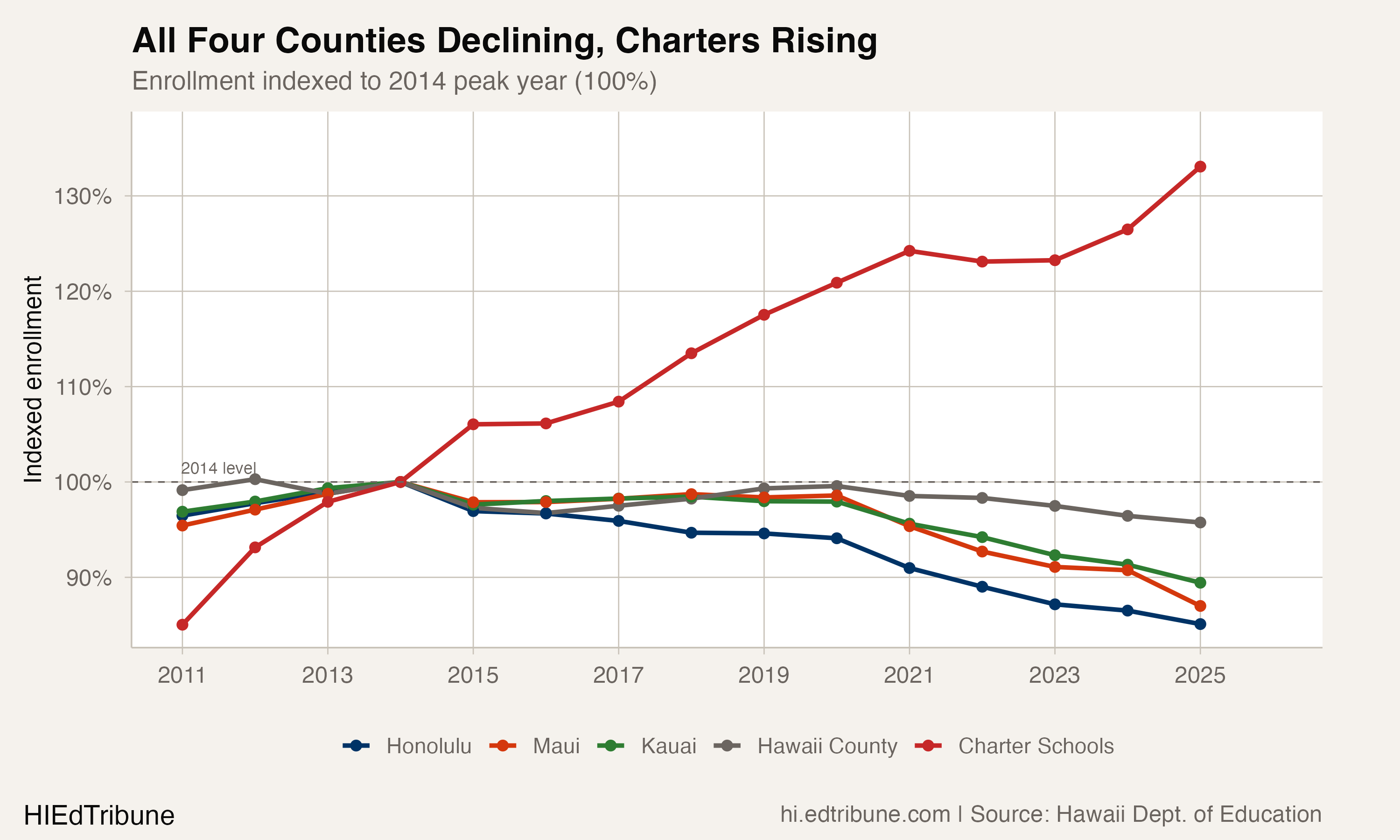
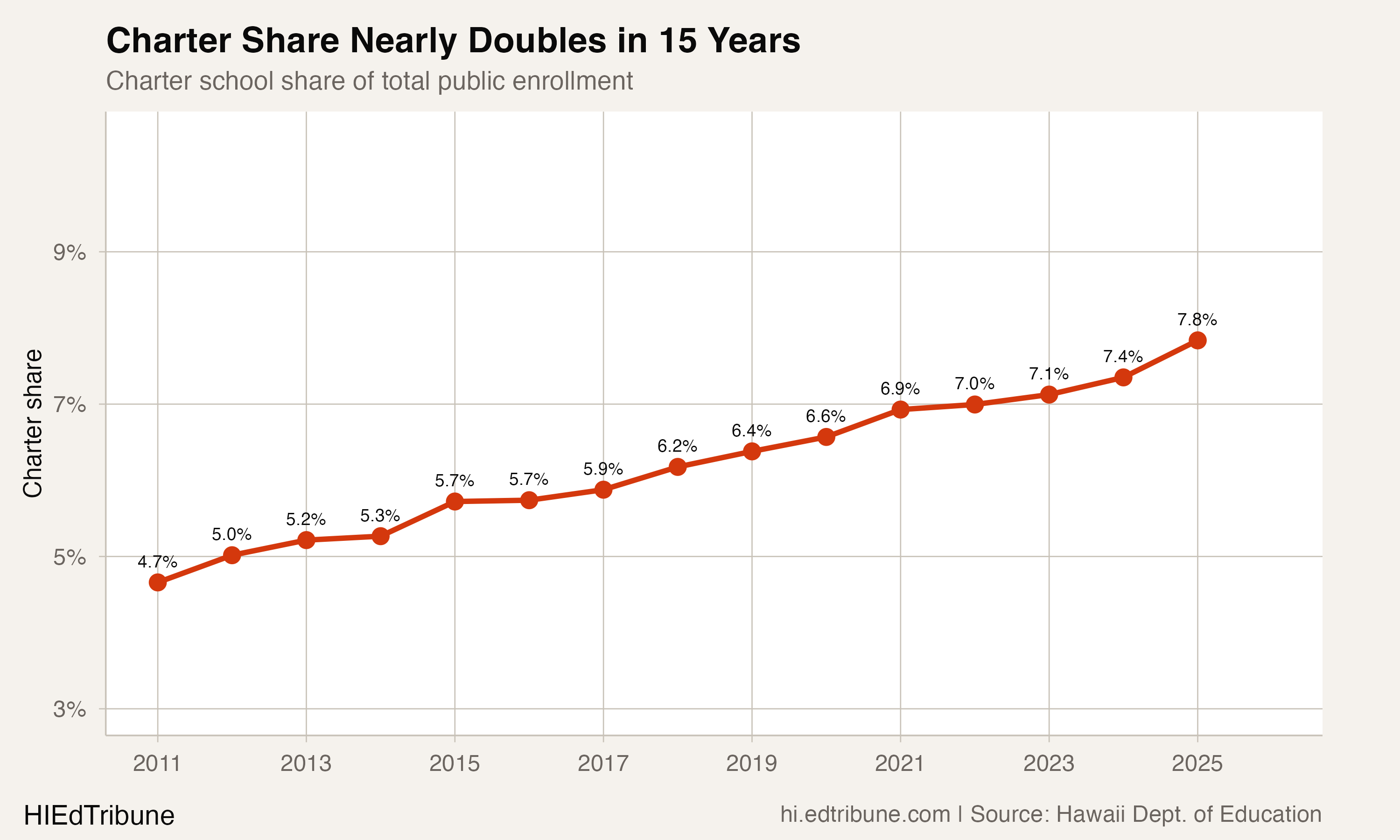
Indexed to 2014, every county system has declined while charter schools have moved in the opposite direction. Charter enrollment↗ET hit a record 13,094 in 2025, up 56.5% from 8,367 in 2011. Charter share of total public enrollment has risen from 4.7% to 7.8%. The Hawaii State Public Charter School Commission reported a third consecutive year of growth in 2024-25 across 38 schools.
Traditional (county-operated) schools, meanwhile, fell to 153,982, a 13.0% decline from their 2014 level of 177,010. The divergence accelerated during the pandemic, when charters grew even as traditional schools hemorrhaged students. Charter growth has not offset the traditional decline. Since 2011, traditional schools lost 17,228 students while charters gained 4,727, meaning charter growth absorbed about 27% of the traditional sector's losses.
What consolidation looks like on islands
The DOE initially studied closing some of the 34 schools enrolling fewer than 250 students, estimating that schools need roughly $1.38 million annually just for basic operations. Board Chair Roy Takumi acknowledged the difficulty: "Closing a school isn't like closing your neighborhood Starbucks."
After community pushback, the department pivoted to redistricting over closures, pushing any consolidation decisions to spring 2028 at the earliest. The geographic reality of island communities, where the nearest alternative school may be across a mountain range or accessible only by a single highway, makes mainland-style consolidation impractical. Rural areas on Lanai, Molokai, and West Maui could see enrollment drop as much as 25%, but closing a school may mean eliminating the only one within driving distance.
The question the DOE faces is structural: at a 1.6% annual decline rate, roughly 13,000 more students will leave the system by 2030. The department projects a loss of 14,600 students by decade's end. Whether those losses concentrate in already-small schools or spread evenly will determine whether redistricting alone can absorb the pressure, or whether closures become unavoidable.
Detailed code that reproduces the analysis and figures in this article is available exclusively to EdTribune subscribers.
Discussion
Sign in to join the discussion.
Loading comments...