In this series: Hawaii 2025-26 Enrollment.
In 2023-24, Hawaii's enrollment decline slowed to 901 students, the smallest annual loss since the pandemic. Two years later that pause is gone: the state lost 3,425 students in 2025-26, 3.8 times the 2023-24 loss and the largest non-pandemic drop in a decade of stable kindergarten reporting (the 2015 drop of 4,466 reflected a kindergarten-cutoff change, not an enrollment shift).
The state now enrolls 163,651 students, down 17,437 since 2019-20, a contraction of 9.6% in six years. At the current pace, total enrollment will fall below 150,000 by 2031.
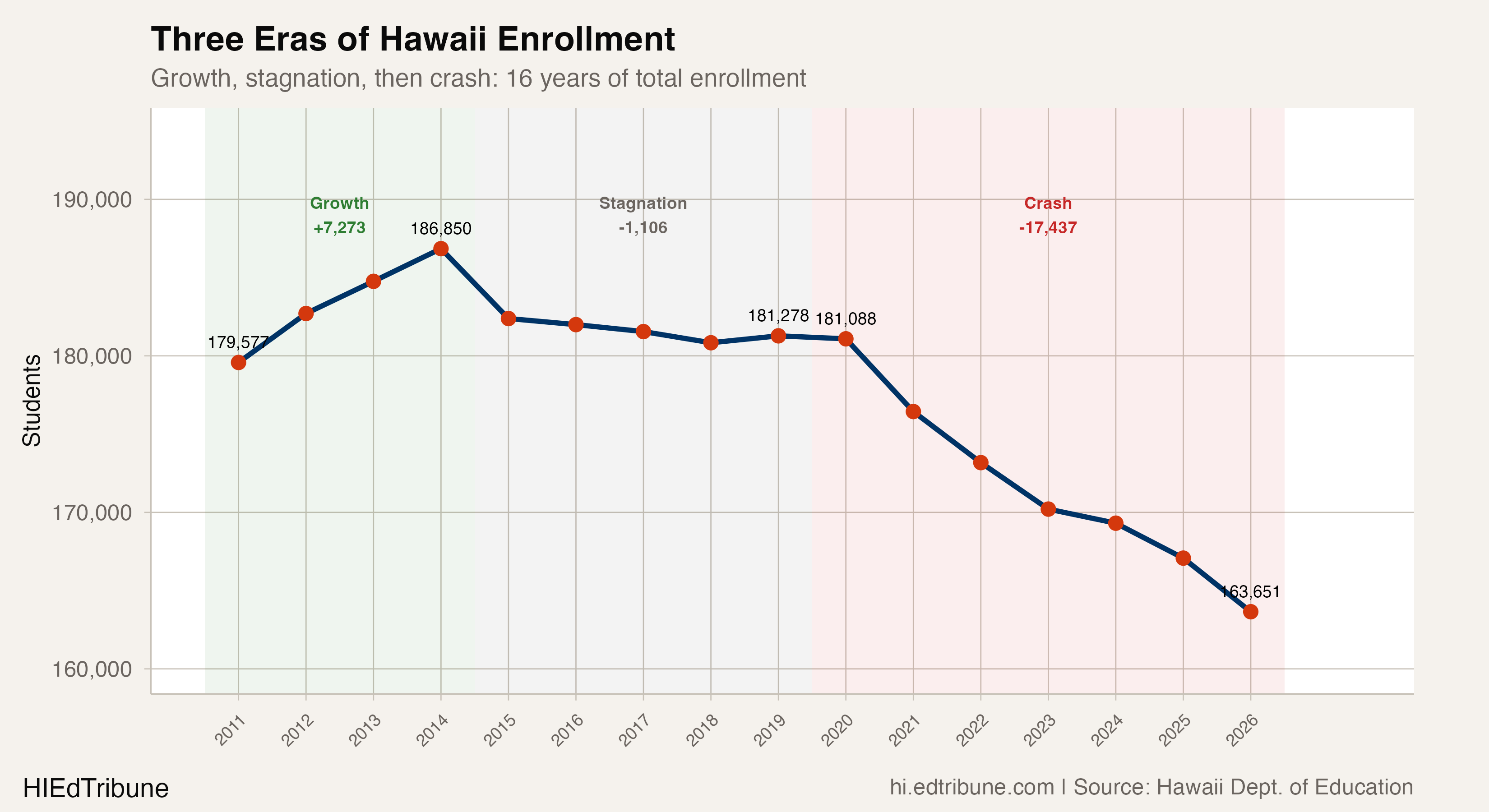
The 16-year arc of Hawaii enrollment breaks into three distinct periods.
Three periods, one direction
From 2010-11 through 2013-14, Hawaii added 7,273 students, averaging 2,424 per year. Enrollment peaked at 186,850 in 2013-14. Then it stopped growing. Over the next five years, the state lost a net 1,106 students, an average of just 276 per year, small enough to explain away with annual fluctuations.
The crash era, which began with the pandemic in 2020-21, has produced losses 16 times larger than the entire stagnation period. The six-year total of -17,437 averages out to -2,906 per year, more than 10 times the stagnation-era pace. After the initial COVID shock of -4,647, losses ran at roughly -3,000 per year for two years, then appeared to moderate to -901 in 2023-24. That pause now looks like a statistical artifact, not a turning point.
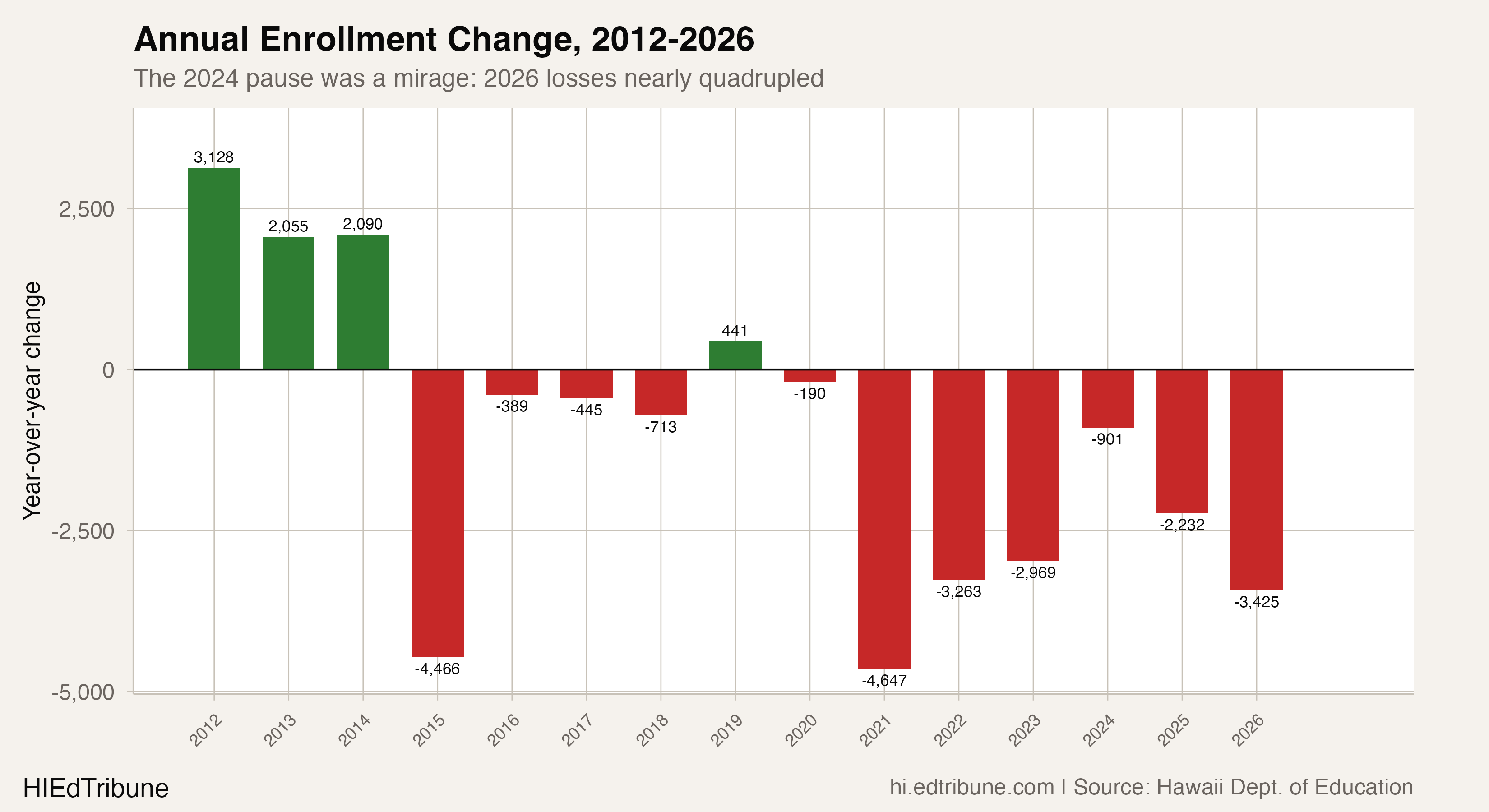
The sequence since 2024 runs -901, then -2,232, then -3,425, each year larger than the one before.
Outmigration and shrinking births
The most likely driver of the acceleration is demographic. Families are leaving Hawaii, and fewer children are being born to replace them. These two forces operate on different timescales but compound each other.
Hawaii's population fell to roughly 1.43 million as of mid-2025, a decline of about 22,500 residents since 2020. Domestic outmigration alone removed 8,876 people in fiscal 2025, according to Census Bureau estimates. A 2025 survey by the Holomua Collective found that 57% of residents plan to leave the islands within five years, up from 46% the previous year, and 75% of middle-income households said they may be forced to relocate due to housing costs. The median single-family home price on Oahu reached $1,160,000 in early 2025.
But the problem extends beyond the price tag. A University of Hawaii Economic Research Organization analysis found that Hawaii's economy more closely resembles economically distressed states than prosperous expensive metros.
"Our prices and incomes combined actually make us look more like Mississippi or Alabama or West Virginia." -- Professor Steven Bond-Smith, University of Hawaii, February 2026
When adjusted for inflation, tourism spending peaked in 1989 and has essentially flatlined since, leaving no high-growth industry to offset housing costs. The outmigration skews young. UHERO research has documented that the cohort most likely to leave is precisely the one most likely to be starting families, pulling both current students and future kindergartners out of the pipeline.
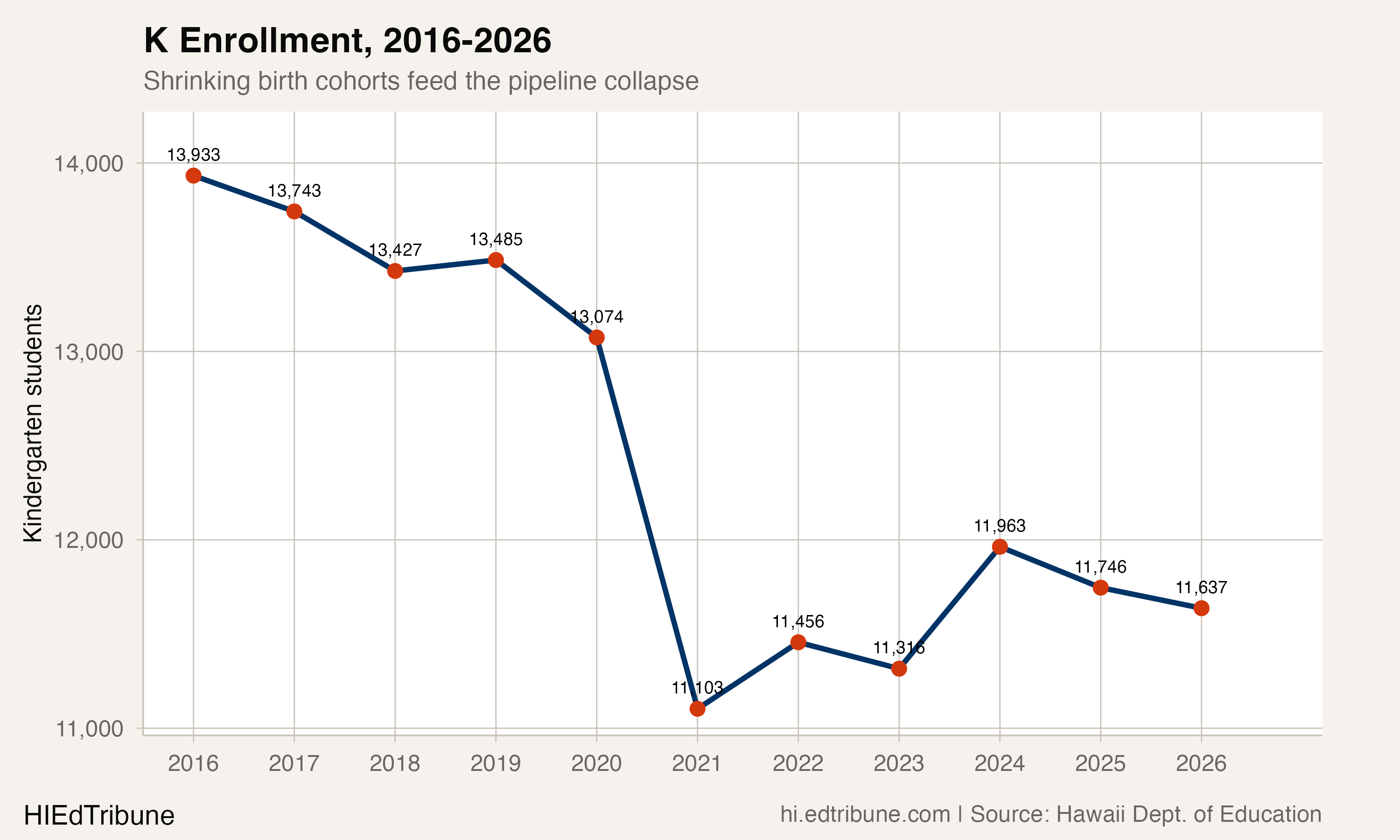
On the birth side, Hawaii recorded 14,964 births in 2024, down nearly 20% from 18,444 a decade earlier. Those shrinking cohorts are now reaching school age. Kindergarten enrollment stood at 11,637 in 2025-26, a 16.5% decline from 13,933 in 2015-16. The K class has not exceeded 12,000 in any of the last three years.
Every island is losing, but Honolulu dominates
All four counties posted losses in the crash era, though the magnitudes differ sharply. Honolulu↗ET accounts for 78% of the statewide crash-era decline, losing 13,639 students since 2019-20, an 11.9% contraction. In 2025-26 alone, Honolulu shed 2,644 students.
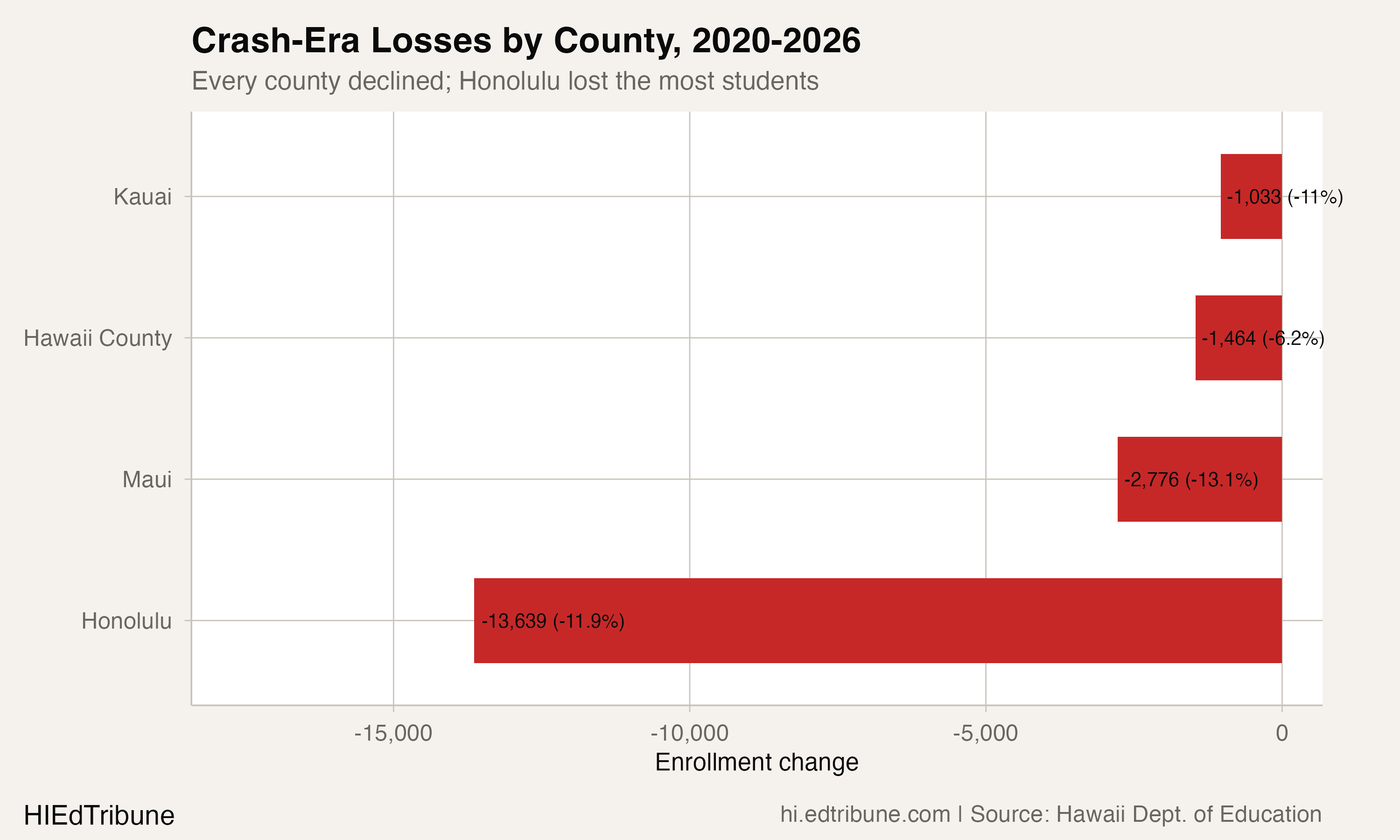
Maui↗ET lost 2,776 students over the crash era (-13.1%), a rate exceeded only by Honolulu in absolute terms but worse in percentage terms. The August 2023 Lahaina fires accelerated Maui's decline, though enrollment had been falling before the disaster. Kauai↗ET lost 1,033 (-11.0%) and Hawaii County↗ET lost 1,464 (-6.2%), making the Big Island the most resilient county in percentage terms but still firmly in decline.
Every county is shrinking. The variation is in degree, not direction.
The system's response: redistricting before closures
The Department of Education reversed course in September 2025 on how to handle declining enrollment. Rather than closing underutilized schools, the department is pursuing "district optimization," adjusting attendance boundaries to redistribute students across existing campuses. The last public school closure, Queen Liliuokalani Elementary in Kaimuki, happened in 2011 and generated significant community pushback.
Under the revised timeline, redistricting changes could take effect for 2026-27. Consolidation studies would not begin until 2027, with the earliest school mergers in spring 2028. That timeline assumes the enrollment trajectory does not worsen further.
The structural mismatch is already severe. Thirty-four schools enrolled fewer than 250 students in 2025, the estimated minimum to adequately fund a campus. Remote schools like Maunaloa Elementary on Molokai, with roughly 70 students 17 miles from the nearest alternative, illustrate why closures are politically and logistically fraught, even as enrollment makes them increasingly difficult to avoid.
What the pipeline signals
The Western Interstate Commission for Higher Education projects that Hawaii will see the nation's steepest decline in high school graduates between 2023 and 2041: a 33% drop, from roughly 11,500 to 7,600. The national average over the same period is 10%.
The kindergarten pipeline confirms the direction. With births running below 15,000 per year and outmigration pulling young families to the mainland, the entering cohorts feeding the system are smaller than the graduating ones leaving it. In 2025-26, the K class (11,637) was smaller than the 12th-grade class (12,095). Each year that gap persists, the system contracts further.
Senator Troy Hashimoto has introduced SB 2541 to create an independent commission to recommend school consolidations, with findings due by fall 2027. By then, if the current pace holds, the system will have lost another 7,000 students. The institutions built for 186,000 are serving 163,000 now. Rural campuses with 70 students and schools 17 miles from the nearest alternative will face decisions before any commission report arrives.
Detailed code that reproduces the analysis and figures in this article is available exclusively to EdTribune subscribers.
Discussion
Sign in to join the discussion.
Loading comments...