In this series: Hawaii 2025-26 Enrollment.
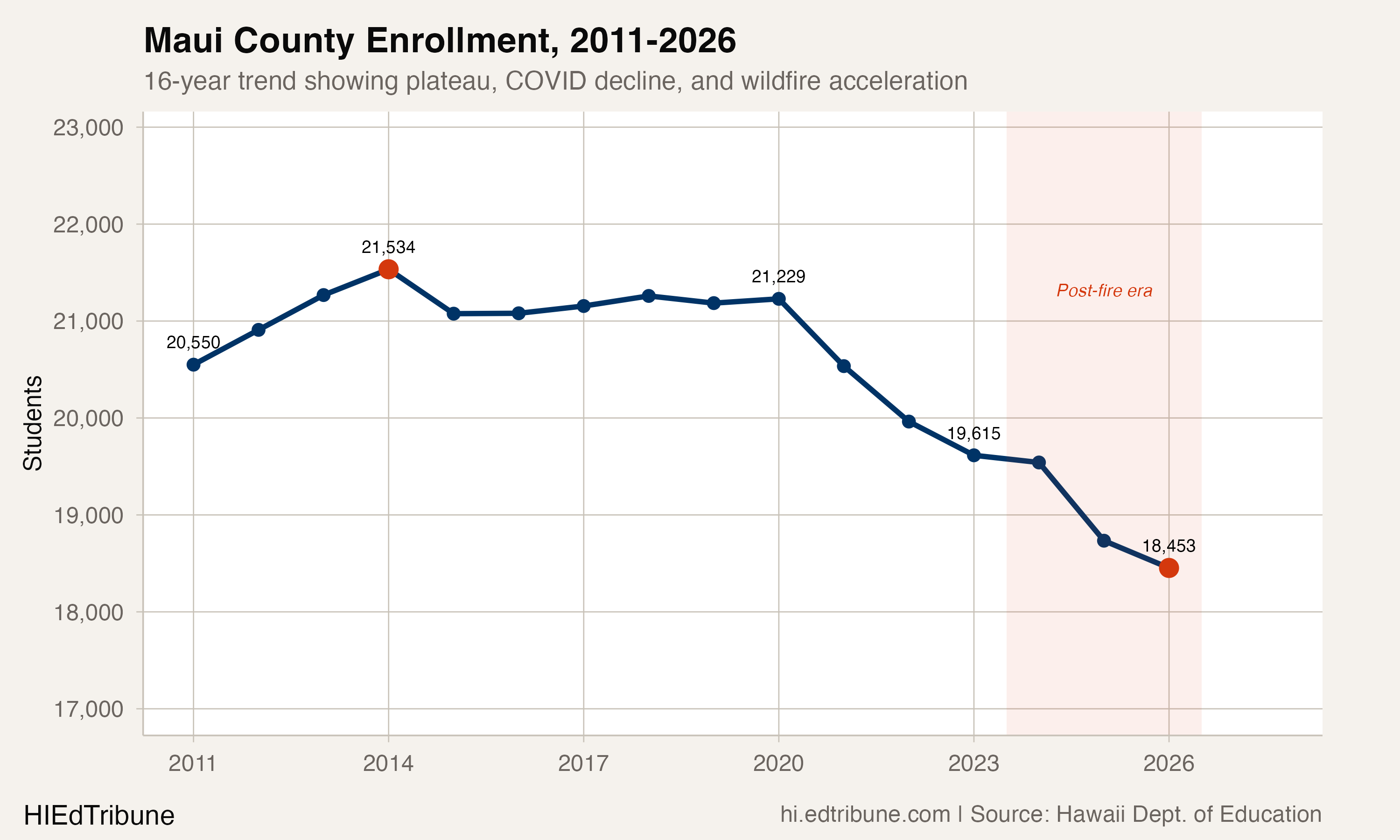
The sharpest year is probably over. Maui↗ET County lost 281 students in 2025-26, a 1.5% decline that would barely register in a normal year. But 2024-25 was not normal: the county lost 807 students, its largest single-year drop on record, as the delayed effects of the August 2023 Lahaina wildfire moved through West Maui's classrooms. The deceleration from 807 to 281 suggests the acute displacement phase has largely passed. What remains is a county that has lost 3,081 students since 2014, with no mechanism for recovery yet in place.
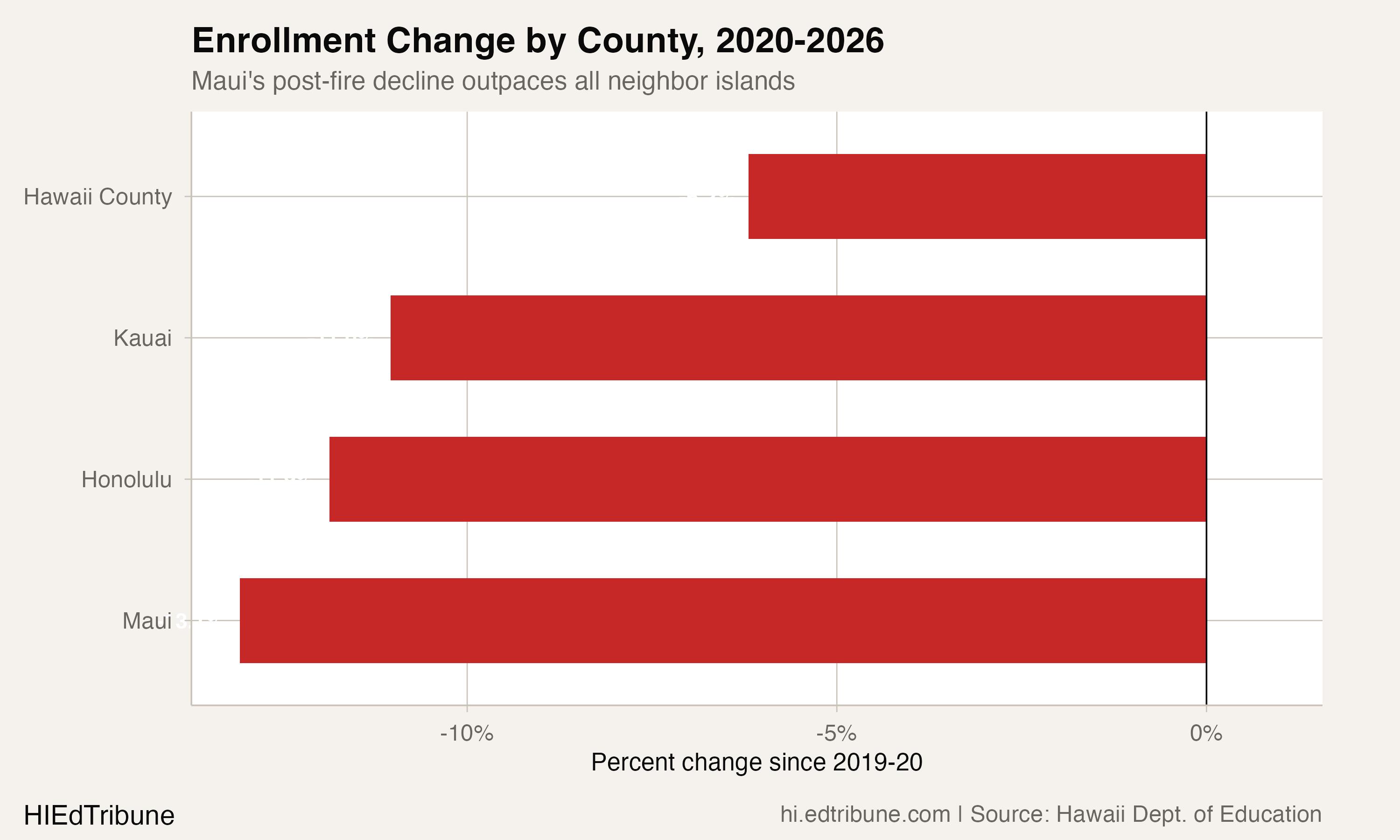
Maui's 281-student loss in 2025-26 is the county's smallest annual decline since 2023-24 (-74), and far below the prior year's -807, but the loss continues a six-year run. The county has shed 2,776 students since 2019-20, a 13.1% drop. Among Hawaii's four counties, Maui's six-year decline is the steepest by percentage, outpacing even Honolulu↗ET's 11.9% loss over the same period.
The fire's fingerprint in the data
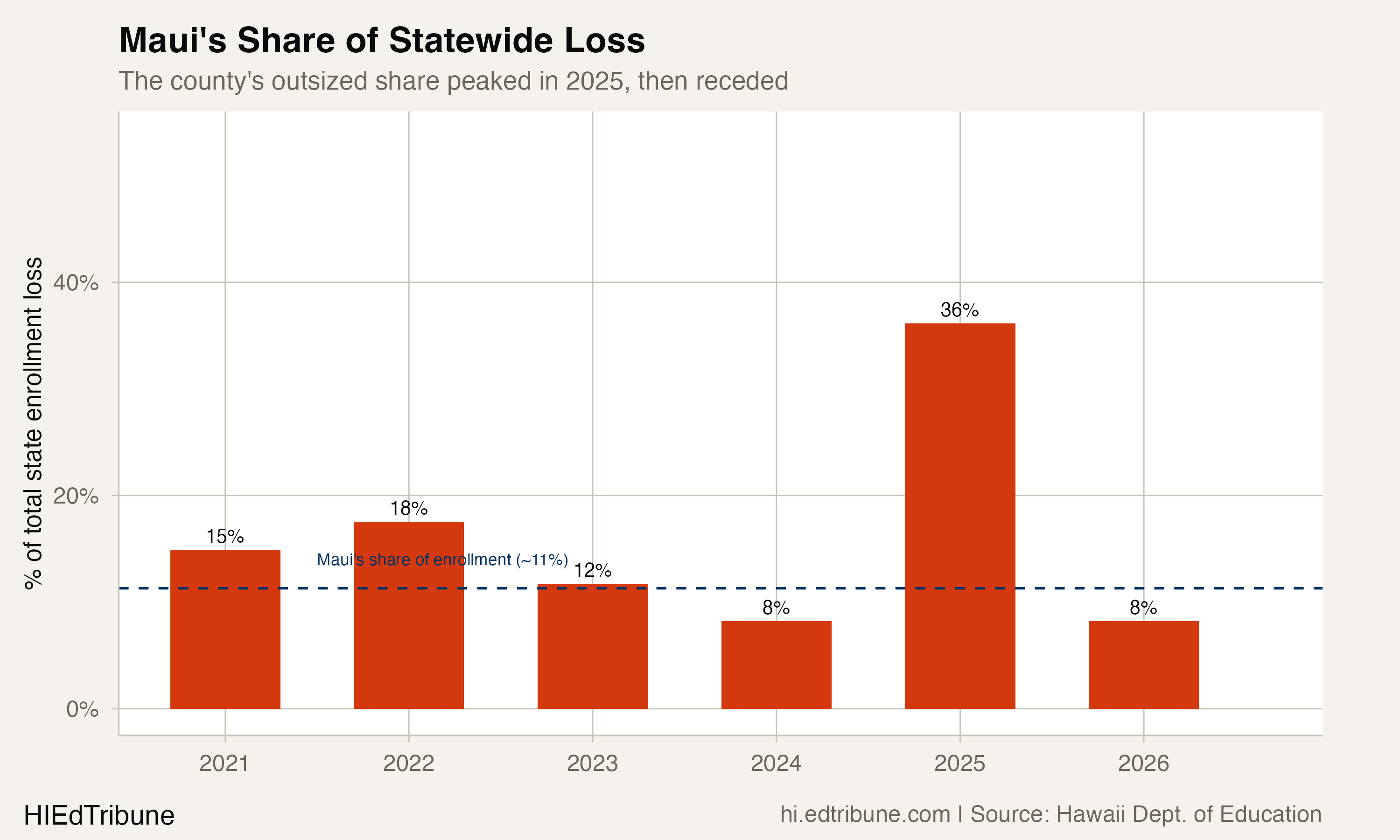
The wildfire's enrollment impact followed an unusual pattern. In 2023-24, the first school year after the August 8, 2023 fire, Maui lost just 74 students. At the time, that looked encouraging: losses had been decelerating from 694 to 572 to 348 in the three COVID-era years, and 74 appeared to continue the pattern. That muted first-year loss reflected a delay rather than a recovery, as families spent the year in temporary housing weighing whether to stay. The 807-student loss the following year, a 4.1% decline, exceeded the worst COVID-era year (694 in 2020-21) by 16% and accounted for 36.2% of Hawaii's total statewide enrollment decline that year, despite Maui holding just 11.5% of the state's students.
Now, in the third post-fire year, the loss has shrunk to 281 students. Maui's share of statewide losses has fallen from 36% back to 8%, roughly proportional to its enrollment share. The fire spike, in other words, has receded. But the underlying decline continues.
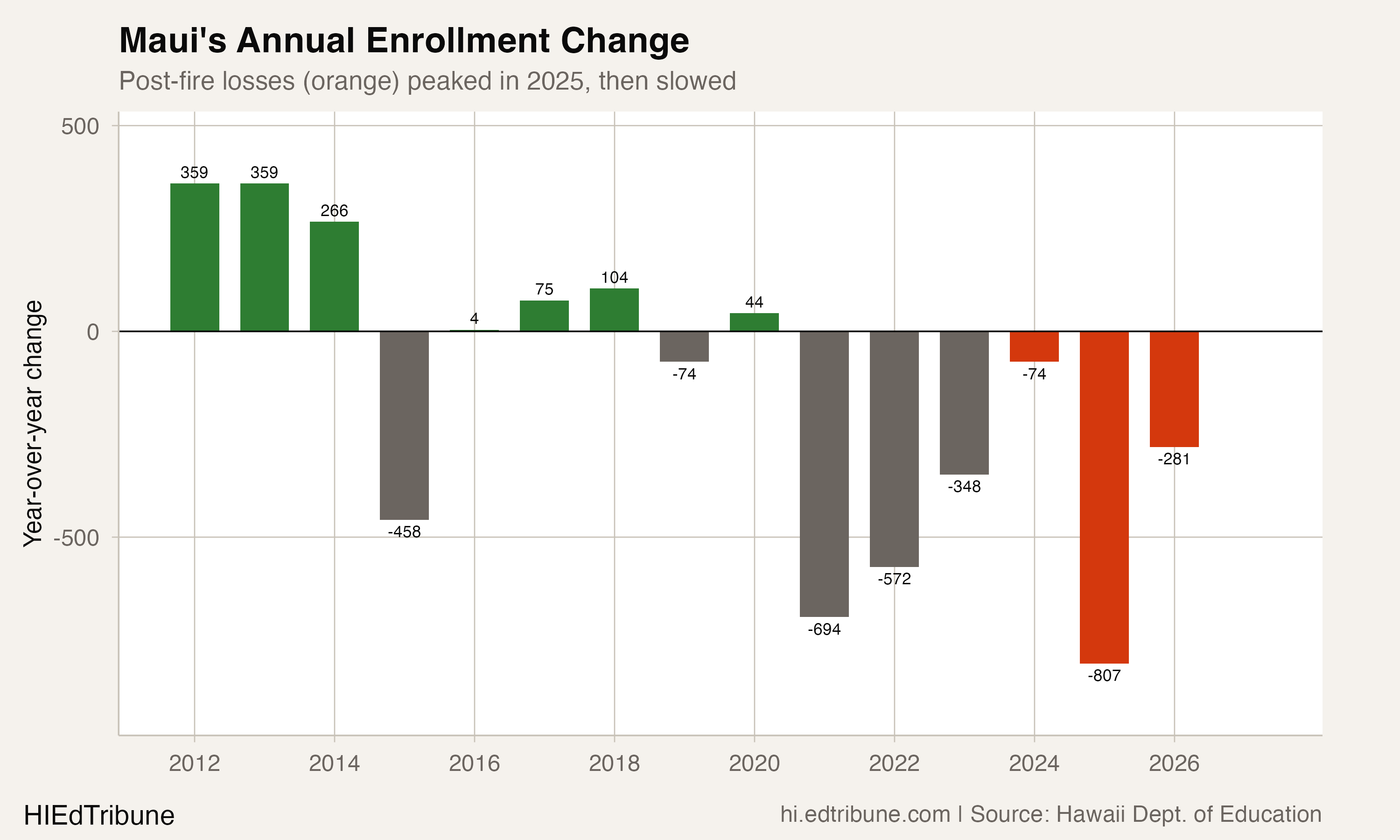
Combined, the three post-fire school years (2023-24 through 2025-26) have cost Maui 1,162 students. Before the fire, between 2020-21 and 2022-23, the county was already averaging 538 students lost per year due to COVID-era pressures and Hawaii's broader demographic contraction. The fire accelerated an existing trajectory rather than creating a new one.
88 homes rebuilt, 80% of households still displaced
The scale of physical destruction in Lahaina continues to constrain any enrollment recovery. As of December 2025, 100 structures had been rebuilt in the fire zone: 96 in Lahaina, four in Kula, with 88 of the Lahaina structures being residential. Another 295 homes were under construction and 350 applications were being processed.
The opening of Kaiāulu o Kūkuʻia, Lahaina's first permanent affordable housing project since the fire, added 200 rental units for families earning 30% to 60% of area median income. That is meaningful for teachers, hotel workers, and first responders priced out of West Maui's housing market. But the broader displacement picture remains stark. At least 1,000 Maui residents left the county entirely in the year after the fire, according to University of Hawaii Economic Research Organization analysis of tax filing data, costing the state roughly $53 million in annual income.
"Kids leaving the island, going back to the mainland, back to the countries that families are from." Richard Carosso, Lahainaluna High School principal, Maui Now, Oct. 2024
The Lahaina school complex illustrates the uneven recovery. King Kamehameha III Elementary, which burned in the fire and relocated to a temporary campus near Kapalua Airport, has gradually regained students, climbing from 265 in spring 2024 to 330 by fall 2024. But Lahainaluna High School has moved the opposite direction, falling from 1,012 before the fire to 813 in 2024-25. The school lost 46 students to out-of-state moves and 36 to private school transfers.
The county's decline predates the fire
Isolating the wildfire's impact requires separating it from a decline that was already underway. Maui peaked at 21,534 students in 2013-14. After a kindergarten-cutoff adjustment in 2015, the county held essentially flat through 2019-20, averaging a net change of roughly 30 students per year. COVID shattered that stability: 694 lost in 2020-21, 572 in 2021-22, 348 in 2022-23.
The pre-fire trend line, in other words, was already pointing steeply downward before August 2023. Hawaii's birth rate has fallen to its lowest level in two decades, with just 15,570 births recorded in 2022. The cost of living continues to push families to the mainland. A statewide enrollment drop of 17,437 students since 2020, or 9.6%, reflects forces that have nothing to do with fire.
What the fire did was compress several years of expected decline into one. The 807-student loss in 2024-25 was roughly 18 months' worth of pre-fire trend crammed into a single school year. The 281-student loss in 2025-26 is actually smaller than the pre-fire average of 538, which could mean the fire pulled forward losses that would have happened gradually, or it could mean the county is running out of students to lose.
Maui's outsized share has receded
In 2024-25, Maui punched far above its weight in the loss column. The county held 11.3% of the state's public school enrollment but generated 36.2% of statewide losses. That ratio made Maui the clear epicenter of Hawaii's enrollment crisis.
In 2025-26, the ratio has normalized. Maui accounted for 8.2% of statewide losses, below its enrollment share. The statewide loss of 3,425 students was driven primarily by Honolulu (2,644 lost, or 77% of the total) and Hawaii County (557 lost, its sharpest decline since the 2014-15 kindergarten cutoff change).
The shift matters for how the DOE allocates attention and resources. In 2024-25, Maui was clearly the state's most acute enrollment problem. In 2025-26, it is one of four counties all declining simultaneously, with Honolulu's scale dominating the picture. The DOE has shifted its approach to declining enrollment, pursuing "district optimization" through redistricting rather than school closures. Redistricting changes could take effect as early as fall 2026, with consolidation studies beginning in 2027.
What to watch
Maui's enrollment at 18,453 students is 14.3% below its 2014 peak. The DOE projects the Lahaina-Lanai-Molokai-Hana school complex could lose another 25% of enrollment by decade's end. If that projection holds, the complex would drop from roughly 3,875 students to under 2,900, raising fiscal viability questions for individual campuses already operating on thin margins. Maunaloa Elementary on Molokai, with 59 students and a $900,000 budget, offers a preview of what small-school sustainability looks like when enrollment drops below the threshold of roughly 250 students needed to fund basic operations.
The rebuilding of King Kamehameha III Elementary at a new site 0.6 miles inland from its original Front Street location, a $162 million project targeting the 2028-29 school year, will test whether a permanent campus draws families back. The answer will determine whether Maui's enrollment decline eventually stabilizes at a lower floor or continues its descent alongside the rest of the state.
Detailed code that reproduces the analysis and figures in this article is available exclusively to EdTribune subscribers.
Discussion
Sign in to join the discussion.
Loading comments...