In this series: Hawaii 2025-26 Enrollment.
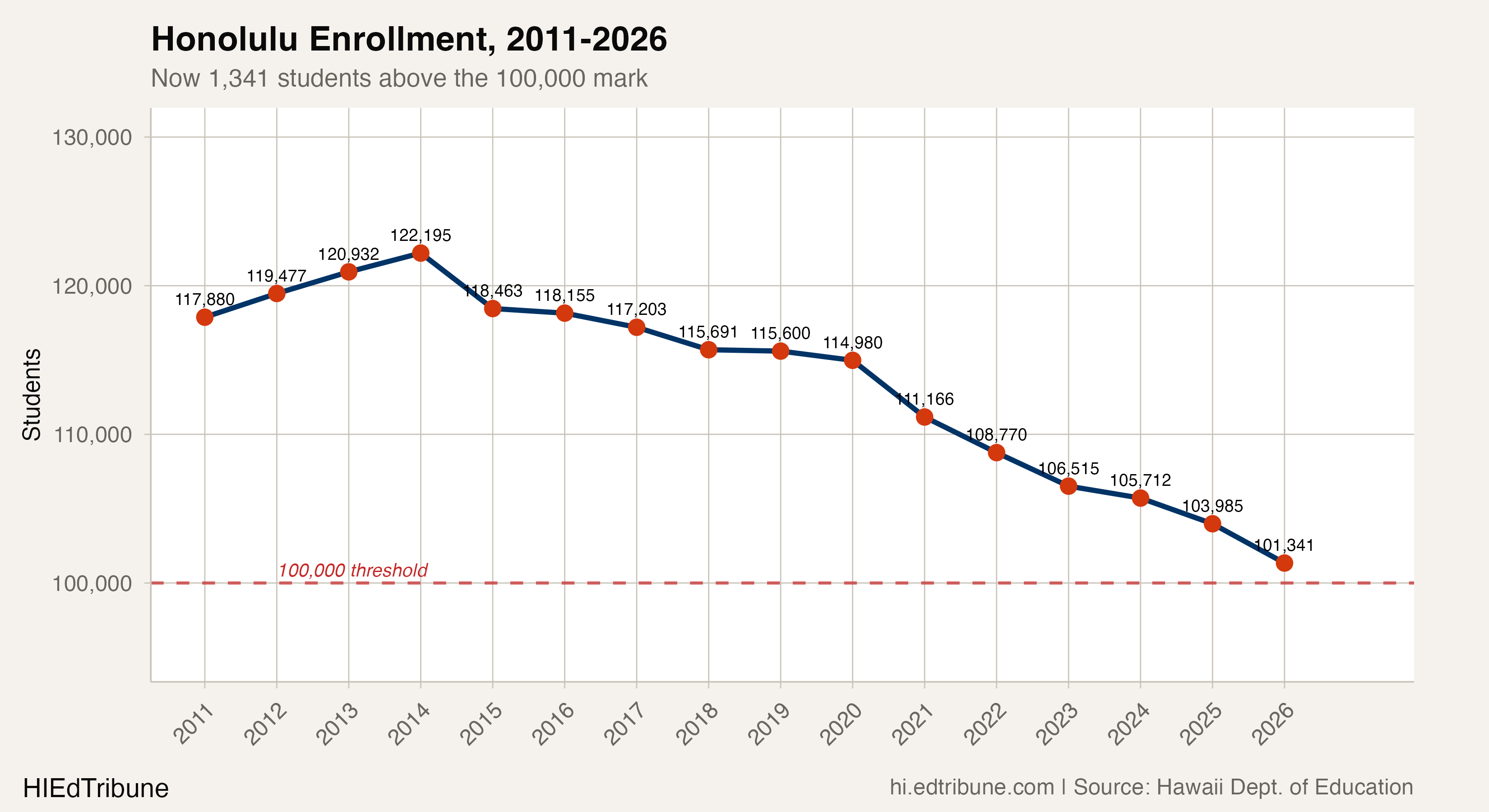
In 2014, Honolulu↗ET County enrolled 122,195 public school students. It was the peak of a three-year growth run, and nothing about the trajectory suggested the county was about to enter freefall. Twelve years later, Honolulu's enrollment stands at 101,341, a loss of 20,854 students, or 17.1%. The county is now 1,341 students from crossing below 100,000, a threshold it has not seen in modern data. At the three-year average pace of decline, that crossing comes next year.
The loss is not just large in absolute terms. Honolulu accounts for nearly 90% of Hawaii's total statewide enrollment decline since 2014, even though it holds only 61.9% of the state's students. The other three counties are shrinking too, but none at the rate or scale of Oahu.
Twelve years and counting
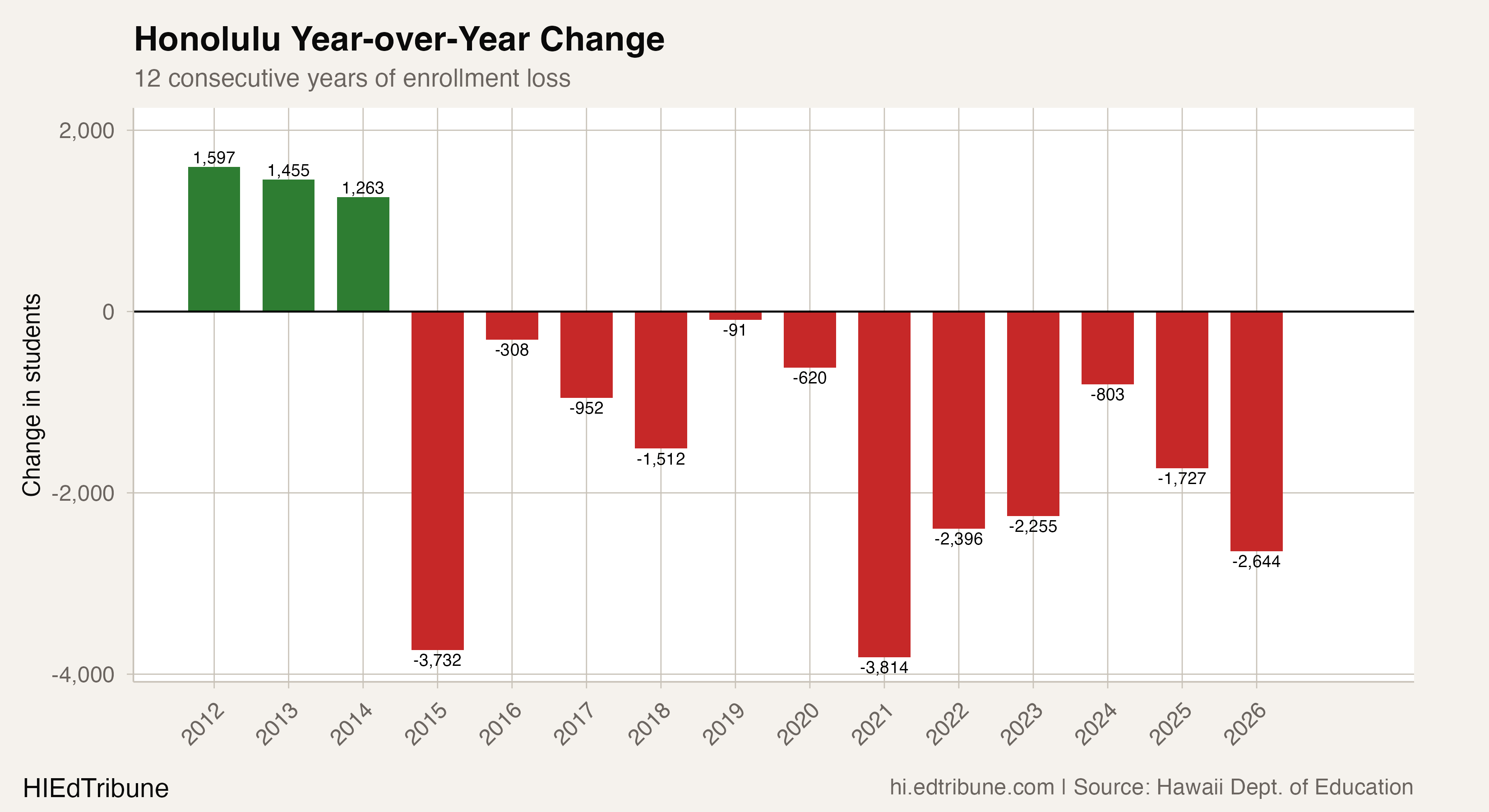
Honolulu's decline streak is the longest of any county in Hawaii. The county has posted negative enrollment every year since 2015, a 12-year run with no reprieve. Hawaii County↗ET has declined for six consecutive years. Kauai↗ET has declined for eight. Maui↗ET for six. None matches Honolulu's duration or depth.
The pace has also accelerated. Between 2016 and 2020, Honolulu lost an average of 697 students per year. Since 2021, the average annual loss has tripled to 2,273. The 2026 loss of 2,644 students is the largest single-year decline outside of the two anomalous years of 2015 and 2021, both of which were shaped by structural breaks: a 2015 counting methodology change that dropped the county by 3,732 in a single year, and the 2021 COVID exodus that removed 3,814.
What makes 2026 different is that there is no methodological explanation. The loss is organic.
The pipeline is inverting
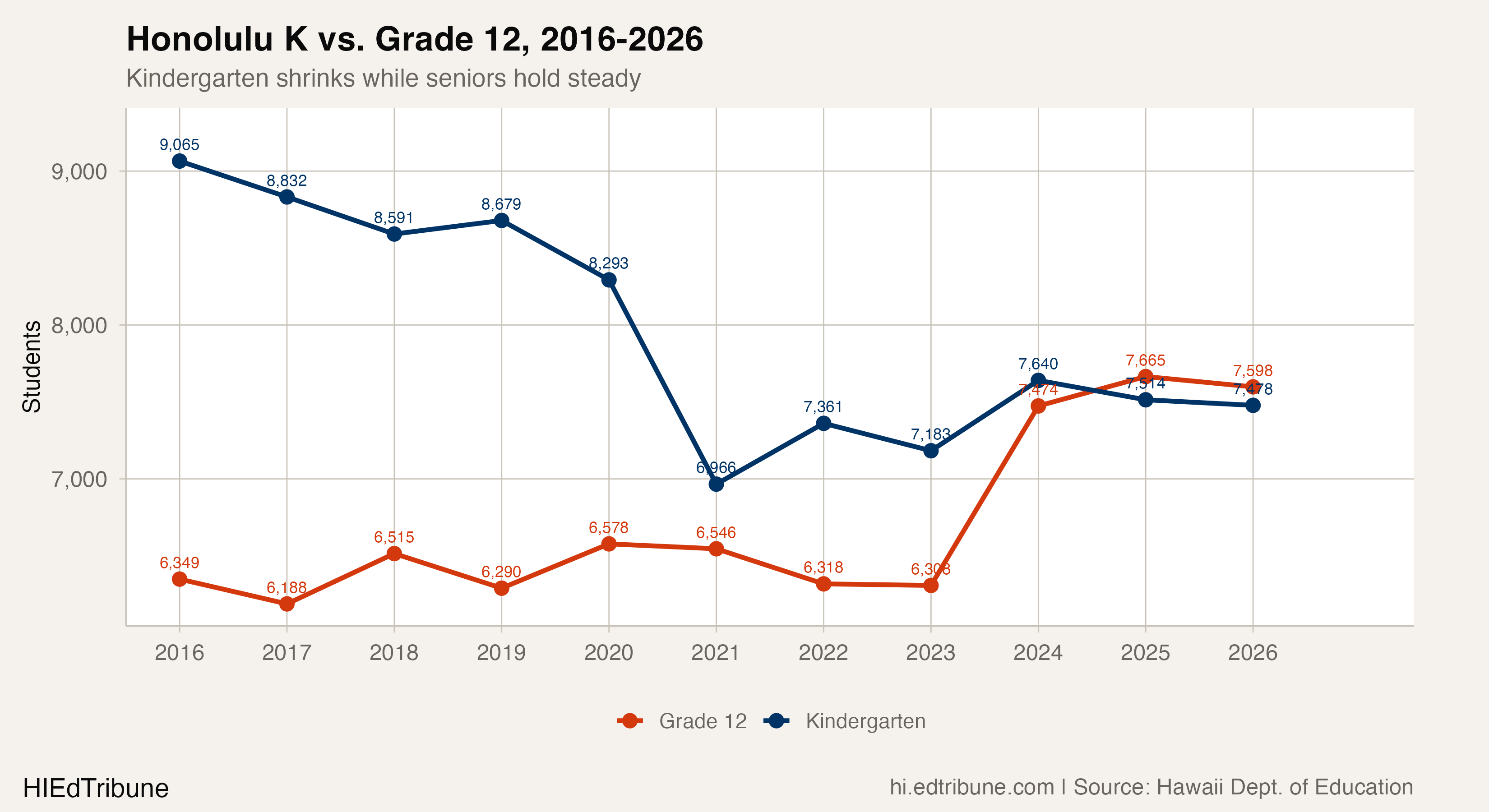
Honolulu's kindergarten enrollment fell from 9,065 in 2016 to 7,478 in 2026, a 17.5% decline. Meanwhile, 12th grade enrollment rose from 6,349 to 7,598 over the same period. In 2025, Grade 12 surpassed kindergarten for the first time: 7,665 seniors versus 7,514 kindergartners. The ratio held in 2026, with 7,598 seniors to 7,478 kindergartners.
This inversion signals that the pipeline feeding Honolulu's schools is shrinking at the entry point while still carrying larger cohorts out the exit. Each graduating class is larger than the kindergarten class replacing it. The structural implication: even if no additional families leave, enrollment will continue to fall as large cohorts graduate and small ones enter.
Hawaii's declining birth rate is the upstream driver. The state recorded just 14,808 live births in 2023, down from 18,059 in 2016, a 14% decline that ranks as the sixth-steepest drop of any state over that period.
Oahu is losing faster than the neighbor islands
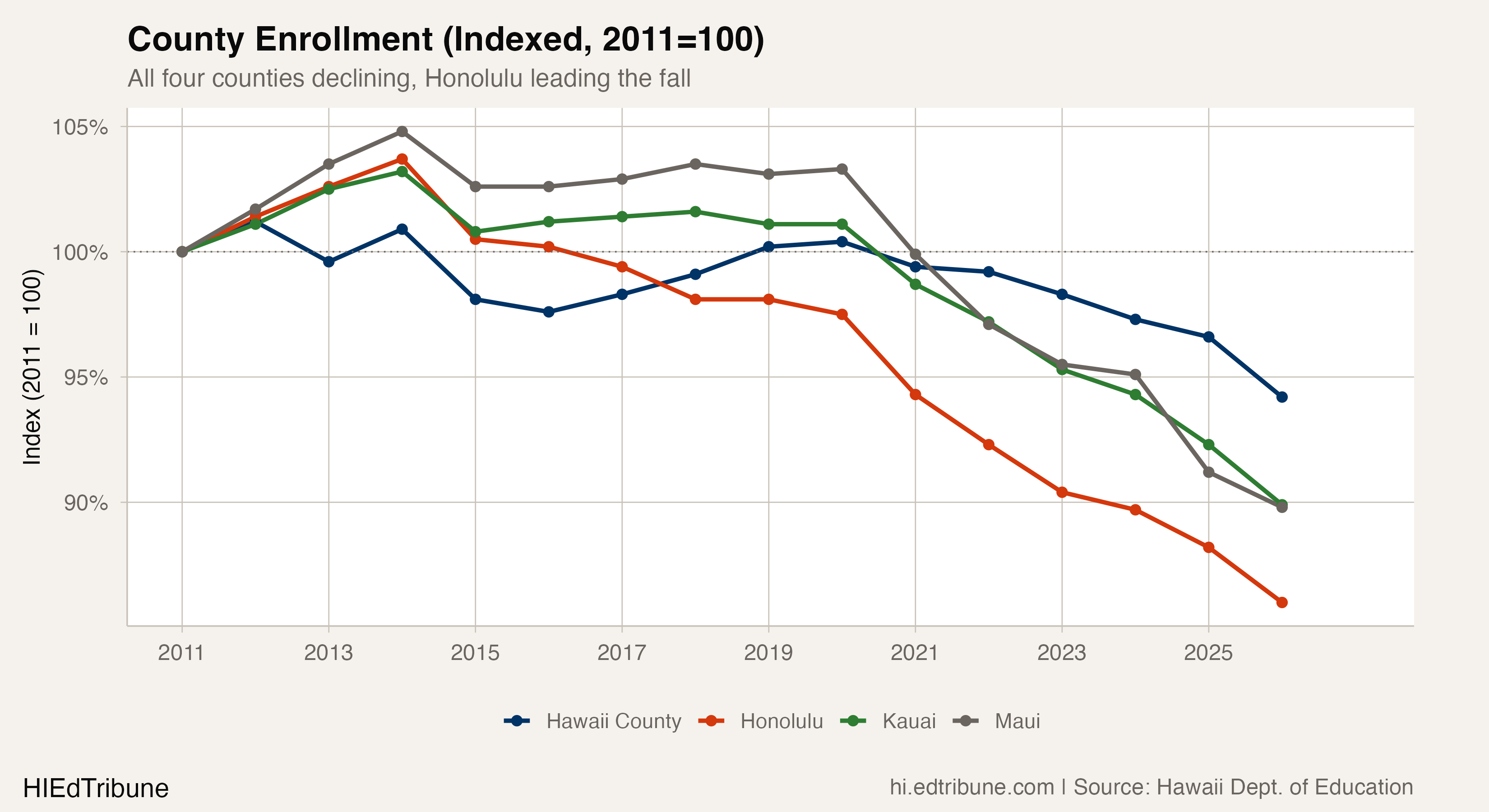
All four counties are declining, but the indexed comparison reveals that Honolulu's trajectory has pulled sharply away from the pack since 2020. Relative to 2011 enrollment, Honolulu has fallen to 85.9% of its baseline, while Hawaii County sits at 94.2%, Maui at 89.8%, and Kauai at 89.9%.
The divergence is partly a function of scale. Honolulu holds 61.9% of the state's students, down from 65.6% in 2011. But the county's losses are disproportionate even relative to its size. In the most recent year, every county lost students: Honolulu dropped 2,644 (-2.5%), Hawaii County lost 557 (-2.5%), Kauai lost 220 (-2.6%), and Maui lost 281 (-1.5%). In absolute terms, Honolulu accounted for 71.4% of the statewide loss.
The cost of living as enrollment policy
Hawaii's enrollment decline is not happening in a vacuum. A January 2025 Aloha United Way report found that one in three Hawaii households considered moving away over the prior year, with 180,000 people actively considering leaving the state's workforce.
"180,000 people right now are considering leaving the state of Hawaii, from our workforce, from our younger families, our Hawaiian families." -- Suzanne Skjold, Aloha United Way COO, Hawaii News Now, Jan. 2025
The median home price in Hawaii exceeds $1,000,000, more than double the national average. Native Hawaiians have been particularly affected: more Native Hawaiians now live on the mainland than in Hawaii, with roughly 15,000 leaving the state each year, driven by housing costs and limited employment options.
Honolulu, as the state's urban and economic center, concentrates this pressure. The high cost of living does not just push families to the mainland. It also shifts them within the islands. West Oahu communities like Ewa Beach and Kapolei, where newer housing developments offer relatively lower entry points, have seen school overcrowding even as the rest of Honolulu empties. Campbell High School enrolled more than 2,880 students in 2025-26, making it the largest school in the state. Meanwhile, McKinley High School in urban Honolulu fell from 1,617 to 1,133 students over five years, a 30% drop.
The same county is simultaneously overcrowded and underfilled, depending on the zip code.
What redistricting cannot fix
The Hawaii Department of Education, which operates as a single statewide district, has shifted away from school closures and toward redistricting as its primary response to declining enrollment. Deputy Superintendent Tammi Oyadomari-Chun told the Board of Education that the department would revise its approach after principals urged alternatives to consolidation.
But redistricting redistributes students across schools. It does not create new ones. If Honolulu County's total enrollment falls below 100,000, no amount of attendance-zone reshuffling changes the fact that fewer families are sending children to public schools on Oahu. The Western Interstate Commission for Higher Education projects that Hawaii will see the steepest decline in high school graduates of any state in the nation by 2041, a 33% drop compared to the national average of 10%.
The DOE's weighted student formula allocates funding on a per-student basis. Every student who leaves a school takes funding with them. The department has not closed a school since 2011, when Queen Liliuokalani Elementary in Kaimuki was shuttered over community objections. Consolidation decisions are now delayed until spring 2028, but the enrollment trajectory will not wait for the planning process.
At its three-year average pace of 2,186 fewer students per year, Honolulu will cross below 100,000 in 2027. At the five-year average of 1,857, it crosses in 2028. Either way, the question is not whether the threshold is breached, but what policy changes follow when it is.
Detailed code that reproduces the analysis and figures in this article is available exclusively to EdTribune subscribers.
Discussion
Sign in to join the discussion.
Loading comments...