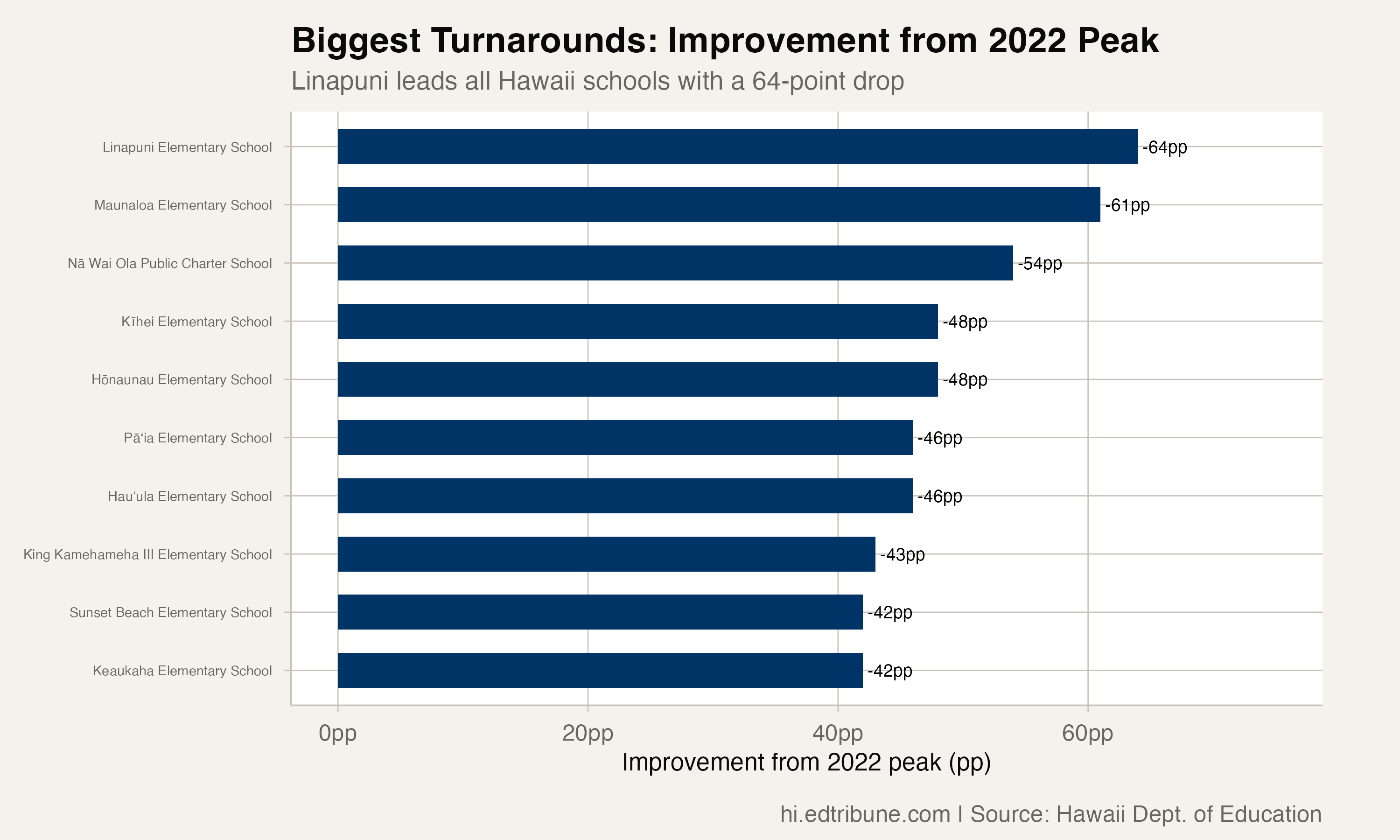
Correction (September 30, 2026): An earlier version said Linapuni Elementary's chronic absence rate fell from 92% in 2021-22 to 28% in 2024-25, a 64-point turnaround and the largest in the state, and ranked other schools the same way. Hawaii changed how it counts chronic absence in 2023-24, from students absent 15 or more days to students absent 18 or more days, so those years are not directly comparable. The comparisons, a comparison with the school's pre-pandemic rate, and a projection of when it would return to that rate have been removed. The article now compares years within one measure. It also removed unsourced descriptions of the school's community, including a location near Chinatown; Linapuni is in Kalihi.
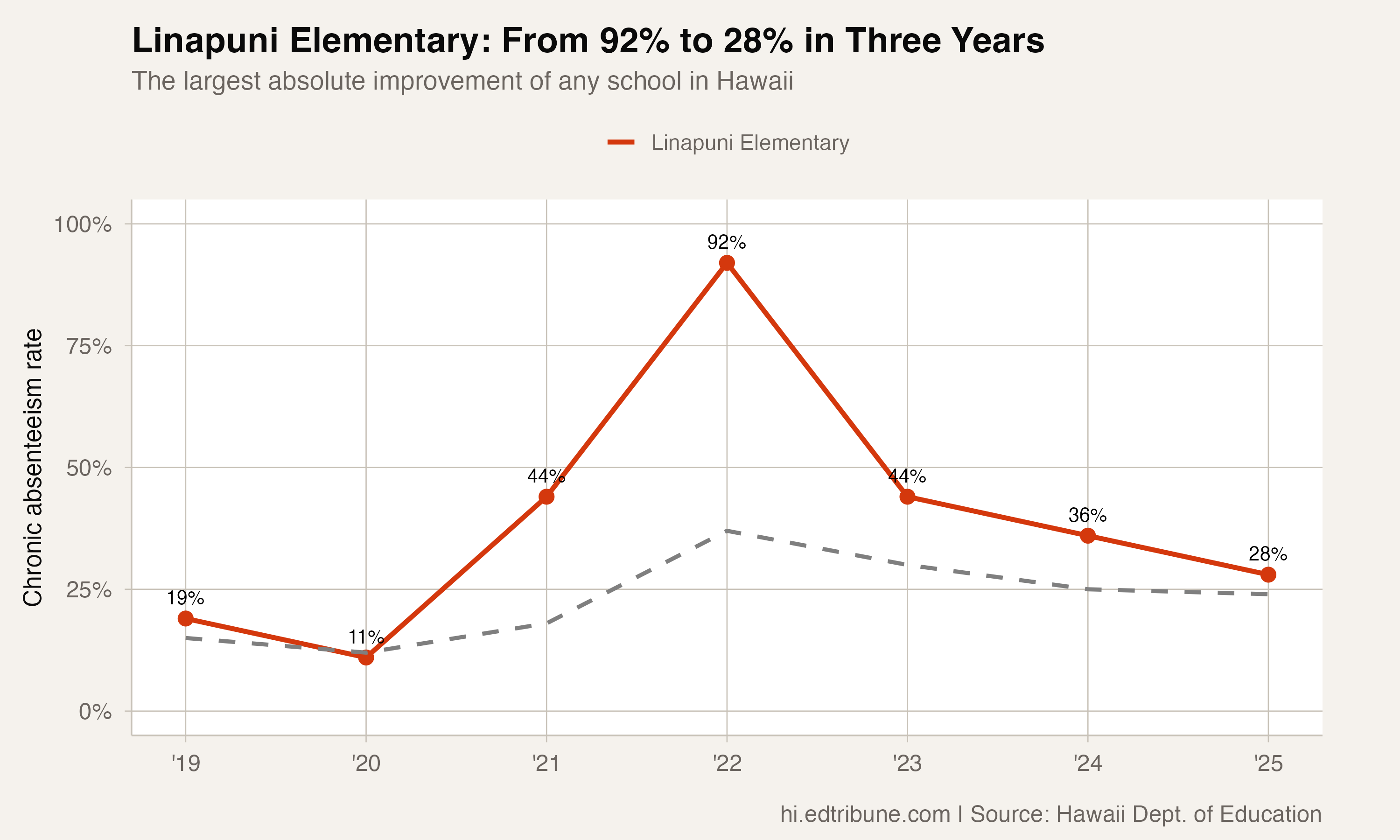
In 2021-22, 92% of Linapuni Elementary's students were chronically absent, meaning they missed 15 or more days of school. The next year, the rate was 44%.
That 48-point drop was the largest one-year change of any school in Hawaii. Among the 293 schools with rates in both years, the next-largest drop was 34 points. The statewide rate fell 7 points that year, from 37% to 30%.
Linapuni kept improving after Hawaii changed its measure in 2023-24. Counting students absent 18 or more days, its rate fell from 36% in 2023-24 to 28% in 2024-25. That 8-point drop put it among the 19 schools, of 293, that fell by 8 points or more. The statewide rate was 24% in 2024-25, 4 points below Linapuni's.
The Record on Each Measure
Under the older measure, Linapuni's rate was 19% in 2018-19 and 11% in 2019-20, the first pandemic spring. It rose to 44% in 2020-21 and 92% in 2021-22 before falling back to 44% in 2022-23.
Under the newer measure, the school has two years of results: 36% and 28%. Because a student now has to miss more days to be counted, the newer rates cannot be set against the older ones, and the gap between 44% and 36% says nothing about whether attendance improved between those two years.
Its Kalihi Neighbors
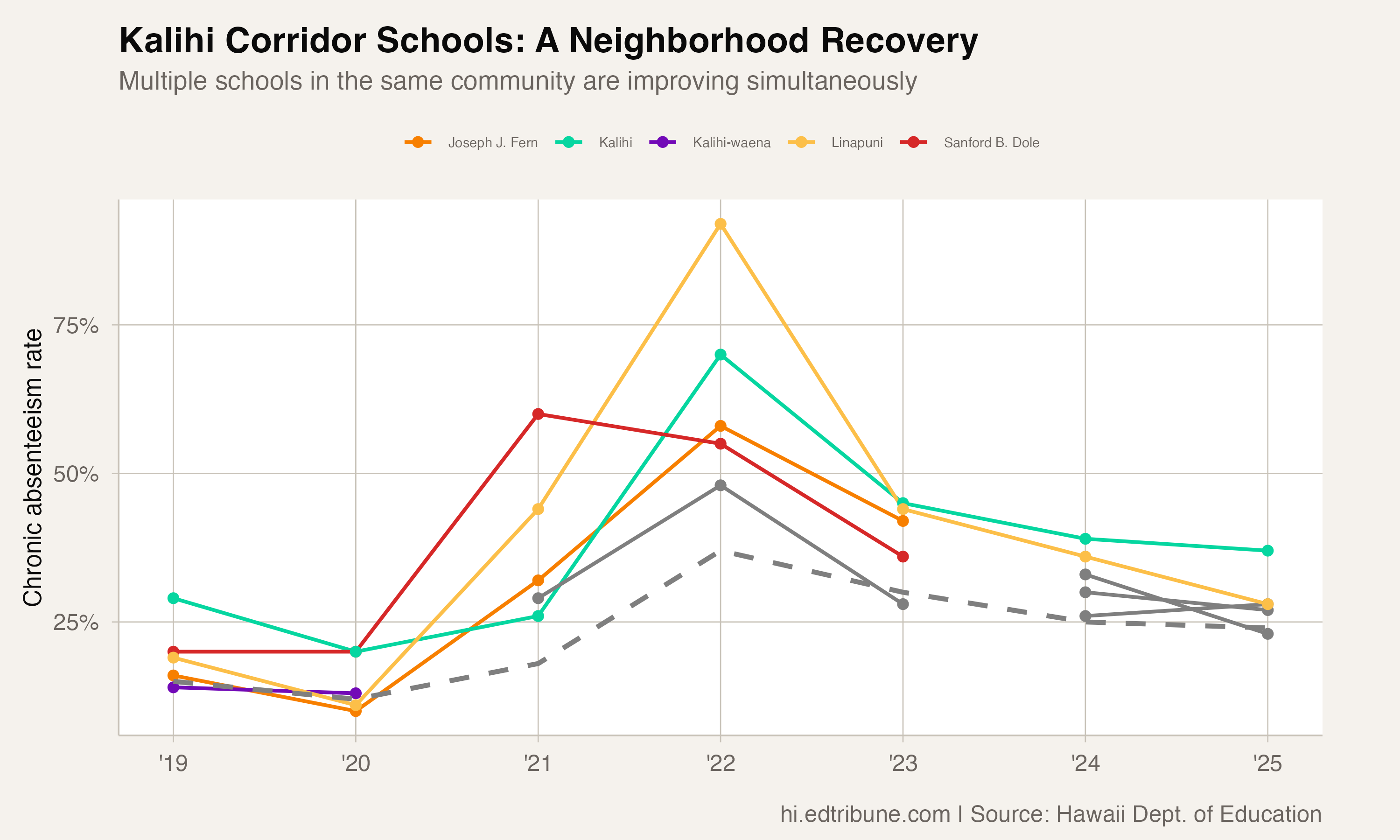
Linapuni was not alone. Between 2021-22 and 2022-23, every nearby Kalihi school in this comparison fell by more than the state's 7 points. Kalihi Elementary went from 70% to 45%, Kalihi-Waena Elementary from 48% to 28%, Kalihi-Uka Elementary from 46% to 27%, Sanford B. Dole Middle from 55% to 36%, and Kalihi-Kai Elementary from 41% to 28%.
On the newer measure, five of the six improved again between 2023-24 and 2024-25. Kalihi-Kai fell from 20% to 16%, Kalihi-Uka from 20% to 17%, Dole Middle from 30% to 27%, and Kalihi Elementary from 39% to 37%. Kalihi-Waena rose 2 points, from 26% to 28%.
The Largest Drops of 2022-23
Linapuni led the state's biggest one-year declines from 2021-22 to 2022-23, all measured on the older 15-day threshold. Behind it were Hau'ula Elementary and Kihei Elementary, each down 34 points from 71% to 37%, and Honaunau Elementary (72% to 39%) and Keonepoko Elementary (73% to 40%), each down 33.
What the Numbers Cannot Say
The state's attendance files record how many students missed school, not why the rate fell, so they cannot identify what Linapuni or its neighbors did differently. Its 2024-25 rate remains above the state's. The 2025-26 data will show whether the school's second year of improvement on the newer measure carries into a third.
Attendance figures come from the Hawaii Department of Education's school accountability reports, covering 2018-19 through 2024-25.
Detailed code that reproduces the analysis and figures in this article is available exclusively to EdTribune subscribers.
Discussion
Sign in to join the discussion.
Loading comments...