Tuesday, July 14, 2026

Farrington High: 72.5% Graduation in Kalihi

One of Honolulu's largest high schools graduates barely seven in 10 students, with Pacific Islander rates below 50% and a 15-year gender gap.

Fewer than half of Pacific Islander students at Farrington High School graduate within four years. The rate, 48.4%, sits 37.4 percentage points below the state average and 39.2 points below the school's own Filipino students. Both groups walk the same hallways in Kalihi, one of Honolulu's densest and most economically strained neighborhoods. They attend the same career academies. They are separated by a graduation gap wider than the one between the highest- and lowest-performing complex areas in the state.

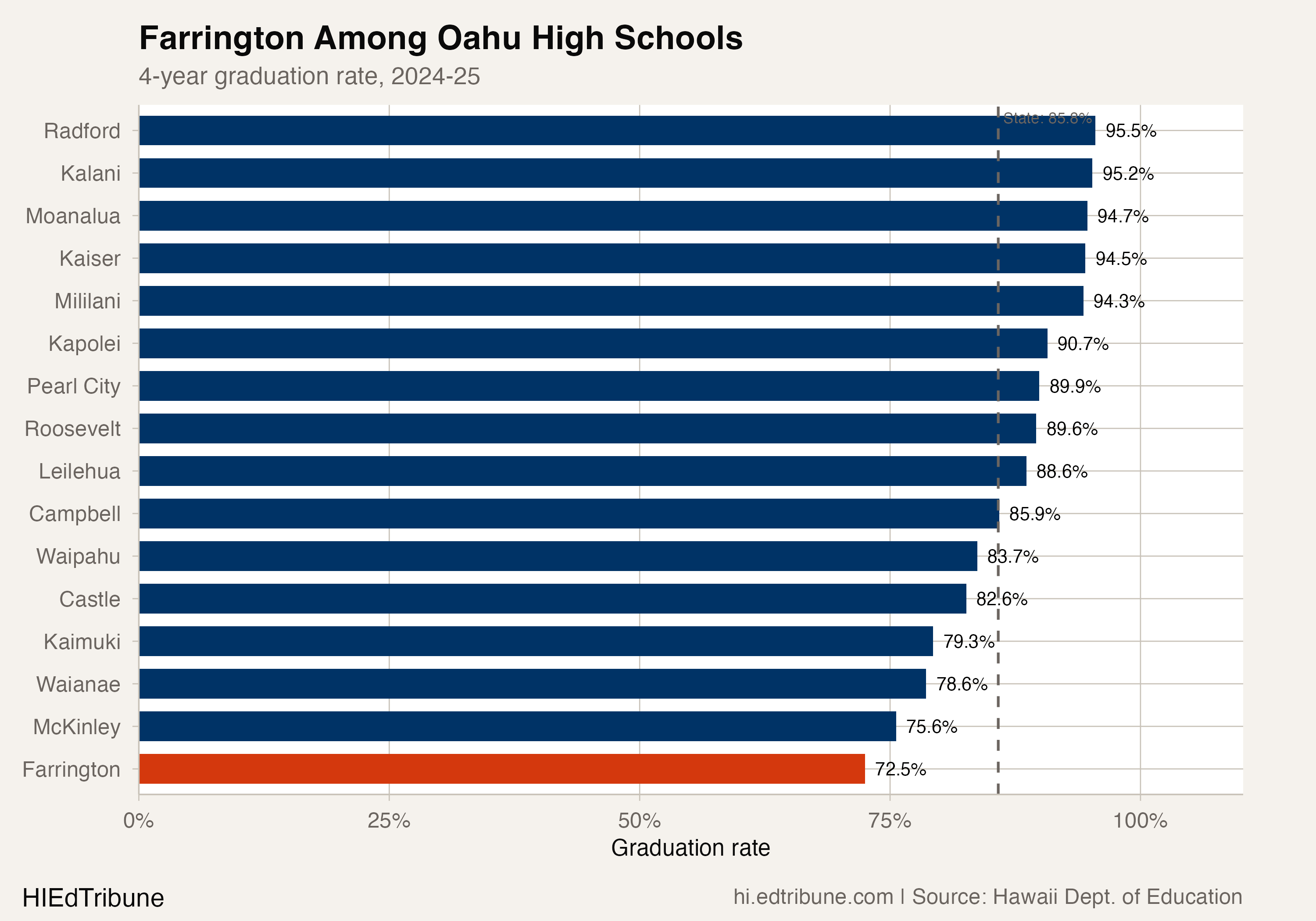
Farrington's overall four-year graduation rate in 2024-25 is 72.5%, ranking sixth from the bottom among Hawaii's 57 high schools with reported data. That is 13.3 percentage points below the statewide average of 85.8%. Among the 16 Oahu high schools tracked in this analysis, only McKinley High (75.6%) comes close to Farrington's position at the bottom.

A gap that grew while the state improved

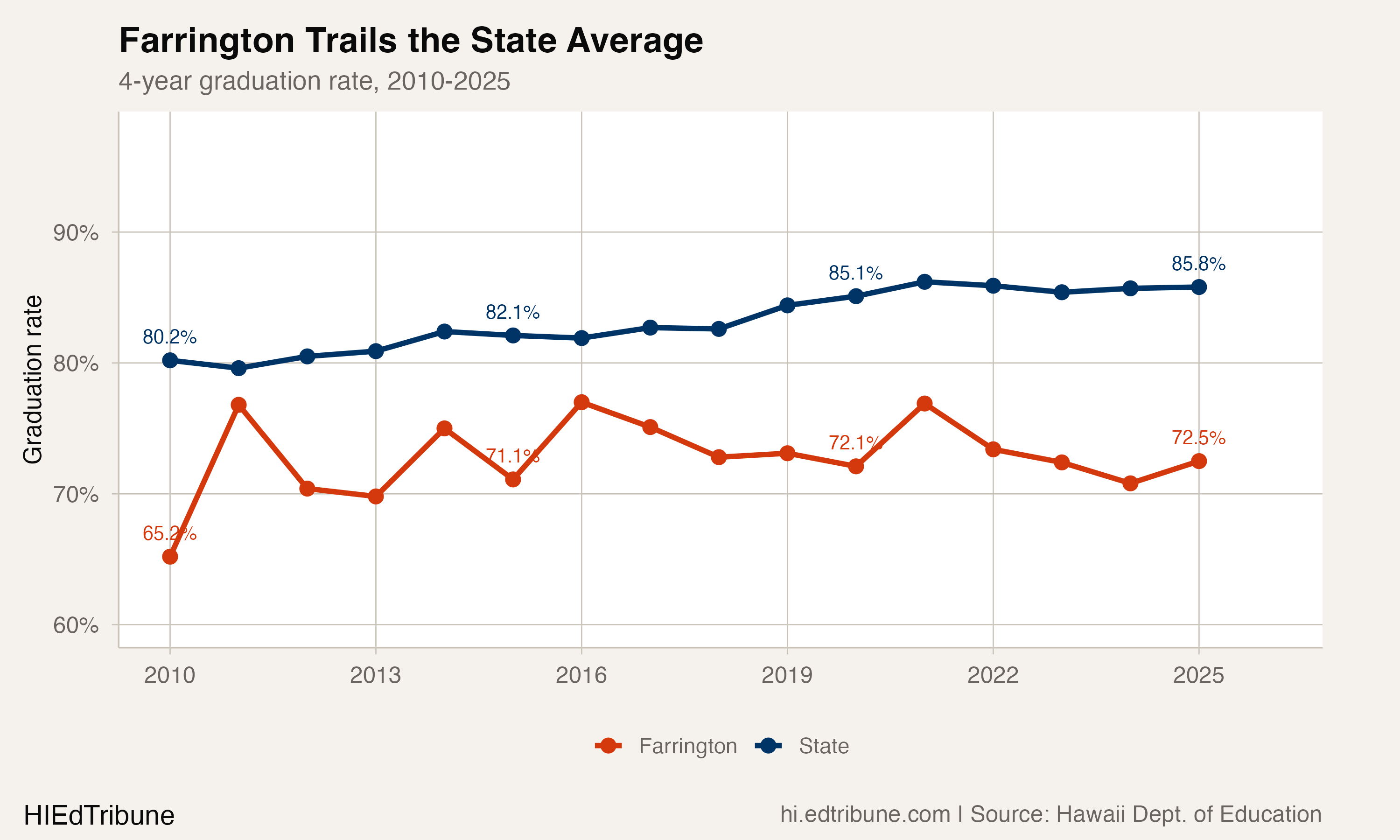
Farrington vs. state graduation rate, 2010-2025

Hawaii's statewide graduation rate climbed steadily over the past 15 years, from 80.2% in 2010 to 85.8% in 2025, a gain of 5.6 percentage points. Farrington improved too, from 65.2% to 72.5%, a 7.3-point gain. But the improvement has not been linear. The school hit 77.0% in 2016, then slid backward. In 2024, the rate touched 70.8%, the lowest mark since 2013.

The result is a gap that has widened. In 2011, Farrington trailed the state by just 2.8 points, though that year was an outlier when Farrington's rate spiked 11.6 points in a single year. By 2020, the gap had grown to 13.0 points. In 2024, it reached 14.9 points, the widest in the dataset. The modest uptick to 72.5% in 2025 narrowed the gap to 13.3 points, but that is still larger than in any year before 2020.

The year-over-year pattern is volatile. Farrington's rate swung by 11.6 points in a single year (2010 to 2011), and has moved by more than 3 points in seven of the past 15 transitions. The state average, by contrast, has not moved by more than 1.8 points in any single year. Whatever is driving Farrington's outcomes operates at a different frequency than the forces shaping the state.

Where one school holds two realities

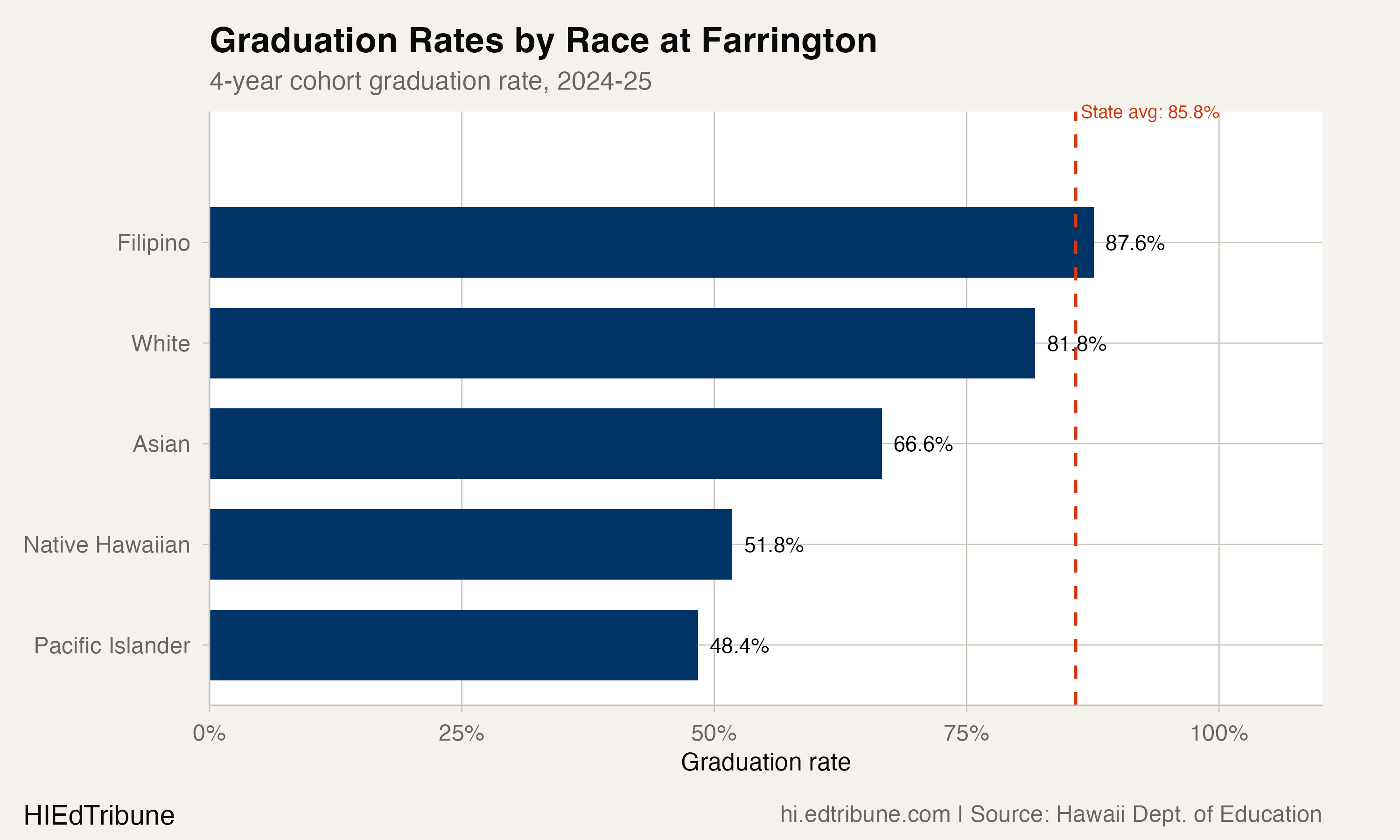
Graduation rates by race at Farrington, 2024-25

The most striking feature of Farrington's data is not its overall rate. It is the distance between the school's highest- and lowest-performing racial groups.

Filipino students graduate at 87.6%, above the state average. White students graduate at 81.8%. Both figures are consistent with statewide norms. Then the floor drops. Asian students (a category that in Hawaii excludes Filipino) graduate at 66.6%. Native Hawaiian students graduate at 51.8%. Pacific Islander students graduate at 48.4%.

That 39.2-point spread between Filipino and Pacific Islander students inside a single school is larger than the gap between Hawaii's top-performing complex area (Aiea-Moanalua-Radford at 94.4%) and its lowest (Nanakuli-Waianae at 78.5%). It means that the most consequential factor in whether a Farrington student graduates is not the quality of the school's instruction or the rigor of its academies. It is which racial group they belong to.

The Native Hawaiian figure deserves particular attention. In 2024, Native Hawaiian students at Farrington graduated at 71.6%. In 2025, that rate collapsed to 51.8%, a single-year drop of 19.8 percentage points. Without cohort counts, it is impossible to determine whether this reflects a small cohort producing noisy data or a genuine deterioration. But if the number holds, roughly half of Native Hawaiian students at one of Honolulu's largest high schools are not finishing on time.

The neighborhood in the numbers

Farrington sits on a 26-acre campus on North King Street in Kalihi, a neighborhood that Honolulu Civil Beat has described as "the last working class neighborhood in central Honolulu." State House District 29, which covers Kalihi-Palama, contains more public housing complexes than any other legislative district in Hawaii. The school's feeder zone includes five public housing projects and draws students from families who work multiple low-wage jobs in hospitality, construction, and food service.

About 53% of Farrington students are classified as economically disadvantaged. The graduation rate for that group at Farrington is 69.6%, compared to 80.9% statewide, a gap of 11.3 points. For English learners, the gap is even steeper: 55.8% at Farrington versus 71.3% statewide. For students receiving special education services, Farrington graduates 50.0% compared to 68.1% statewide, an 18.1-point deficit.

These service-population gaps overlap substantially with the racial disparities. Many of Kalihi's Pacific Islander and immigrant families are Marshallese, Chuukese, and Samoan households navigating English as a second language alongside economic instability. The graduation data does not disaggregate by national origin, but the convergence of low Pacific Islander rates and low English learner rates at the same school suggests the challenges compound.

The male side of the gap

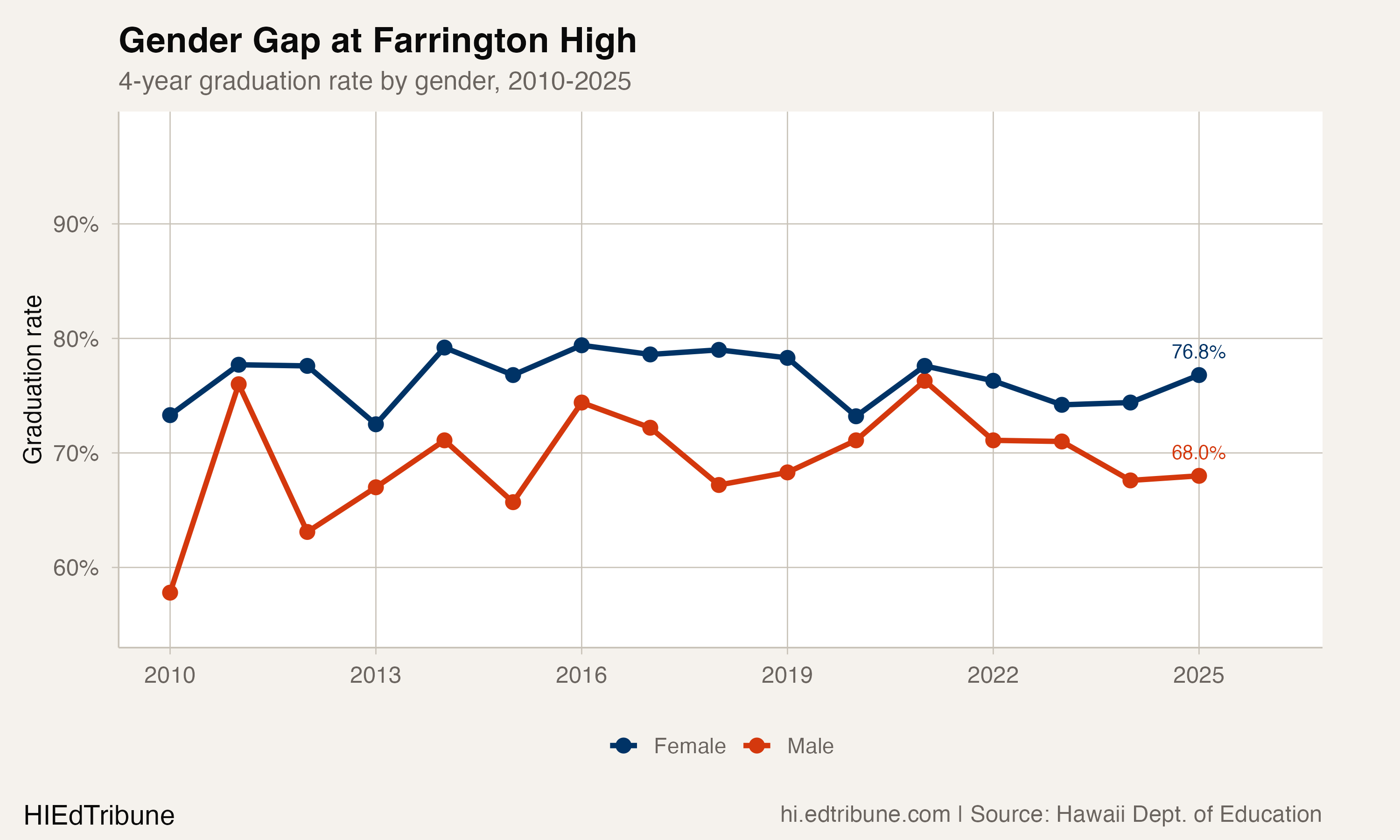
Gender gap at Farrington, 2010-2025

Farrington's gender gap is persistent and wide. In 2025, female students graduated at 76.8% while male students graduated at 68.0%, a gap of 8.8 percentage points. In 2010, the gap was 15.5 points (73.3% female vs. 57.8% male). Male graduation rates have improved since then, but at Farrington, being male still means roughly one in three students does not finish high school on time.

The gap briefly closed in 2020 and 2021. In 2020, males graduated at 71.1% and females at 73.2%, a gap of just 2.1 points. In 2021, males hit 76.3% and females 77.6%, the narrowest gap in the dataset at 1.3 points. Both years coincided with pandemic-era grading flexibility. When normal assessment conditions returned, the gap reopened: 5.2 points in 2022, 3.2 in 2023, 6.8 in 2024, and 8.8 in 2025.

The pattern suggests that whatever mechanisms help close the gender gap operated most strongly under conditions of reduced academic gatekeeping. When standard expectations returned, the structural factors pulling male graduation rates down at Farrington reasserted themselves.

The Farrington-Kaiser-Kalani complex area

The Farrington-Kaiser-Kalani (FKK) complex area, which includes Farrington alongside Kaiser High (94.5%) and Kalani High (95.2%), illustrates how a single struggling school can pull down an entire complex's metrics. The FKK complex area overall graduates 83.7% of students, placing it seventh of 16 complex areas. That composite masks a 22.7-point range between Farrington (72.5%) and Kalani (95.2%) within the same administrative grouping.

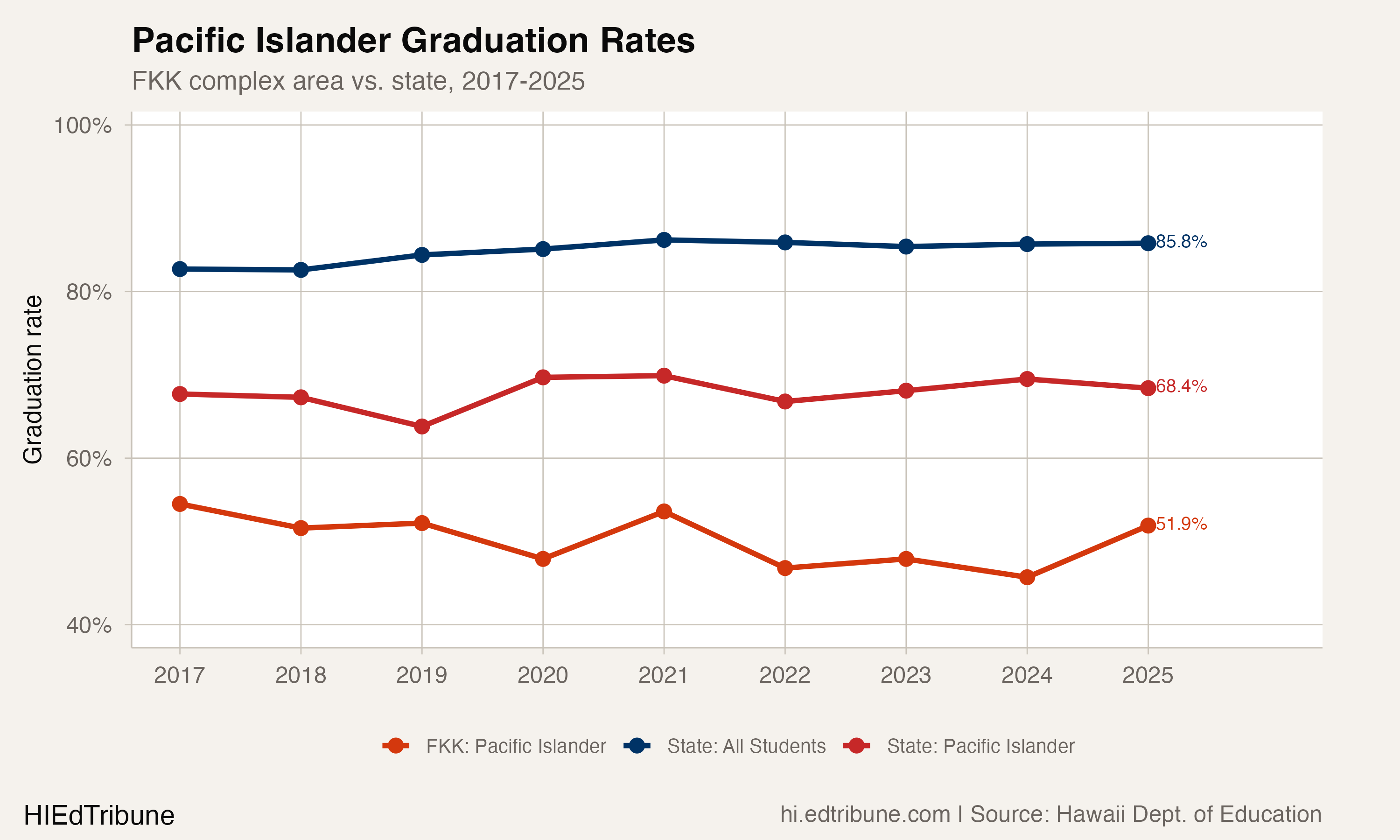
Pacific Islander graduation rates: FKK complex area vs. state, 2017-2025

For Pacific Islander students specifically, the FKK complex area holds the lowest rate in the state at 51.9%. That is below Kailua-Kalaheo (52.3%), below Kaimuki-McKinley-Roosevelt (58.7%), and below Nanakuli-Waianae (74.3%). The FKK Pacific Islander rate has not exceeded 55% in any of the nine years for which racial data is available. It dipped as low as 45.7% in 2024 before recovering slightly to 51.9% in 2025.

What the school is building

Farrington is not without institutional capacity. The school transitioned in 2018 to a wall-to-wall academy structure, organizing all students into six career academies: Business, Creative Arts and Technology, Engineering, Health, Ke Ala Pono, and Public Service. By 2023, four academies had earned Model status from the National Career Academy Coalition. In the class of 2024, 13 students earned associate degrees before receiving their high school diplomas.

These are real achievements. The academy model is designed to give students a reason to stay in school by connecting coursework to career pathways. But the graduation data suggests the model's benefits are not reaching all students equally. A school where Filipino students graduate at 87.6% and Pacific Islander students graduate at 48.4% is a school where the academy structure works for some students and something else, something prior to or alongside the academy, is determining outcomes for others.

The question Farrington raises

Farrington among Oahu high schools, 2024-25

Hawaii's education conversation tends to focus on rural schools, neighbor island districts, and the challenge of serving geographically isolated communities. Farrington complicates that framing. This is an urban school, 10 minutes from downtown Honolulu, surrounded by bus routes and social services and community organizations. It has a math proficiency rate of 27%, and a graduation rate that has been essentially flat for a decade while the state climbed six points around it.

The question is not whether Farrington's challenges are real. They are visible in every subgroup, every year, every metric. The question is whether the graduation gap between Farrington and schools like Kaiser (94.5%) and Kalani (95.2%), located in the same complex area, is a school-level problem or a neighborhood-level problem wearing a school's name. If it is the latter, then the solutions that matter most may not be instructional at all. They may be about housing stability, language access, and whether a family that works two jobs at $15 an hour can keep a teenager in school for four consecutive years.

The class that entered Farrington in fall 2025 will be the first to spend all four years under the fully mature academy model. Its graduation rate in 2029 will be the first clean test of whether structural school reform can move the needle in a community where the obstacles begin long before the first bell.

Detailed code that reproduces the analysis and figures in this article is available exclusively to EdTribune subscribers.

Discussion

Loading comments...