Tuesday, July 14, 2026

Students Who Are Homeless Surged from 62% to 77% Graduation, the Fastest-Improving Group in Hawaii

The graduation rate for Hawaii students who are homeless jumped 15 points since 2018, cutting the gap with the state average in half and outpacing every other subgroup.

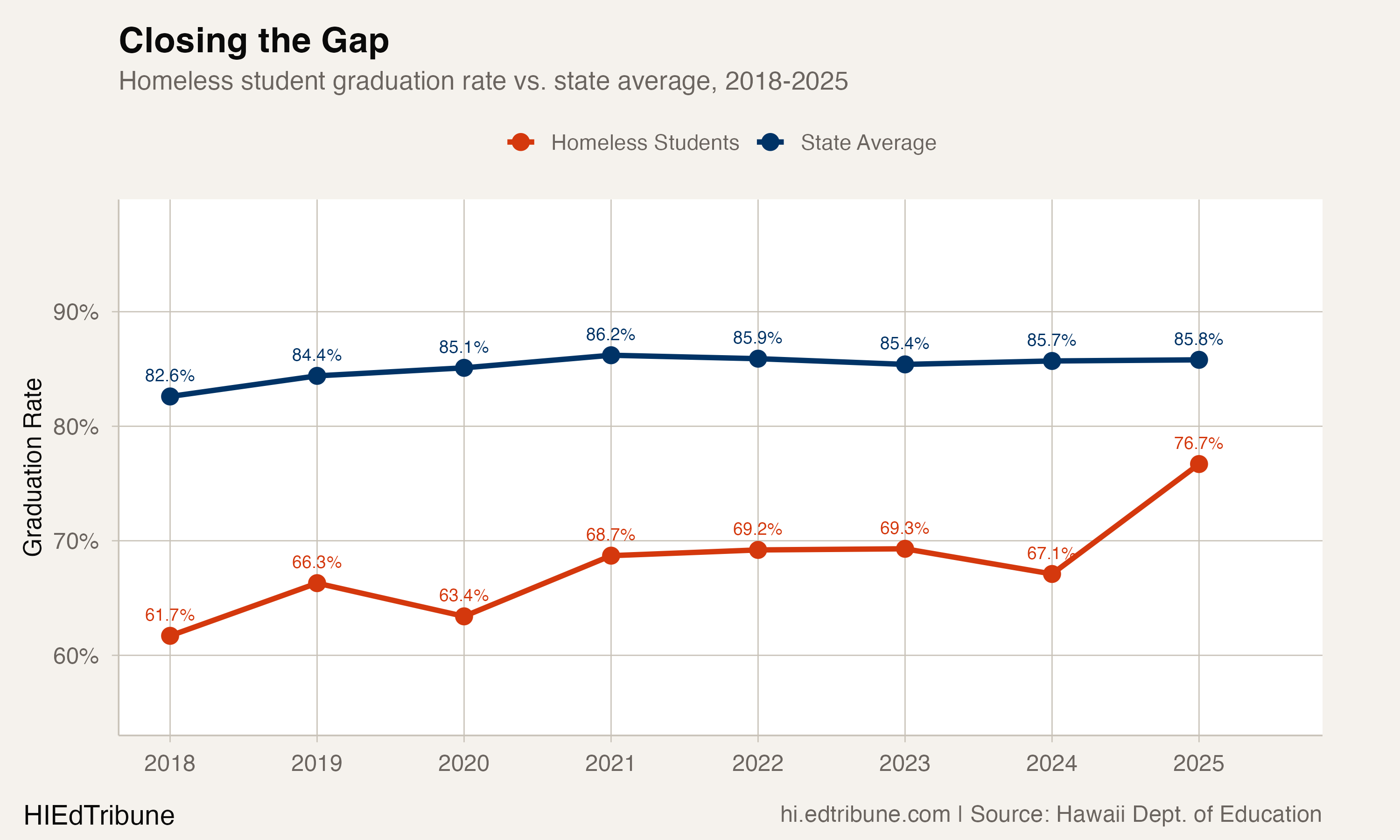
The number that stands out in Hawaii's graduation data is not the state average, which has flatlined near 86% for four years. It is the line climbing underneath it.

In 2018, 61.7% of students who are currently homeless in Hawaii graduated on time. In 2025, 76.7% did. That 15 percentage point gain is the largest improvement of any subgroup in the state, larger than any racial group, any special population, any demographic slice the Hawaii Department of Education tracks.

Graduation rate trend for students who are homeless vs state average

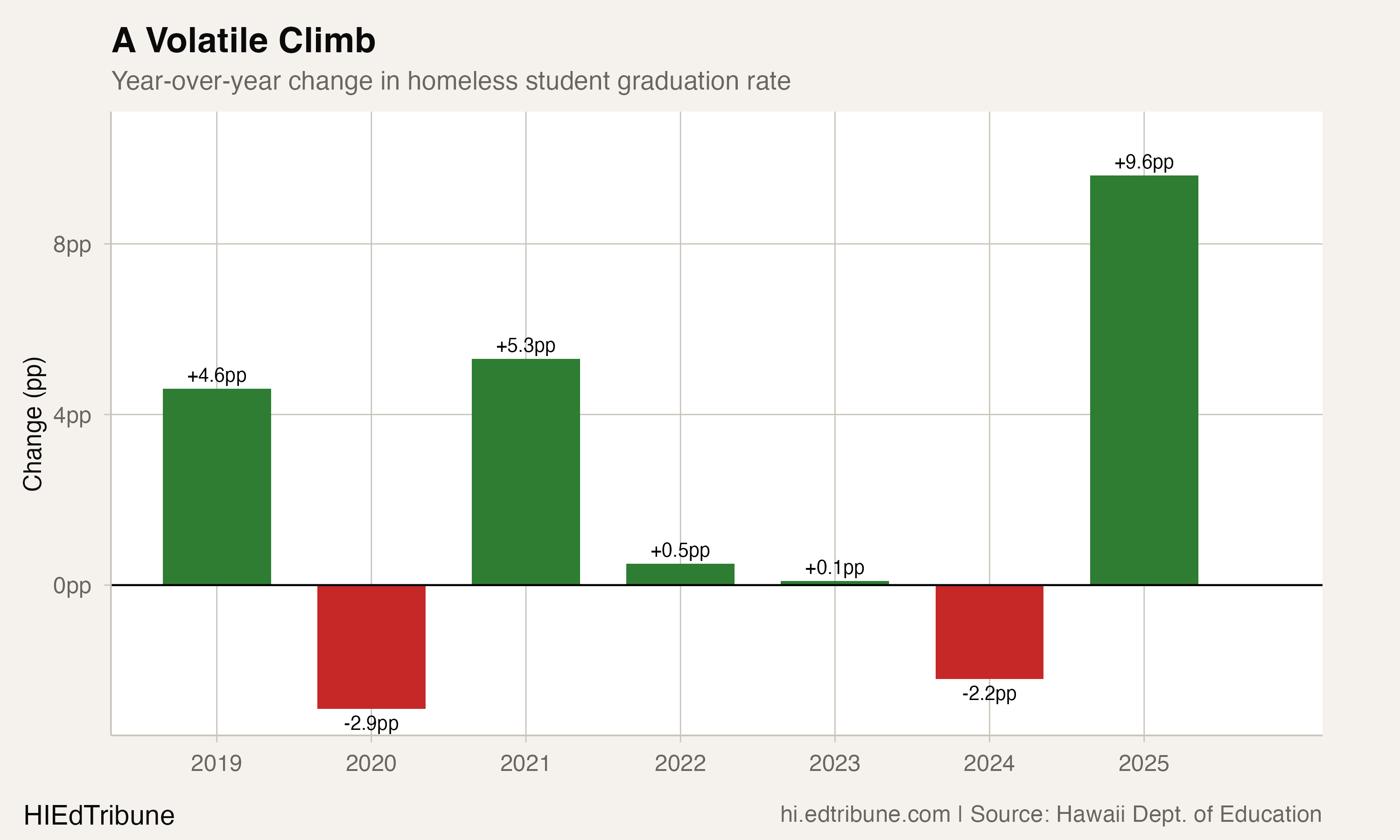
The improvement is not steady. The trajectory lurches: a 4.6-point jump in 2019, a 2.9-point COVID drop in 2020, a 5.3-point recovery in 2021, then three years of plateau near 69%. The 2025 reading of 76.7% represents a single-year surge of 9.6 percentage points from 67.1% the prior year, the largest one-year gain for any subgroup in at least a decade.

A gap halved

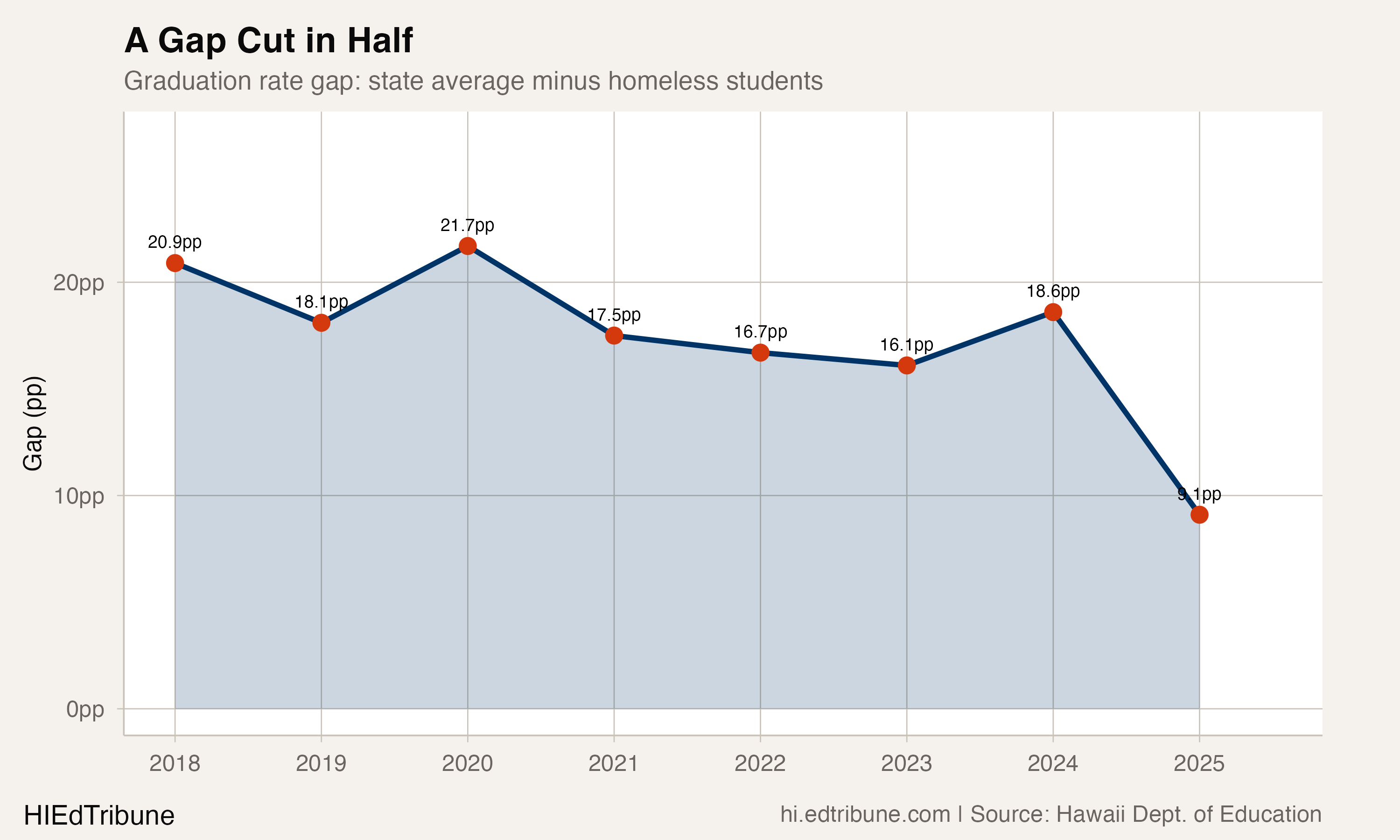
The gap between students who are currently homeless and the state average narrowed from 20.9 points in 2018 to 9.1 points in 2025. That gap has been cut by more than half.

Gap between graduation rate for students who are homeless and state average

This narrowing happened almost entirely from the homeless side. The state rate gained 3.2 points over the same period. Students who are currently homeless gained 15. When nearly all the movement comes from the group that was behind, the improvement is genuine, not an artifact of a statewide tide lifting all boats.

Context: Hawaii's housing crisis

Hawaii has the highest housing costs in the nation. The state's median home price exceeded $800,000 in 2024, and rents for a two-bedroom apartment averaged over $2,100 statewide. Student homelessness in Hawaii is not primarily about living on the street. It is about families doubled up in overcrowded apartments, staying in shelters, or sleeping in cars. Under the McKinney-Vento Act's broad definition, these students qualify as homeless.

The Hawaii Department of Human Services reported that homelessness remained a persistent challenge, with the state's unsheltered count among the highest per capita in the country. For students, housing instability means changing schools, missing instruction, and lacking quiet space for homework.

Where the gains concentrate

Not all complex areas saw the same improvement. Farrington-Kaiser-Kalani, which serves Kalihi and urban Honolulu neighborhoods with high immigrant and Pacific Islander populations, saw its graduation rate for students who are homeless jump from 43.7% in 2018 to 63.3% in 2025, a 19.6-point gain and the largest of any complex area.

At the top of the scale, Kapaa-Kauai-Waimea graduated 92.5% of its students who are currently homeless in 2025, a rate higher than most complex areas achieve for all students combined.

The bottom tells a harder story. Kaimuki-McKinley-Roosevelt graduated just 57.1% of students who are currently homeless. Kailua-Kalaheo and Leilehua-Mililani-Waialua both sat at 63.1%. The spread between the best and worst complex areas is 35.4 points, a chasm within a single statewide school system.

The outlier among vulnerable groups

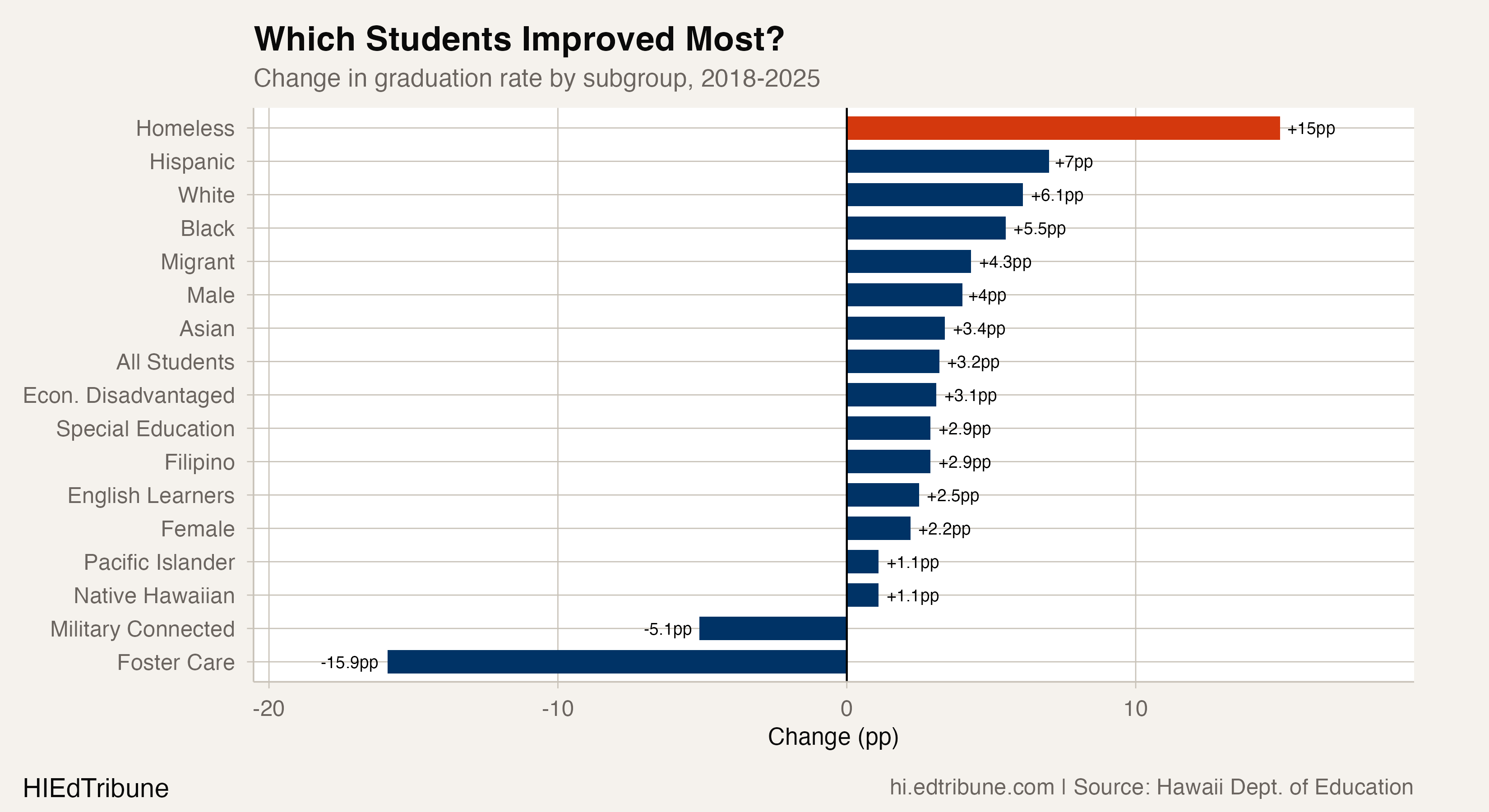
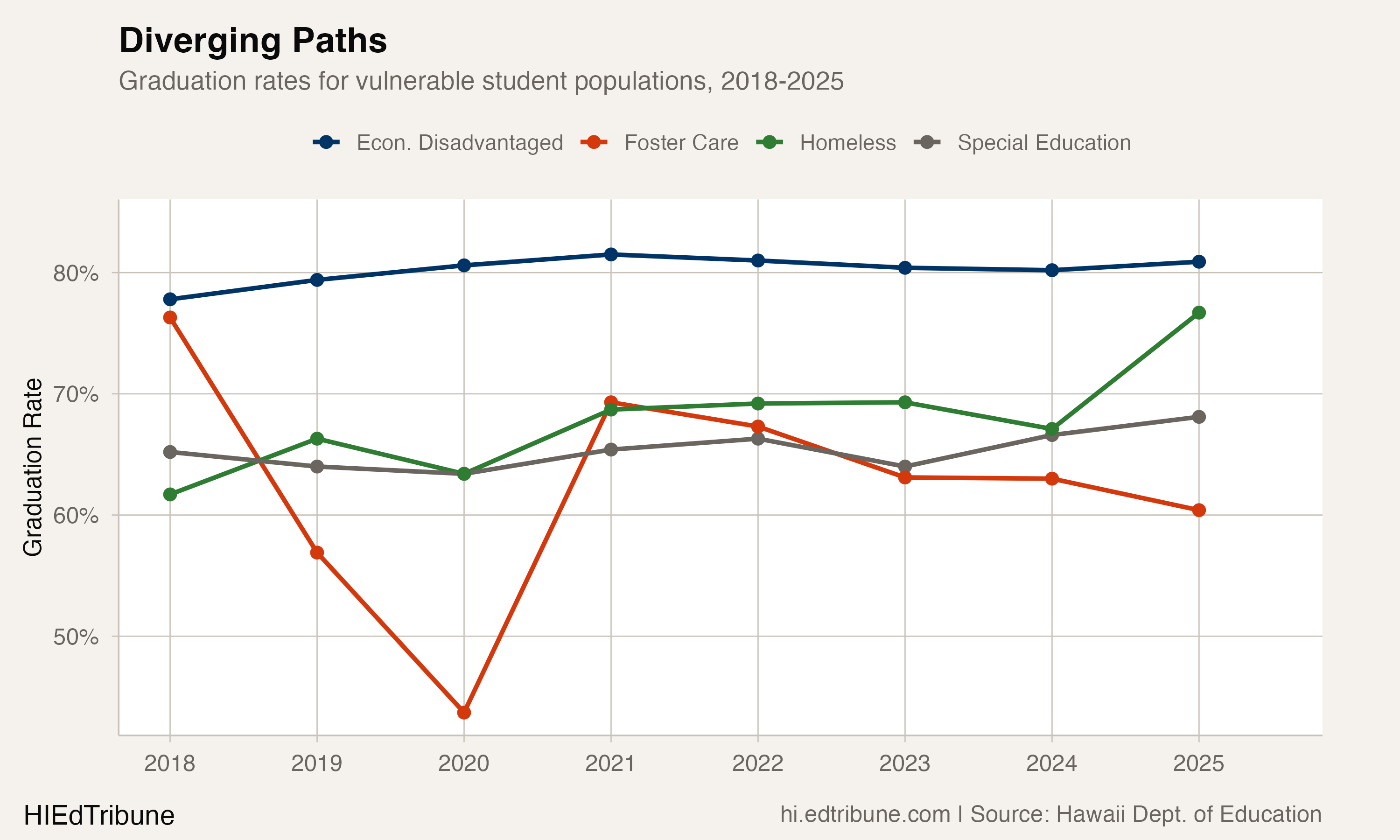
Vulnerable population graduation rate comparison

What makes the homeless improvement striking is how it diverges from other vulnerable populations. Students in foster care, the other group defined by instability rather than demographics, went the opposite direction, falling from 76.3% in 2018 to 60.4% in 2025, a 15.9-point decline. Economically disadvantaged students gained 3.1 points. Special education students gained 2.9 points. English learners gained 2.2 points.

Students who are currently homeless gained nearly five times more than any of these groups.

Vulnerable population improvement comparison

Military-connected students, by contrast, graduate at 93.8%, a group defined in part by guaranteed housing. The 17.1-point gap between military and students who are currently homeless in 2025 is smaller than it was in 2018 (32.1 points), but the comparison shows how much housing stability shapes educational outcomes.

What the 9.6-point jump might mean

A single-year surge of 9.6 points, from 67.1% to 76.7%, is large enough to warrant scrutiny. Several possibilities exist.

The Hawaii State Department of Education expanded its McKinney-Vento services in recent years, including transportation support, school stability provisions, and coordinated services with community partners. The Partners in Development Foundation and the Institute for Human Services have expanded wraparound programs for families experiencing homelessness.

It is also possible that the definition of who counts changed, or that identification practices shifted. If fewer students who are marginally homeless were identified in 2025, the remaining cohort might be more connected to services and more likely to graduate. Without enrollment data broken out by homeless status alongside graduation rates, this cannot be tested directly.

The most honest reading: something meaningful happened for this group of students, and the data does not yet tell us exactly what.

Year-over-year volatility

Year-over-year changes in graduation rate for students who are homeless

The graduation rate for students who are homeless is volatile in a way the state average is not. The year-over-year changes since 2018: +4.6, -2.9, +5.3, +0.5, +0.1, -2.2, +9.6. The state average moved less than 1.8 points in any single year over the same period.

Small cohort sizes likely explain part of this. Hawaii does not publish the number of students who are currently homeless in each graduating cohort, only the rate. If the cohort is 200 students rather than 2,000, a handful of additional graduates shifts the percentage meaningfully. The 9.6-point jump in 2025 may reflect both genuine improvement and statistical noise from a small denominator.

What comes next

If 76.7% holds, Hawaii will have achieved something rare: meaningful, sustained narrowing of an equity gap defined not by race or disability but by economic precariousness.

The gap is still 9.1 points. Nearly one in four students who are currently homeless still does not graduate on time. But the trajectory, from nearly two in five not graduating in 2018 to fewer than one in four in 2025, is the kind of movement that education data rarely shows for vulnerable populations.

Whether it continues depends on factors largely outside the school system's control: housing costs, shelter capacity, community services, and the economic pressures that make Hawaii one of the most expensive places in the country to raise a family.

Detailed code that reproduces the analysis and figures in this article is available exclusively to EdTribune subscribers.

Discussion

Loading comments...