At McKinley High School in urban Honolulu, 35.5% of Pacific Islander students graduate on time. At Mililani High, 20 miles northwest on the same island, that number is 97.4%. The two schools operate under the same statewide district, the same curriculum standards, the same funding formula. The 62-point spread between them is not a typo. It is the range within which Pacific Islander students experience Hawaii's public school system.
Statewide, Pacific Islanders graduate at 68.4%, a rate that has barely moved since Hawaii began reporting race-specific graduation data in 2017. That year, it was 67.7%. Over nine years of available data, the gain is 0.7 percentage points. Over the same period, Hispanic students gained 10.9 points. Black students gained 7.1. White students gained 5.4. Every racial group in Hawaii's schools improved by at least 1.6 points. Pacific Islanders, the group with the most ground to make up, made the least progress of any.
The 26-Point Classroom
The starkest way to understand this gap is to put it in a room. An Asian student in Hawaii's public schools has a 94.3% chance of graduating on time. A Pacific Islander student has a 68.4% chance. The 25.9-point gap between them is the widest equity chasm in the state's graduation data, and it exists within classrooms where these students often sit side by side.
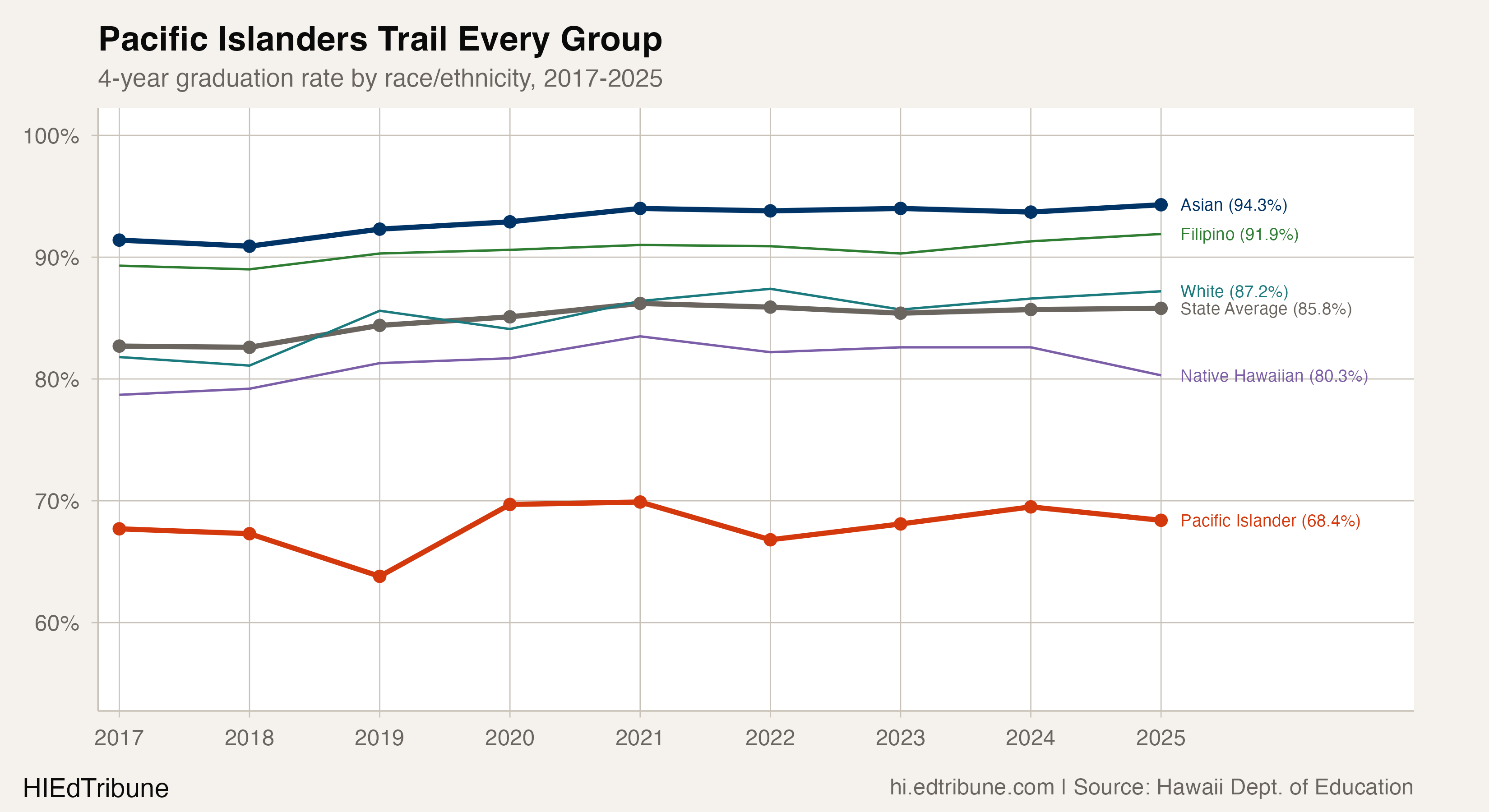
The gap has not always been this wide. In 2017, it was 23.7 points. But Asian students kept climbing, from 91.4% to 94.3%, while Pacific Islanders flatlined. In 2019, the Pacific Islander rate actually dropped to 63.8%, its lowest point on record, widening the gap with Asian students to 28.5 points before a partial recovery.
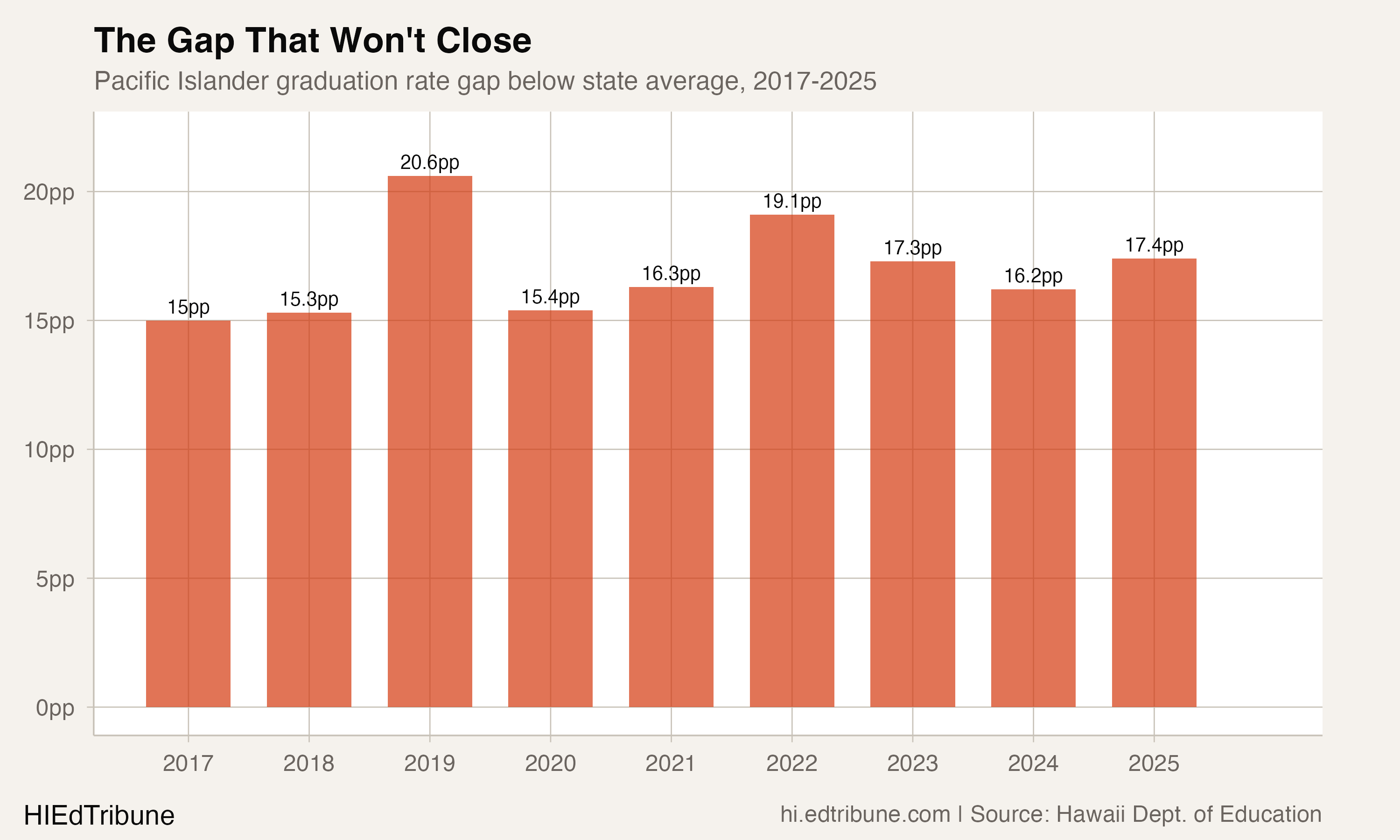
The gap between Pacific Islanders and the state average tells a similar story. At 17.4 points in 2025, it is wider than the 15-point gap in 2017. The state improved. Pacific Islanders did not keep pace.
Lower Than Students Who Are Homeless, Lower Than English Learners
For context on where 68.4% falls: students who are currently homeless in Hawaii graduate at 76.7%. English learners graduate at 71.3%. Economically disadvantaged students graduate at 80.9%. The only groups with rates near or below Pacific Islanders are students with disabilities (68.1%) and students in foster care (60.4%).
That comparison is not quite apples-to-apples, since race and service-population categories overlap. Many Pacific Islander students are also classified as economically disadvantaged or English learners. But the ordering is revealing. A student identified solely by their housing instability has a higher graduation probability than a student identified by Pacific Islander ancestry in the same school system.
Where the Floor Falls Out
The statewide 68.4% rate masks enormous variation across Hawaii's complex areas. In the Farrington-Kaiser-Kalani complex, which serves central Honolulu neighborhoods including Kalihi and Palama, the Pacific Islander graduation rate is 51.9%. Nearly half of Pacific Islander students in that complex do not finish high school on time. The overall rate in the same complex is 83.7%, a 31.8-point internal gap.
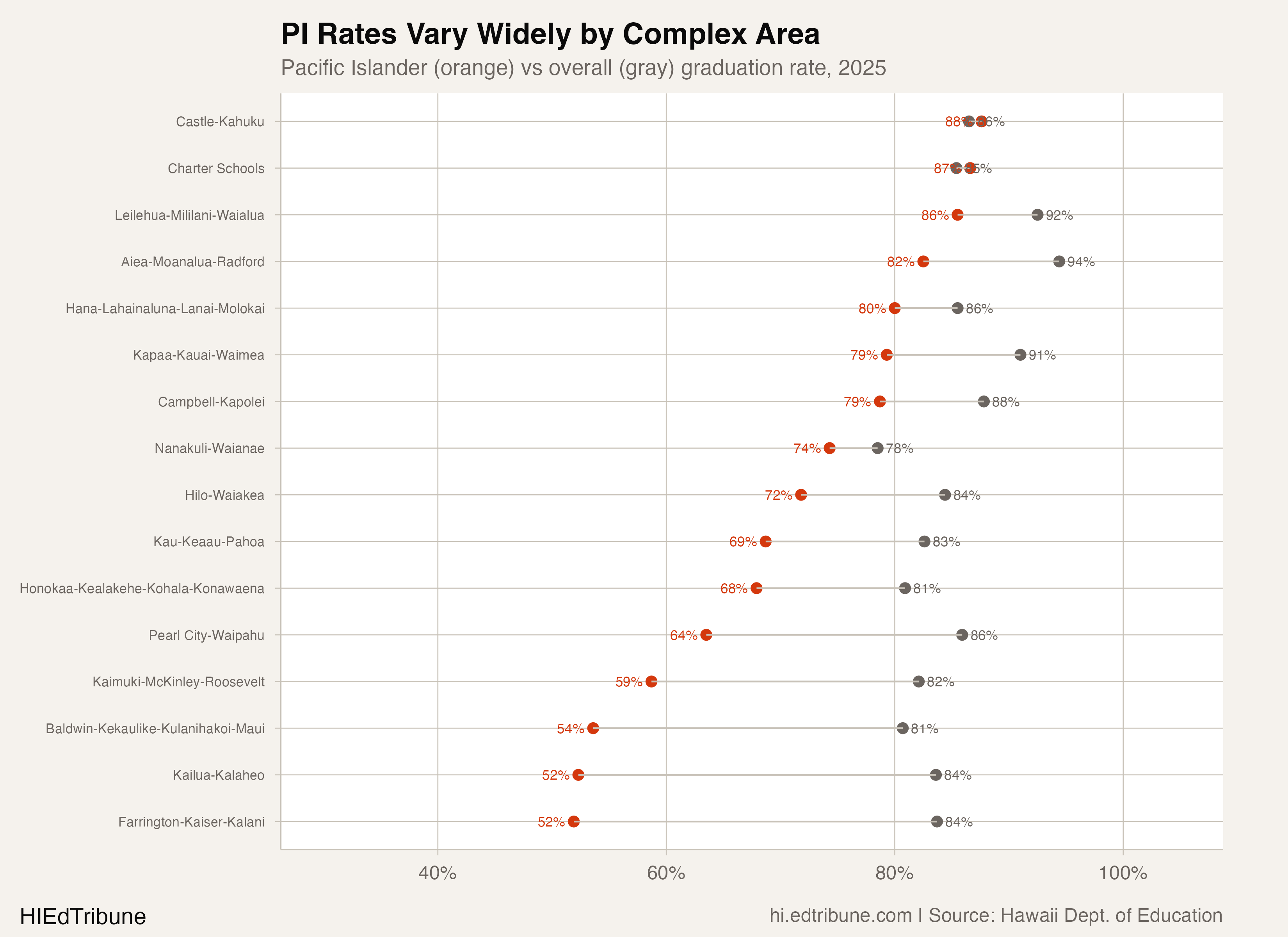
Kailua-Kalaheo is nearly as dire at 52.3%. Baldwin-Kekaulike-Kulanihakoi-Maui on the Valley Isle comes in at 53.6%. In all three complex areas, the Pacific Islander rate is more than 27 points below the complex-wide average.
At the school level, Farrington High is at 48.4% for Pacific Islanders, and it is not even the worst: McKinley High, also in the Kaimuki-McKinley-Roosevelt complex, reports 35.5%. Roughly two in three Pacific Islander students at McKinley do not graduate on time.
But the data also shows what is possible. Castle-Kahuku on windward Oahu has a Pacific Islander graduation rate of 87.6%, actually exceeding its 86.5% overall rate. Mililani, in central Oahu's more affluent suburbs, reaches 97.4% at the school level. The gap is not biological or cultural destiny. It tracks geography, poverty, and the concentration of Compact of Free Association migrants in specific Honolulu neighborhoods.
Language, Poverty, and the COFA Pipeline
The Pacific Islander category in Hawaii's data encompasses a range of communities with vastly different histories. It includes Samoan families who have been in Hawaii for generations alongside recently arrived Marshallese, Chuukese, and Palauan migrants who came under the Compact of Free Association. The COFA nations (the Federated States of Micronesia, the Republic of the Marshall Islands, and the Republic of Palau) have treaties with the United States that permit their citizens to live and work in the U.S. without a visa.
An estimated 20,000 to 30,000 COFA migrants live in Hawaii, concentrated in low-income Honolulu neighborhoods near Farrington and McKinley high schools. Many students arrive in the U.S. school system mid-adolescence, speaking Chuukese or Marshallese at home, and face the structural challenge of learning academic English before they can accumulate graduation credits.
"It's not an intelligence issue, it's a preparedness issue." -- Honolulu Civil Beat, May 2018
That quote, from McKinley High social studies chair Jonathan Loomis, captures the structural trap. Students designated as English Language Learners cannot enroll in standard credit-bearing courses until they reach academic English proficiency, a process that takes five to seven years according to research on Honolulu's Micronesian student population. Students who arrive in ninth or tenth grade face an impossible timeline: they must acquire academic English and accumulate four years of credits before aging out of the system at 18.
A 2022 analysis by Honolulu Civil Beat found that between 2013 and 2018, only about half of Micronesian students who entered ninth grade graduated four years later. The analysis framed the disparity within "a framework of systemic racism" involving discriminatory policies, stereotyping, and socioeconomic barriers working in combination.
Not Just a Language Story
The language barrier is real but not sufficient as an explanation. Native Hawaiian students, who overwhelmingly speak English as a first language, graduate at 80.3%, a rate that has itself barely improved since 2017 (78.7%, a gain of 1.6 points). Both Pacific Islander and Native Hawaiian rates have stagnated while other groups pulled away.
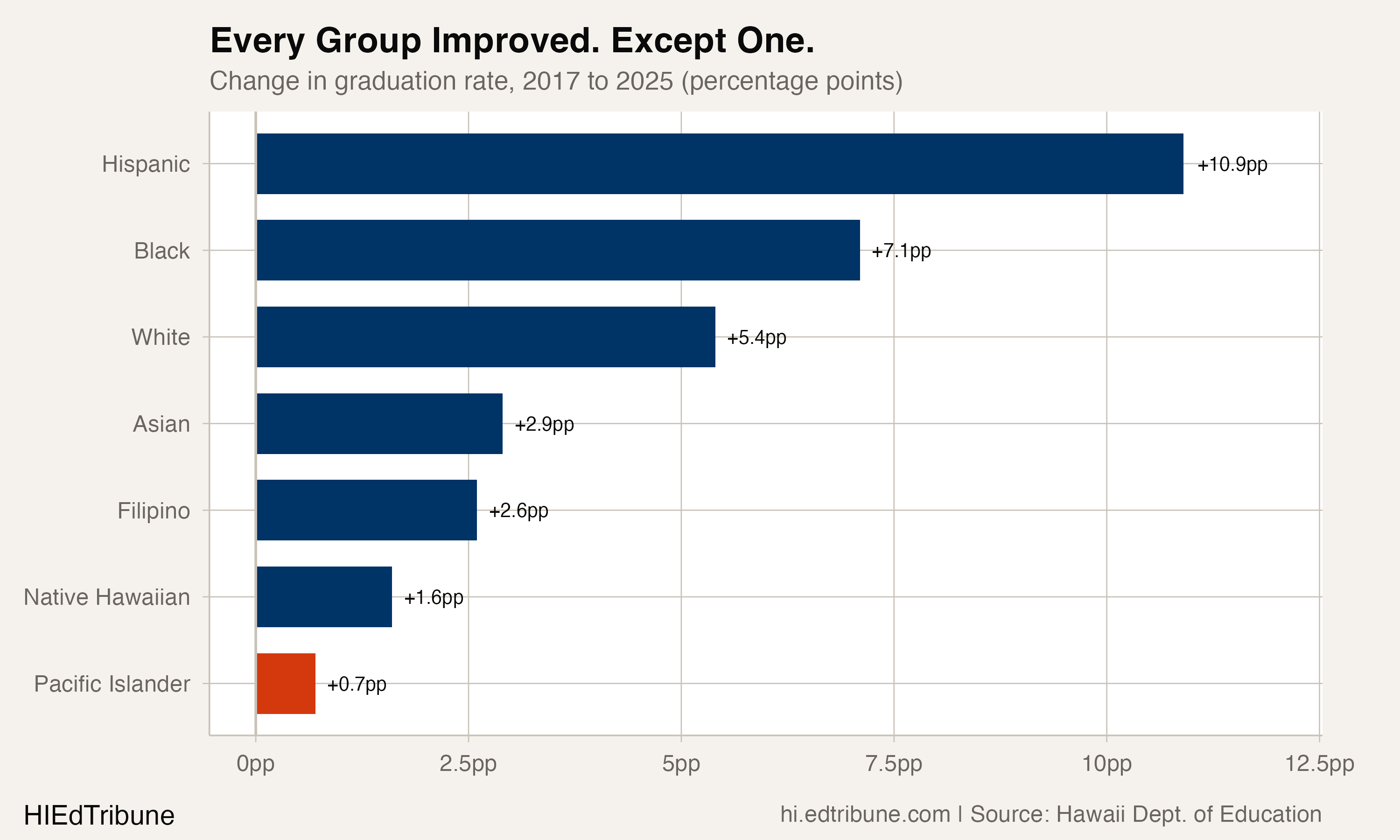
Hispanic students offer a counterpoint. In 2017, they graduated at 73.9%, only 6.2 points above Pacific Islanders. By 2025, they reached 84.8%, nearly matching the state average. Hispanic enrollment in Hawaii also includes many English learners and students in poverty, but that group's trajectory bent sharply upward while Pacific Islanders' remained flat.
What separates the two trajectories is not fully explained by available data. One possibility is that the Pacific Islander category's internal diversity, spanning long-established communities and newly arrived COFA migrants, creates a statistical tug-of-war that masks improvement among some while reflecting stagnation or decline among others. Without cohort-level demographic detail beyond race, the data cannot distinguish between these dynamics.
The 2024 COFA Renewal
One development that may gradually change conditions for COFA-community students is the March 2024 renewal of the Compacts of Free Association, which restored federal benefits, including education assistance and Medicaid, that had been stripped from COFA citizens in 1996. Hawaii had been spending $183 million annually from state funds to cover key benefits for COFA residents. The restoration of federal Medicaid eligibility alone could alleviate some of the economic pressure on COFA families, though its effects on graduation rates, if any, would take years to materialize.
Whether that policy shift translates into classroom outcomes depends on what happens inside schools. At the complex-area level, the data suggests that where Pacific Islander students attend school matters more than almost anything else. A Pacific Islander student in the Castle-Kahuku complex graduates at 87.6%. The same student in Farrington-Kaiser-Kalani graduates at 51.9%. That 36-point spread, within a single statewide district, is not a problem that federal benefits alone will solve.
The next published graduation-rate data point will be the Class of 2026. If the COFA benefit restoration and ongoing school-level interventions are having any effect, the Farrington-Kaiser-Kalani rate should begin to move. It has been between 45.7% and 54.5% for nine consecutive years. At some point, a rate that does not respond to a decade of attention stops being a gap and becomes a feature of the system.
Detailed code that reproduces the analysis and figures in this article is available exclusively to EdTribune subscribers.
Discussion
Sign in to join the discussion.
Loading comments...