Correction (July 21, 2026; audited July 22, 2026): An earlier version described Hawaii's four-year graduation rate as showing that two in five students in foster care never graduate. The data establish that 39.6% did not graduate within four years, not that they never earn a diploma. The article also incorrectly called foster care the only tracked subgroup whose rate fell from 2018 to 2025; military-connected students declined from 98.9% to 93.8% over the same period. The later audit removed an external policy detour that the graduation files could not test.
In the Kau-Keaau-Pahoa complex area, half of the students in foster care who entered high school four years ago did not graduate within four years. The overall rate there is 82.6%. For students in foster care, it is 50%.
That 32.6 percentage point gap is not the worst in the state. In Leilehua-Mililani-Waialua, 92.5% of all students graduate, while the foster care rate is 53.3%, a gap of 39.2 points. The complex area's overall rate is among the highest in Hawaii. Its foster care rate is among the lowest.
The only line going down
Statewide, Hawaii's foster care graduation rate has fallen from 76.3% in 2018 to 60.4% in 2025. That is a 15.9 percentage point decline across seven years.
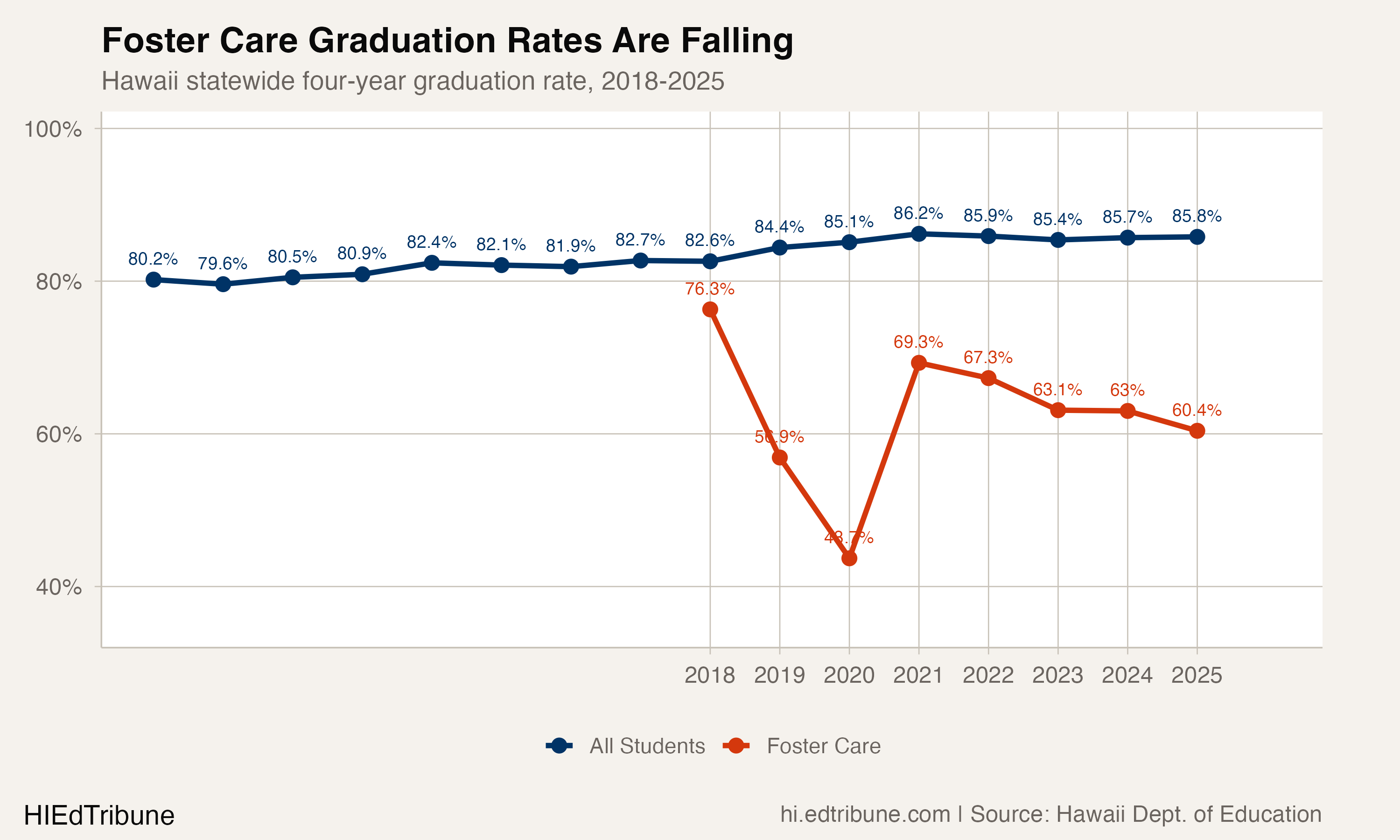
During the same period, the overall graduation rate climbed 3.2 points to 85.8%. The gap between students in foster care and their peers widened from 6.3 points in 2018 to 25.4 points in 2025. Put differently, the chasm quadrupled.
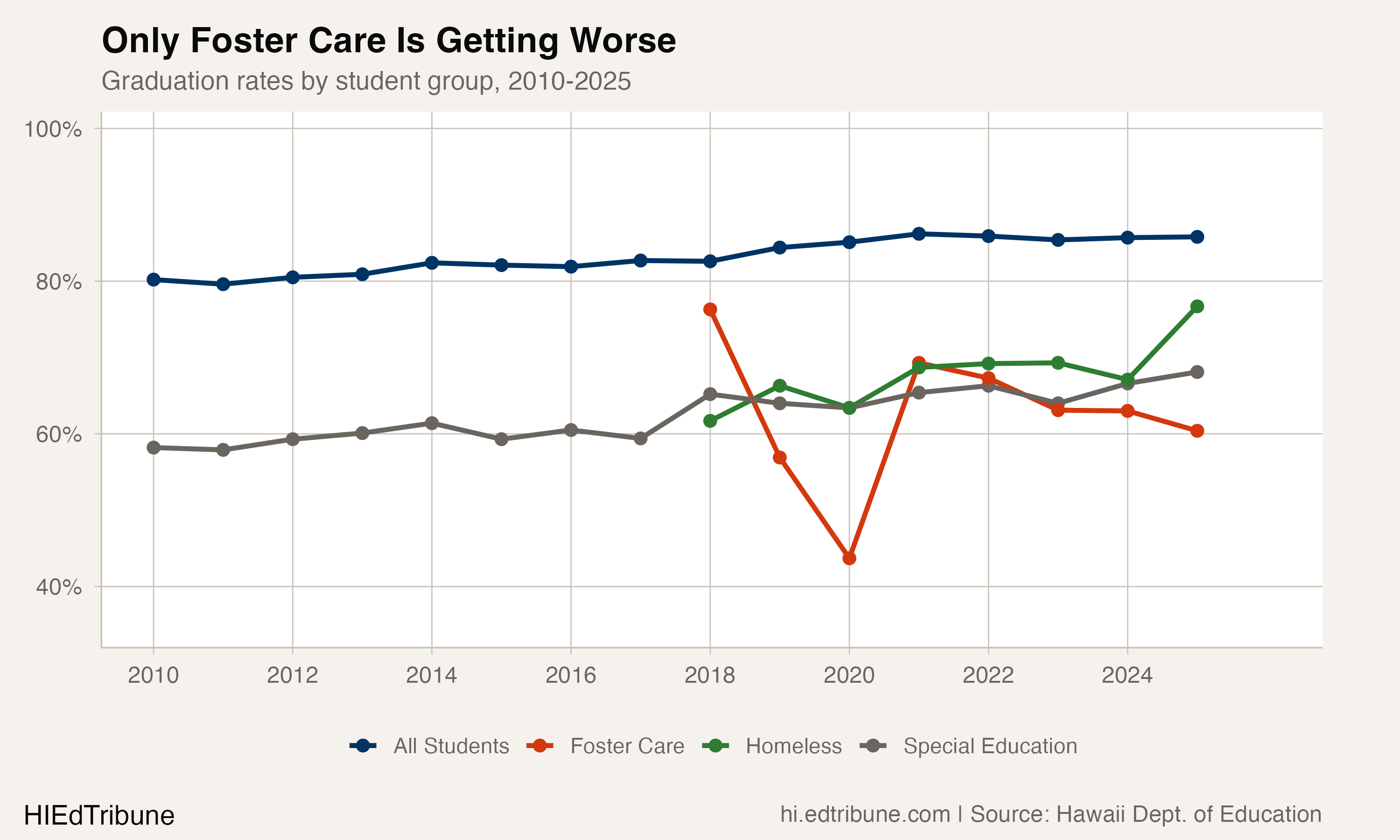
Other vulnerable groups compared here moved in the opposite direction. Students who are currently homeless gained 15.0 points over the same span, rising from 61.7% to 76.7%. Special education students gained 9.9 points since 2010. English learners gained 2.5 points from 2018 to 2025.
Across every tracked subgroup with both endpoints, however, foster care was not the only decline: military-connected students fell from 98.9% to 93.8%. Foster care's 15.9-point drop was the largest decline.
A gap unlike any other
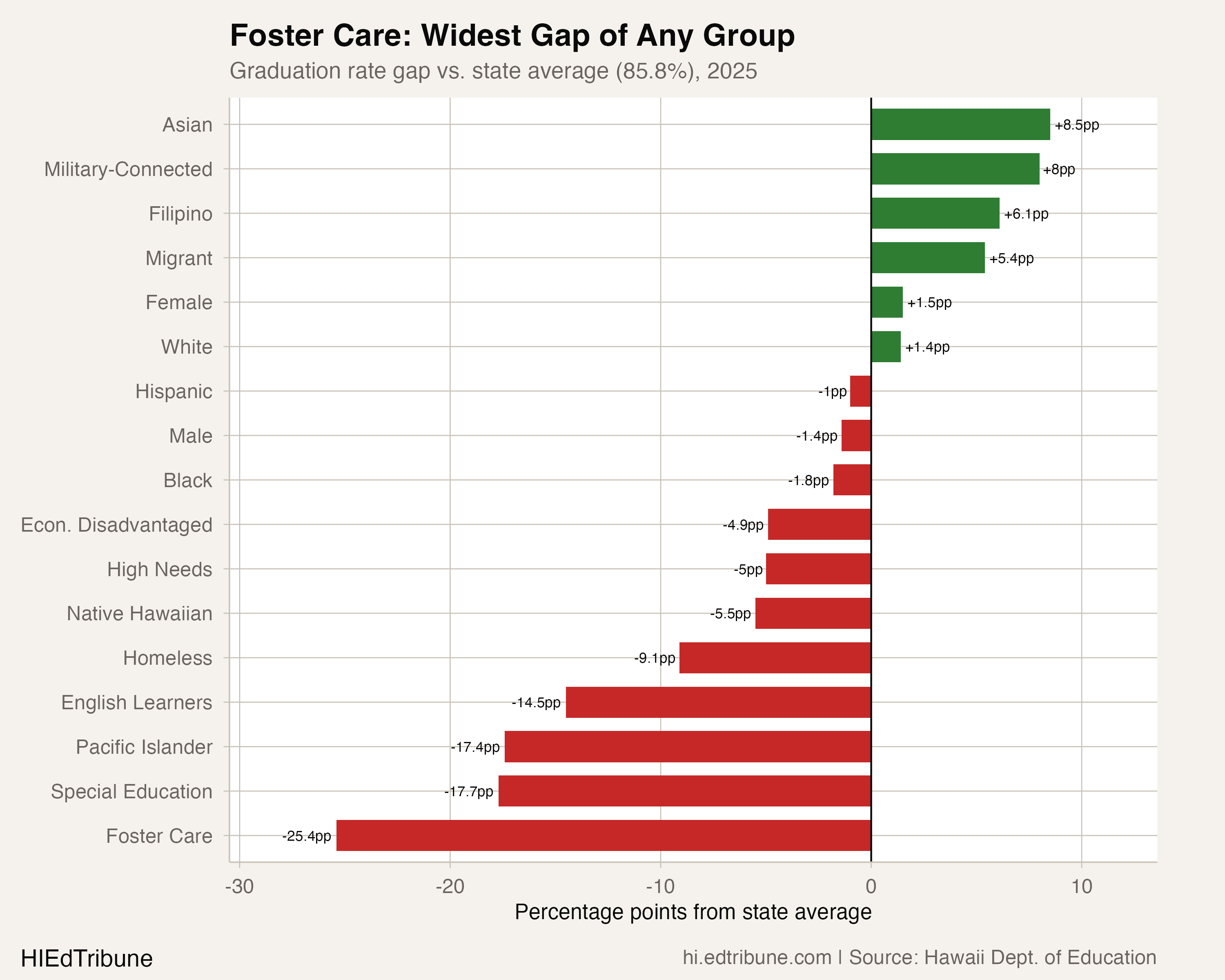
At 25.4 points below the state average, foster care produces the widest graduation gap of any subgroup Hawaii reports, wider than special education (17.7 points below), wider than Pacific Islander students (17.4 points), wider than English learners (14.5 points).
The comparison to students who are currently homeless is instructive. In 2018, students in foster care graduated at 76.3% while youth who were homeless trailed at 61.7%. By 2025, students who are currently homeless had climbed to 76.7% while students in foster care fell to 60.4%. The group that was 14.6 points ahead is now 16.3 points behind. The graduation dataset shows the divergence but does not identify its cause.
Six of nine complex areas below 60%
Only nine of Hawaii's 16 complex areas reported enough students in foster care for the state to publish a graduation rate in 2025. In six of those nine, fewer than 60% of students in foster care graduated.
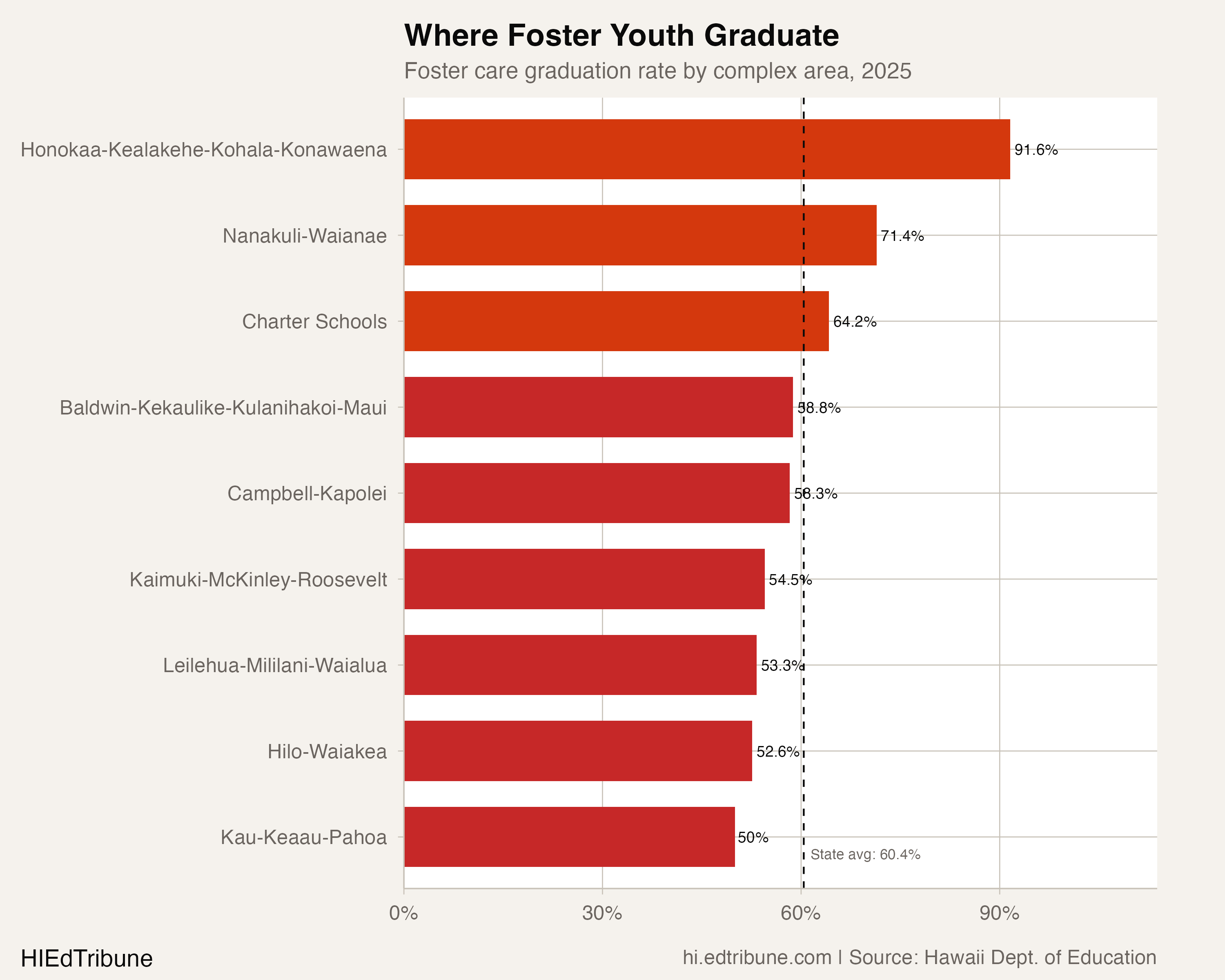
Kau-Keaau-Pahoa posted 50.0%. Hilo-Waiakea was close behind at 52.6%. Leilehua-Mililani-Waialua posted 53.3%, Kaimuki-McKinley-Roosevelt 54.5%, Campbell-Kapolei 58.3%, and Baldwin-Kekaulike-Kulanihakoi-Maui 58.8%.
The one outlier, Honokaa-Kealakehe-Kohala-Konawaena, posted 91.6%. Its reported foster care rate moved from 50.0% in 2023 to 61.9% in 2024 to 91.6% in 2025. The package does not include cohort counts for these area rates, so the single-year estimates should be read with caution.
A volatile reported rate
The year-over-year data reveals how volatile the reported rate is. Foster care graduation rates dropped 19.4 points between 2018 and 2019, then fell another 13.2 points to a nadir of 43.7% in 2020. The overall rate that year was 85.1%.
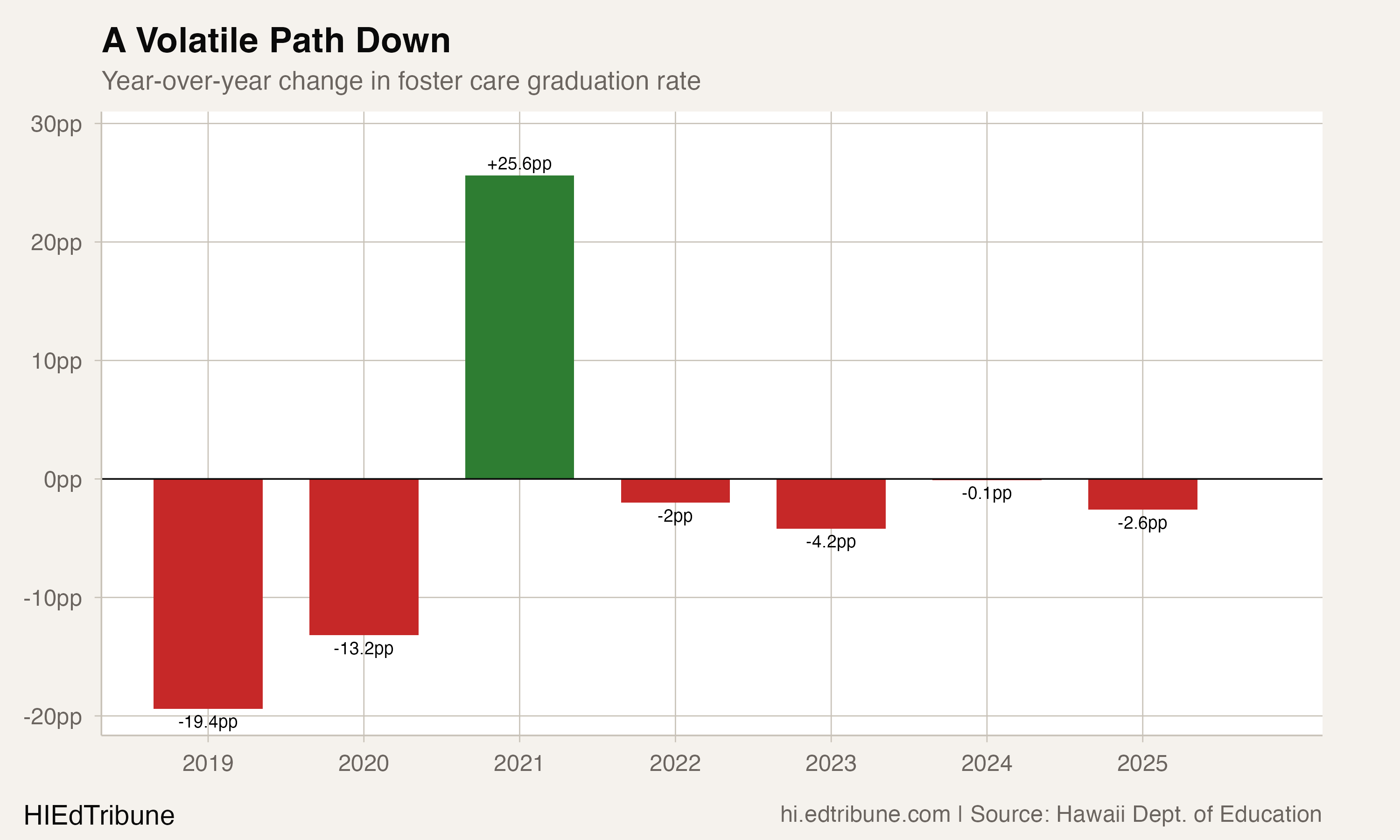
A partial rebound to 69.3% arrived in 2021, but it stalled. Since then, the rate has declined each year: 67.3% in 2022, 63.1% in 2023, 63.0% in 2024, 60.4% in 2025. The outcome data show the pattern but do not explain it.
Reporting limits
Seven of Hawaii's 16 complex areas did not report a foster care graduation rate in 2025. The statewide rate of 60.4% obscures substantial variation among reporting areas: from 50.0% in Kau-Keaau-Pahoa to 91.6% in Honokaa-Kealakehe-Kohala-Konawaena. Without cohort counts in the package, the rates cannot be converted into numbers of individual students.
What is clear is directionality. The foster care graduation rate has declined in four of the last five years. The gap to the state average has widened every year since 2021. Among the other vulnerable groups compared here, the reported rates for students who were homeless, students in special education, and English learners all improved across their stated spans. Foster care moved the other way.
Detailed code that reproduces the analysis and figures in this article is available exclusively to EdTribune subscribers.
Discussion
Sign in to join the discussion.
Loading comments...