Correction (September 30, 2026): An earlier version said chronic absenteeism in Hawaii rose from 14% of students in 2019 to 34% in 2022 and declined to 25% in 2024, still above pre-pandemic levels, citing a Civil Beat article that does not report the 2019 or 2024 figures. Hawaii also changed how it counts chronic absence in 2023-24, from students absent 15 or more days to students absent 18 or more days, so rates from before and after that change are not directly comparable. The passage now uses the state's own figures from before the change. The enrollment findings are unchanged.
In this series: Hawaii 2025-26 Enrollment.
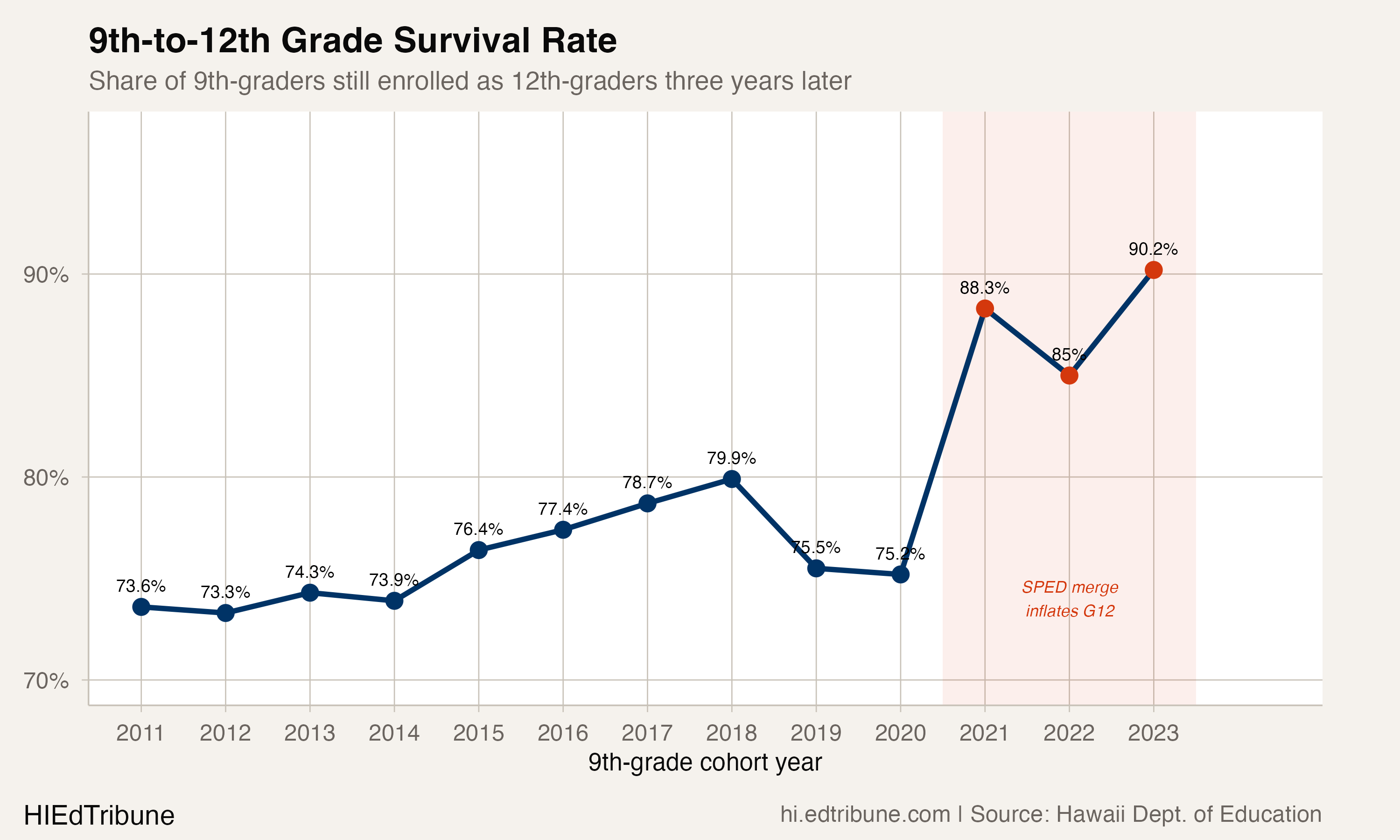
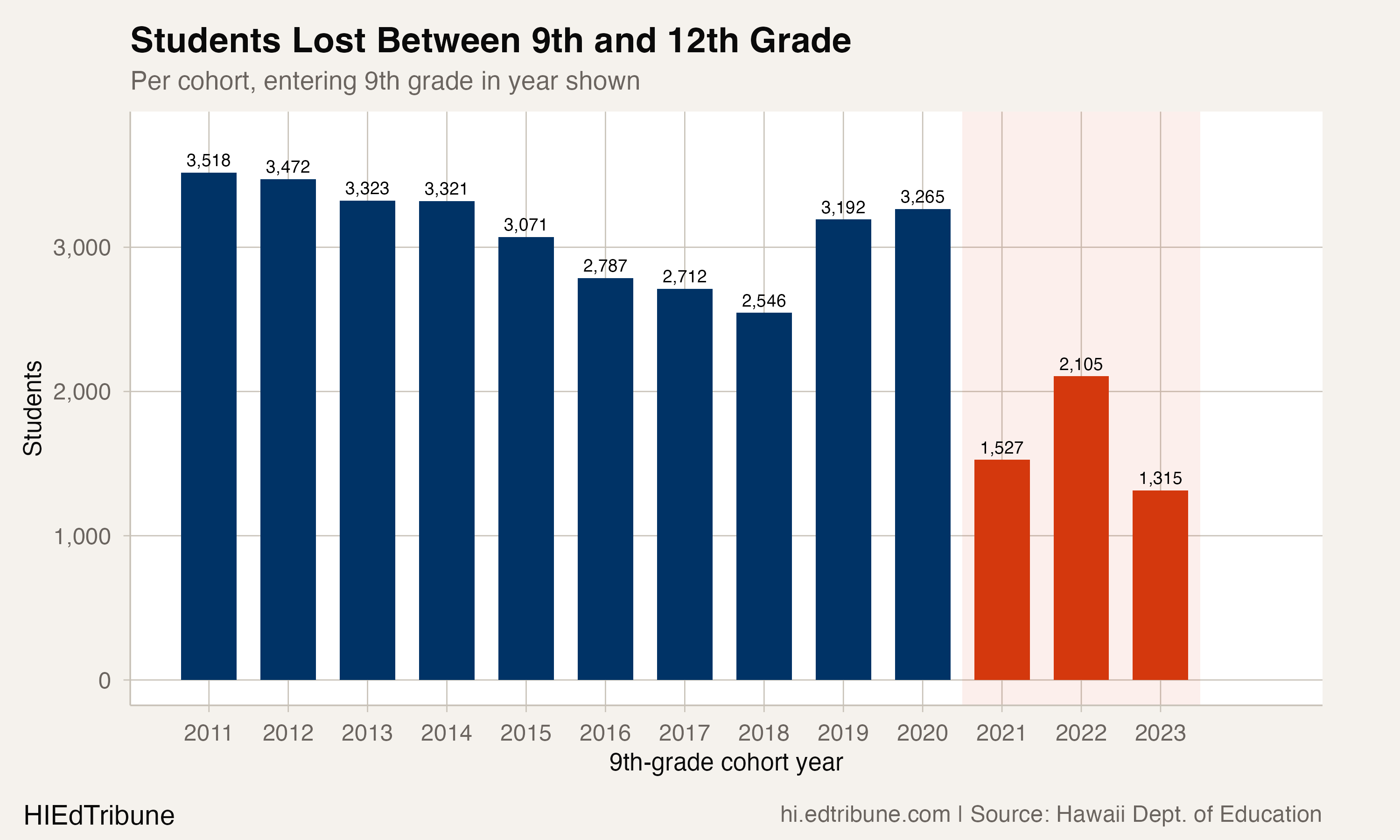
Hawaii's senior class of 2026 is 90.2% the size of the ninth-grade class that entered in 2023. That survival rate is the highest on record, a 16.6 percentage-point jump from the 73.6% rate for the cohort that entered ninth grade in 2011. If taken at face value, it would mean Hawaii had nearly eliminated the high school attrition problem that once cost the system as many as 3,518 students per cohort.
It should not be taken at face value. In 2024, Hawaii's Department of Education stopped counting approximately 18,000 students who receive special education in a separate grade category and folded them into regular grade-level enrollment. That reclassification inflated 12th-grade counts by 16.8% in a single year, artificially boosting the survival rate for every cohort exiting after 2023. The pre-reclassification survival rate peaked at 79.9% for the 2018 cohort. The real improvement, from the 2011 cohort to the 2018 cohort, was 6.3 percentage points, not 16.6.
Two eras, one chart
The survival rate measures something straightforward: how many students who enter ninth grade in a given year are still enrolled as 12th-graders three years later. It does not track individual students. It cannot distinguish between a student who dropped out and one who transferred to private school or left the state. But as a cohort-level metric, it captures the net retention of the high school pipeline.
From 2011 through 2020, that metric moved slowly. The 2011 cohort survival rate was 73.6%. The 2012 cohort was 73.3%. Rates gradually climbed through the mid-2010s, reaching a pre-reclassification peak of 79.9% for the 2018 cohort before falling back to 75.5% (2019) and 75.2% (2020). Across a full decade, the net improvement was 1.6 percentage points.
Then the SPED reclassification hit. The 2021 cohort, whose seniors were the first to be counted under the new method in 2024, posted an 88.3% survival rate. The 2022 cohort came in at 85.0%. The 2023 cohort reached 90.2%. These post-reclassification rates are not comparable to the pre-reclassification era. They measure a different population.
What the reclassification did
Through 2023, Hawaii reported roughly 18,000 students in a grade category labeled "SPED." These students received special education services but were not assigned to individual grade levels in enrollment reporting. In 2024, the state eliminated the SPED category entirely and distributed those students across their actual grade levels.
The effect on 12th-grade enrollment was immediate: it jumped from 9,876 in 2023 to 11,538 in 2024, a 16.8% increase that had nothing to do with more students staying in school. When the survival rate calculation divides 12th-grade enrollment by the same cohort's ninth-grade enrollment from three years earlier, the denominator (ninth-grade counts, which never included the SPED category before 2024) stays the same while the numerator (12th-grade counts, now including those students) jumps. The result is an artificial spike.
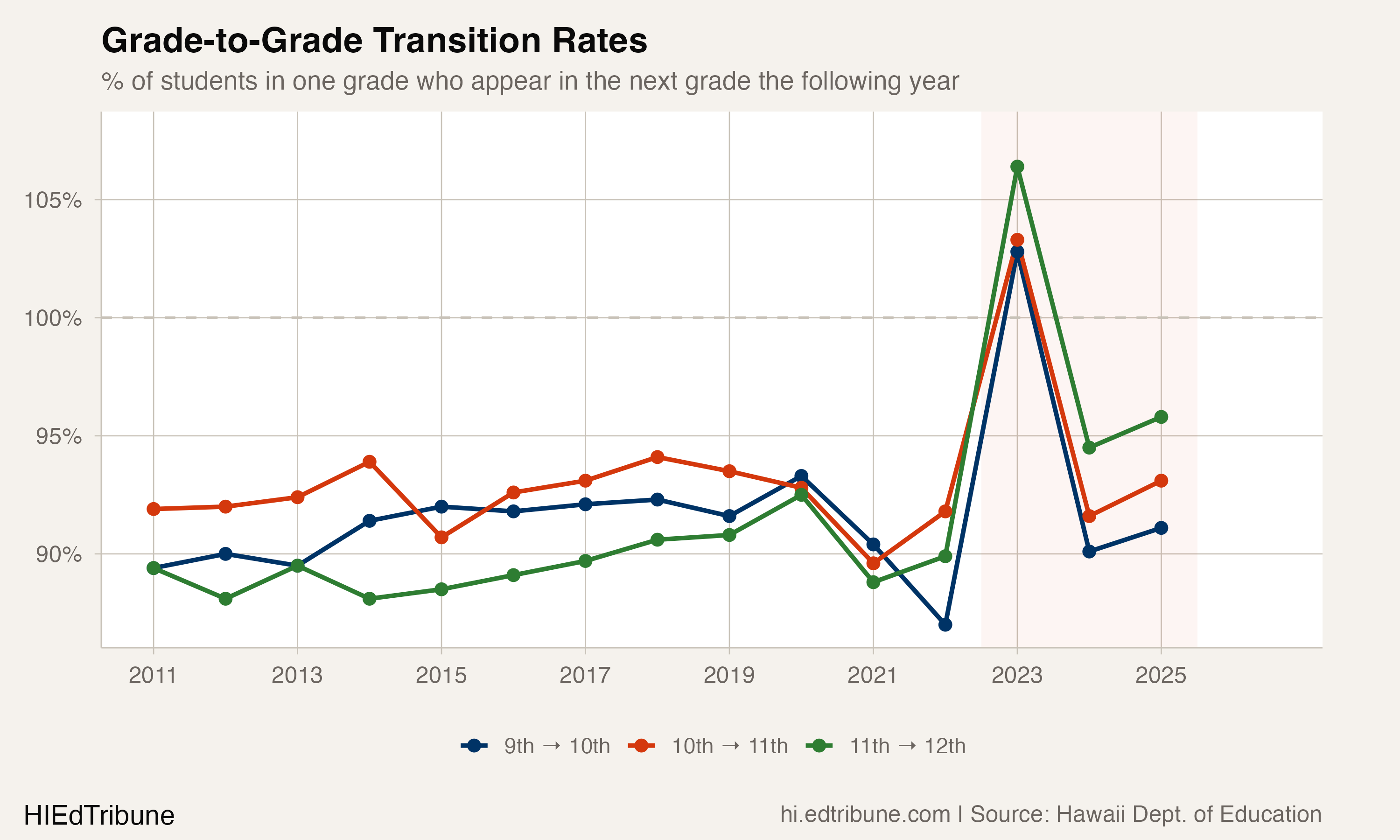
The grade-to-grade transition rates make the break unmistakable. In the 2023-to-2024 transition, when the SPED merge took effect, the 11th-to-12th rate hit 106.4%, meaning 12th-grade enrollment in 2024 exceeded 11th-grade enrollment in 2023 by 6.4%. The 10th-to-11th rate was 103.3%, and the 9th-to-10th rate was 102.8%. A grade that grows larger than the grade below it was a year earlier is a mathematical signature of students being added to grade-level counts through reclassification, not through retention.
The improvement that is real
Strip away the reclassification effect and the pre-merge era still tells a story worth examining. Between the 2011 and 2018 cohorts, the survival rate climbed 6.3 percentage points, from 73.6% to 79.9%. That improvement corresponded to roughly 970 fewer students lost per cohort: the 2011 cohort lost 3,518 between ninth and 12th grade, while the 2018 cohort lost 2,546.
Several factors plausibly contributed. Hawaii's official graduation rate reached a record-tying 86% for the class of 2024, suggesting that the system has gotten better at moving students through to completion. The Harvard/Stanford Education Recovery Scorecard ranked Hawaii fourth nationally in math recovery and second in reading recovery since the pandemic, evidence that the state's academic supports have been comparatively effective.
But the improvement was not sustained even within the clean data era. The 2019 and 2020 cohorts, which entered ninth grade just before and during the pandemic, posted survival rates of 75.5% and 75.2%, erasing most of the gains made between 2011 and 2018. The pandemic's disruption to student engagement is one plausible explanation.
Attendance moved sharply in those years. Under the state's older measure, which counted students absent 15 or more days, chronic absence rose from 15% of Hawaii students in 2018-19 to 37% in 2021-22. The state changed that measure in 2023-24 and now counts students absent 18 or more days, so later rates cannot be set directly against those earlier ones.
A shrinking pipeline feeds the paradox
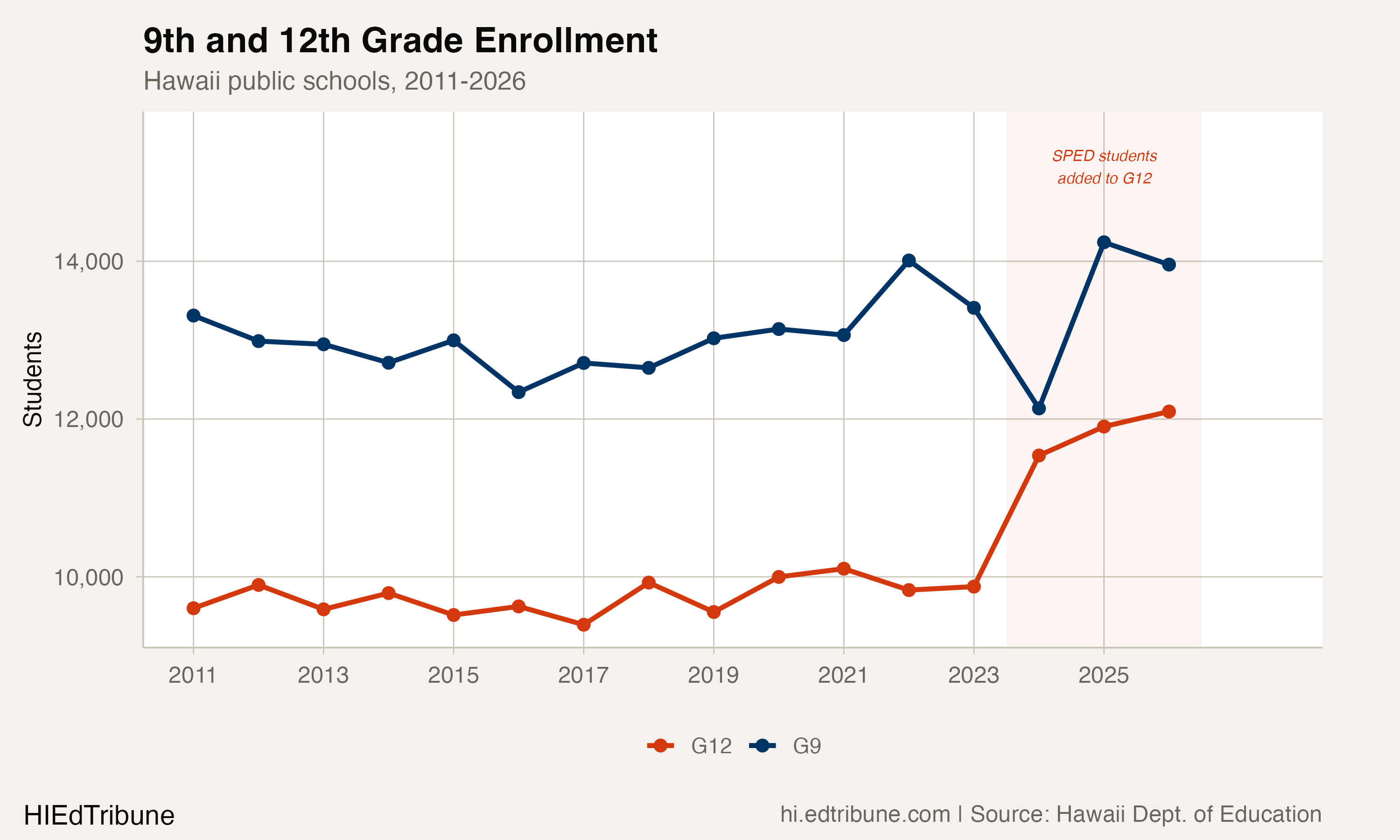
The survival rate creates a paradox in Hawaii's current enrollment environment. Even as the rate appears to improve, the absolute number of 12th-graders will soon decline because the ninth-grade classes feeding the pipeline are getting smaller.
Ninth-grade enrollment has been relatively flat over the 16-year dataset, ranging from 12,135 to 14,241, but that stability masks a structural shift.
The cohorts now entering ninth grade were born during a period of accelerating birth rate decline. Hawaii recorded 15,570 births in 2022, the fewest in 21 years, and preliminary 2024 data shows 14,964. Those children will not reach ninth grade until the early 2030s.
The Western Interstate Commission for Higher Education projects that Hawaii will see the steepest decline in high school graduates of any state in the nation: a 33% drop between 2023 and 2041, from roughly 11,500 graduates to just over 7,600. The national projection is a 10% decline. In other words, even if every ninth-grader stayed through senior year, Hawaii would still have fewer seniors in 2041 than it does today.
What a real survival rate would require
The meaningful question is not whether the survival rate has reached 90.2%. It has not, in any clean comparison. The meaningful question is whether Hawaii can sustain and extend the modest pre-pandemic improvement that moved the rate from 73.6% to 79.9%.
Answering that question requires the DOE to publish grade-level enrollment data that accounts for the SPED reclassification, either by restating prior years to place students who receive special education in individual grades or by providing a consistent time series that researchers can compare across the 2023-2024 boundary. Without that, any trend analysis spanning the break will produce misleading results.
The 2018 cohort's 79.9% survival rate, achieved without the SPED inflation, represents a genuine 6.3 percentage-point improvement over seven years. That is a meaningful gain. Roughly 970 more students per cohort stayed through to their senior year compared to the 2011 baseline. Whether the pandemic reversed that gain or merely interrupted it will not become clear until the 2024 and 2025 cohorts (entering ninth grade post-pandemic, exiting twelfth grade in 2027 and 2028) complete the pipeline. Those classes will be the first post-pandemic cohorts with clean, post-reclassification data on both ends.
Detailed code that reproduces the analysis and figures in this article is available exclusively to EdTribune subscribers.
Discussion
Sign in to join the discussion.
Loading comments...