In this series: Hawaii 2025-26 Enrollment.
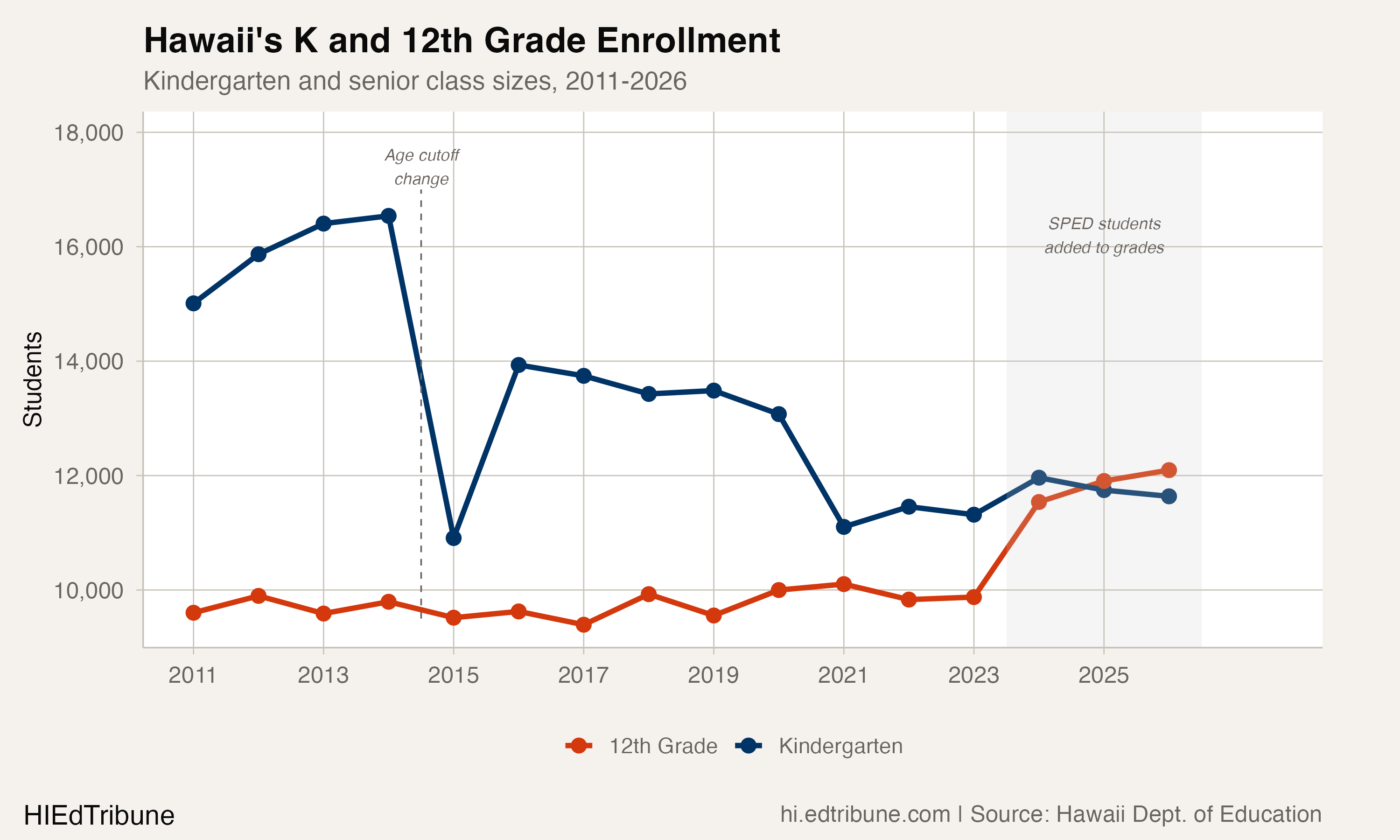
Last year, Hawaii crossed a threshold: for the first time on record, public schools enrolled more 12th-graders than kindergartners. The gap was 159 students, narrow enough to look like a statistical blip. It was not. In 2025-26, the gap nearly tripled to 458, with 11,637 kindergartners and 12,095 seniors. The K-to-G12 ratio fell from 98.7 to 96.2, confirming that the inversion is not a one-year anomaly but a structural feature of Hawaii's public school system.
The ratio measures the balance between the system's entrance and exit. When it sits above 100, more students are entering than leaving. When it falls below 100, the pipeline is contracting from the bottom. Hawaii's ratio stood at 156 as recently as 2011, meaning the state enrolled roughly three kindergartners for every two seniors. Today that relationship has reversed.
A decade of convergence
The ratio's decline has two distinct chapters. Between 2014 and 2015, it dropped 54 points in a single year, from 168.9 to 114.6. That collapse was the immediate effect of Act 76, a 2012 law that moved Hawaii's kindergarten entry cutoff from December 31 to July 31. The first year under the new cutoff, roughly 5,800 children were barred from entering public kindergarten, and enrollment fell from 16,539 to 10,908. Ninety-five kindergarten teachers were reassigned.
The ratio partially recovered in 2016 and 2017 as the one-time gap resolved, climbing back to 146.3. But it never returned to pre-Act 76 levels. The second chapter has been a steady grind downward, driven not by policy but by demography. Since 2017, kindergarten enrollment has fallen from 13,743 to 11,637, a 15.3% decline. Over the same period, 12th-grade classes grew as the larger pre-cutoff cohorts moved through the system.
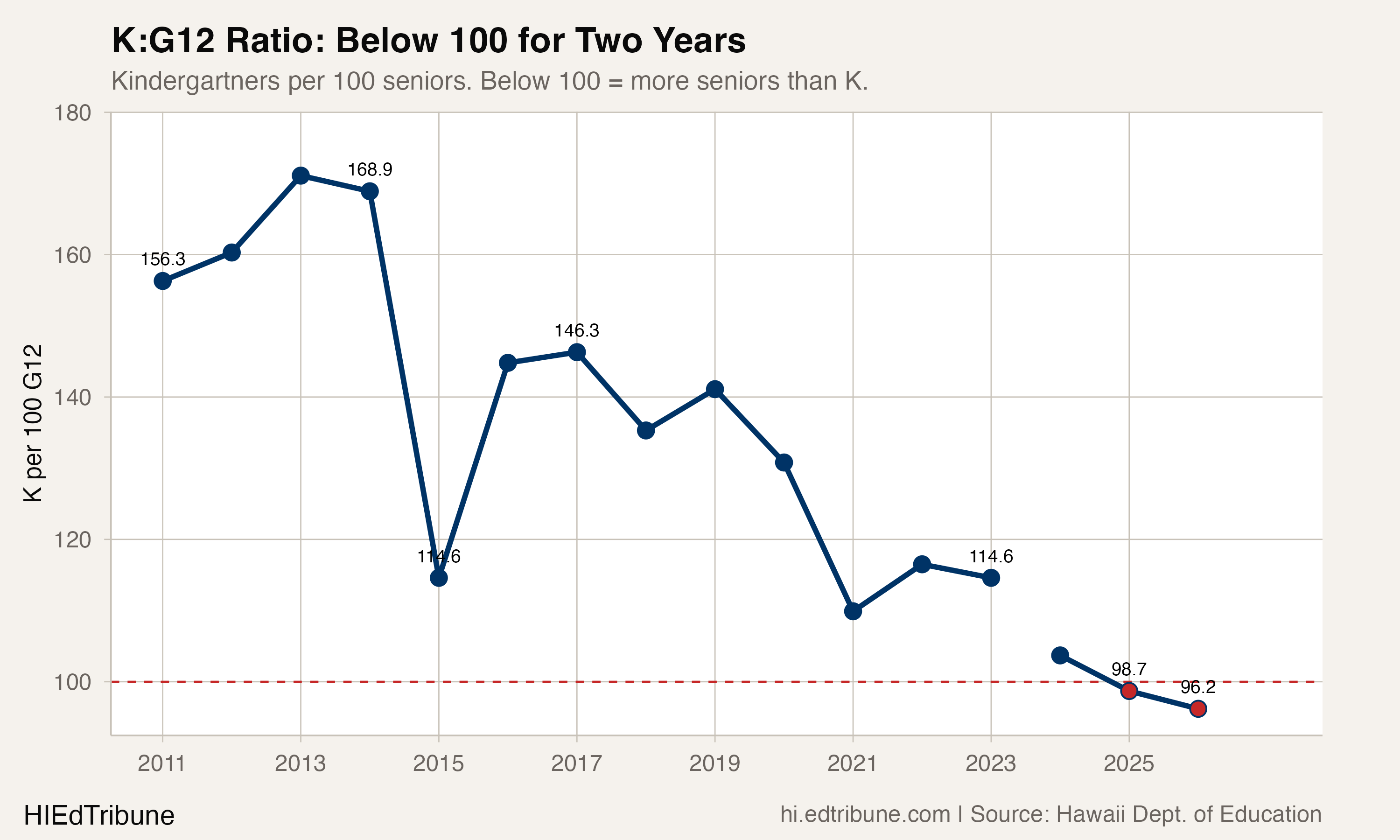
One caveat is essential for interpreting the ratio's fall below 100. Through 2023, Hawaii reported approximately 18,000 special education students in a separate "SPED" grade category rather than distributing them across individual grades. In 2024, those students were folded into regular grade counts. This reclassification inflated 12th-grade enrollment by roughly 16.8% across the 2023-to-2024 boundary. The pre-SPED-merge ratio in 2023 was 114.6, suggesting the "clean" ratio would still be well above 100 without the reclassification. The inversion trend is real, but the timing of the crossover below 100 was accelerated by the reporting change.
The pipeline that kindergarten built
What kindergarten enrollment looks like today is what total enrollment will look like in 12 years. Every grade from first through 10th currently enrolls more students than kindergarten. Only 11th grade, at 10,179, is smaller.
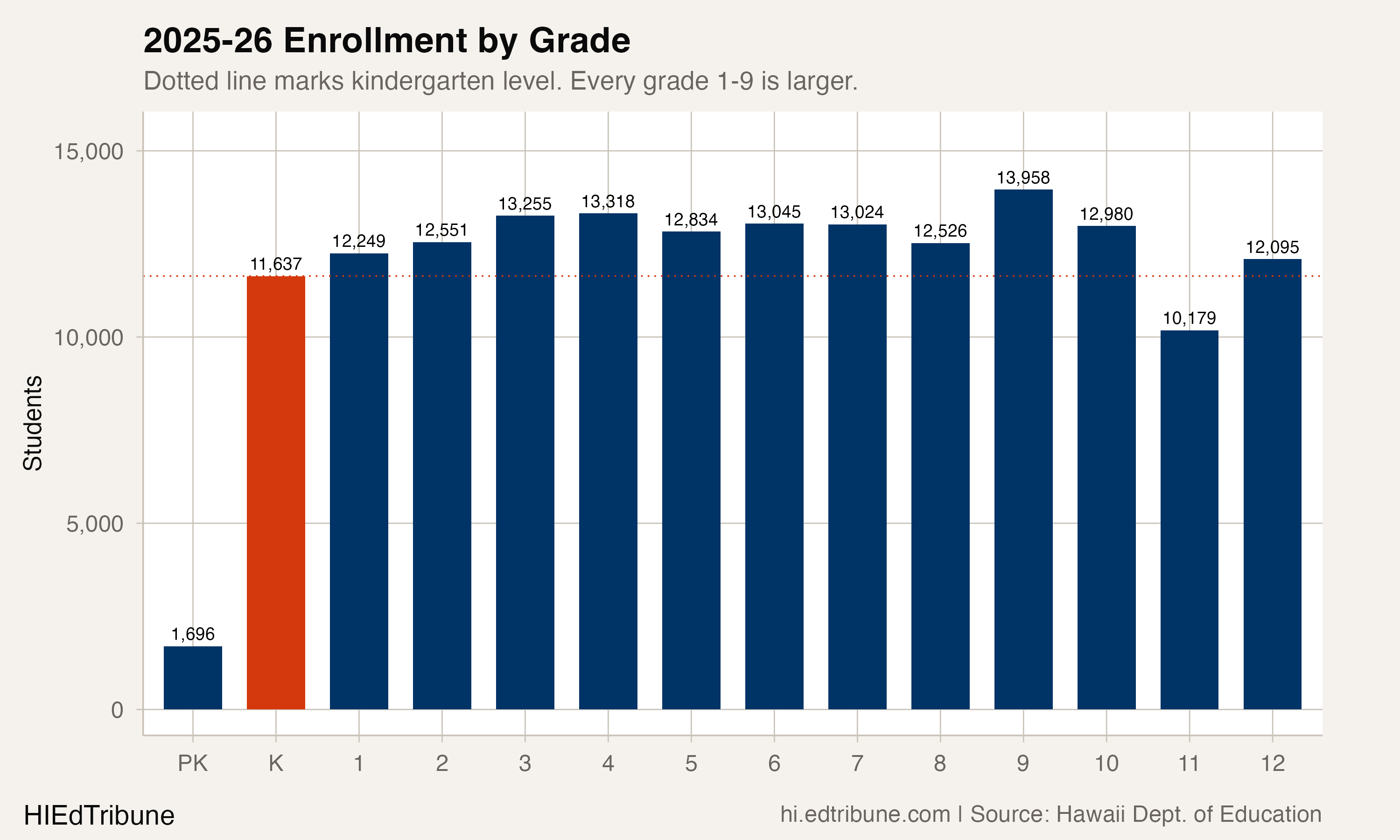
The shape of this grade profile carries a mechanical consequence. Fourth grade (13,318 students) will become 12th grade in eight years. When it does, its replacement kindergarten class will likely be smaller than today's 11,637, because Hawaii's annual births continue to fall. The state recorded 15,570 births in 2022, the fewest in 21 years, and preliminary 2024 data shows 14,964 births. Those children will not reach kindergarten until 2029 and 2030.
The birth-rate decline compounds the age-cutoff effect. Post-Act 76 kindergarten enrollment peaked at 13,933 in 2016 and has fallen in seven of the 10 years since, settling near 11,600. That level represents the new baseline. Unless birth rates reverse or families begin migrating to Hawaii in significant numbers, kindergarten enrollment has no demographic path back to 13,000.
Two cohorts tell the story
The class of 2026 entered kindergarten in 2014, the last year before the age cutoff change took effect. That cohort started with 16,539 kindergartners, and the 2025-26 enrollment file counts 12,095 12th-graders, a 26.9% attrition rate across 13 years. The class that entered kindergarten in 2016, the first full post-cutoff cohort, started with 13,933 students and is now in 10th grade with 12,980. Tracking these two cohorts side by side illustrates the permanent size reduction the cutoff imposed on every class that followed.
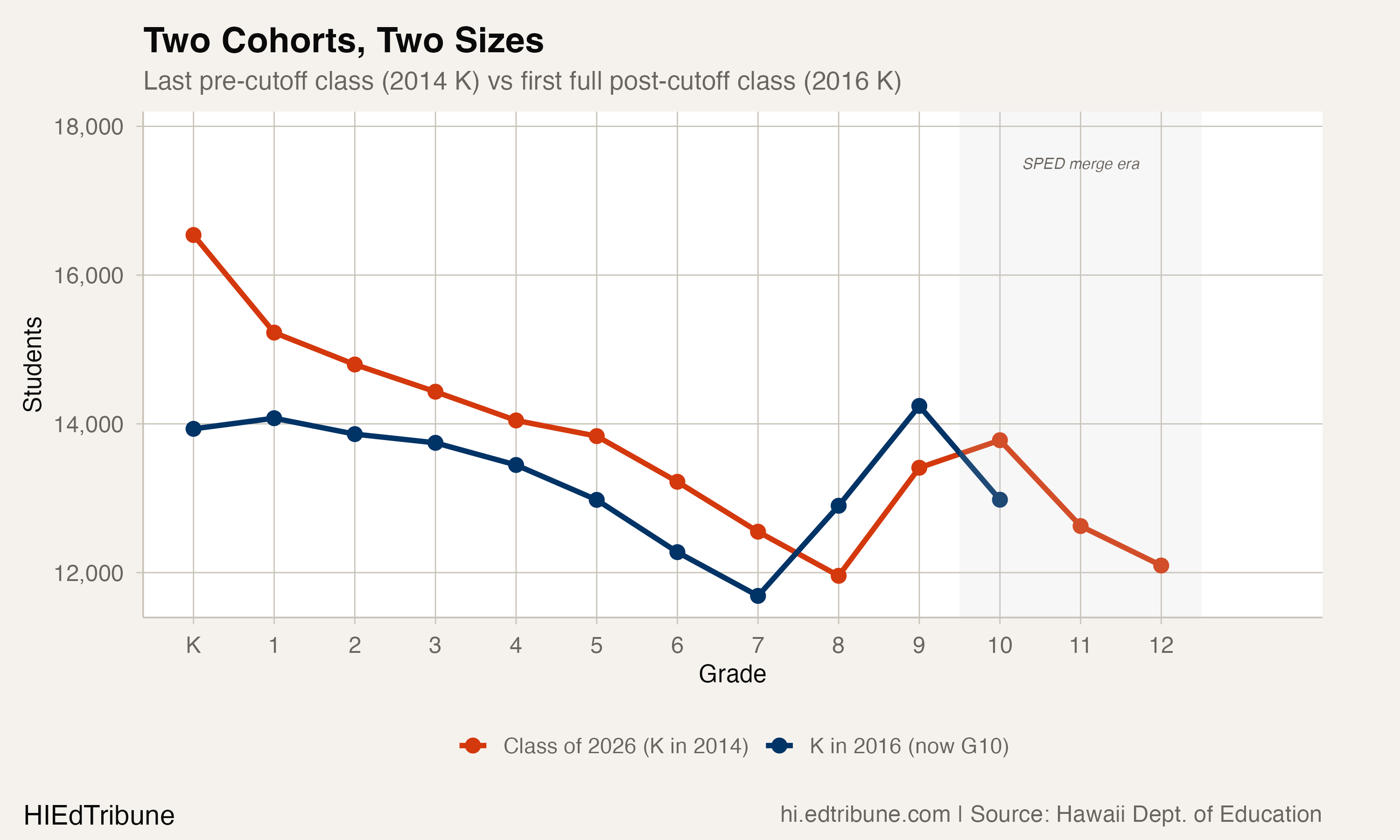
The pre-cutoff cohorts are large enough to produce senior classes above 12,000 for at least the next year or two. After that, the smaller post-cutoff cohorts will begin graduating, and 12th-grade enrollment will fall. At that point, both ends of the pipeline will be contracting simultaneously.
What the projections say
The Western Interstate Commission for Higher Education projects that Hawaii will see the steepest decline in high school graduates of any state in the nation: a 33% drop between 2023 and 2041, from roughly 11,500 to just over 7,600. The national projection is a 10% decline. Hawaii's outlier status reflects the compounding of its birth rate decline, outmigration, and the permanent reduction in cohort sizes from the 2014 cutoff change.
The Department of Education has already begun preparing for this reality. Thirty-four schools currently enroll fewer than 250 students, the estimated minimum for adequate funding. Rather than closing schools, the DOE has shifted to a "district optimization" strategy, redrawing attendance boundaries for the 2026-27 school year and deferring consolidation decisions until at least spring 2028. The approach reflects political reality: no Hawaii public school has been closed since Queen Liliuokalani Elementary in 2011.
"People are used to what they have. Change is hard." Wes Lo, Board of Education member, Honolulu Civil Beat, Sept. 2025
The birth rate arithmetic behind the K-to-G12 ratio is indifferent to how difficult change is. If kindergarten enrollment continues near 11,600 and the post-cutoff cohorts begin graduating at roughly that same level, the ratio will stabilize near 100. But total enrollment will still decline, because each new kindergarten class is smaller than the grade it replaces. Hawaii's public school system enrolled 163,651 students in 2025-26, down 12.4% from its 2014 peak. By the time the children born in 2024 reach kindergarten, the WICHE projections suggest total enrollment could be well below 150,000.
Board of Education member Wes Lo put it plainly last fall: "People are used to what they have. Change is hard." The children born in 2024 (Hawaii's smallest birth cohort in a generation) will enter kindergarten in 2029. They will be fewer than the seniors they replace. The pipeline inversion is not a forecast. It is arithmetic, already locked in by births that have already happened and families that have already left.
Detailed code that reproduces the analysis and figures in this article is available exclusively to EdTribune subscribers.
Discussion
Sign in to join the discussion.
Loading comments...