In 2024-25, Hawaii's public schools enrolled 14,241 ninth graders. The year before, those same schools had 12,899 eighth graders. That is 1,342 more students than the cohort that should have fed into the grade, a 10.4% surge that appeared without any new school opening, any boundary change, or any obvious explanation in the enrollment data itself.
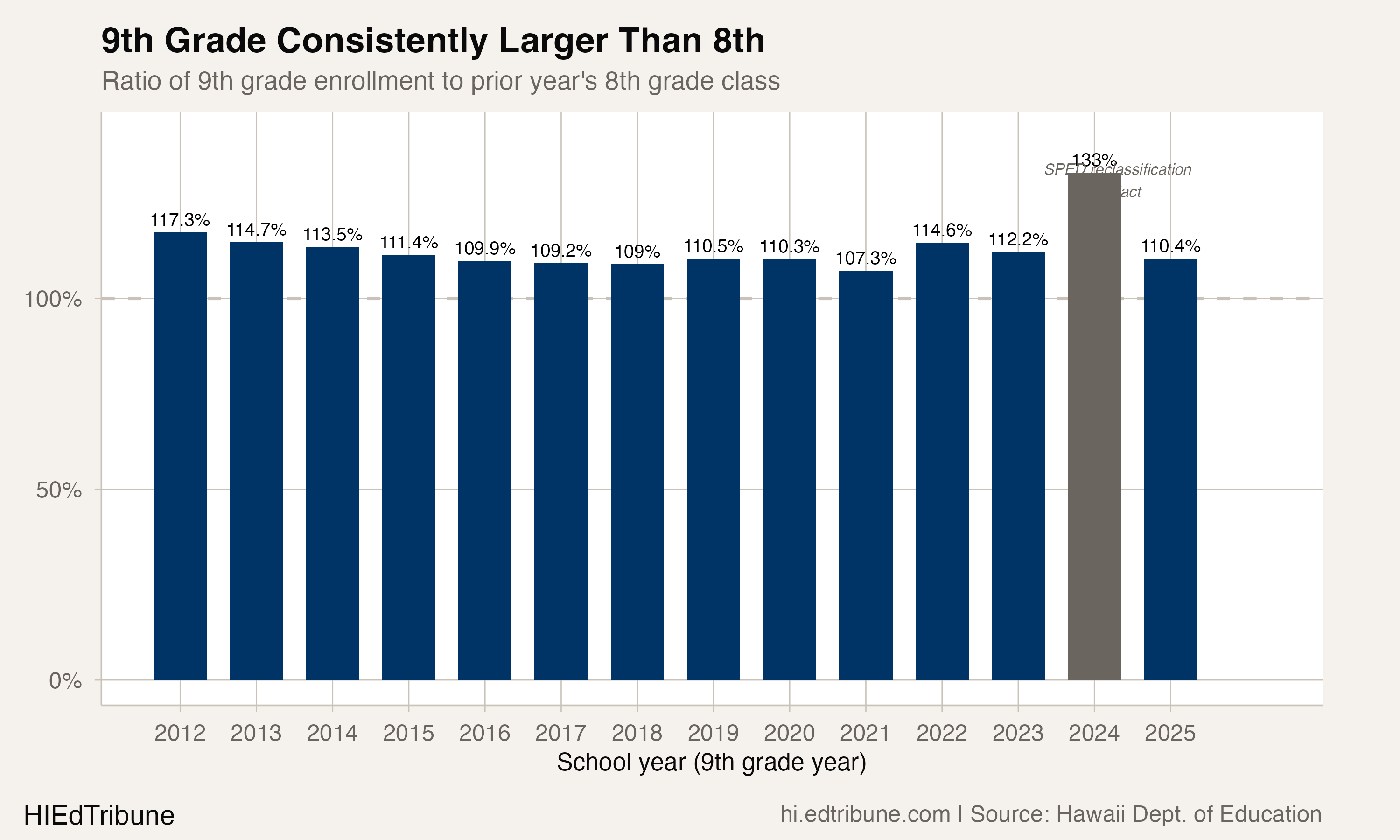
This is not a one-year anomaly. Over 13 measured transitions from 2011 to 2024 (excluding one year distorted by a reporting change), Hawaii's 9th grade class has exceeded the prior year's 8th grade class every single time. The mean ratio is 111.6%, and it has never fallen below 107%. In the average year, roughly 1,350 students materialize in public high schools who were not in public middle schools the year before.
Where 1,350 students come from
The most likely source is Hawaii's private school sector, the largest in the nation by enrollment share. Nearly 17% of the state's K-12 students attend private schools, roughly double the national average of 9-10%. According to NCES data, approximately 39,480 students were enrolled in Hawaii's private schools as of 2021, compared to 170,209 in public schools.
Many of these private schools serve only elementary and middle school grades. When families reach the high school transition, the calculus changes. Tuition at Hawaii's most expensive private high schools approaches $30,000 per year. For families already stretched by a median home price exceeding $750,000 in Honolulu, the jump from a $15,000 K-8 program to a $25,000-$30,000 high school can tip the balance toward public schools.
A second contributing factor is military families. Hawaii has no Department of Defense schools; all military-dependent children attend public schools. More than 14,000 military dependents are enrolled in the system. PCS (Permanent Change of Station) rotations bring mainland families to Hawaii on multi-year cycles, and these transfers cluster at natural school transition points, particularly the start of high school.
Neither explanation can be isolated in the enrollment data. Hawaii's Department of Education does not publicly track the prior-year sector of incoming 9th graders, so the 1,350-student gap is a net figure that blends private-to-public transfers, homeschool re-entries, mainland arrivals, and inter-island moves. The private school pipeline is the most plausible primary driver given the scale, but it remains circumstantial.
The pattern holds across all four counties
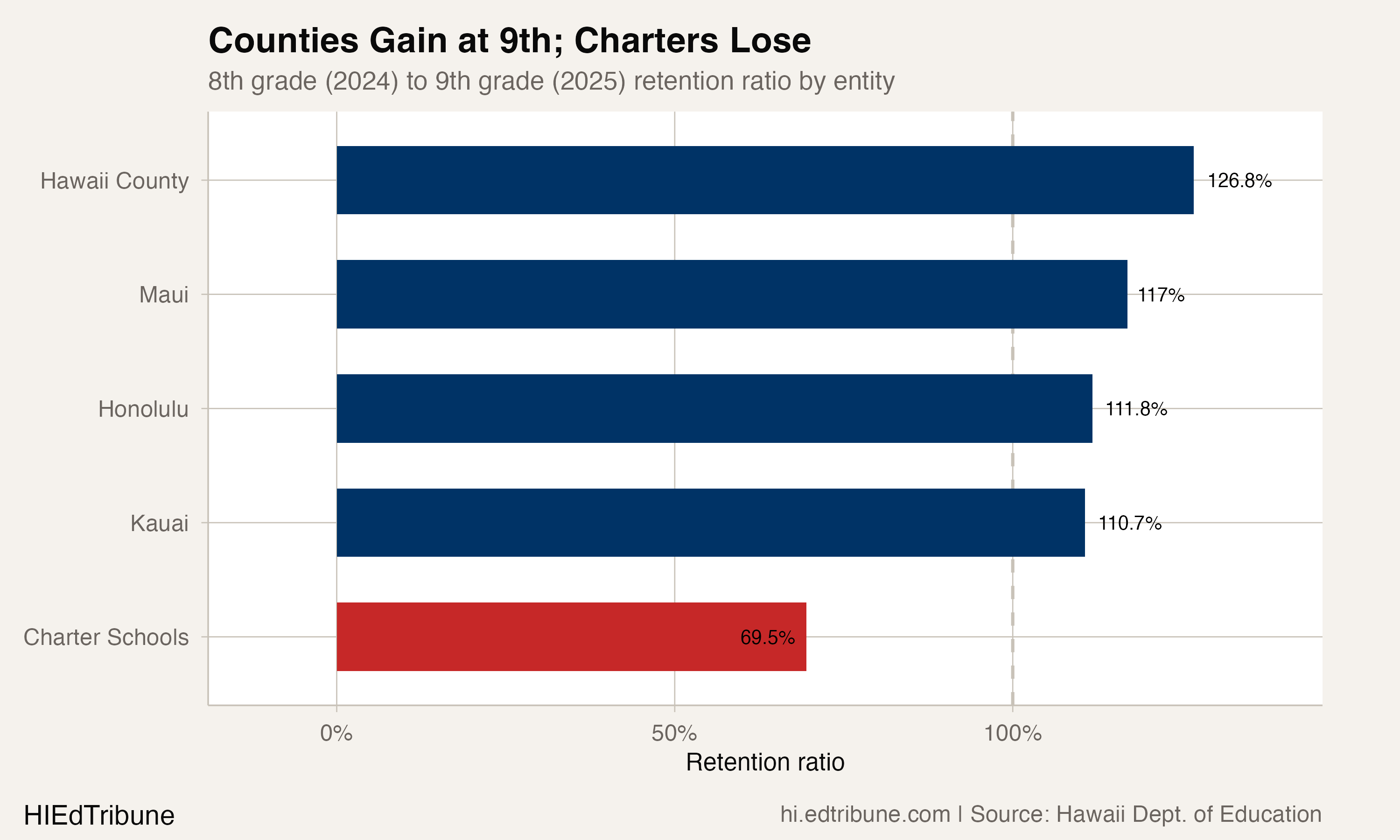
The 9th grade bulge is not a Honolulu phenomenon. In 2024-25, every county system gained students at the 8th-to-9th transition. Hawaii County↗ET showed the largest surge at 126.8%, with 449 more 9th graders than the prior year's 8th grade class. Maui↗ET followed at 117.0%, Honolulu↗ET at 111.8%, and Kauai↗ET at 110.7%.
The Big Island's outsized ratio is notable, though it rests on a smaller base: 1,674 8th graders becoming 2,123 9th graders. Hawaii County has fewer private school options than Honolulu, and those that exist tend to end at 8th grade. The rural geography also means that students from smaller communities may have no nearby private high school even if families could afford one.
Charter schools show the inverse pattern. Their 8th-to-9th ratio in 2025 was 69.5%, meaning nearly a third of charter 8th graders did not continue to charter 9th grade. Over 14 years, the charter retention ratio has averaged just 71.0%. Charter middle schools appear to function as a pipeline into traditional public high schools, not a self-contained K-12 alternative.
The 9th grade spike, the 10th grade cliff
The bulge does not persist. After the influx at 9th grade, the cohort shrinks at every subsequent transition. In 2024-25, the 9th-to-10th retention ratio was just 90.1%, the 10th-to-11th was 91.6%, and the 11th-to-12th was 94.5%. By contrast, elementary grades show near-perfect retention: the 1st-to-2nd ratio was 100.4%, and the 2nd-to-3rd was 100.3%.
The full grade-transition ladder reveals the 8th-to-9th transition as a singular discontinuity. It is the only transition in all of K-12 where the receiving grade is substantially larger than the sending grade. At 110.4%, it stands 13 percentage points above the next-highest transition (K-to-1st at 104.1%) and 20 points above the 9th-to-10th drop that immediately follows.
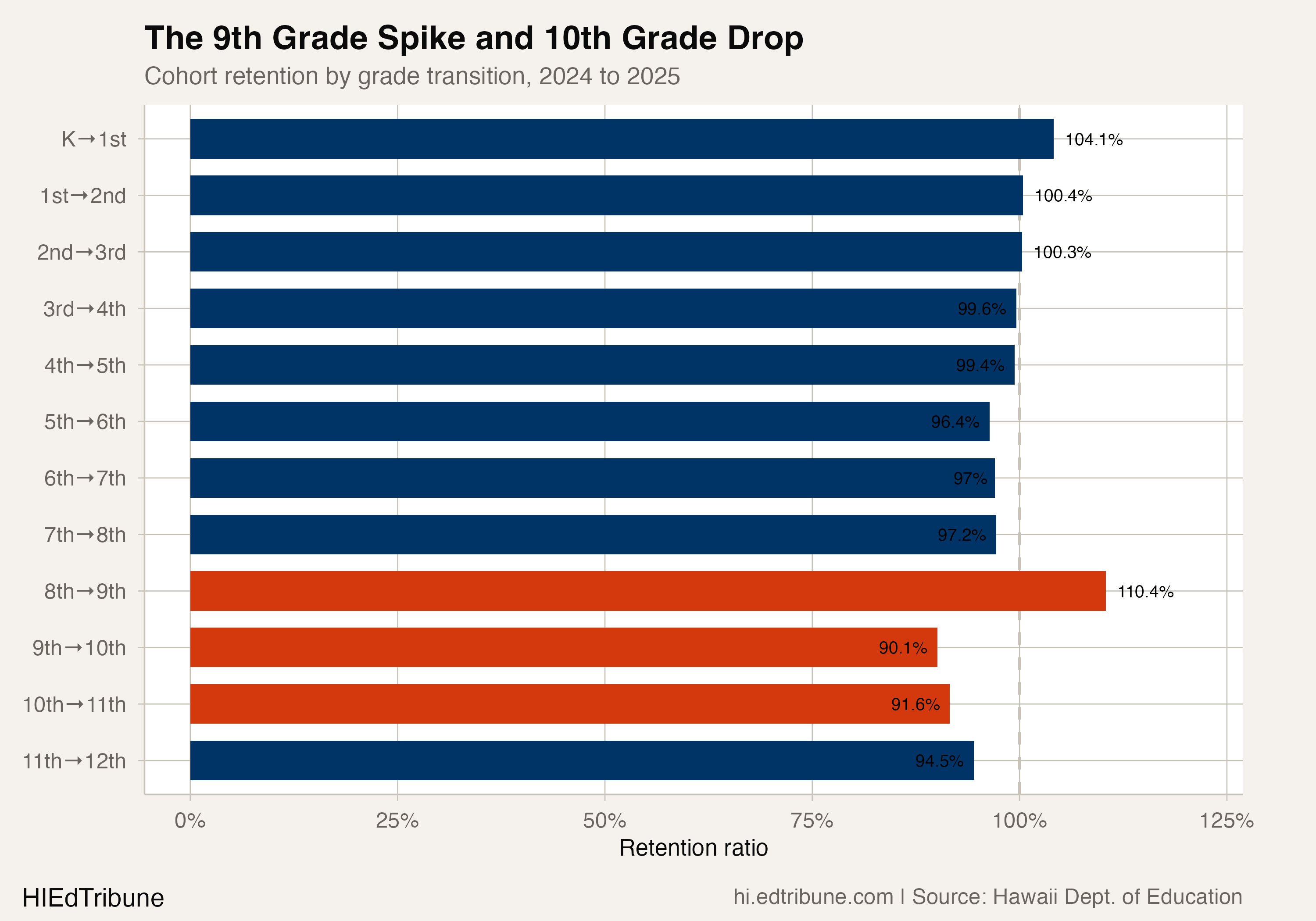
The 9th-to-10th drop averages 90.8% across years (excluding a 2023 data artifact). That means roughly 1,200 students vanish between 9th and 10th grade each year. Some of this is standard attrition: credit deficiency holding students back, families relocating to the mainland, or students transferring to alternative programs. But the sheer scale, nearly matching the 9th grade inflow, suggests that a portion of the students who enter public high school from private school or the mainland do not stay through graduation.
The scale over time
Over 13 clean transitions (excluding 2023, which is distorted by a special education reporting change), an estimated 17,584 students entered Hawaii's public 9th grade beyond what the 8th grade pipeline would have produced. That is nearly the size of Maui County's entire enrollment.
The annual inflow has fluctuated. It peaked at 1,920 in 2012, dropped to 887 in 2021 during the pandemic, then rebounded to 1,782 in 2022. The 2025 figure of 1,342 sits near the long-run average.
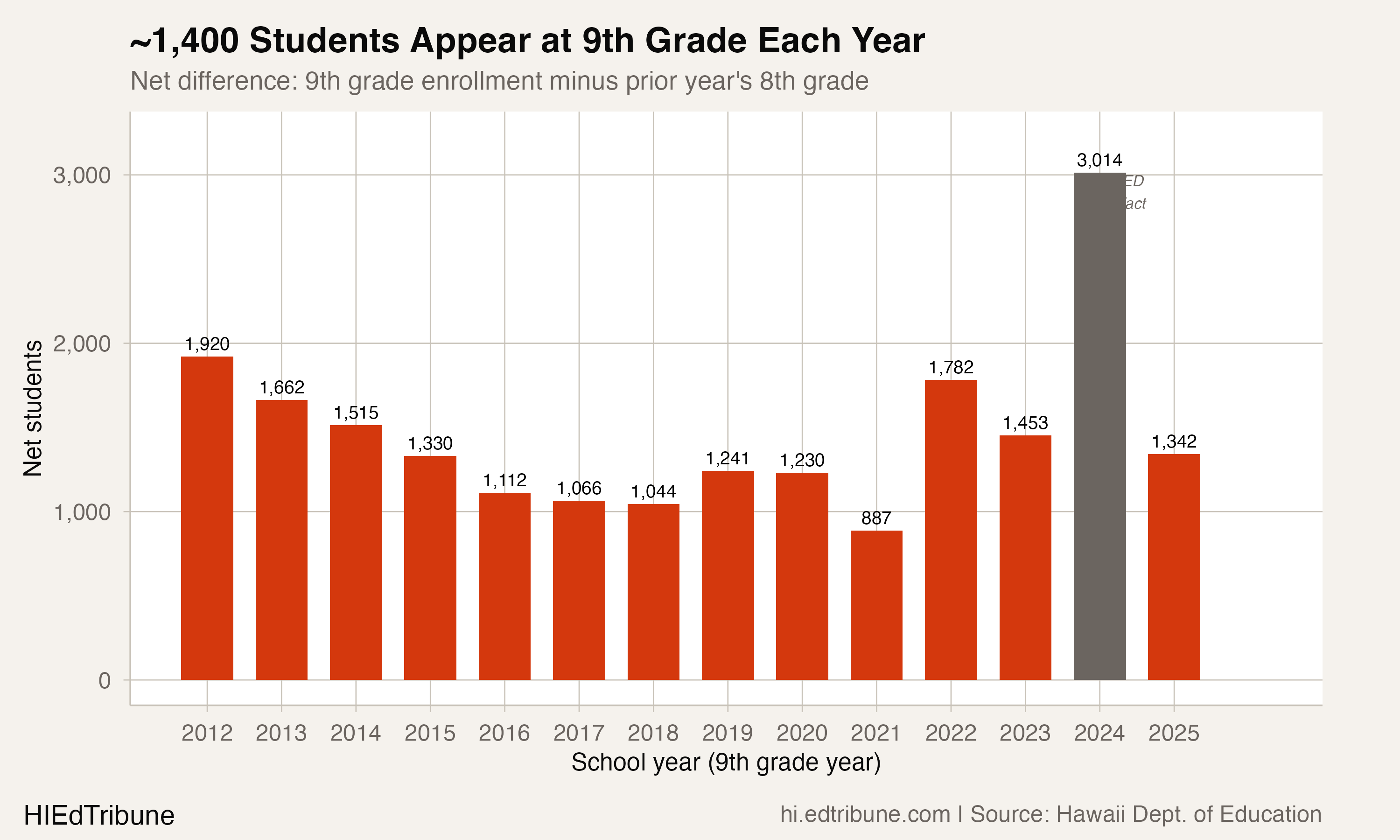
The pandemic year stands out. In the 2020-21 school year, only 887 net students appeared at 9th grade, the lowest figure in the dataset. Military PCS rotations slowed during COVID-19 travel restrictions, and some private school families who might otherwise have transferred chose to stay put during the disruption. The pattern snapped back the following year.
A data caveat on 2023-24
The 2023-24 transition shows an apparent ratio of 133.0%, far above the normal range. This is an artifact of a reporting change, not a real enrollment shift. Through 2023, approximately 18,000 special education students were reported under a separate "SPED" grade category rather than assigned to their actual K-12 grade. When these students were folded into regular grade levels beginning in 2024, the 2023 8th grade count (9,121) was artificially low because it excluded SPED-coded 8th graders. The statewide total enrollment was unaffected. Adjusting for the estimated share of SPED students in 8th grade brings the 2023 ratio to approximately 119%, still elevated but within the historical range.
What reporting suggests
The private-to-public pipeline at 9th grade is well-understood locally, even if the state does not formally track it. Honolulu Civil Beat reported on the competitive pressure of Hawaii's private school admissions culture:
"Nearly 17% of Hawaii students were enrolled in 98 private schools" as of 2023-24, with tuition at the most expensive institutions approaching $30,000 annually. Source: Honolulu Civil Beat, November 2024
The charter sector's role as a middle-school feeder into traditional high schools has not received similar attention. The data shows that charter schools↗ET, despite growing to 38 schools and 7.9% of public enrollment, lose roughly 30% of their 8th graders at the high school transition every year. Many Hawaii charter schools emphasize Hawaiian culture-based education models at the elementary and middle levels but do not operate comprehensive high school programs.
What the bulge means for high schools
The 9th grade bulge is not a problem in itself. It is a structural feature of a state where one in six families chooses private school for the early grades and then returns to the public system for high school. But it creates planning challenges that compound other pressures.
Hawaii's statewide enrollment has fallen 19,774 students, or 10.6%, from its 2014 peak of 186,850 to 167,076 in 2025. Elementary grades are shrinking as smaller birth cohorts work through the pipeline. Yet high school enrollment remains elevated by the annual private-school transfer wave.
The result is a lopsided system. In 2024-25, 9th grade was the largest grade in Hawaii's public schools at 14,241 students, larger than kindergarten (11,746), larger than any elementary grade, and 30% larger than 10th grade (10,938). High schools absorb students that the K-8 system never served, bearing the cost of onboarding without the years of state funding that would have accompanied those students through elementary and middle school.
The question for Hawaii's single statewide district is whether the private-to-public pipeline will persist as enrollment declines accelerate. If private schools contract alongside public ones, the 9th grade bulge could shrink. If private schools hold steady while public enrollment falls, the incoming wave will represent an even larger share of each high school's capacity. Either way, the pattern that has delivered 1,350 extra 9th graders per year for at least 14 years shows no sign of changing.
Detailed code that reproduces the analysis and figures in this article is available exclusively to EdTribune subscribers.
Discussion
Sign in to join the discussion.
Loading comments...