Kauai lost 181 students last year. Hawaii County lost 165. In isolation, those are small numbers for small systems. But in 2024-25, they add up to something that has never happened before in at least 15 years of records: all four of Hawaii's county school systems are at their lowest enrollment levels simultaneously. The only part of Hawaii's public education system setting records in the other direction is its charter sector, which hit an all-time high of 13,094 students.
The synchronized decline across Honolulu↗ET, Hawaii County↗ET, Maui↗ET, and Kauai↗ET rules out the usual local explanations. This is not one island losing families to another. It is the entire state contracting at once.
From every shore, the same trajectory
Hawaii enrolled 167,076 public school students in 2024-25, down 19,774 from the 2014 peak of 186,850, a 10.6% decline over 11 years. The losses have not been evenly distributed, but the direction has been universal.
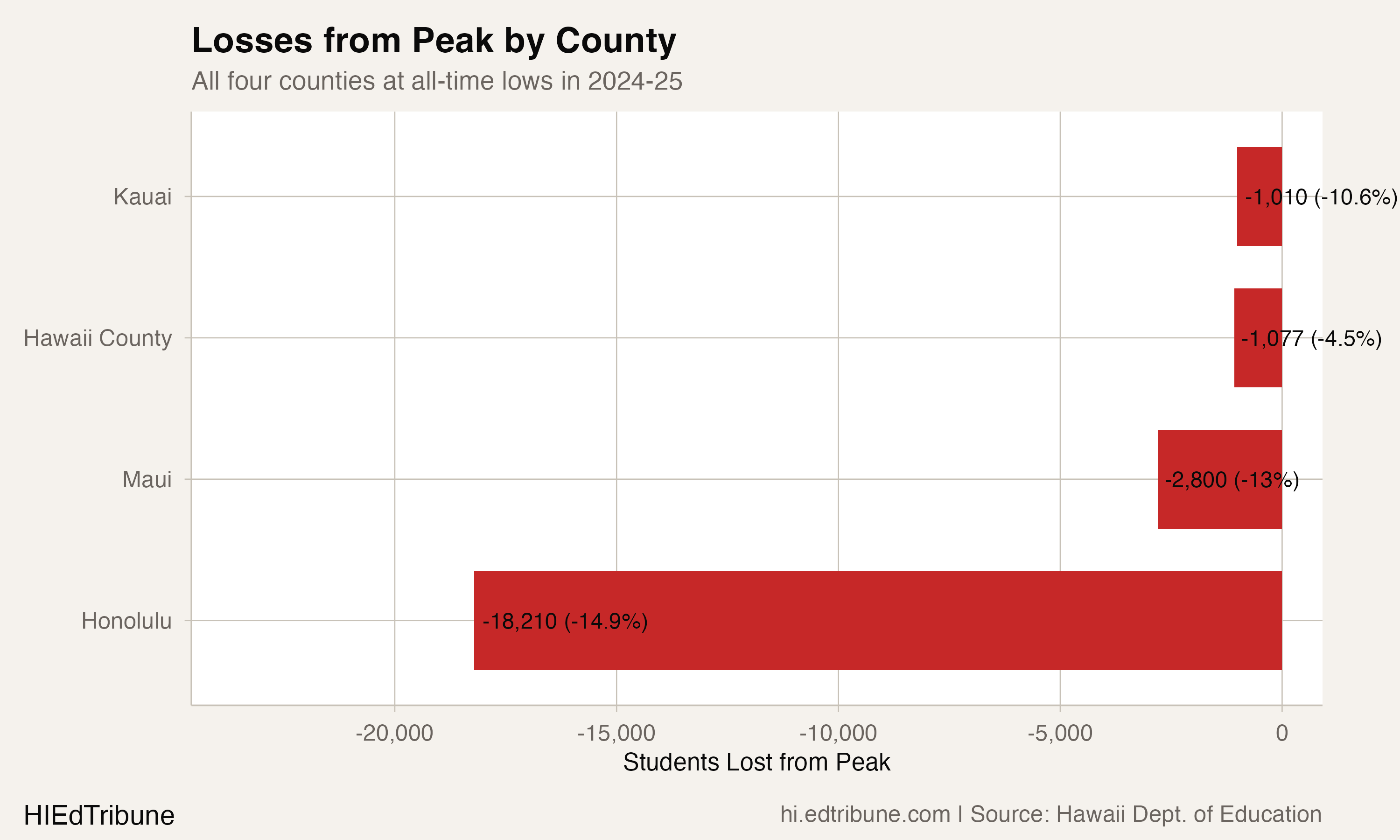
Honolulu, home to 62.2% of the state's students, has declined every single year since 2014. Its 11-year streak is the longest in the state: from 122,195 students at peak to 103,985 in 2024-25, a loss of 18,210, or 14.9%. Honolulu alone accounts for 92% of the statewide decline from peak, losing nearly as many students as Maui's entire current enrollment.
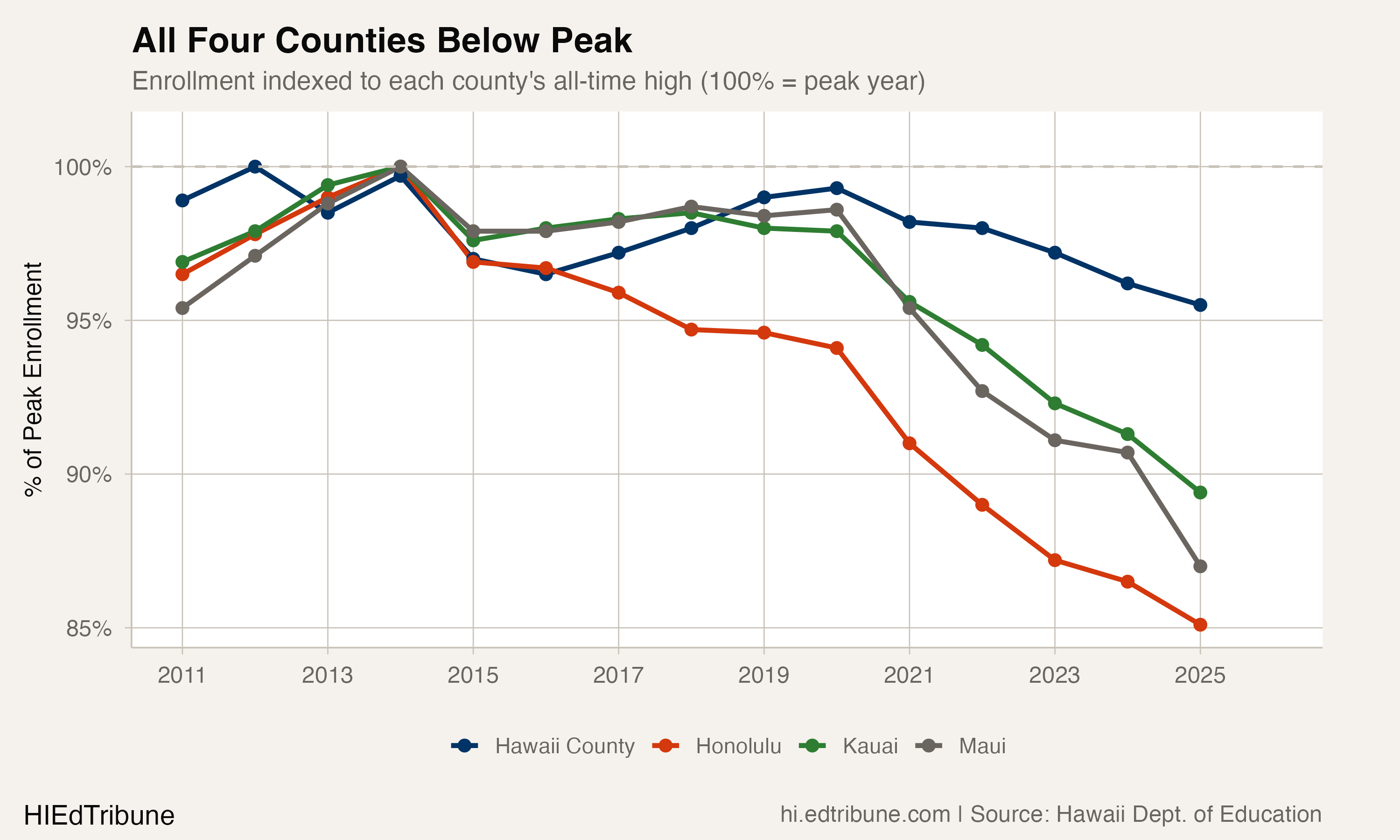
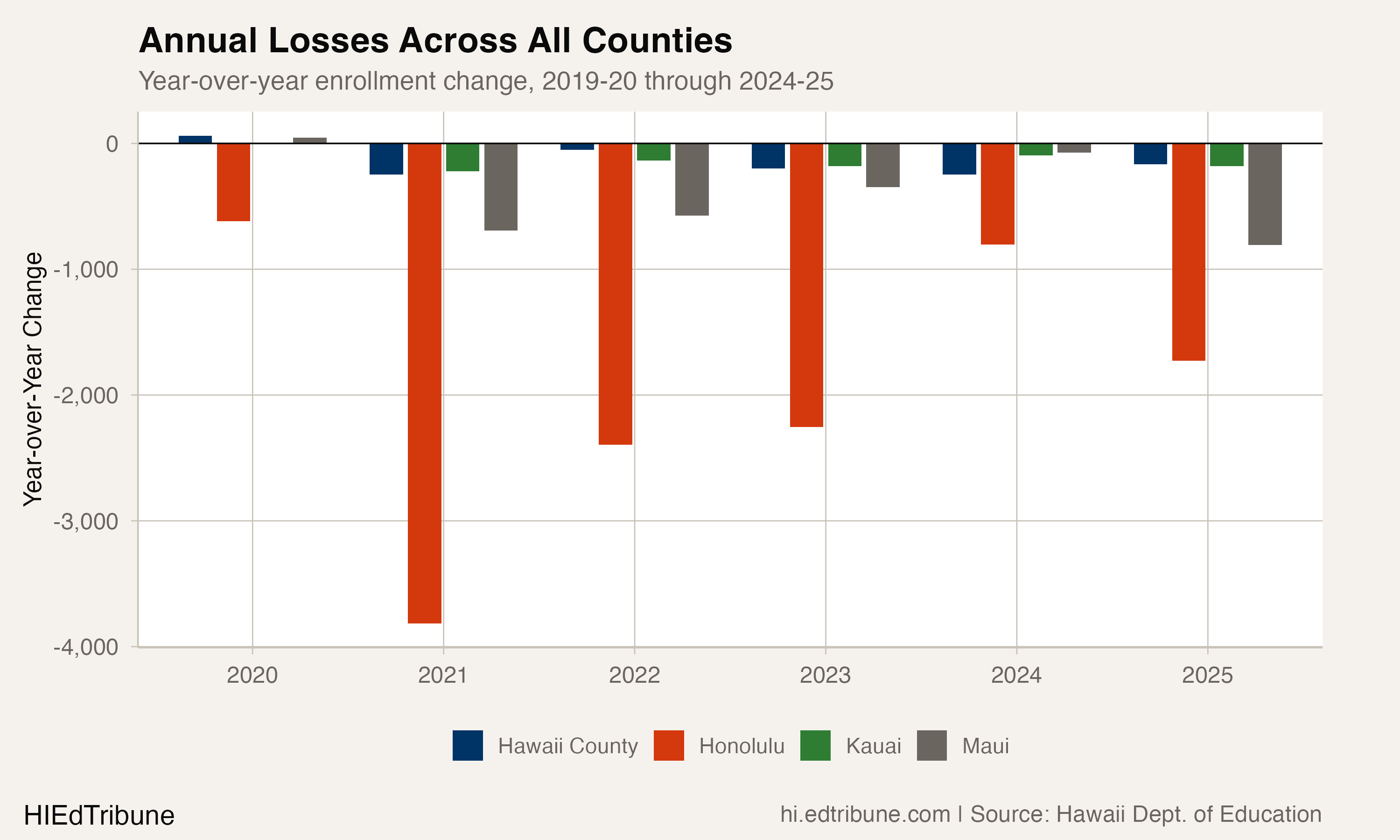
The neighbor islands held up longer. Hawaii County grew through 2020, reaching 23,622 before the pandemic erased its gains. Kauai and Maui both peaked in 2014 but remained relatively stable through 2019 before COVID accelerated their declines. Now all four are falling together: every county posted losses in 2025, with Maui's 807-student drop the sharpest single-year loss on the neighbor islands.
| County | Peak | Peak Year | 2024-25 | Loss | % Change |
|---|---|---|---|---|---|
| Honolulu | 122,195 | 2014 | 103,985 | -18,210 | -14.9% |
| Maui | 21,534 | 2014 | 18,734 | -2,800 | -13.0% |
| Kauai | 9,558 | 2014 | 8,548 | -1,010 | -10.6% |
| Hawaii County | 23,792 | 2012 | 22,715 | -1,077 | -4.5% |
Three forces, one outcome
The most direct driver of enrollment decline is demographic. Hawaii's birth rate has fallen 14% since 2016, the sixth-steepest drop of any state. There were roughly 14,820 births in 2023, down from over 18,000 a decade earlier. Fewer babies born on every island means fewer kindergartners five years later, compounding across 13 grade levels over time.
Outmigration intensifies the pressure. Hawaii lost roughly 20,000 residents on net between 2020 and 2024, and lost another 2,132 residents between 2024 and 2025. The departure pattern skews young. Demographer Karl Eschbach identified the core dynamic on the Big Island: "older people and retirees are moving to the island, while younger adults are moving away and not coming back." That creates a double loss: the departing adults and the children they take or would have had.
Housing costs are the mechanism behind much of the migration. With Oahu single-family home prices exceeding $1.1 million, young families face an arithmetic that often resolves with a one-way ticket to the mainland. A statewide survey found over one-third of Hawaii households have considered leaving the state due to high living and housing costs.
Maui's wildfire wound
Maui's 807-student drop in 2025, the largest single-year loss among neighbor islands, carries a specific cause layered onto the broader trend. The August 2023 Lahaina wildfire displaced roughly 3,000 students in a single week. Two years later, the damage is still visible in enrollment figures.
"Kids leaving the island, going back to the mainland, back to the countries that their families are from." -- Lahainaluna High School Principal Richard Carosso, Maui Now, Oct. 2024
Lahaina's four-school Canoe Complex enrolled 4,310 students before the fire. By 2024-25, that figure had fallen to roughly 3,875, a decline of about 10%. Lahainaluna High School alone went from 1,012 students on August 7, 2023 to 813 in 2024-25, a 20% drop. The fire did not create Maui's enrollment decline. Maui peaked in 2014, a decade before the disaster. But the wildfire collapsed a decade of gradual erosion into a single catastrophic year.
The charter exception
While every county posted a new low, charter schools↗ET reached an all-time high of 13,094 students, up 648 from the prior year, a 5.2% gain. It was the third consecutive year of growth.
"Charter school enrollment has continued to rise, increasing by 5% from last year. Currently, 13,070 students are enrolled in Kindergarten through 12th grade across 38 charter schools." -- Hawaii State Public Charter School Commission, 2024
The charter sector's share of total enrollment has grown from 4.7% in 2010-11 to 7.8% in 2024-25. In absolute terms, charters have gained 4,727 students since 2011, a 56.5% increase. Over the same period, traditional county-run schools lost 17,228 students, falling from 171,210 to 153,982, a 10.1% decline.
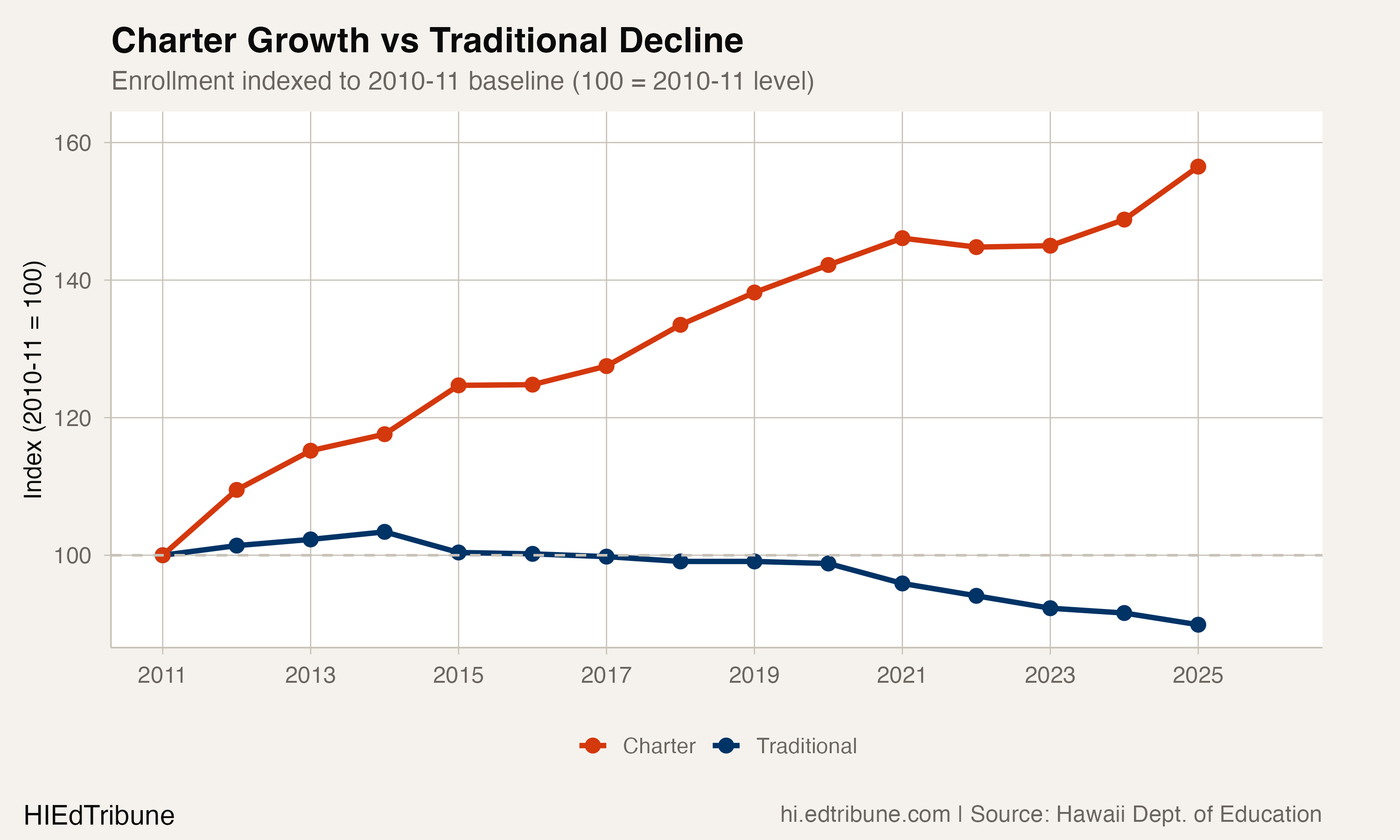
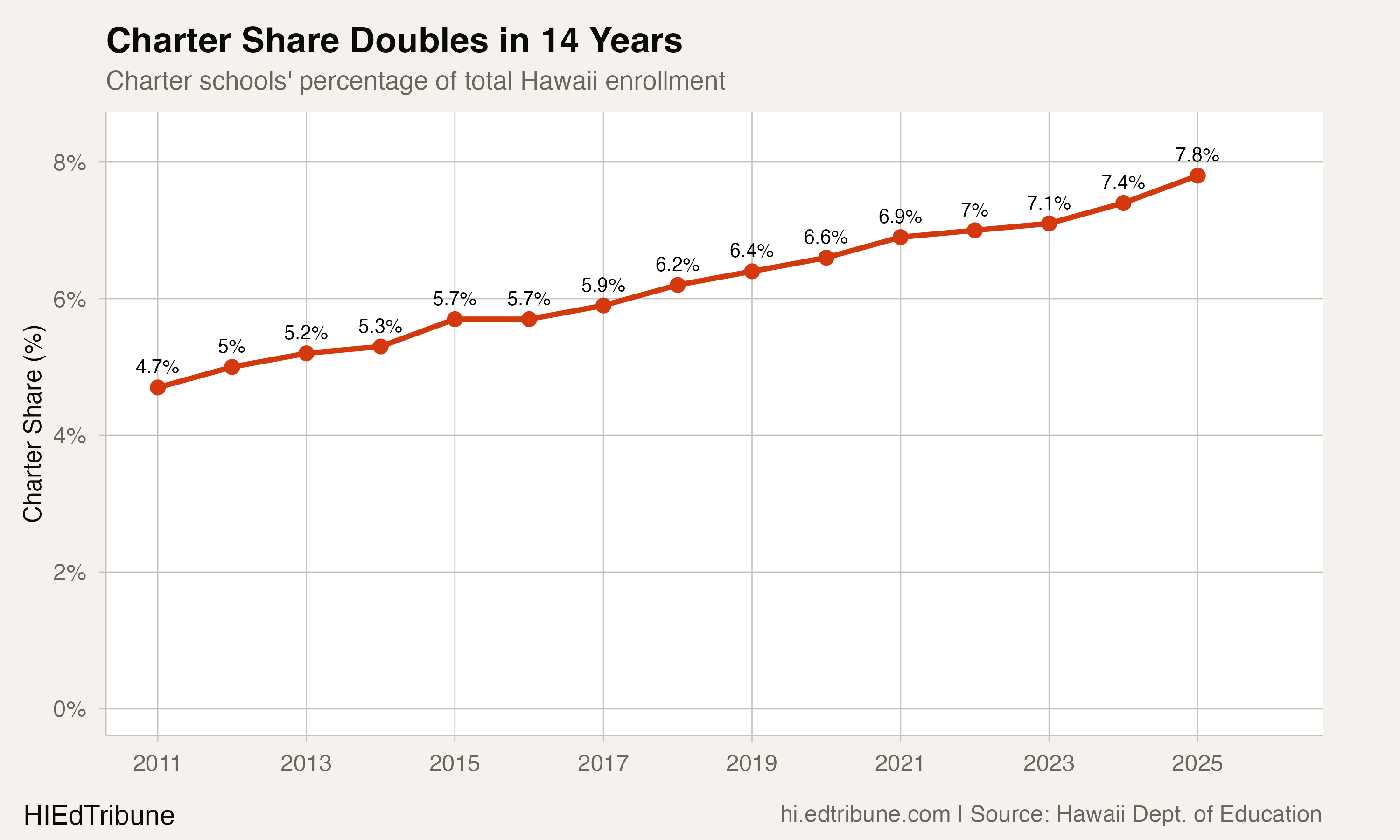
The divergence is real, but context matters. Charter schools enroll 13,094 students across 38 campuses. The traditional system serves nearly 154,000 across roughly 256 schools. Even at its current growth rate, the charter sector cannot offset statewide losses that exceeded 2,200 students in the last year alone. The charter gain of 648 students replaced less than a third of the state's net loss.
The fiscal arithmetic
Hawaii allocates funding on a per-pupil weighted student formula. DOE Deputy Superintendent Curt Otaguro framed the fiscal bind to state lawmakers:
"We've got more need than we have money and resources." -- Curt Otaguro, Civil Beat, Jan. 2023
At roughly $5,000 to $6,000 per student per year in direct school allocations, the 19,774-student decline from peak translates to approximately $100 million to $120 million in lost annual school-level funding. Fixed costs, including aging buildings, utilities, and certificated staff on multi-year contracts, do not shrink at the same rate. That mismatch is most acute in small schools. The DOE identified 34 schools with fewer than 250 students, each carrying overhead costs that grow larger per remaining student as enrollment falls.
Rather than close those schools, the DOE has pivoted to "district optimization", planning to redraw attendance boundaries by 2026-27 rather than make closure decisions before spring 2028. It is a strategy that redistributes students across existing buildings without removing any buildings from the inventory.
What the data cannot answer
The simultaneous lows raise a question the enrollment numbers alone cannot resolve: how much of the decline is families leaving the state permanently, and how much is families choosing private or homeschool options while remaining in Hawaii? The data tracks public school enrollment, not total school-age population. Hawaii's private school sector is among the largest in the nation by market share, and the state does not publish comprehensive private enrollment data on the same timeline.
What is clear is that the bottom is not yet in view. With births continuing to fall and housing costs continuing to push young families toward the mainland, the incoming kindergarten classes will be smaller than the graduating senior classes for years to come. Hawaii DOE's own projections, cited by Civil Beat, place enrollment below any level since 1962 by 2027-28. Four counties at all-time lows is a milestone. It is unlikely to be the last.
Detailed code that reproduces the analysis and figures in this article is available exclusively to EdTribune subscribers.
Discussion
Sign in to join the discussion.
Loading comments...