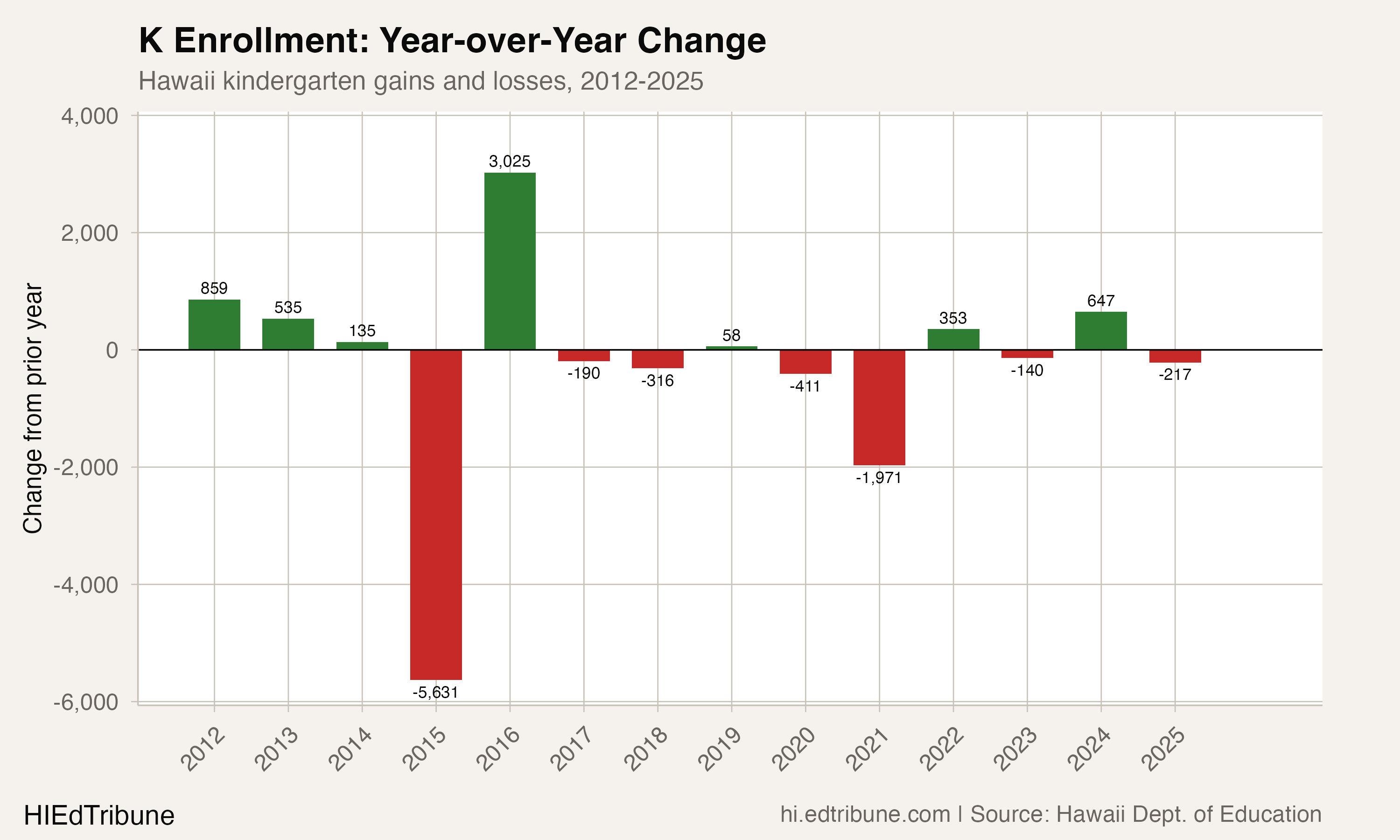
In 2014, Hawaii had 16,539 kindergartners. One year later, it had 10,908. No disaster, no pandemic, no economic collapse. The state legislature had moved the kindergarten entry age cutoff from December 31 to July 31, and roughly 5,800 children were barred from starting school.
A decade later, the 2024-25 kindergarten class stands at 11,746 students, still 29.0% below the pre-cutoff peak. Of the 5,631 students lost in a single year, only 838 have come back. That is a recovery rate of 14.9%.
The permanent dent
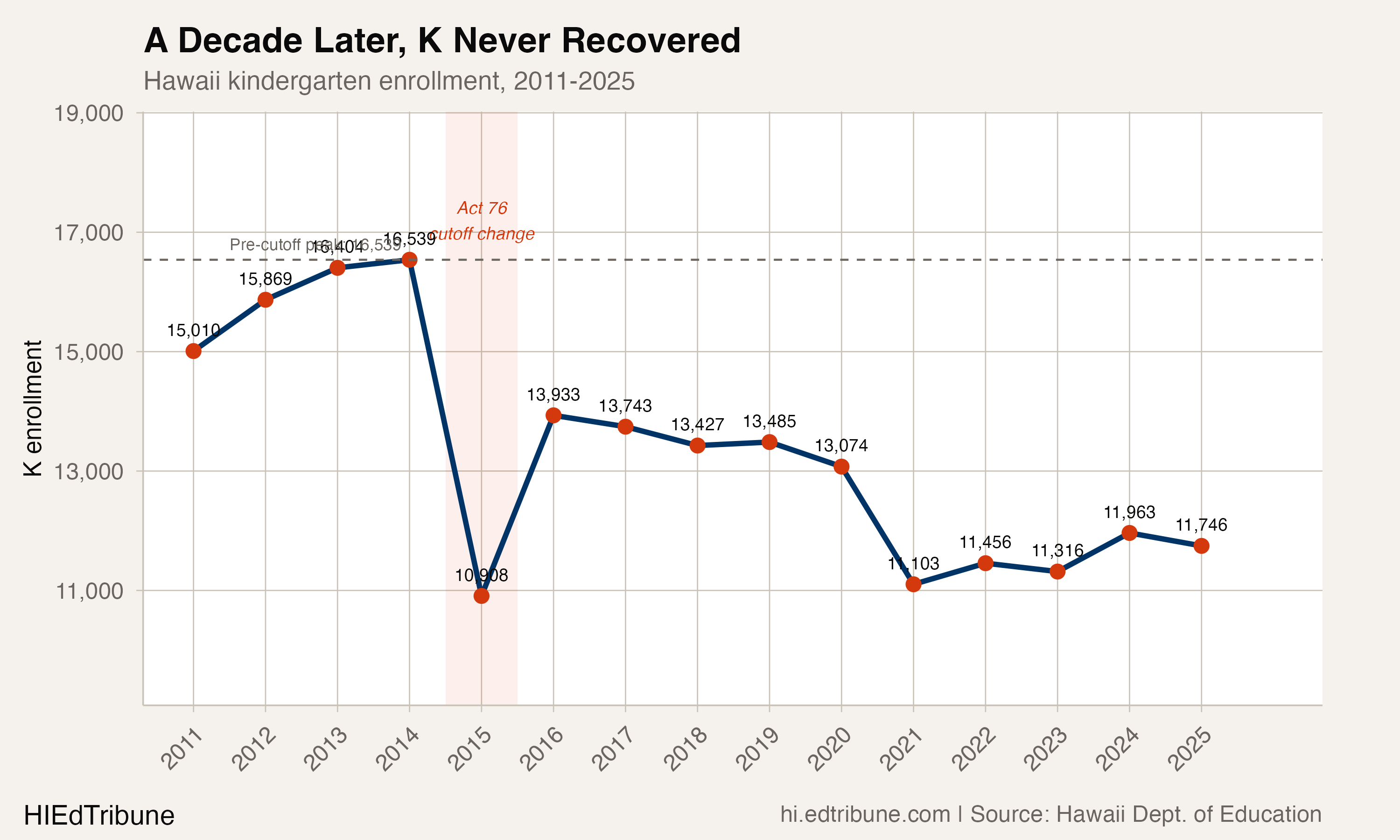
The trajectory tells a story in three acts. Before the cutoff change, K enrollment was climbing steadily, adding 1,529 students between 2011 and 2014. Then Act 76 hit, carving away 34.0% of the kindergarten class in one year.
The 2015-16 school year brought a partial bounce. K enrollment surged back to 13,933, recovering 3,025 of the lost students as the one-time "gap cohort" of children who had waited a year finally entered school. But 13,933 was still 15.8% below the pre-cutoff peak. The bounce was a reflex, not a restoration.
From there, the post-cutoff baseline began drifting lower. The average K class from 2016 to 2019 was 13,647 students. From 2022 to 2025, it was 11,620, a drop of more than 2,000 per year from the earlier post-cutoff period. COVID compounded the damage: K enrollment cratered to 11,103 in 2020-21, a loss of 1,971 from the prior year on top of a baseline already suppressed by the age cutoff.
Where the children went
Act 76 was designed to align Hawaii with developmental standards followed by most states, which use a summer or early-fall cutoff for kindergarten entry. The intent was to give younger children more time to develop before starting school. But the policy assumed a robust early childhood education system would absorb the displaced children. That system did not exist.
"We've taken away something from children and parents without putting something we hope to be better in place." -- Deborah Zysman, Good Beginnings Alliance executive director, Honolulu Civil Beat
The state allocated $6 million to expand the Preschool Open Doors subsidy program, which supported 1,087 children with an average family income of $32,800. Private preschool in Hawaii averaged over $8,000 a year. Some families, like one profiled by Civil Beat, left the state entirely: the Youngs relocated to Texas, where they could enroll their child in free public kindergarten rather than pay $10,000 annually for a private option on a $65,000 household income.
The most likely driver of the permanent shortfall is the interaction between the cutoff change and Hawaii's broader demographic decline. Hawaii births fell 14% between 2016 and 2021, from 18,059 to 15,565, driven by rising housing costs, delayed family formation, and continued out-migration of young adults. Even if the cutoff had never changed, K enrollment would have fallen. But the cutoff compressed the decline into a single shock, forcing schools to shed kindergarten teachers and close classrooms. Ninety-five kindergarten teachers were reassigned in 2014-15 alone. Rebuilding that capacity as births continued to fall was structurally unlikely.
A competing explanation is that the cutoff change pushed families into private schools and out of the public system permanently. Hawaii has the highest private school enrollment rate of any state, with 17.9% of K-12 students attending private schools. More than 3,300 students left the DOE for private schools in 2020-21 alone, up from 1,289 the prior year. How many of those initial decisions trace back to families who, forced to pay for an extra year of private preschool in 2014, simply stayed? No public data tracks this pipeline, but the pattern is suggestive.
Kindergarten falls below grade 12
The K shortfall has produced an outcome that was unprecedented before the cutoff: in 2024-25, for the first time in the data, Hawaii enrolled fewer kindergartners than 12th graders.
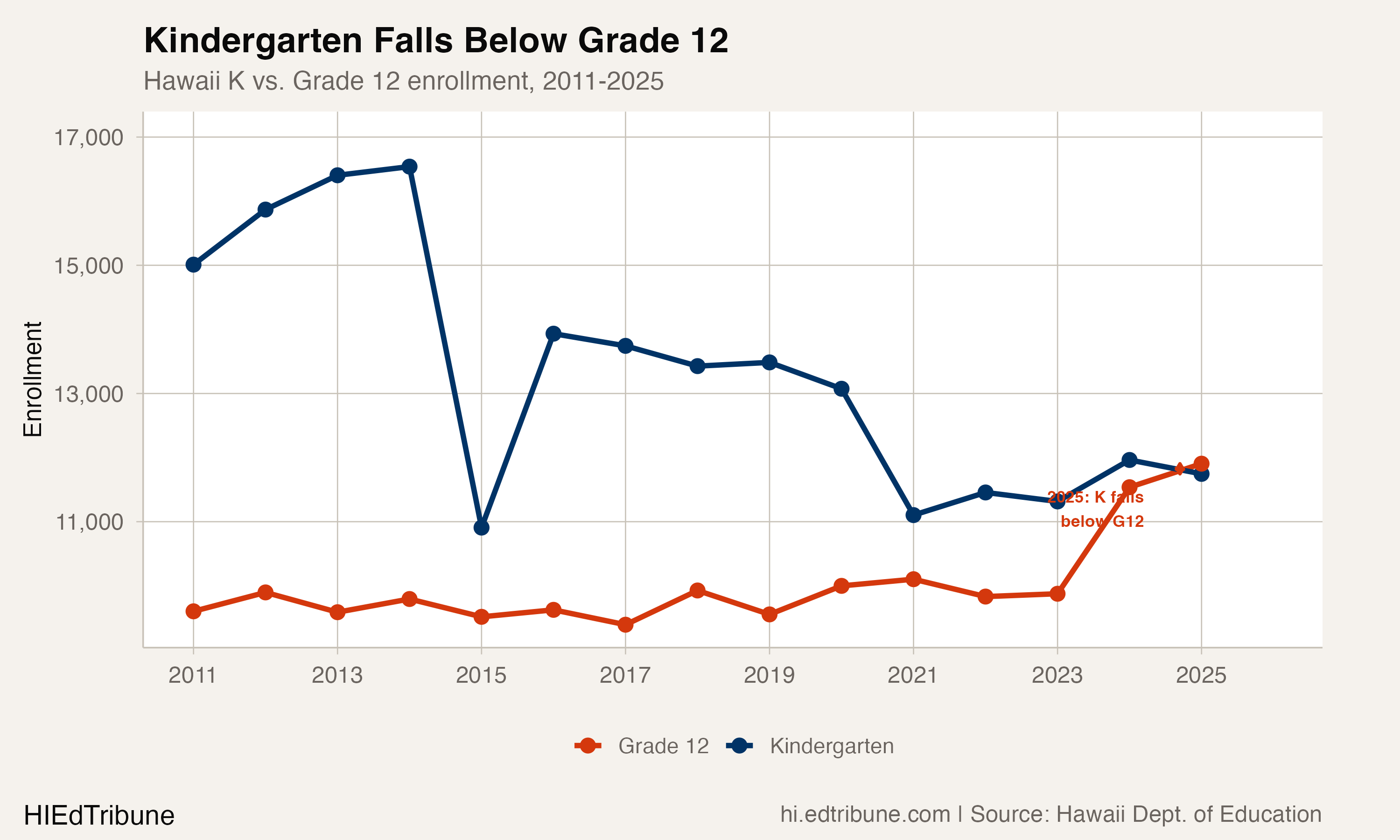
The K-to-grade-12 ratio is a standard pipeline health indicator. In 2014, Hawaii enrolled 169 kindergartners for every 100 seniors. By 2025, that ratio had fallen to 99, meaning kindergarten classes are now smaller than the senior classes they will eventually need to replace. Grade 12 enrollment in 2025 was 11,905; kindergarten was 11,746, a gap of 159 students.
This inversion reflects two simultaneous forces. Kindergarten is being squeezed by the permanent cutoff effect and declining births. Grade 12 is being inflated by the last of the larger pre-cutoff cohorts reaching the end of the pipeline. In 2025, the 12th-grade class includes students who entered kindergarten in 2012-13, when K enrollment was 16,404. Those large cohorts will age out within two years.
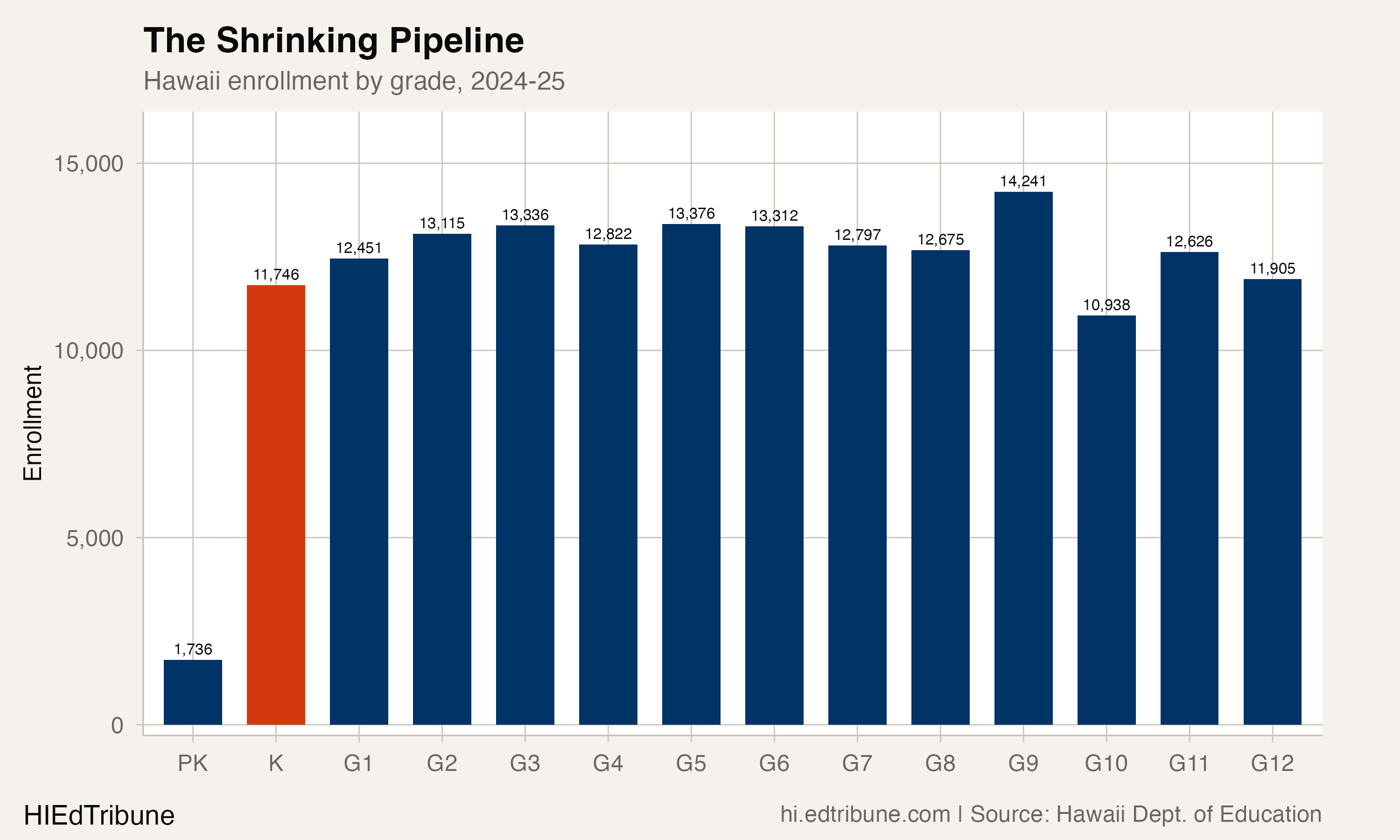
The grade-by-grade pipeline for 2024-25 shows the compression. Kindergarten at 11,746 is smaller than every grade from first through ninth. First grade at 12,451 is 6.0% larger than K, a typical step-up as some families delay kindergarten but enroll in first grade, and as inter-island and out-of-state arrivals enter the system. But by grade 9 the pipeline swells to 14,241, reflecting the larger cohorts that entered K before the cutoff.
Every county felt it
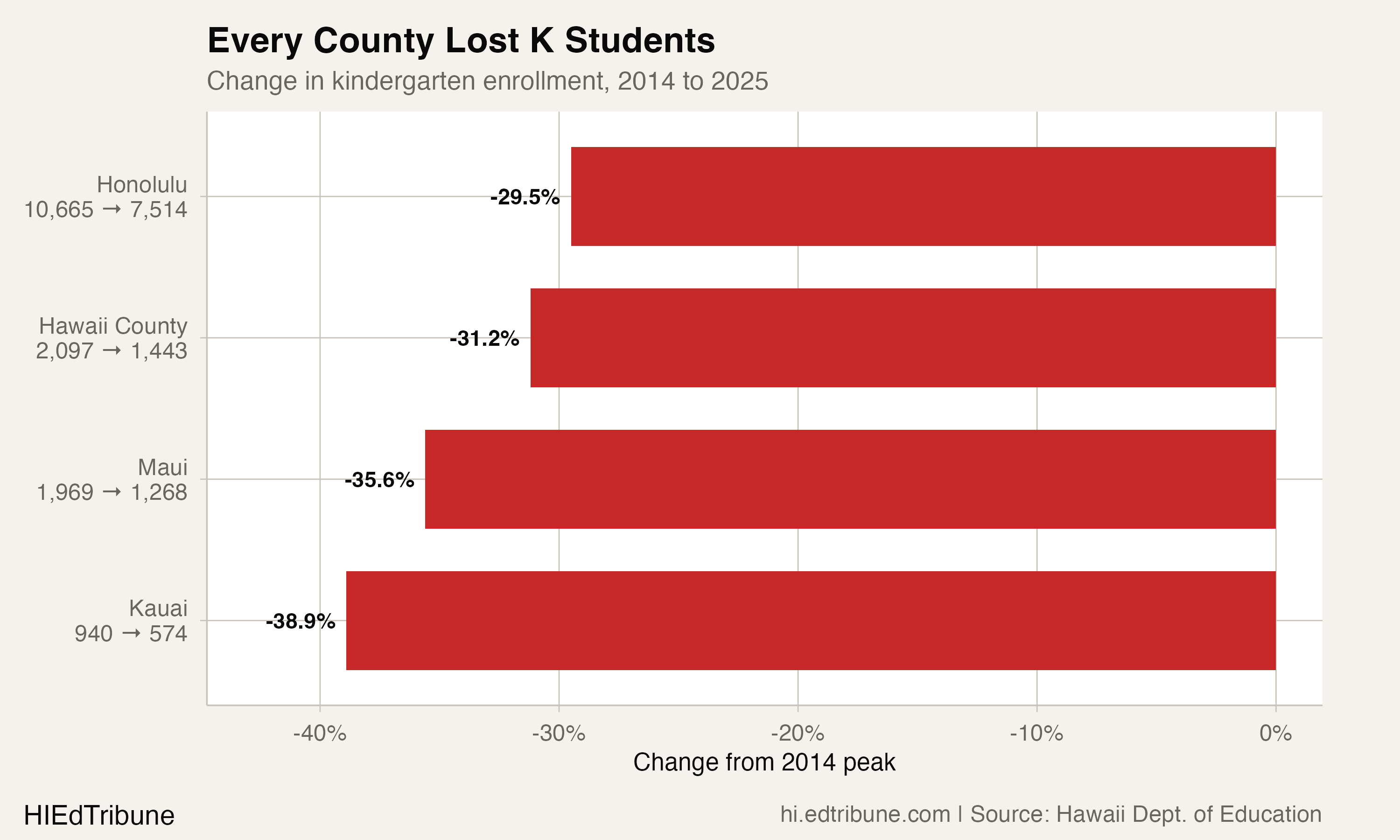
Kauai↗ET lost the largest share of its kindergarten class: 38.9%, falling from 940 to 574 students. Maui↗ET lost 35.6%, dropping from 1,969 to 1,268. Hawaii County↗ET lost 31.2%, from 2,097 to 1,443. Honolulu↗ET, with the largest absolute numbers, lost 29.5%, from 10,665 to 7,514.
The pattern is consistent with what happens when a policy shock hits a state where smaller communities have fewer fallback options. Kauai and Maui have thinner private school markets and less access to early childhood programs. Families on those islands who could not afford an extra year of private preschool, and could not wait, had fewer choices. Some left. Others homeschooled. The DOE does not track which option families chose, only that they did not enroll.
What the smaller K class means for the system
The state's total enrollment has fallen from 186,850 in 2013-14 to 167,076 in 2024-25, a decline of 19,774 students, or 10.6%. That decline is accelerating: the system lost 2,232 in the most recent year and 6,102 over the past three years. The shrinking kindergarten pipeline is the leading edge.
The DOE now has 34 elementary schools enrolling fewer than 250 students, the estimated threshold for adequate funding. Eight schools operate with budgets below $1.38 million. Board of Education Chair Roy Takumi told Civil Beat that "closing a school isn't like closing your neighborhood Starbucks." The department has shifted to a "district optimization" strategy, prioritizing redistricting over closures, with the earliest possible consolidation decisions pushed to 2028.
The question is whether the K pipeline gives them that long. The 2025 kindergarten class of 11,746 will become the first-grade class of 2026, the second-grade class of 2027, and so on. Each year, a smaller cohort replaces a larger one. Hawaii's births fell 14% between 2016 and 2021, from 18,059 to 15,565, and have continued declining. The children who will enter kindergarten in 2028 have already been born, and there are fewer of them.
Detailed code that reproduces the analysis and figures in this article is available exclusively to EdTribune subscribers.
Discussion
Sign in to join the discussion.
Loading comments...