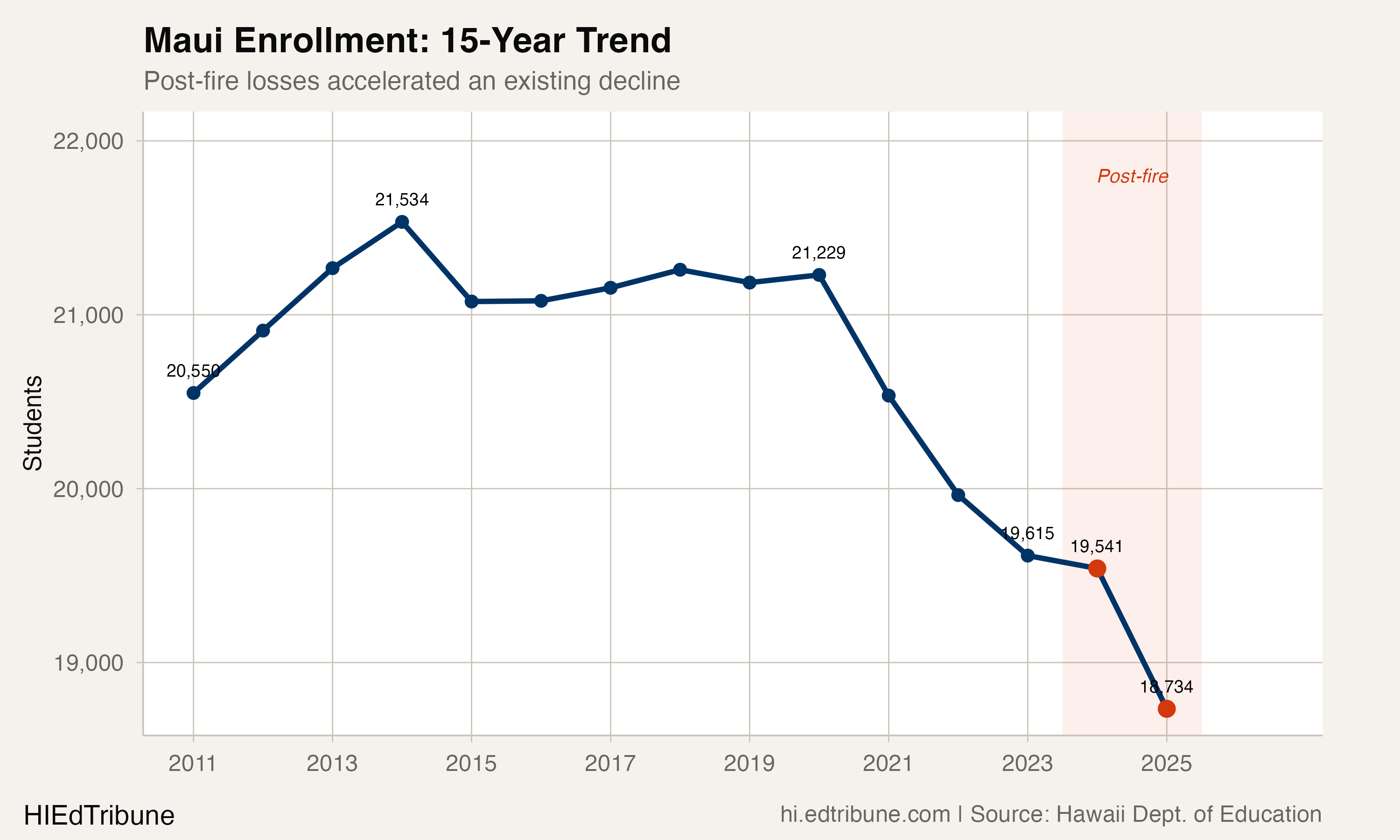
Between 2016 and 2020, Maui↗ET County's public school enrollment barely moved. The island held steady at around 21,200 students while Honolulu bled thousands. Then COVID hit, and Maui began losing students at rates it had never seen. By the time the Lahaina wildfire struck in August 2023, the county had already lost 1,614 students in three years. The fire turned a steady decline into a collapse: 807 students gone in 2024-25 alone, the largest single-year loss in Maui's recorded enrollment history.
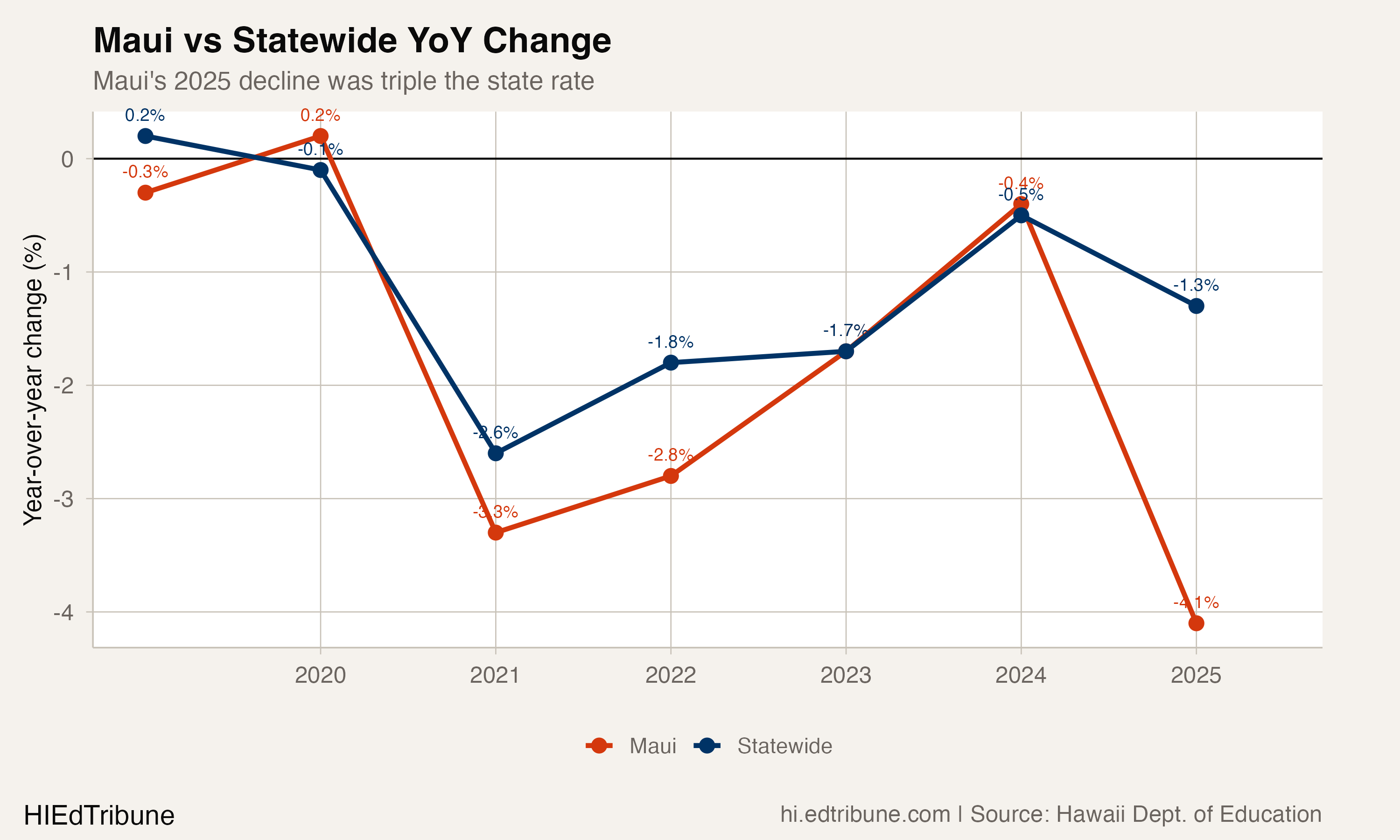
That one-year loss of 4.1% was triple the statewide rate of 1.3%. Maui County, home to just 11.2% of Hawaii's public school students, accounted for 36.2% of the state's total enrollment loss in 2024-25.
A plateau, then a cliff
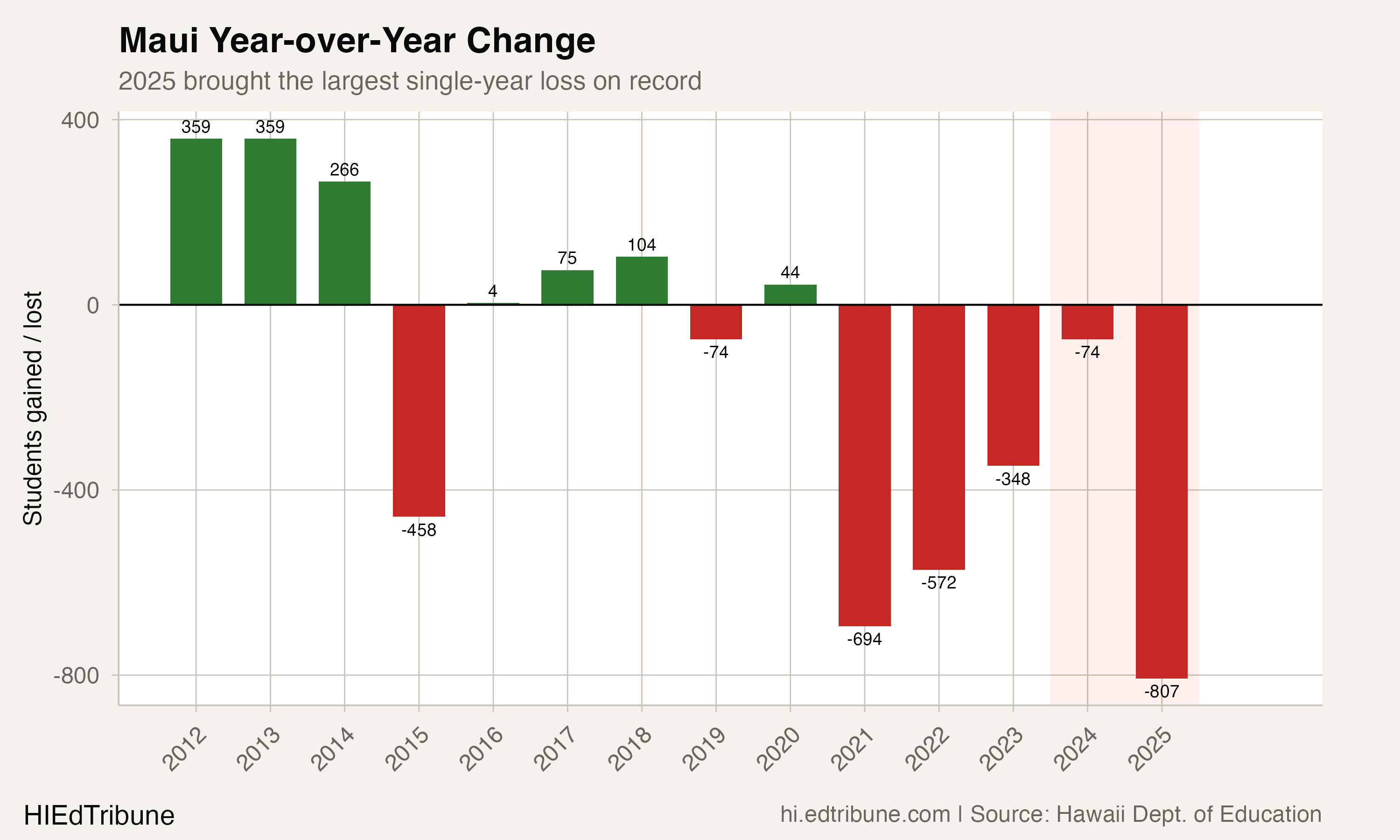
Maui's enrollment peaked at 21,534 students in 2013-14. The county shed 458 students the following year, an artifact of Act 76, which moved Hawaii's kindergarten entry cutoff from December 31 to July 31, temporarily shrinking the kindergarten class statewide. After that correction, Maui stabilized. Between 2015-16 and 2019-20, the county averaged a net change of roughly 30 students per year, gaining and losing in nearly equal measure.
COVID broke that equilibrium. Maui lost 694 students in 2020-21, followed by 572 in 2021-22 and 348 in 2022-23. The pre-fire average annual loss from 2019 to 2023 was 392 students, or about 1.9% per year.
Then the wildfire hit Lahaina on August 8, 2023. The first post-fire school year (2023-24) showed only a 74-student loss, a number that masked a delayed effect. The second post-fire year brought the reckoning: 807 students, a 4.1% decline that exceeded any year during COVID and nearly doubled the worst pre-fire loss.
In total, Maui has lost 881 students since the fire, a 4.5% drop in two years, and 2,800 from its 2014 peak, a 13.0% decline.
Where the students went
The 2025 loss did not fall evenly across Maui's schools. The Lahaina complex, which includes Lahainaluna High School, Lahaina Intermediate, Princess Nahienaena Elementary, and King Kamehameha III Elementary, bore the heaviest damage. King Kamehameha III Elementary, located in the burn zone, lost roughly 40% of its pre-fire enrollment by the 2024-25 school year, falling from 543 to 330 students. The Lahaina complex collectively enrolled about 3,875 students in 2024-25, down from 4,310 before the fire.
Some families transferred to other Maui schools. Honolulu Civil Beat reported that the Maui Preparatory Academy, a private school in Napili, absorbed roughly 140 displaced Lahaina students. But more telling is what the data shows about off-island movement: 46 Lahainaluna students relocated off-island entirely, and the composition of the remaining student body shifted. The share of economically disadvantaged students in the Lahaina complex rose from about 50% to at least 75%, suggesting that families with more resources were more likely to leave.
"The state capped our losses" through a phased reduction approach, limiting annual budget decreases to 7.5% maximum over four years rather than immediate cuts. Richard Carosso, Lahainaluna Principal, Maui Now, Oct. 2024
Maui's loss outpaces every county
Maui's 11.8% enrollment decline since 2019-20 is the steepest of any county in Hawaii. Honolulu↗ET, which dominates the state's enrollment at 103,985 students, lost 9.6% over the same period. Kauai↗ET lost 8.7%. Hawaii County↗ET, the Big Island, lost just 3.8%, the mildest decline in the state.
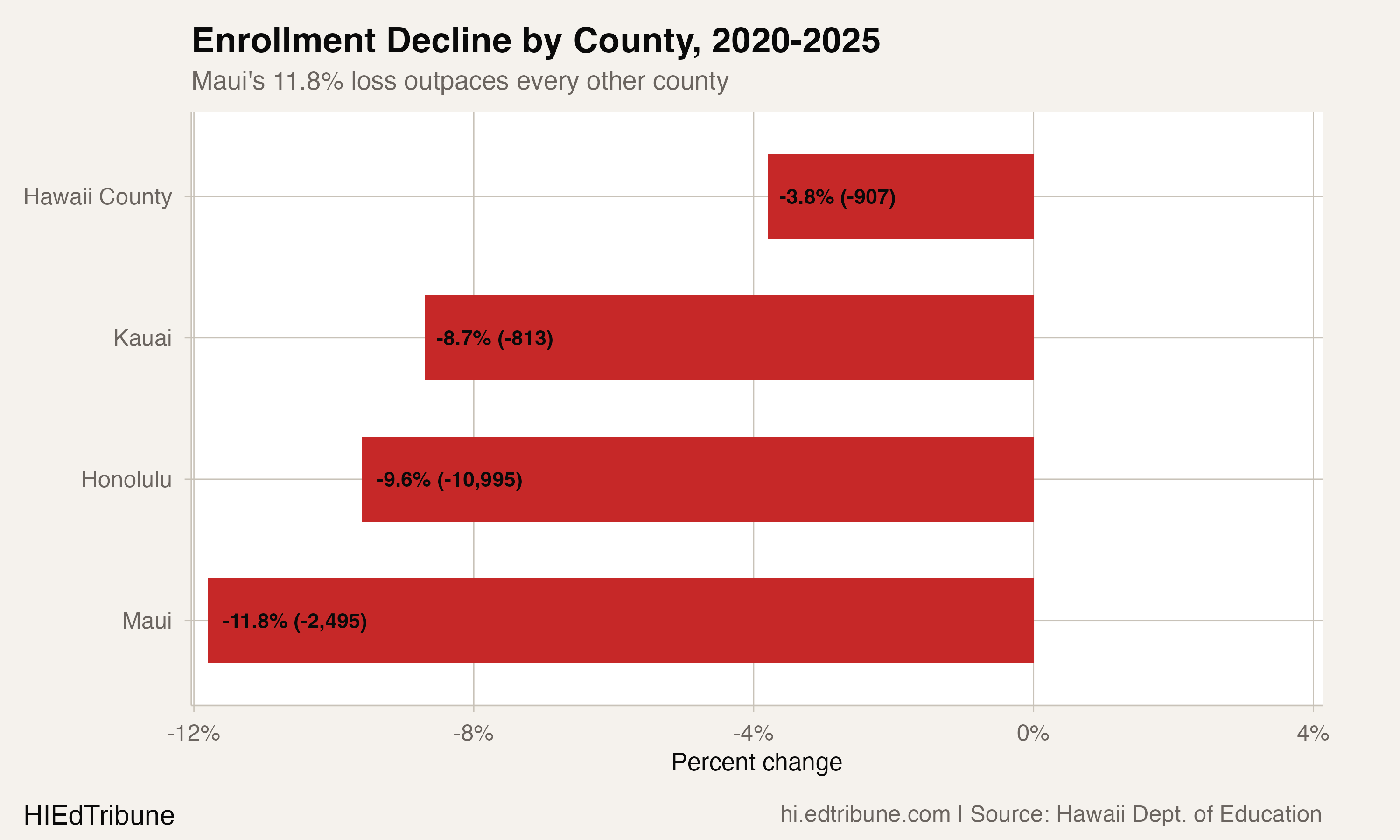
In raw numbers, Honolulu's 10,995-student loss since 2020 dwarfs Maui's 2,495. But as a share of its own enrollment base, Maui's decline is running at a pace that no other county matches. The wildfire is one factor, but only a partial explanation. Maui was already declining faster than Hawaii County before August 2023.
Hawaii's statewide population has declined in five of the past six years, shrinking by nearly 22,500 since 2020, driven by outmigration to more affordable mainland states. That pressure falls hardest on communities where housing was already scarce. On Maui, where the fire destroyed more than 2,200 structures in Lahaina, housing scarcity is now acute.
The pipeline narrows
One metric captures Maui's long-term trajectory more plainly than the total enrollment figures. The ratio of kindergartners to 12th graders, a rough proxy for whether more students are entering the system than leaving it, dropped below parity for the first time in 2023-24.
In 2010-11, Maui had 161 kindergartners for every 100 seniors. By 2023-24, the ratio was 98.1. In 2024-25, it fell further to 94.5: for every 100 seniors graduating, only 95 kindergartners were entering.
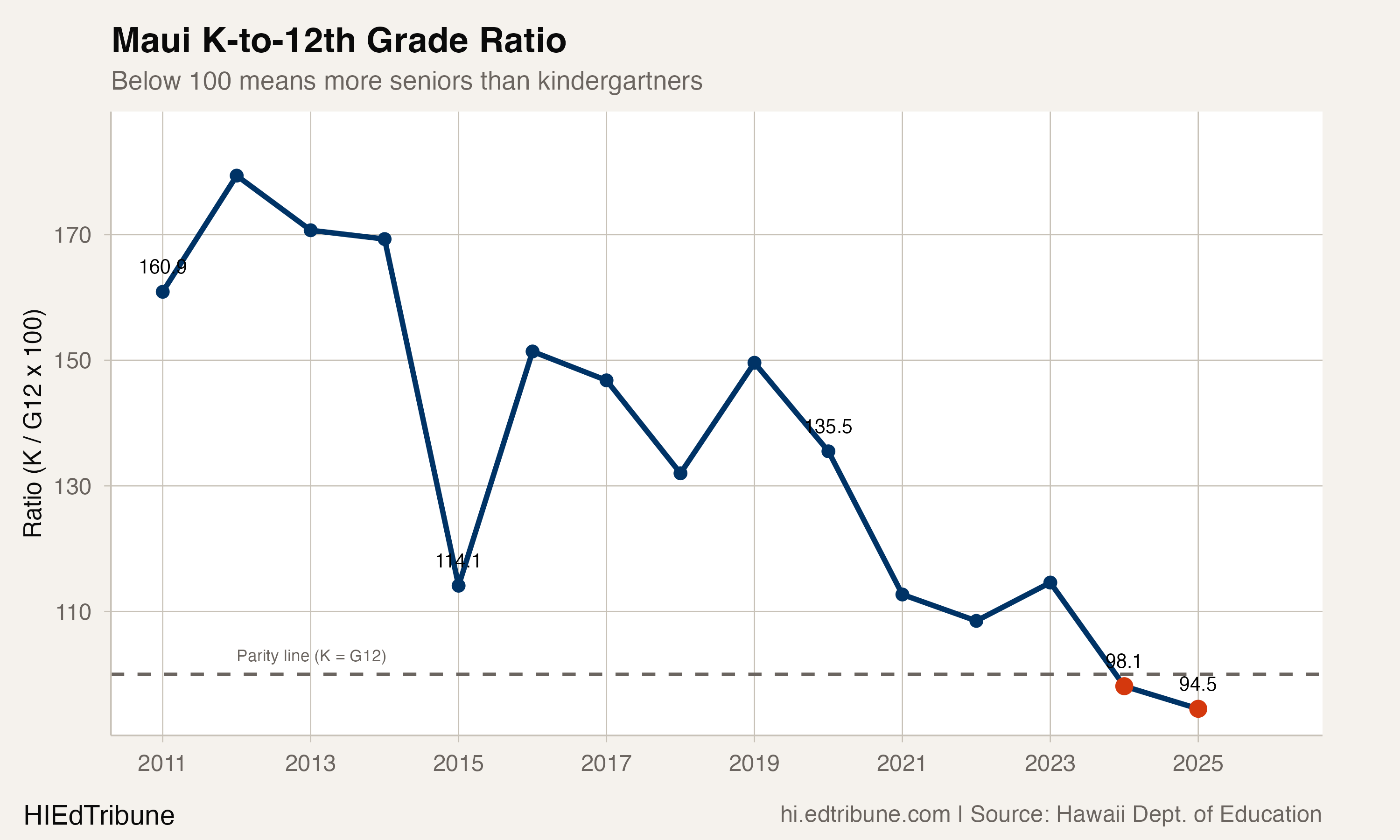
Maui's kindergarten enrollment peaked at 2,018 in 2012-13 and has since fallen 37.2% to 1,268 in 2024-25. Part of this reflects the Act 76 cutoff change, which permanently removed a cohort from kindergarten starting in 2014-15. But the decline continued well past that adjustment. Hawaii's annual births have fallen steadily, from 18,059 in 2016 to 14,964 in 2024, a 17% decline. Fewer kindergartners entering Maui schools in 2024-25 means fewer students at every grade level in the years ahead.
The wildfire layered onto a structural decline
The August 2023 fire did not create Maui's enrollment problem. The county was losing students at an accelerating rate before Lahaina burned. COVID drove 1,614 students out between 2020 and 2023. The fire added 881 more in the two years since.
The most likely driver of the pre-fire decline is the same force pushing families off every Hawaiian island: housing costs. On Oahu, the median single-family home price exceeds $1.2 million. Maui's rental market tightened further after the fire destroyed thousands of housing units.
An alternative explanation for some of the post-fire divergence is school choice. Statewide, charter school enrollment grew by 648 students in 2024-25, a 5.2% increase and the largest annual gain since 2012. Some Lahaina families may have used the disruption as an exit point from the traditional system, though the data does not allow direct tracking of individual student transfers between sectors.
What to watch next
The Hawaii Board of Education is beginning a process to evaluate under-enrolled schools for potential closure or consolidation, the first such effort since 2011. Thirty-four schools statewide enroll fewer than 250 students. Maui's smaller campuses, already stressed by the fire and outmigration, are likely candidates.
The more pressing question is whether Maui's 2025 loss represents a new baseline or a one-time displacement shock that will partially reverse. If displaced Lahaina families return as rebuilding progresses, the county could stabilize. If the fire permanently displaced families who would otherwise have stayed, the 18,734 students enrolled in 2024-25 may be close to a ceiling, not a floor. With kindergarten enrollment at 1,268 and falling, the pipeline suggests Maui's schools will continue shrinking regardless.
Detailed code that reproduces the analysis and figures in this article is available exclusively to EdTribune subscribers.
Discussion
Sign in to join the discussion.
Loading comments...