Correction (September 30, 2026): An earlier version said Maunaloa Elementary's chronic absence rate fell from 63% in 2021-22 to 2% in 2024-25, a 61-point improvement that left it 13 points below its pre-pandemic rate, and compared Molokai schools the same way. Hawaii changed how it counts chronic absence in 2023-24, from students absent 15 or more days to students absent 18 or more days, so those years are not directly comparable. The comparisons have been removed and the article now compares years within one measure. The Molokai comparison also omitted Kilohana Elementary, which has been added, and unsourced descriptions of school size and community income were removed.
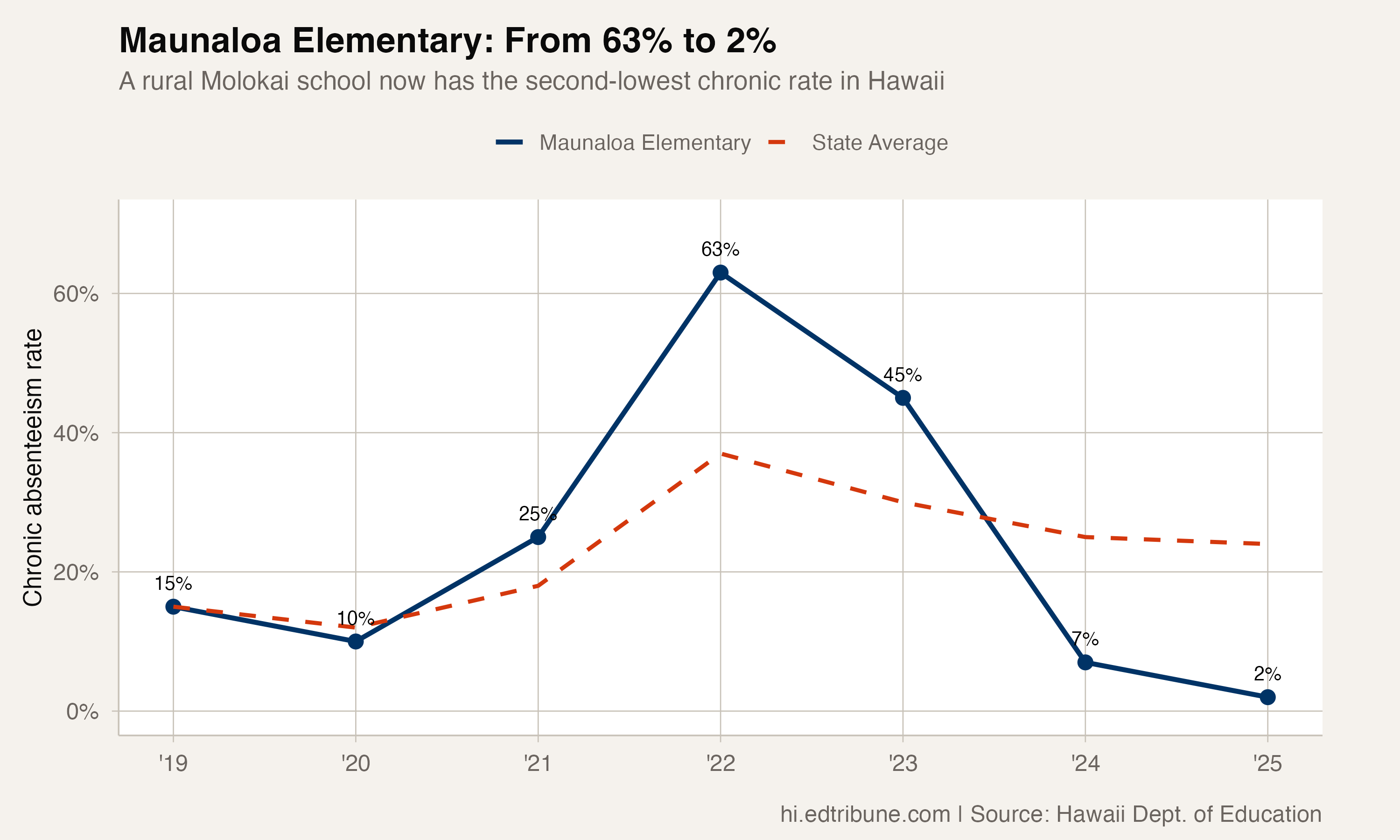
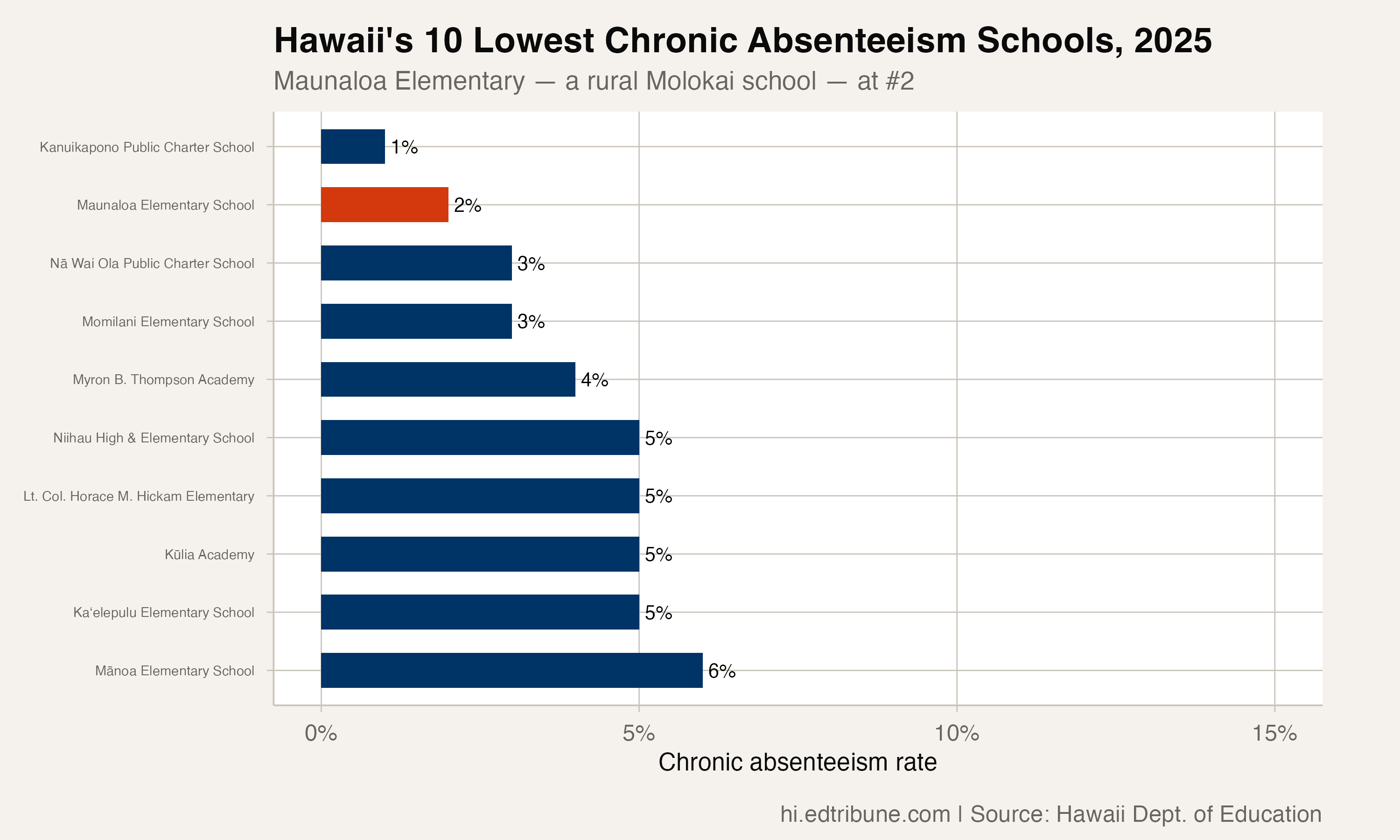
Maunaloa Elementary School sits in a small town on the western end of Molokai. In 2024-25, 2% of its students were chronically absent, meaning they missed 18 or more days of school. Among 295 Hawaii schools with a published rate, only Kanuikapono Public Charter School, at 1%, was lower. The statewide rate was 24%.
It was not a one-year blip. In 2023-24, the first year of the same measure, Maunaloa's rate was 7%, tied for fifth-lowest of 293 schools.
Two Measures, Two Stories
Before 2023-24, Hawaii counted students absent 15 or more days. On that measure, Maunaloa's rate was 15% in 2018-19, climbed to 63% in 2021-22, and fell 18 points to 45% in 2022-23.
The step from 45% in 2022-23 to 7% in 2023-24 spans the change in definition, so its size cannot be read directly. Some of that difference reflects the new, higher threshold; the data cannot say how much.
Among the Lowest in the State
The nine lowest chronic absence rates in Hawaii in 2024-25 ran from 1% to 5%, and the next four schools sat at 6%. Maunaloa is second on that list, alongside Momilani Elementary and Na Wai Ola Public Charter School at 3% and Myron B. Thompson Academy at 4%.
Molokai's Other Schools
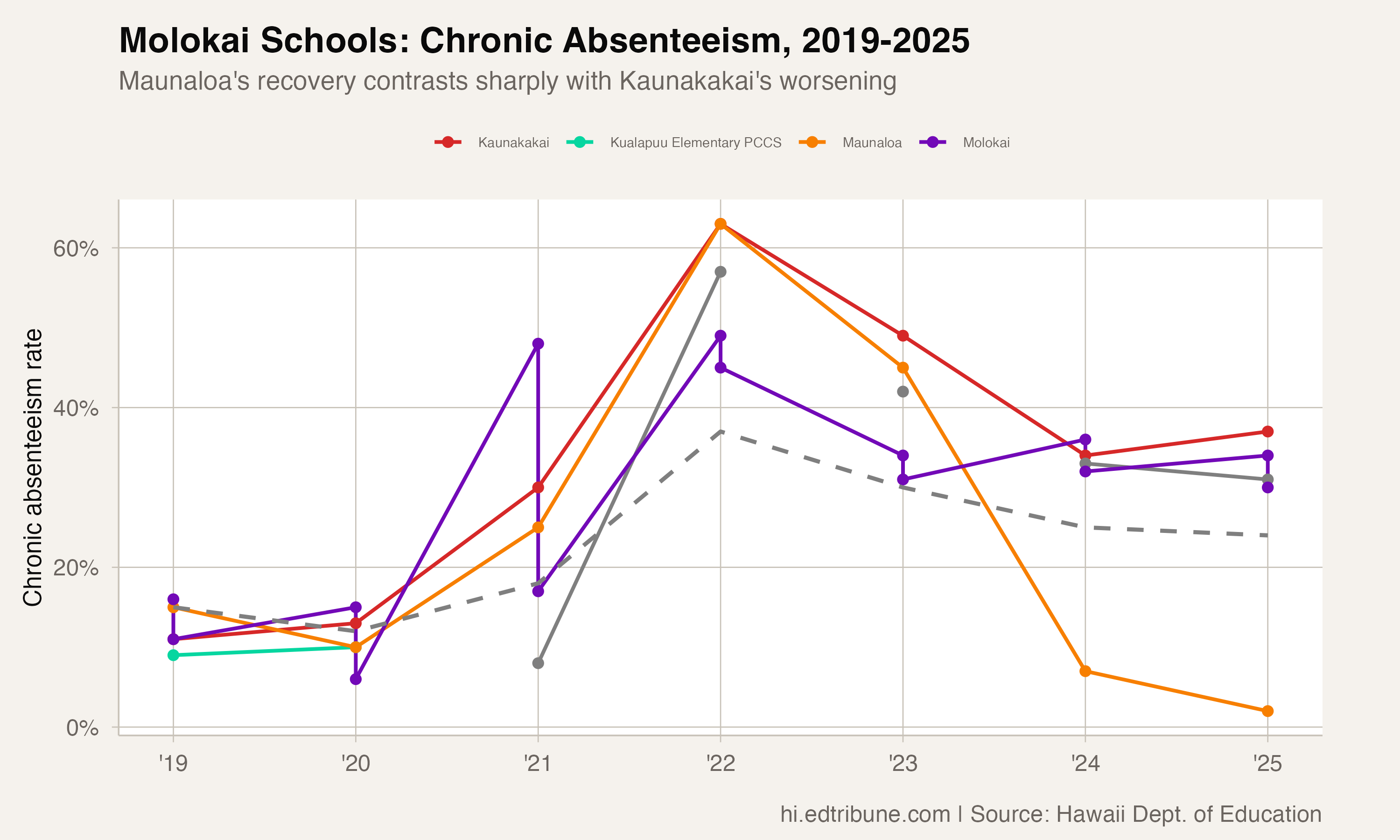
On the newer measure, Maunaloa's 5-point drop from 2023-24 to 2024-25 was the largest among Molokai's six public schools. Kualapu'u Conversion Charter, Molokai Middle, and Molokai High each fell 2 points, to 31%, 30%, and 34%. Kaunakakai Elementary rose 3 points, from 34% to 37%, and Kilohana Elementary rose 15, from 17% to 32%.
Under the older measure, every Molokai school fell between 2021-22 and 2022-23. Kilohana fell most, from 69% to 38%. Kaunakakai, which had the same 63% peak as Maunaloa in 2021-22, fell to 49% the following year, while Maunaloa fell to 45%.
Questions Worth Asking
Two straight years near the bottom of the state's table, on the same measure, is a record worth understanding. The state's attendance files do not say what produced it. They record rates, not the leadership, family outreach, or community partnerships that could shape them, and they carry no enrollment counts, so they cannot show whether the student body changed or how many students each percentage point represents.
What they do show is that on the measure Hawaii now uses, Maunaloa's students missed school less often than students almost anywhere else in the state.
Attendance figures come from the Hawaii Department of Education's school accountability reports, covering 2018-19 through 2024-25.
Detailed code that reproduces the analysis and figures in this article is available exclusively to EdTribune subscribers.
Discussion
Sign in to join the discussion.
Loading comments...