Correction (September 30, 2026): An earlier version said King Kamehameha III Elementary's chronic absence rate fell from 67% in 2021-22 to 24% in 2024-25, a 43-point recovery, and compared each Lahaina school's 2024-25 rate with its rate before the pandemic. Hawaii changed how it counts chronic absence in 2023-24, from students absent 15 or more days to students absent 18 or more days, so those years are not directly comparable. The earlier version also described 2022-23 as the year of the fire; that school year ended before the August 2023 fire. The comparisons now stay within one measure. A news-sourced enrollment figure and an unlinked casualty figure were removed, and the mental health findings now cite the University of Hawaii's own release.
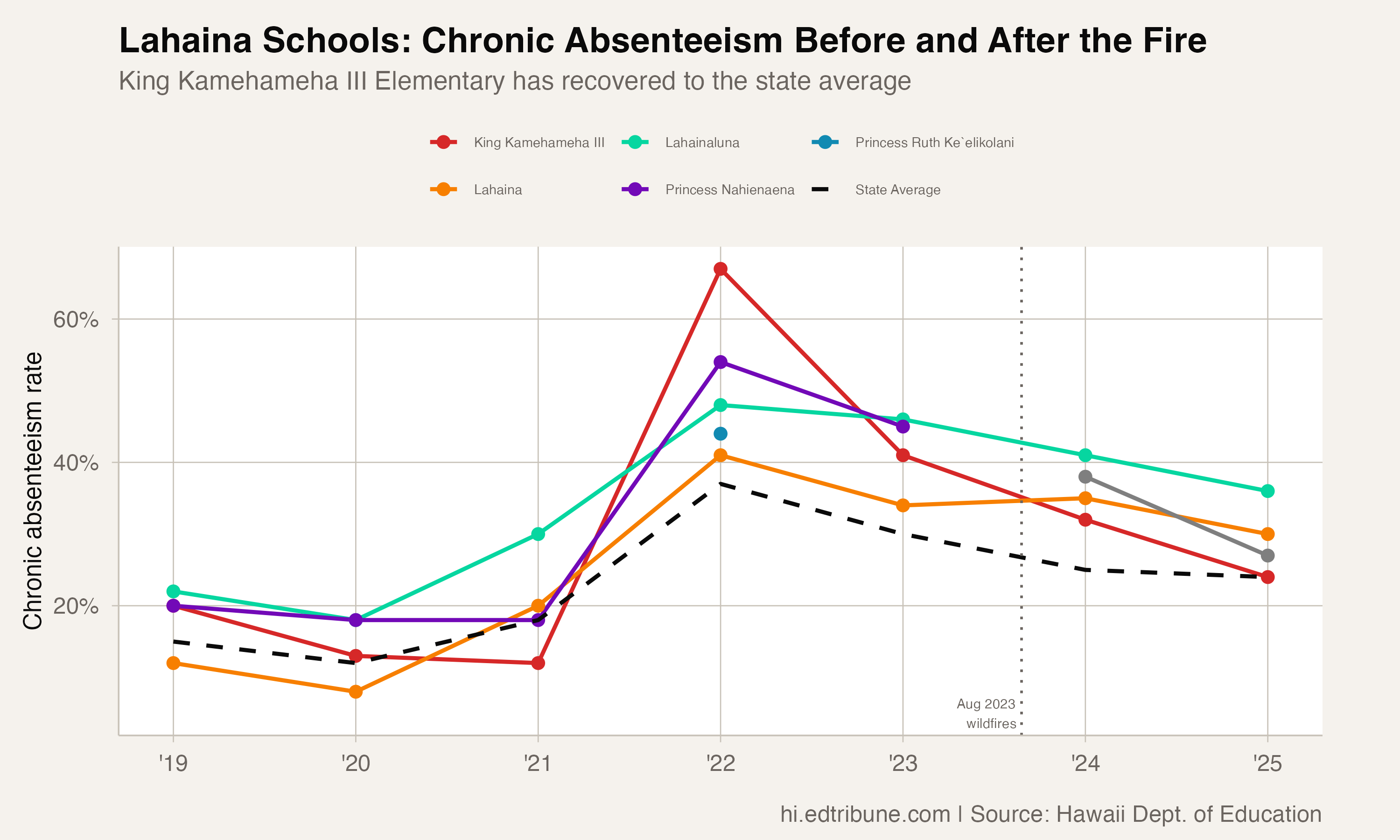
The August 2023 Lahaina wildfire destroyed King Kamehameha III Elementary, the school known locally as K3, at the start of the 2023-24 school year. That same year, Hawaii changed how it counts chronic absence. So every attendance figure from before the fire uses one measure, and every figure since uses another.
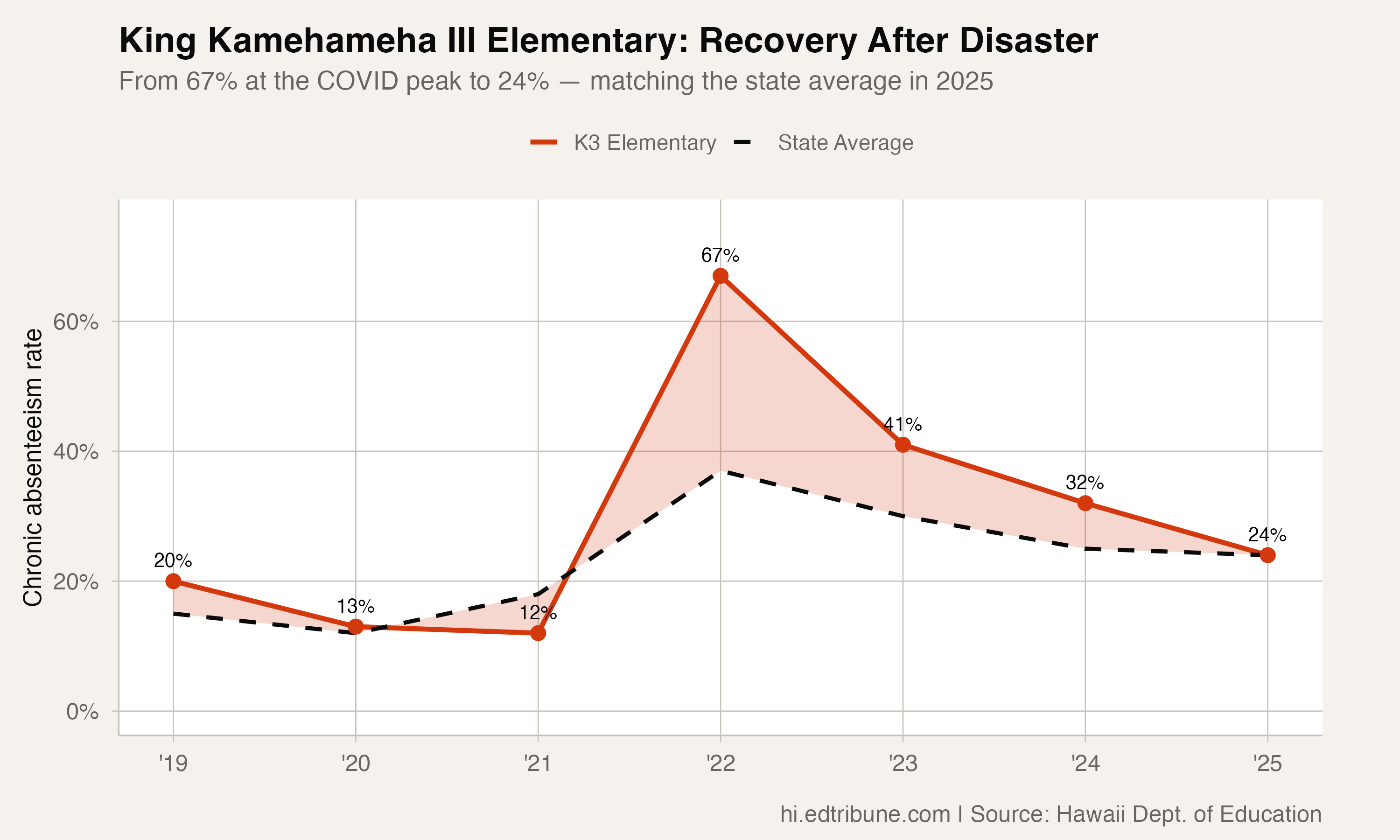
On the newer measure, which counts students absent 18 or more days, K3's rate fell from 32% in 2023-24 to 24% in 2024-25. The statewide rate went from 25% to 24%. In the first year after the fire, K3 was 7 points above the state. In the second, it matched it.
K3's 8-point drop was one of the larger one-year changes in the state. Of 293 schools with rates in both years, 19 fell by 8 points or more.
Before the Fire
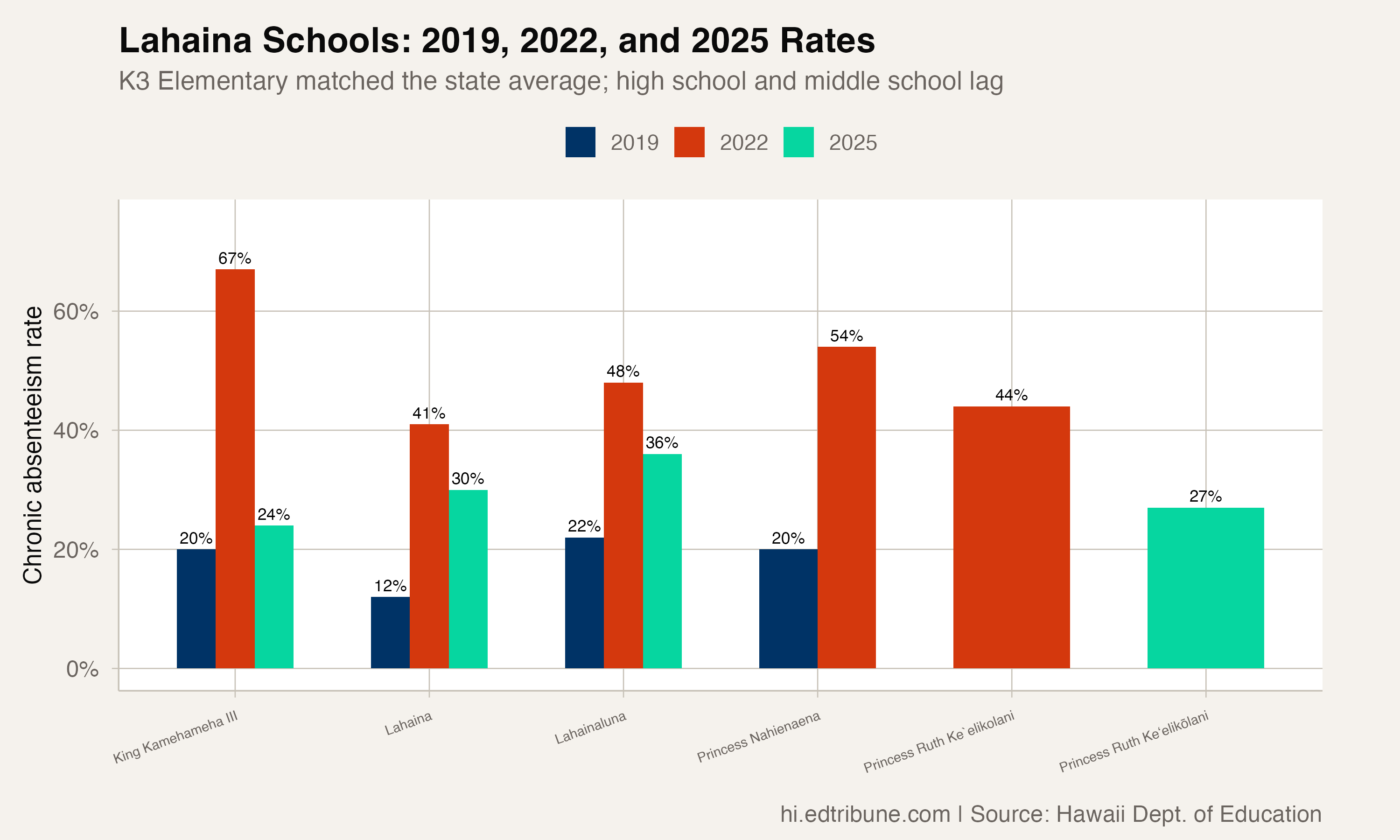
Under the older measure, which counted students absent 15 or more days, K3's rate was 20% in 2018-19. It peaked at 67% in 2021-22, when the statewide rate was 37%, and fell 26 points to 41% in 2022-23, the last school year before the fire.
Those older figures describe a different measure and a school that still had its building. They cannot be set directly against the 24% of 2024-25.
The Other Lahaina Schools
Lahaina Intermediate and Lahainaluna High also improved between the two post-fire years, and by more than the state. Lahaina Intermediate went from 35% in 2023-24 to 30% in 2024-25, and Lahainaluna from 41% to 36%. Each fell 5 points, against 1 point statewide.
Both schools remain above the state rate, as they were before the fire. Under the older measure, Lahaina Intermediate peaked at 41% and Lahainaluna at 48% in 2021-22; in 2022-23 they were at 34% and 46%.
What Students Are Carrying
Attendance data do not capture what these students went through.
The University of Hawaii's Maui Wildfire Exposure Study found that 51% of children ages 10 to 17 screened positive for depression, about 30% reported anxiety symptoms, and nearly 45% still showed signs of PTSD two years after the fires.
The state's attendance files cannot say why K3's rate fell. They do not record how many students left Maui or returned, which services reached which families, or how a year on a temporary campus shaped the next one. It is possible that the families who stayed, or came back, differ from those who left. The files carry no enrollment counts, so they cannot show how much the student body changed.
What Comes Next
K3 matched the state rate in only its second year after the fire, on a measure that has existed for two years. Whether it holds there is a question the 2025-26 data will begin to answer.
Attendance figures come from the Hawaii Department of Education's school accountability reports, covering 2018-19 through 2024-25.
Detailed code that reproduces the analysis and figures in this article is available exclusively to EdTribune subscribers.
Discussion
Sign in to join the discussion.
Loading comments...