Correction (September 30, 2026): An earlier version compared the 2024-25 chronic absence rate for students eligible for free or reduced-price lunch with their 2018-19 rate, said the gap with all students was a third larger than before the pandemic, and projected when the gap would return to its earlier size. Hawaii changed how it counts chronic absence in 2023-24, from students absent 15 or more days to students absent 18 or more days, so rates on either side of the change are not directly comparable. Those comparisons and the projection have been removed, and changes are now reported within each measure. The earlier version also described this group as economically disadvantaged or low-income; the state reports it as eligibility for free or reduced-price lunch. Several outside figures on housing and youth mental health that could not be confirmed at their cited sources were removed.
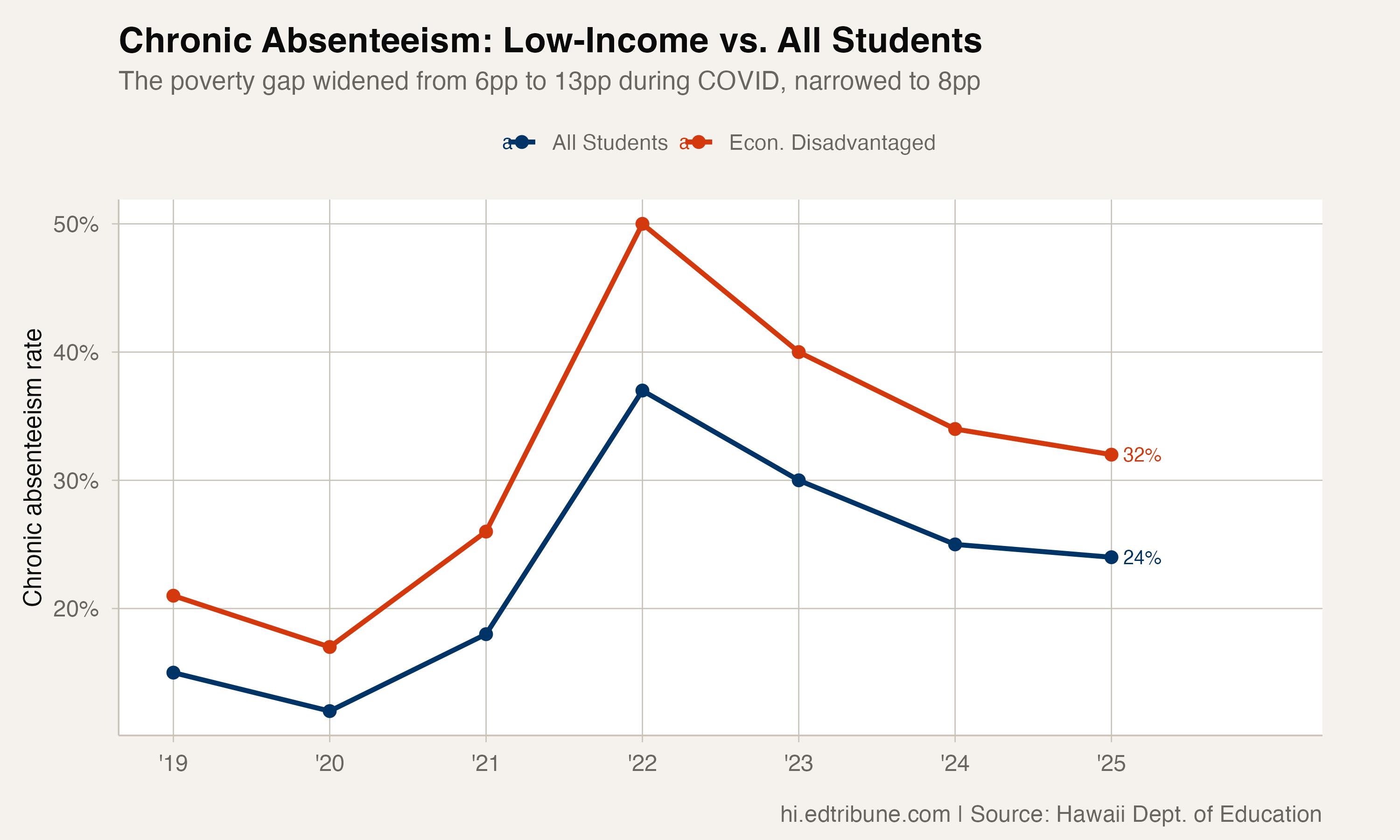
In 2024-25, 32% of Hawaii students eligible for free or reduced-price lunch were chronically absent, meaning they missed 18 or more days of school. That is nearly one in three. The rate for all students was 24%.
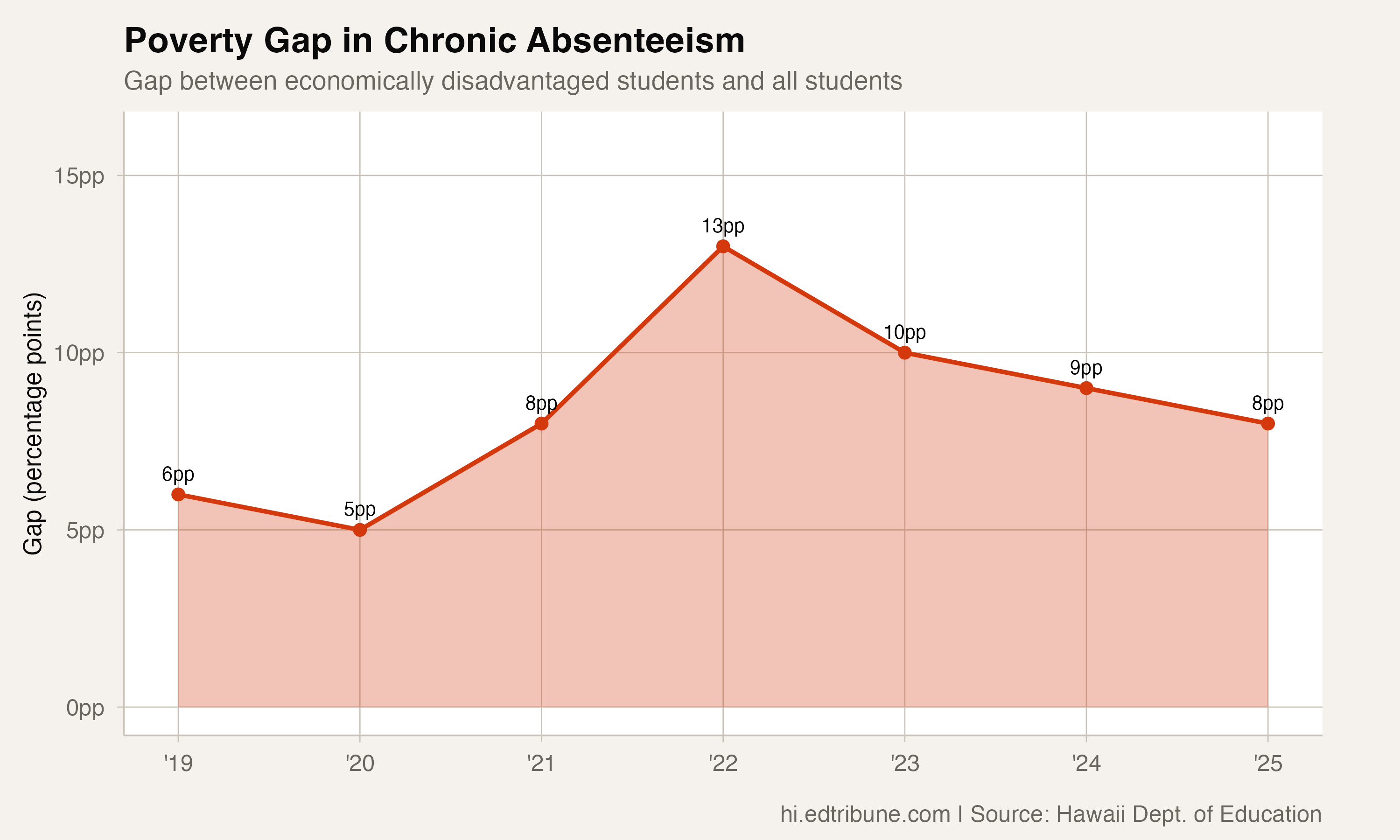
The gap between the two groups has narrowed, but that finding comes with a condition. Hawaii changed how it counts chronic absence in 2023-24, so the gap can only be tracked honestly inside each measure.
A Gap That Narrowed Twice
Under the older measure, which counted students absent 15 or more days, the gap between lunch-eligible students and all students was 6 percentage points in 2018-19. It widened to 13 points in 2021-22, when 50% of lunch-eligible students were chronically absent against 37% of all students. By 2022-23 it had narrowed to 10 points, as the lunch-eligible rate fell 10 points to 40% and the overall rate fell to 30%.
Under the newer measure, which counts students absent 18 or more days, the gap was 9 points in 2023-24 and 8 points in 2024-25. The lunch-eligible rate fell 2 points, from 34% to 32%, while the overall rate fell 1 point, from 25% to 24%.
The direction is the same under both measures. The levels are not comparable across the change: rates from 2023-24 on run lower partly because a student now has to miss more days to be counted.
Where the Gap Is Widest
At the school level, the gap can be far wider than the statewide 8 points. Among the 294 schools that reported rates for both groups in 2024-25, Kamilo'iki Elementary had the largest: 14% of all its students were chronically absent, against 36% of its lunch-eligible students, a 22-point gap. Niu Valley Middle had one of the next largest, 17 points, with 11% of all students and 28% of lunch-eligible students chronically absent.
The highest rates for lunch-eligible students were at Olomana School (77%), Ho'okena Elementary (63%), and Connections PCS (61%). Five schools on Oahu's Waianae Coast were also in the top ten: Wai'anae High (59%), Nanaikapono Elementary (58%), Wai'anae Elementary (56%), Makaha Elementary (55%), and Kamaile Academy (54%).
Overlapping Groups
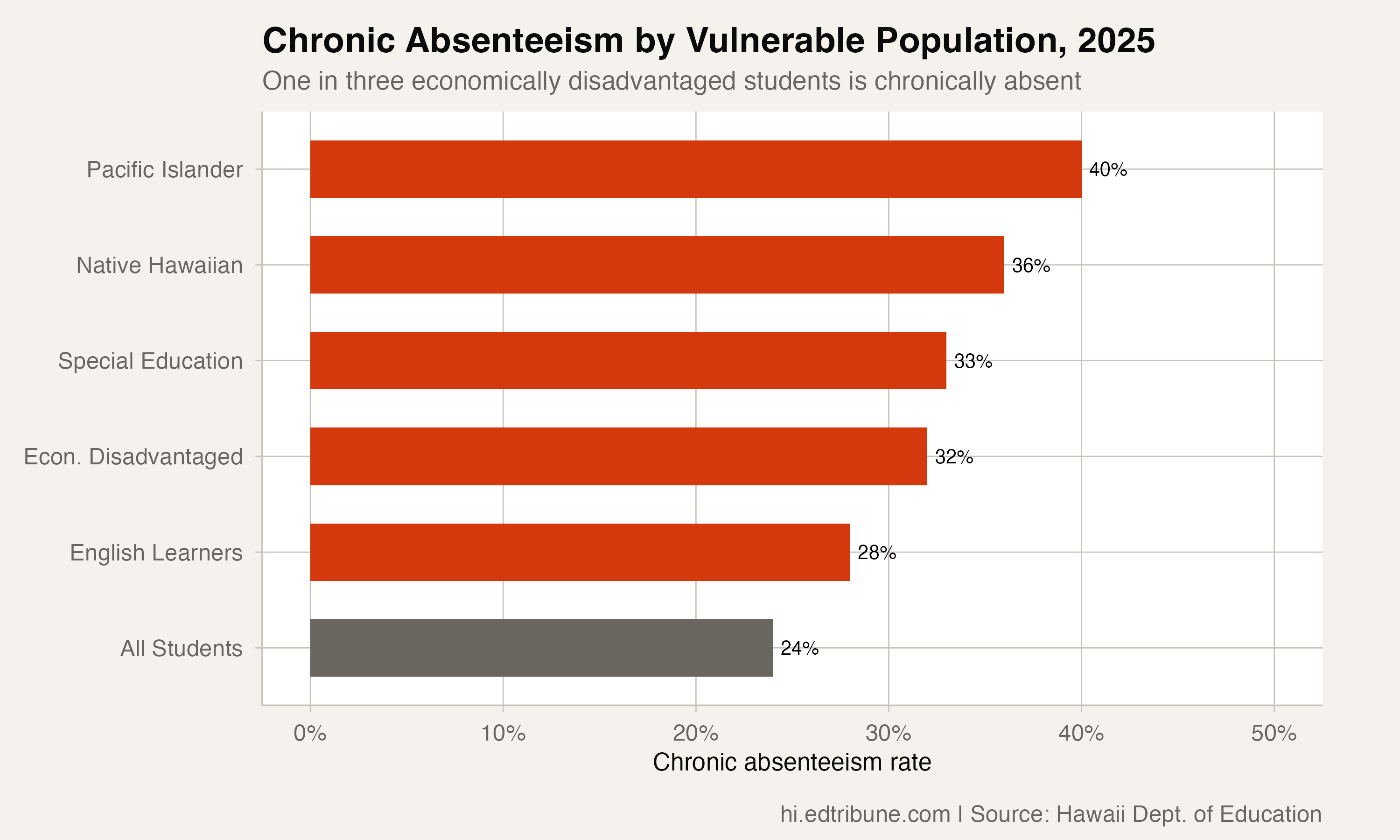
The 32% rate for lunch-eligible students sits alongside other published group rates for 2024-25:
- Pacific Islander students: 40%
- Native Hawaiian students: 36%
- Students receiving special education services: 33%
- Students eligible for free or reduced-price lunch: 32%
- English learners: 28%
- All students: 24%
These groups overlap. A student who is Pacific Islander and lunch-eligible is counted in both rows, so the figures are separate measures rather than pieces of one whole, and they cannot be added or netted against each other.
What the Data Cannot Say
Housing costs, health care access, and transportation are often cited as reasons students miss school, and all three bear down on families in Hawaii. The state's attendance files do not record any of them, so they cannot say how much each contributes to the gap, or why it narrowed.
Attendance figures come from the Hawaii Department of Education's school accountability reports, covering 2018-19 through 2024-25.
Detailed code that reproduces the analysis and figures in this article is available exclusively to EdTribune subscribers.
Discussion
Sign in to join the discussion.
Loading comments...