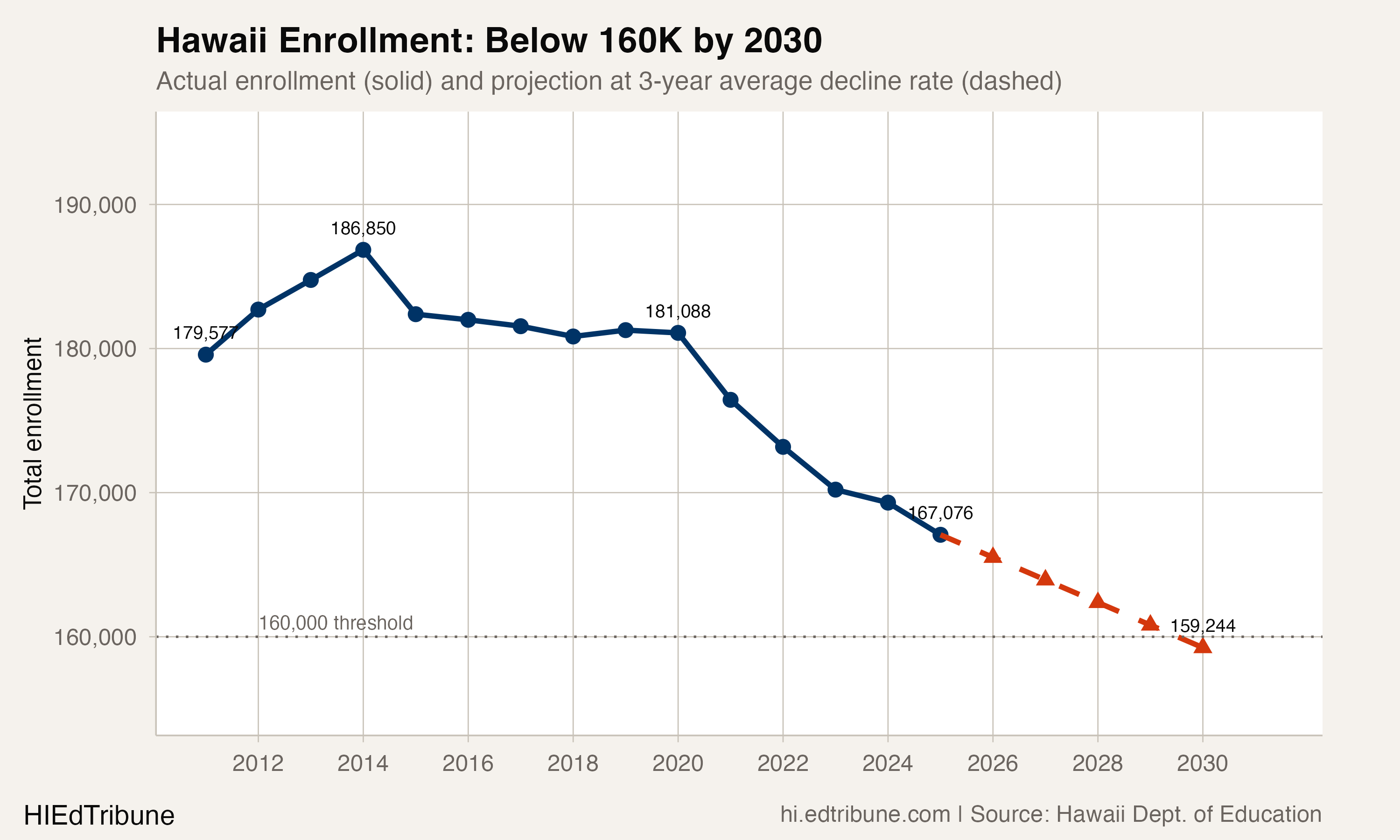
In 2024, Hawaii's public school enrollment slipped below 170,000 for the first time in modern records. A year later, it fell again to 167,076. At the three-year average rate of decline, the state will cross below 160,000 by 2030, a threshold that was hard to imagine a decade ago, when enrollment peaked at 186,850.
The projection is not a forecast. It assumes the recent pace of loss holds steady. But the forces driving it, declining births and persistent outmigration, are accelerating, not moderating. Hawaii is already 13,682 students below where a pre-COVID trend line would have placed enrollment in 2025.
The arithmetic of 160,000
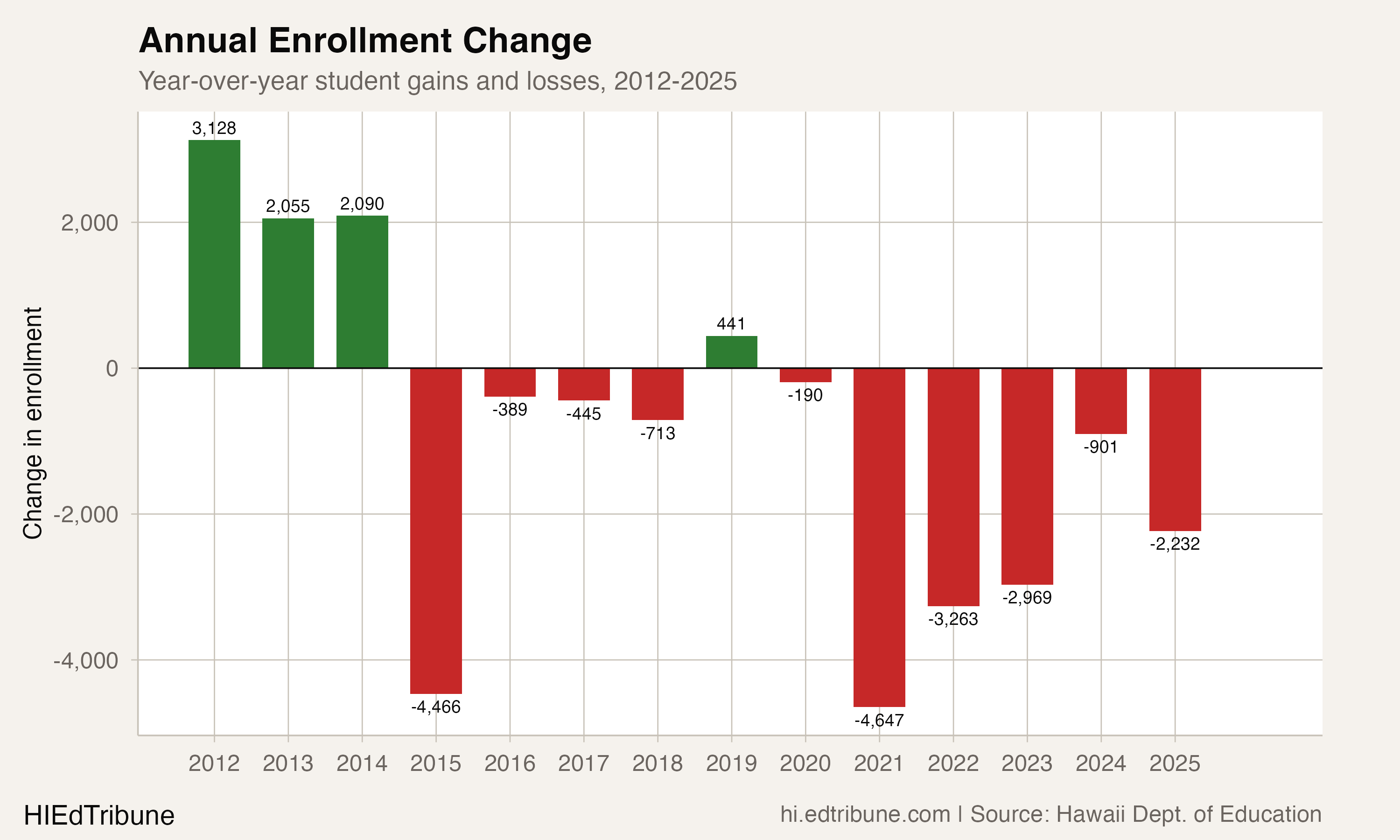
Hawaii lost 2,232 students in the 2024-25 school year, a 1.3% decline. That followed losses of 901 in 2023-24 and 2,969 in 2022-23. Averaging the last two years produces a pace of -1,566 students per year. Extend that line five years and enrollment reaches 159,244 by 2030.
The loss rate has varied considerably. COVID delivered the single largest drop: 4,647 students vanished between 2020 and 2021, a 2.6% decline in one year. But the pandemic did not create the trajectory. It deepened one that started after the 2014 peak. Since that high of 186,850, Hawaii has lost 19,774 students, a 10.6% decline over 11 years. The only year in that span to show a gain was 2019, when enrollment ticked up by 441 students before resuming its slide.
The state's five-year compound annual growth rate stands at -1.6%. At that pace, enrollment would reach roughly 154,000 by 2030, an even bleaker trajectory than the two-year linear projection.
13,682 students missing from the trajectory
One way to measure the depth of the current decline is to compare actual enrollment against where the pre-COVID trend was heading. A linear model fit to 2011-2019 data projects 2025 enrollment at 180,758. The actual figure of 167,076 falls 13,682 below that line.
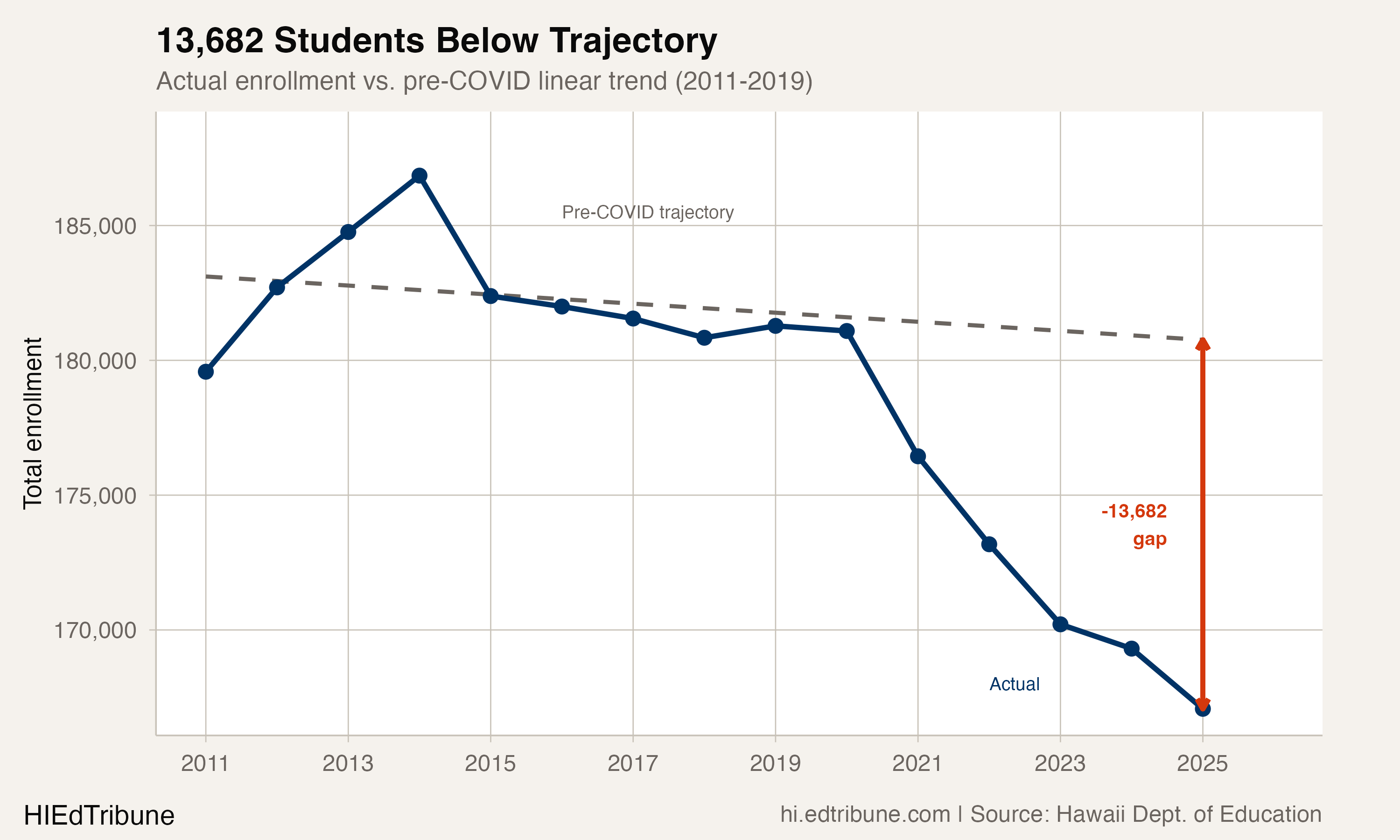
The pre-COVID trend was itself essentially flat, declining at only 168 students per year from 2011 to 2019. Hawaii was not growing, but it was not collapsing. The pandemic broke the equilibrium. Between 2020 and 2025, the state lost 14,012 students, roughly 2,800 per year, a pace 17 times the pre-COVID rate.
Not all of that acceleration traces to the pandemic itself. Birth rates began falling in 2016, and the children born in those smaller cohorts are now entering kindergarten. The pandemic-era losses compounded a demographic pipeline that was already narrowing.
Where the pipeline narrows
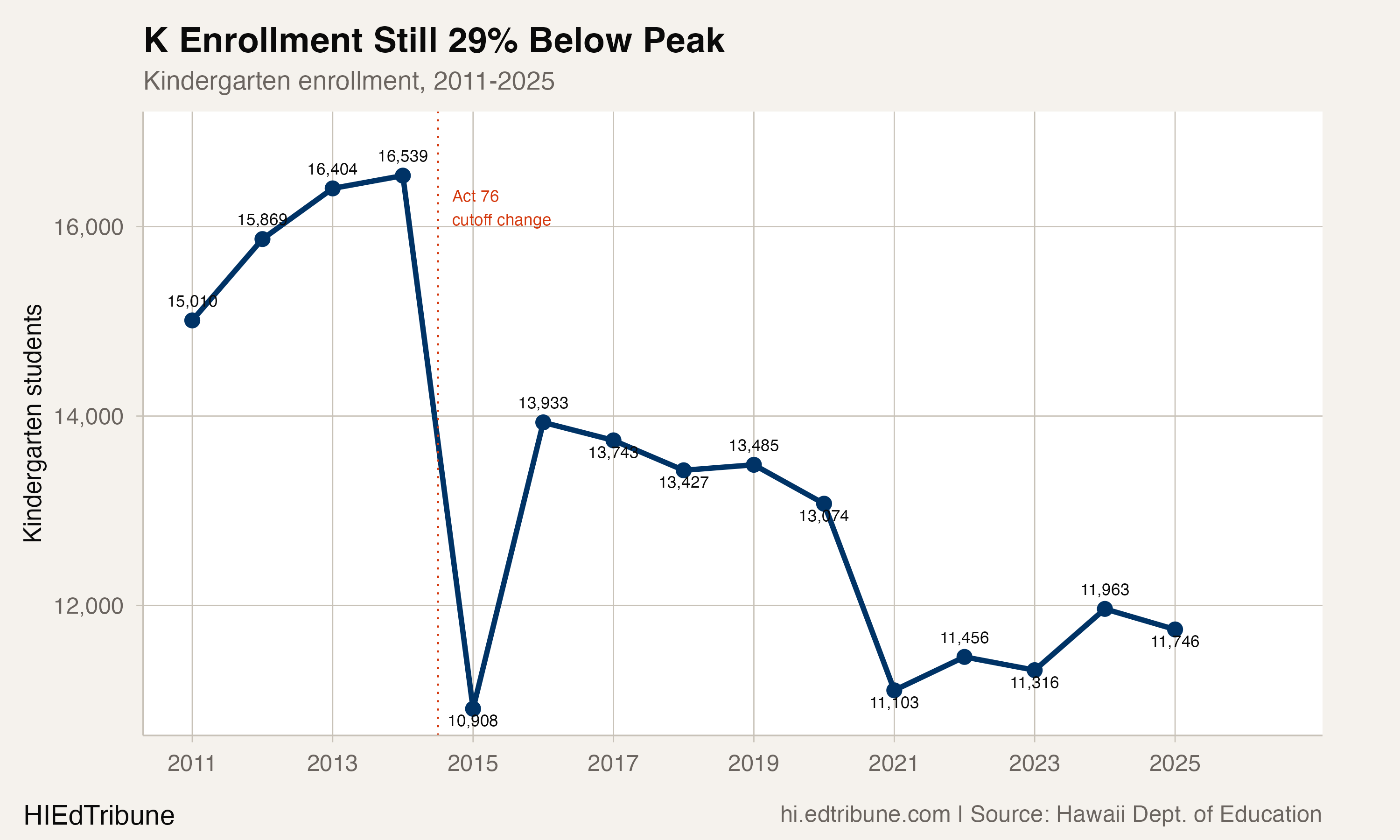
The most direct evidence of what the next decade holds sits in kindergarten enrollment. Hawaii's K class peaked at 16,539 in 2014. The following year, Act 76 moved the kindergarten age cutoff from December 31 to July 31, immediately excluding thousands of children from eligibility. K enrollment crashed 34.0% in a single year, dropping to 10,908.
A decade later, the kindergarten class has never recovered. The 2025 class of 11,746 remains 29.0% below the pre-cutoff peak. The partial rebound to 13,933 in 2016 proved temporary. Since then, K enrollment has drifted downward, settling into a band between 11,100 and 12,000.
Those smaller kindergarten cohorts are now moving through the system. As they progress through elementary and middle school, each grade level shrinks. Meanwhile, the larger pre-Act 76 cohorts are graduating. In 2025, Hawaii enrolled 11,905 twelfth graders but only 11,746 kindergartners. That means the system is losing more students at the top than it is replacing at the bottom, a structural guarantee that total enrollment will continue falling even if no additional families leave.
The forces behind the numbers
Two mutually reinforcing pressures are driving the decline: fewer children are being born in Hawaii, and families with children are leaving.
Hawaii recorded 14,820 births in 2023, down from approximately 17,200 in 2016, a 14% drop. That decline feeds directly into kindergarten enrollment five years later. Each year of lower births translates into a smaller entering class, and those smaller classes propagate through 13 grades over the following decade.
Outmigration compounds the birth rate effect. Census estimates show Hawaii lost a net 2,132 residents in fiscal 2025, with approximately 8,876 residents leaving for other states. The loss is cumulative. Hawaii has shed nearly 22,500 residents since 2020. An Aloha United Way report found that one in three Hawaii households considered moving away in the past year, with roughly 180,000 people actively contemplating departure.
The cost of living is the most frequently cited driver. Hawaii's median home price exceeds $1 million in some markets, and 29% of households qualify as ALICE (Asset Limited, Income Constrained, Employed), meaning they earn too much for public assistance but too little to cover basic expenses. When those families leave, they take school-age children with them.
Not all students who leave public schools leave the state. Hawaii has one of the nation's highest private school enrollment rates, and some families shift to homeschooling or private options rather than relocating. The enrollment data cannot distinguish between families who moved to the mainland and those who chose a different school type. Both reduce public school headcount, but the implications for community demographics are different.
What reporting suggests
The Western Interstate Commission for Higher Education projects the consequences will be severe and sustained.
"Hawaii could see a 33% drop in the number of students graduating from high school" between 2023 and 2041, the highest rate in the nation. -- Honolulu Civil Beat, January 2026
The national average decline over the same period is projected at 10%. Hawaii's rate triples that. If the WICHE projection holds, annual public school graduates would fall from roughly 11,500 in 2023 to just over 7,600 by 2041.
The Department of Education has acknowledged the trajectory. DOE Deputy Superintendent Curt Otaguro told lawmakers that the system faces a structural mismatch between facilities built for a larger student body and the revenue generated by a shrinking one.
"We've got more need than we have money and resources." -- Honolulu Civil Beat, January 2023
The DOE has shifted its strategy from school closures to "district optimization," a process of redrawing attendance boundaries to rebalance enrollment across campuses before considering consolidation. Redistricting is expected to begin in the 2026-27 school year. The department will not make consolidation decisions until spring 2028. Thirty-four schools currently enroll fewer than 250 students.
All four counties are shrinking
The decline is not isolated to one island. All four county systems, Honolulu↗ET, Hawaii County↗ET, Maui↗ET, and Kauai↗ET, are at all-time enrollment lows in 2025.
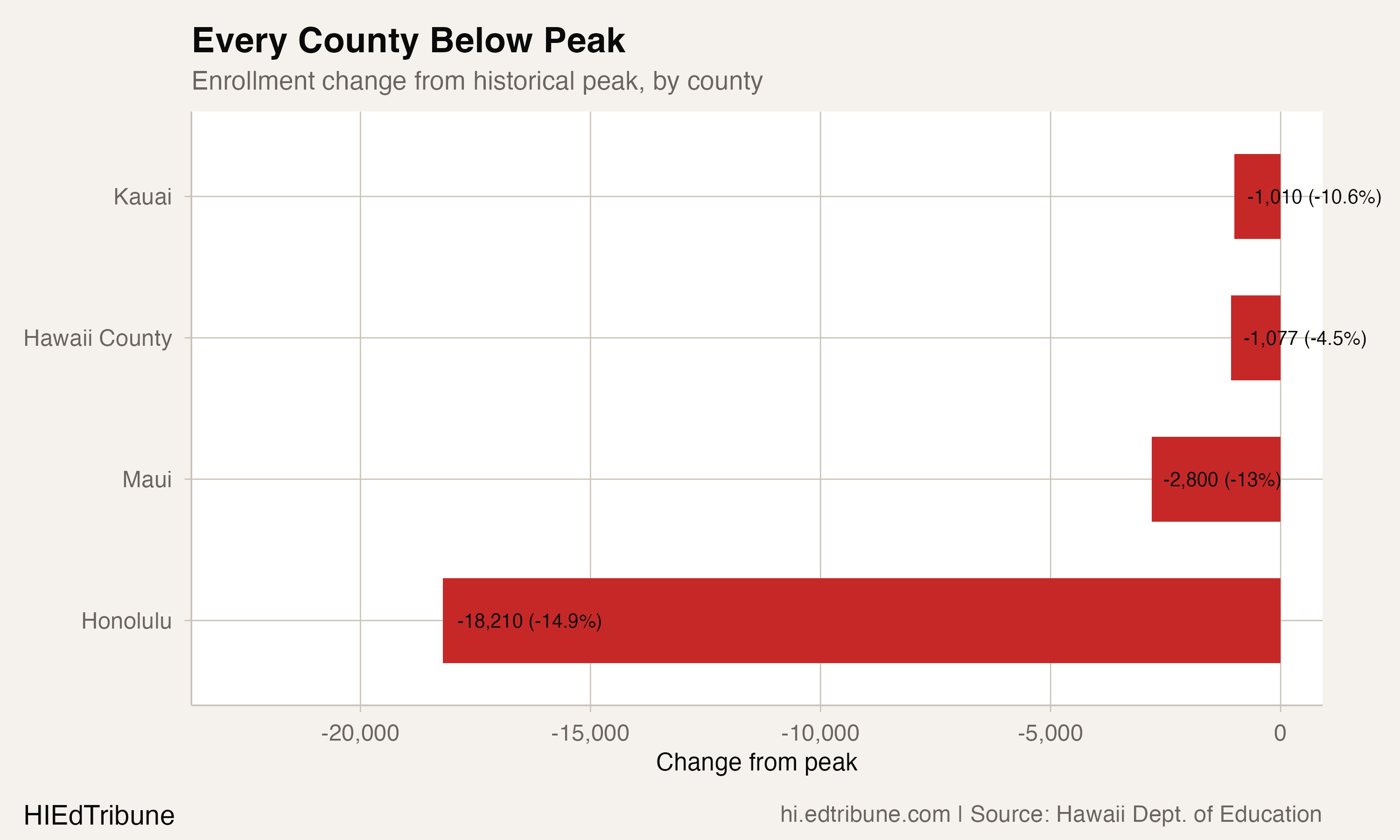
Honolulu accounts for the bulk of the loss: 18,210 students, a 14.9% decline from its 2014 peak. That single-county loss is larger than Maui's entire current enrollment of 18,734. Maui has lost 2,800 students (-13.0%), a decline accelerated by the August 2023 Lahaina wildfire, which displaced roughly 20% of Lahaina school enrollment. Kauai is down 1,010 (-10.6%) and Hawaii County 1,077 (-4.5%).
The only entity posting gains is the charter sector, which enrolled a record 13,094 students in 2025. Charter share has grown from 4.7% to 7.8% since 2011. But charter growth has not offset traditional losses. Charters added 4,727 students over 15 years while traditional county schools lost 17,228. The charter sector absorbed roughly 27% of the traditional system's decline.
The next five years
If the 160,000 threshold seems distant, consider that Hawaii was at 181,088 just five years ago. The state has lost 14,012 students in that span, an average of 2,800 per year. The two-year projection of -1,566 per year is actually the optimistic scenario. It assumes the pace of loss moderates.
The birth rate data suggests otherwise. Children born in 2023 will enter kindergarten in 2028 or 2029. With births at 14,820, down from 16,810 just four years earlier, the entering classes of the late 2020s will be smaller still. The pipeline does not recover until birth rates stabilize, and there is no indication that they have.
Board of Education Chair Bruce Voss has called the decline "a significant concern." What remains unclear is whether it becomes a crisis that forces school closures, or whether redistricting can stretch existing campuses to cover the gap. Hawaii has not closed a school since 2011.
Detailed code that reproduces the analysis and figures in this article is available exclusively to EdTribune subscribers.
Discussion
Sign in to join the discussion.
Loading comments...