A Harvard-Stanford study ranked Hawaii's public schools second nationally in reading recovery and fourth in math recovery since the pandemic. By the usual metrics of school quality, the system is working.
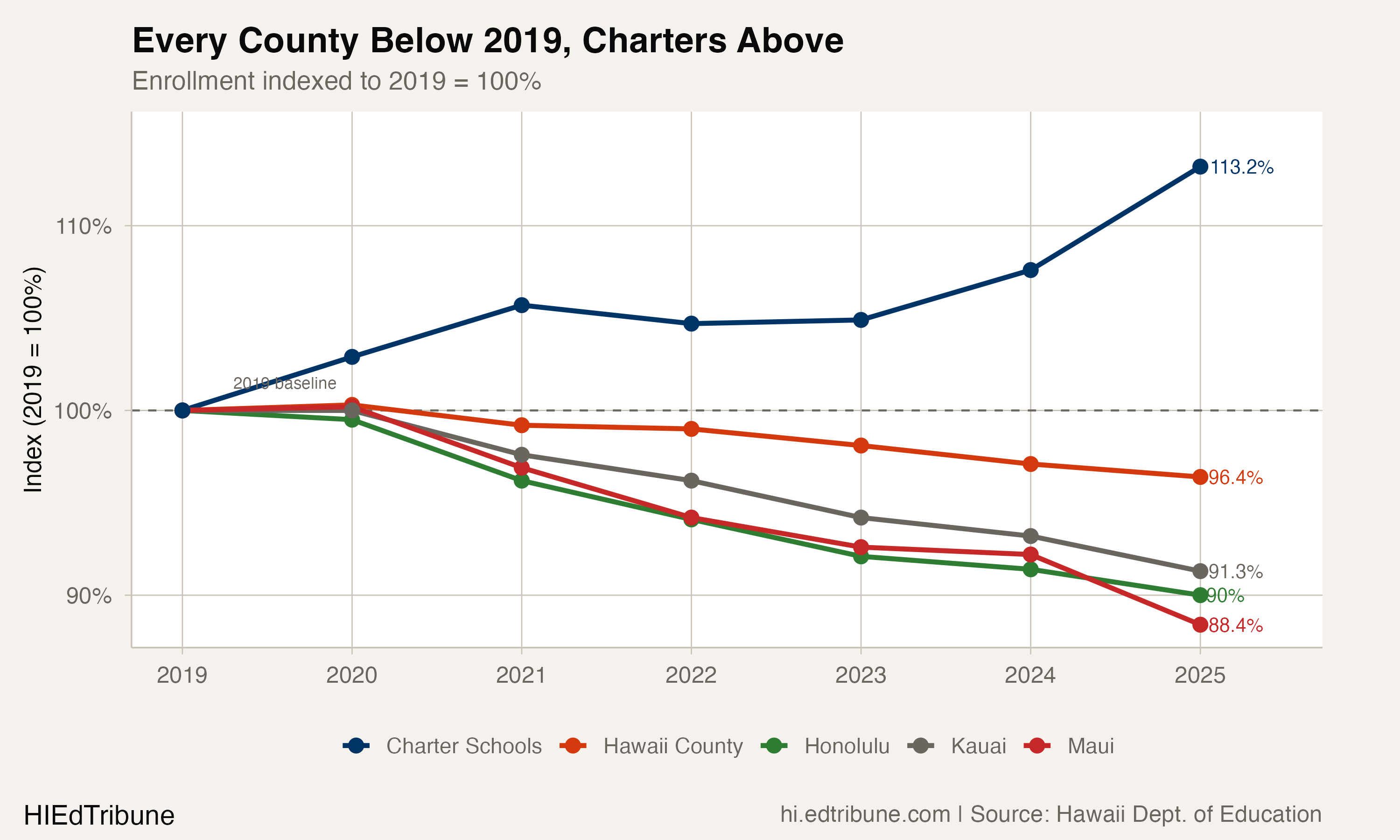
The enrollment data tells a different story. Hawaii's public schools enrolled 167,076 students in 2024-25, down 14,202 from pre-pandemic levels, a 7.8% loss. Every county system was further below its 2019 enrollment in 2024-25 than it was at the initial COVID trough in 2020-21. The students who left during the pandemic did not return. And thousands more have followed them out the door.
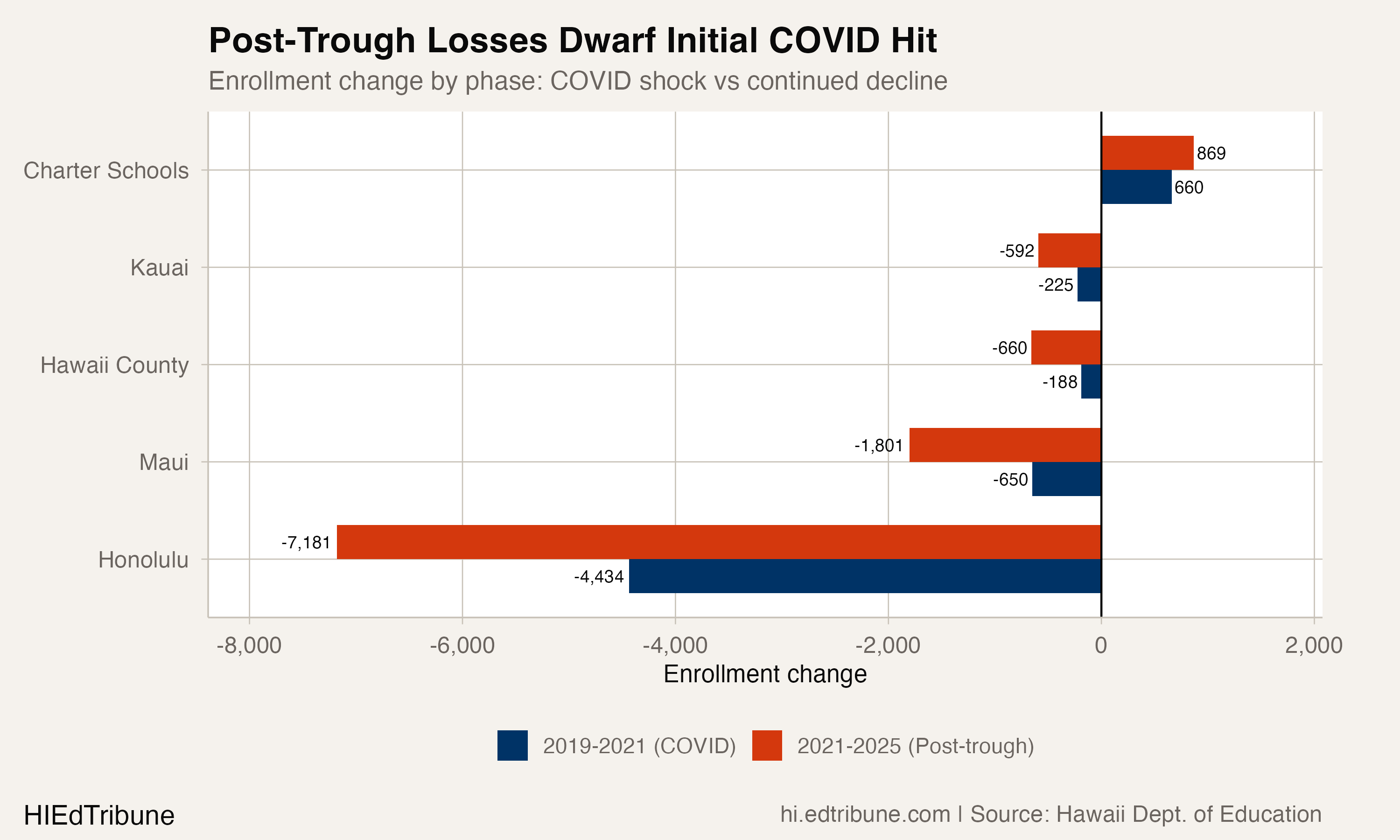
The post-trough losses since 2021 total 9,365 students, nearly double the 4,837-student hit from the pandemic's first two years. COVID was the accelerant, not the cause.
The geography of loss
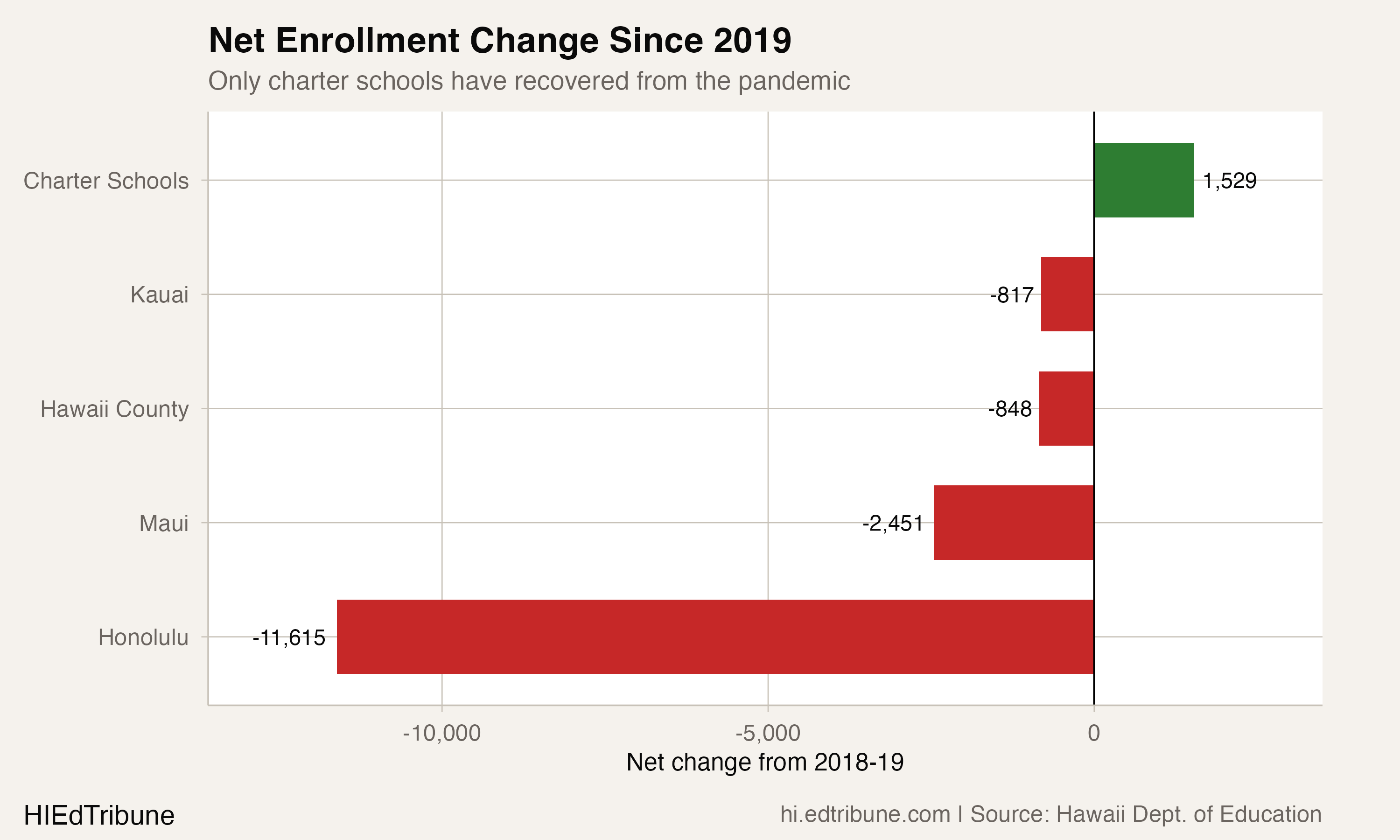
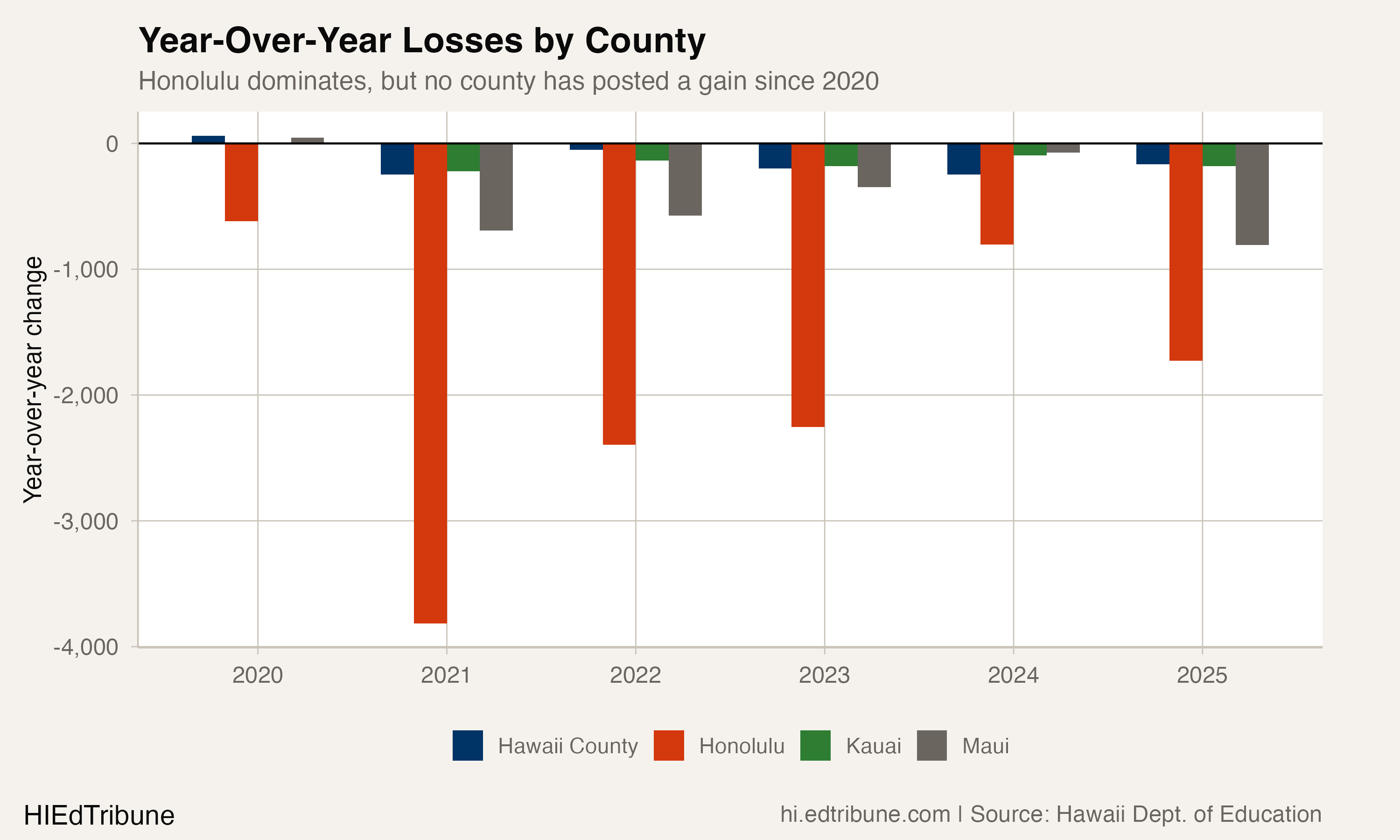
Honolulu↗ET accounts for 81.8% of the statewide decline from 2019, losing 11,615 students, a 10.0% drop. The county has posted a loss every year since 2020 and shows no sign of stabilizing: 2025's decline of 1,727 students was more than double the previous year's 803.
The neighbor islands are smaller in scale but steeper in rate. Maui↗ET is down 11.6% from 2019, the sharpest percentage decline of any county. The August 2023 Lahaina wildfire accelerated an existing trajectory: Maui's 2025 loss of 807 students was its largest single-year drop on record. Kauai↗ET fell 8.7%, and Hawaii County↗ET dropped 3.6%.
No county has posted even a single year of growth since 2020.
The post-trough crater
The conventional narrative frames COVID as a shock with a recovery arc. In Hawaii, there is no arc. The initial COVID hit, 4,837 students lost between 2019 and 2021, was just the opening. Every county has since lost substantially more than its initial pandemic hit.
Honolulu lost 4,434 students during COVID, then another 7,181 afterward, 1.6 times the original shock. Hawaii County's post-trough losses are 3.5 times its COVID-era losses. Maui's are 2.8 times, and Kauai's 2.6 times.
Statewide, the 9,365 students lost between 2021 and 2025 are 1.9 times the pandemic's initial blow. The pandemic did not create this decline. It revealed that families on the fence about public schooling, or about staying in Hawaii at all, needed only a push.
The charter exception
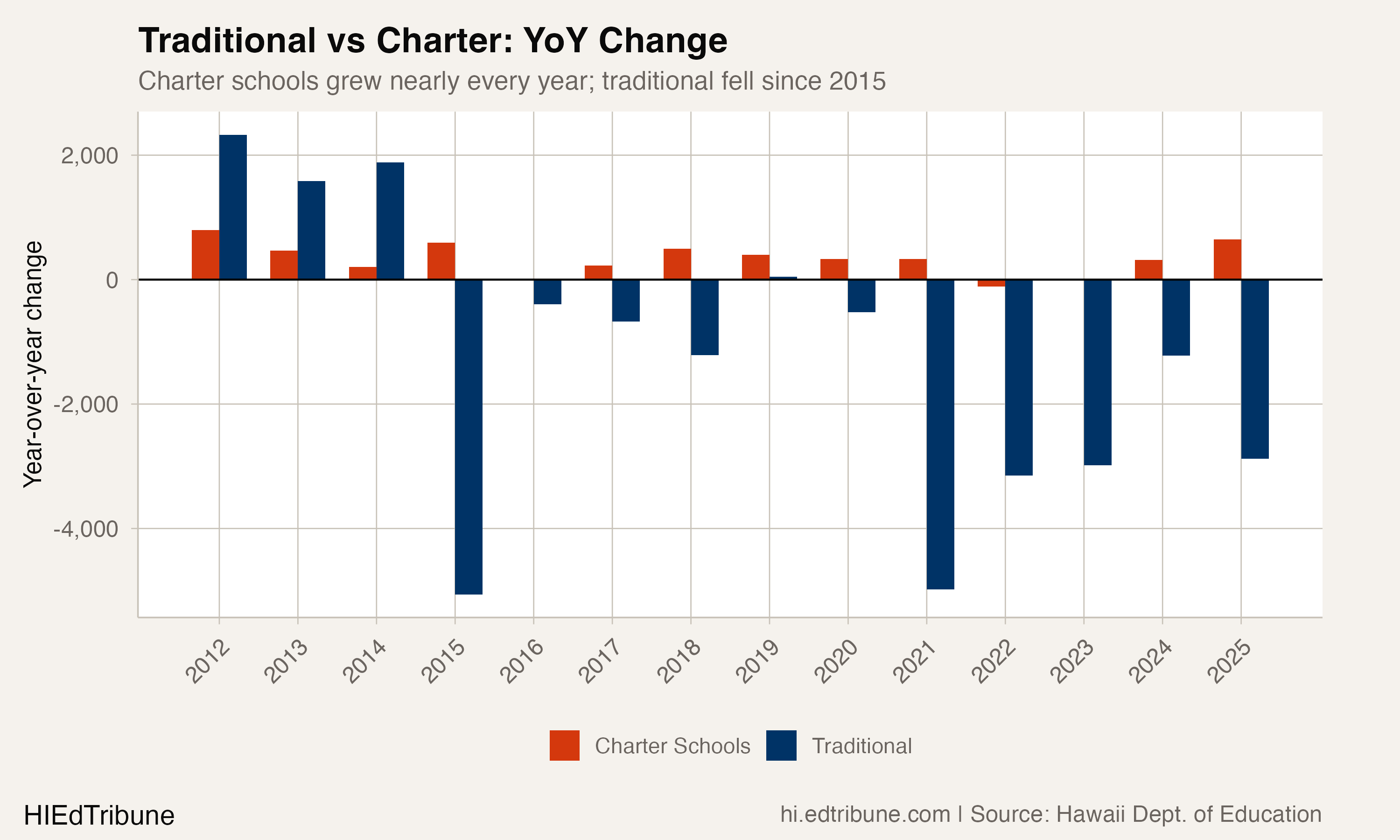
One sector grew through the pandemic and has continued growing since: charter schools. Hawaii's 38 charters enrolled 13,094 students in 2024-25, up 1,529 from 2019, a 13.2% gain. Charter share rose from 6.4% to 7.8% over that period.
Traditional county schools lost 15,731 students, 9.3%, over the same span. Charters grew in 13 of 14 year-over-year transitions since 2011, dipping only in 2022 before rebounding in 2023, 2024, and 2025.
"The consistent growth in both K-12 and pre-K charter enrollment highlights the increasing appeal of charter schools in Hawai'i, where families are seeking diverse and innovative educational options." Source: Hawaii State Public Charter School Commission, Oct 2024
The charter sector's 1,529-student gain offsets only 9.7% of the traditional system's 15,731-student loss. Charters are not draining the traditional system so much as catching a small share of a far larger outflow.
What is pulling families out
The most direct driver is demographic. Hawaii births fell from 16,810 in 2019 to 14,820 in 2023, a 14% decline since 2016 that ranks sixth-largest among all states. Fewer births five years earlier meant fewer kindergartners in 2024-25, which means smaller cohorts flowing through the entire pipeline.
Outmigration compounds the birth decline. Hawaii lost roughly 20,000 residents through net domestic migration between 2020 and 2024, and the Grassroot Institute of Hawaii reports that 70% of local workers surveyed are either planning to leave or considering it. Housing costs are the primary catalyst: median home prices exceed $750,000 in Honolulu, and more than half of residents spend over 30% of income on housing. Young families face the tightest squeeze: housing, childcare, and daily costs compound in ways that make the mainland an increasingly rational financial decision.
On Maui, the Lahaina wildfire displaced hundreds of families whose children attended schools that no longer physically exist. King Kamehameha III Elementary was destroyed, and Lahaina-area enrollment fell over 20% since the fire. Maui's 2025 enrollment of 18,734 is 13.0% below its 2014 peak of 21,534.
34 schools under pressure
The enrollment decline is not abstract. Civil Beat reported that 34 Hawaii schools now enroll fewer than 250 students, the threshold the DOE estimates is necessary to adequately fund a school. Eight elementary schools have budgets below $1.38 million annually, the minimum for basic operations.
The Department of Education has pivoted from closures to "district optimization," planning redistricting before consolidation. Board Chair Roy Takumi acknowledged that "closing a school isn't like closing your neighborhood Starbucks." By September 2025, Civil Beat reported that redistricting plans could take effect as early as fall 2026, with consolidation studies following in 2027. The state has not closed a department-run public school since 2011.
The paradox ahead
Hawaii's schools are getting better by the measures that education policy traditionally values. Test scores are recovering faster than nearly every other state. The 2024-25 Strive HI report showed postsecondary enrollment among the Class of 2024 rose to 53%, breaking a four-year plateau at 50-51%.
But academic recovery has not translated into enrollment recovery, and there is no reason to expect it will. The forces emptying Hawaii's classrooms, falling birth rates, housing costs that push families to the mainland, a wildfire that erased an entire school community, operate independently of school quality. A system that is teaching better is simultaneously shrinking in ways that will force difficult decisions about which campuses to consolidate and which communities lose their neighborhood school.
The 2026-27 kindergarten cohort, born during Hawaii's steepest birth decline, will enter a system already 14,202 students smaller than it was six years ago.
Detailed code that reproduces the analysis and figures in this article is available exclusively to EdTribune subscribers.
Discussion
Sign in to join the discussion.
Loading comments...