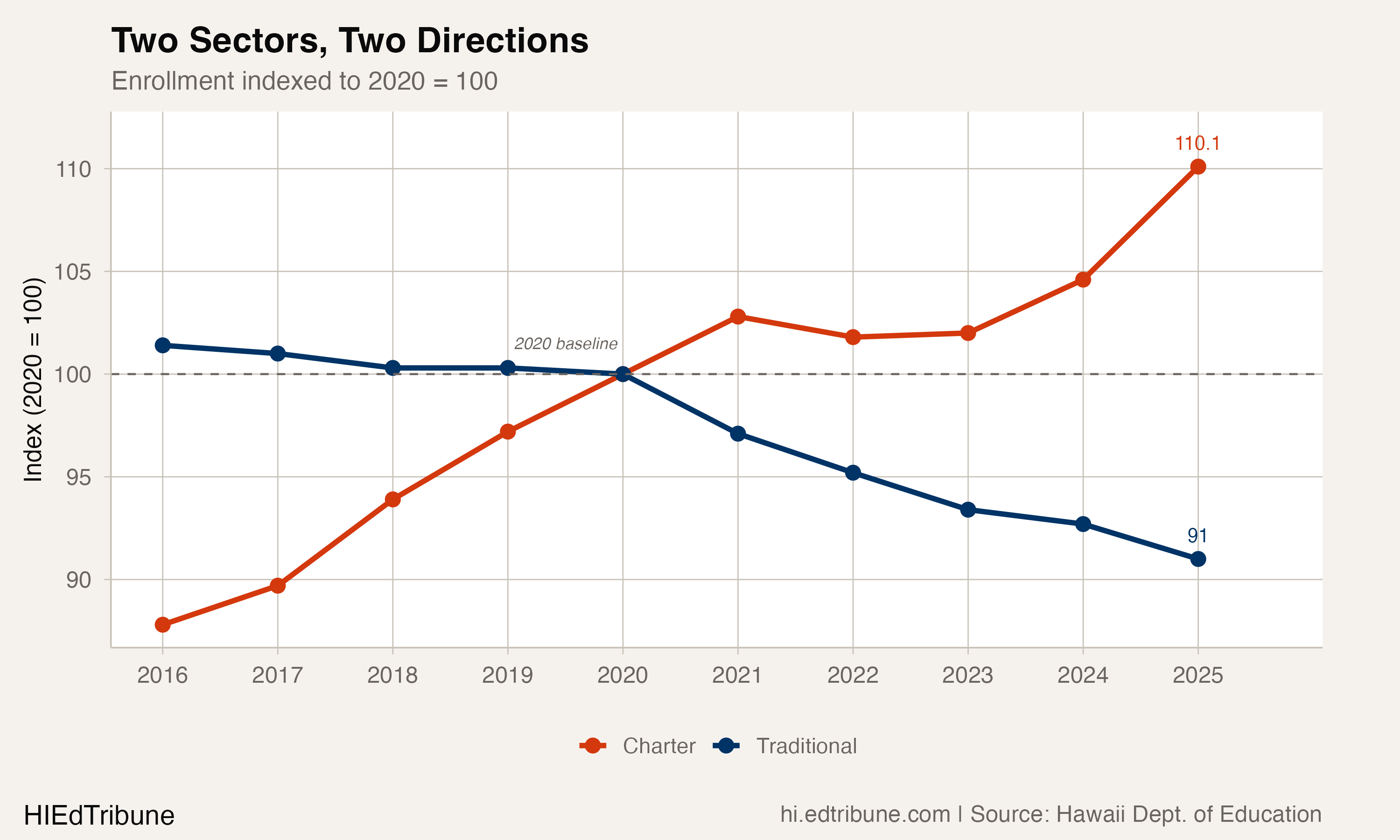
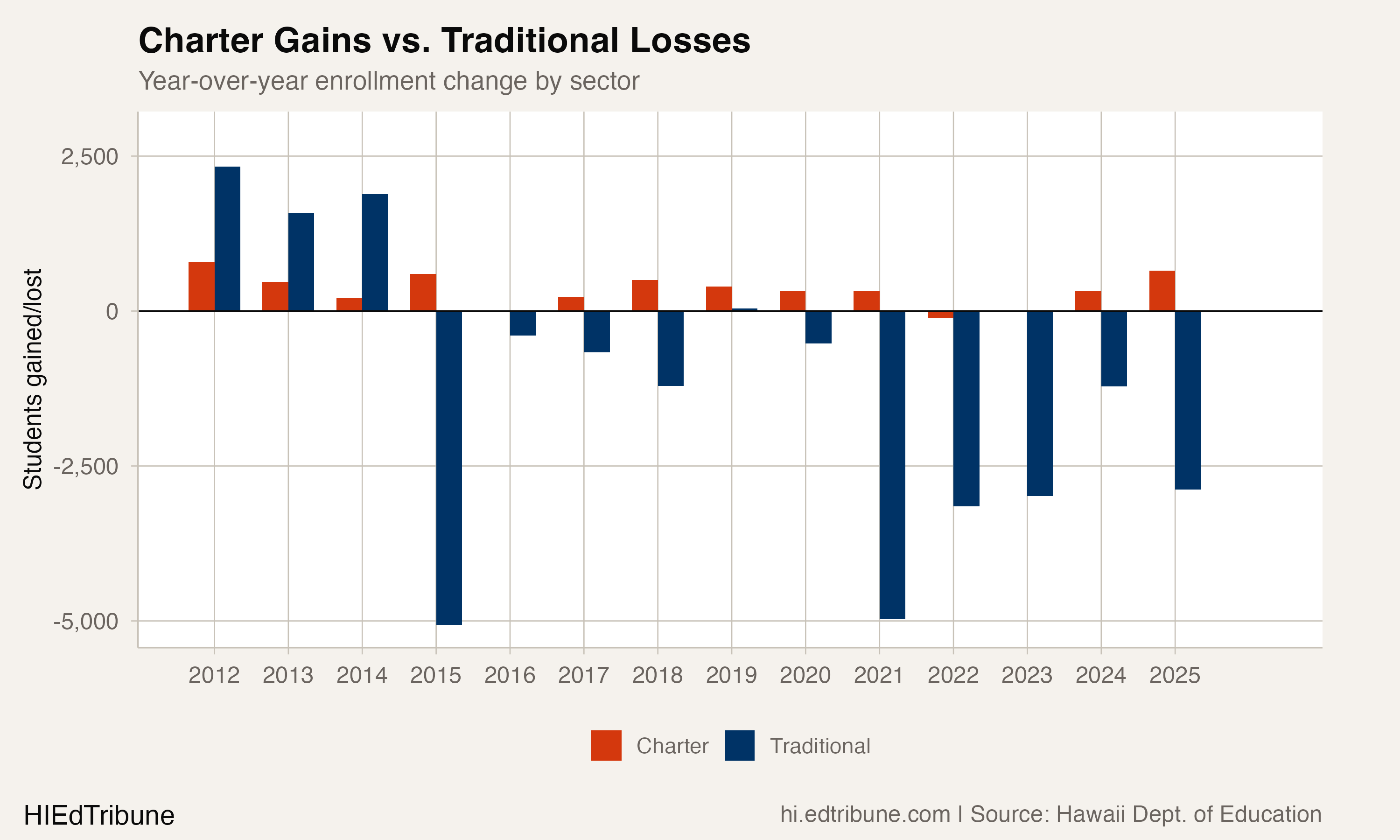
In the year the pandemic emptied classrooms across Hawaii, one sector kept growing. Charter schools added 329 students between 2020 and 2021, a 2.8% gain, while traditional public schools in every county shed a combined 4,976, a 2.9% loss. That single-year gap has only widened since. Five years later, charters have gained 1,198 students overall, a 10.1% increase. Traditional schools have lost 15,210, a 9.0% decline.
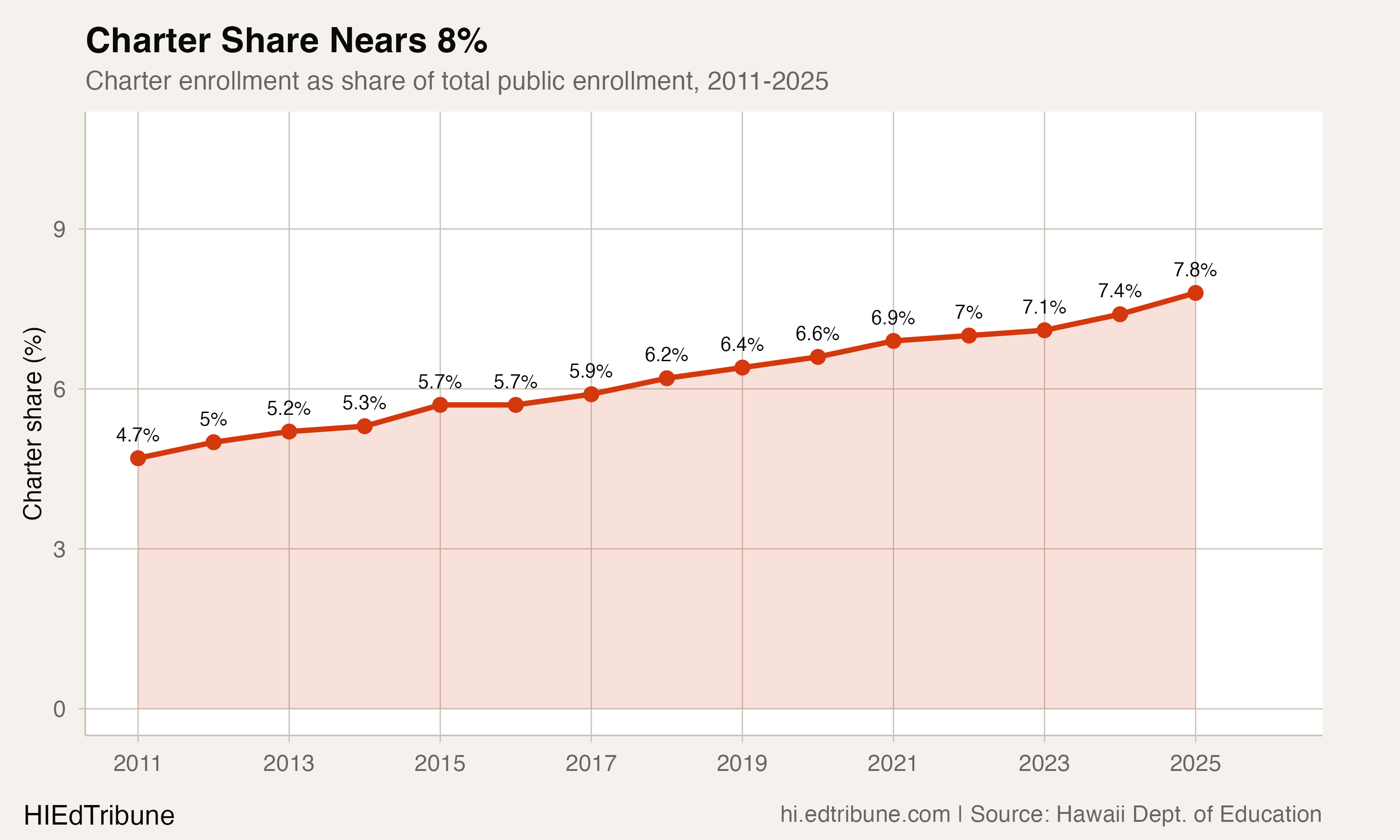
The 38 schools that make up Hawaii's charter sector now enroll 13,094 students, an all-time high and 7.8% of total public enrollment. That share has nearly doubled from 4.7% in 2011. The divergence is not subtle: indexed to 2020, charter enrollment sits at 110 while traditional enrollment has fallen to 91.
A 14-year climb with one interruption
Charter enrollment in Hawaii has grown in 13 of the past 14 years. The only interruption came in 2022, when enrollment dipped by 111 students, followed by a near-flat year in 2023 with a gain of just 14. The sector recovered in 2024 with a 318-student gain, then accelerated in 2025 with 648 new students, a 5.2% jump that marks the fastest growth rate since 2015.
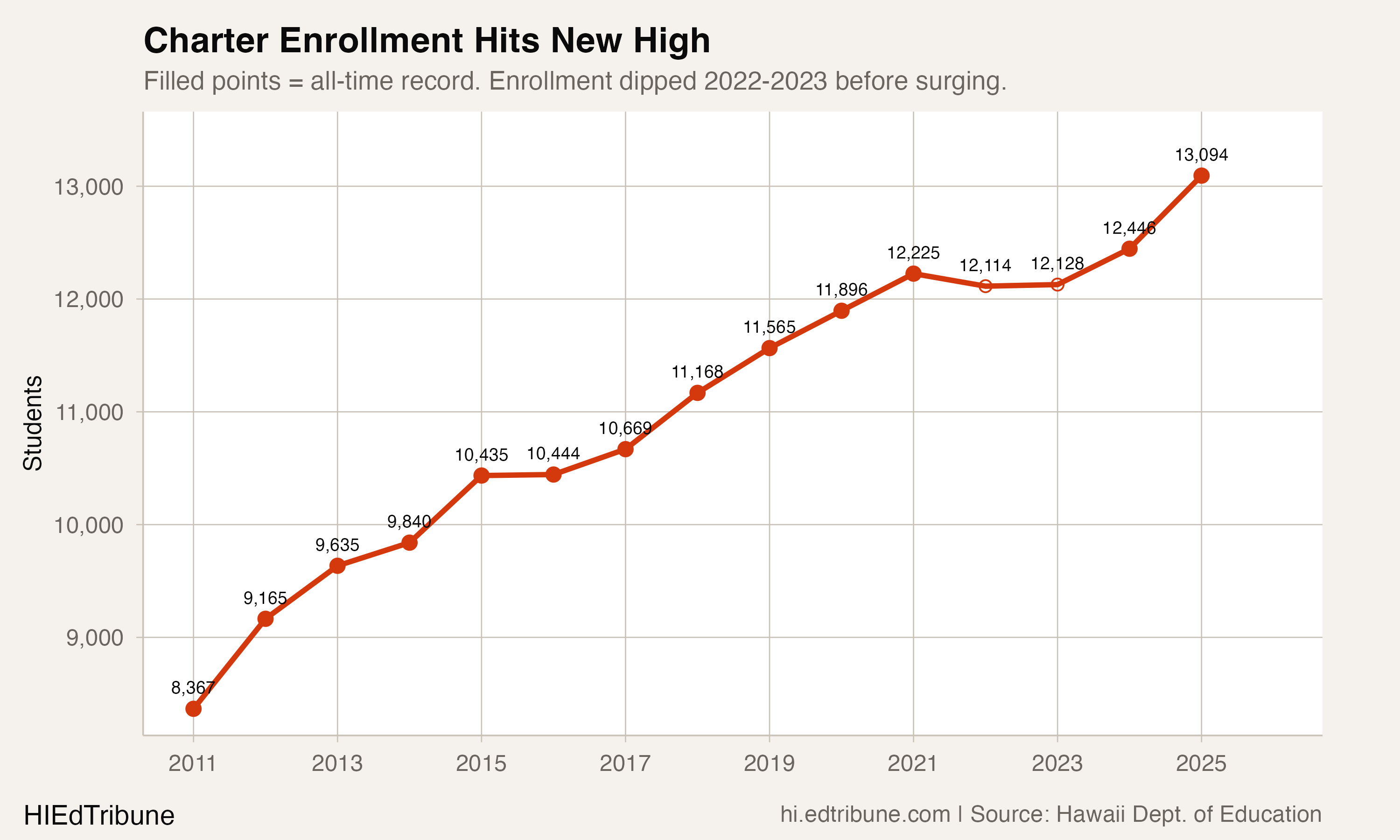
That 2022-2023 plateau coincided with the period when pandemic-era federal relief dollars were flowing into traditional schools, though the data alone cannot confirm whether those funds slowed charter transfers. What is clear is that the pause was temporary.
Since 2011, charters have added 4,727 students, a 56.5% increase. Over the same period, total statewide enrollment fell from 179,577 to 167,076, a decline of 19,774 students, or 10.6%, from the 2014 peak of 186,850.
Where traditional schools are bleeding
The losses are not evenly distributed. Honolulu↗ET accounts for 72% of all traditional enrollment decline since 2020, losing 10,995 students, a 9.6% drop. That concentration reflects both the county's size (it enrolls 62% of all public students) and its exposure to Hawaii's cost-of-living-driven outmigration.
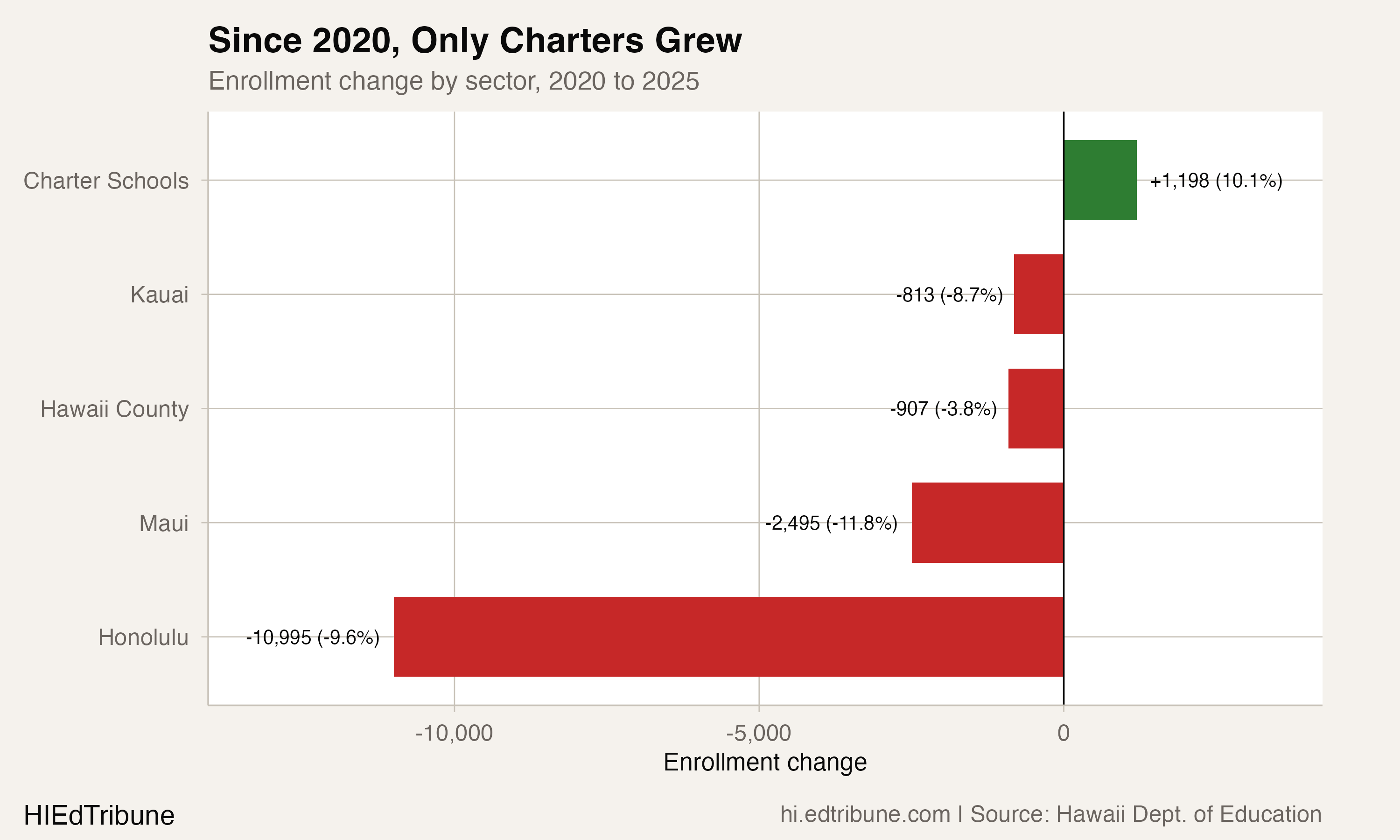
Maui↗ET has lost 2,495 students since 2020, an 11.8% decline, the steepest percentage drop of any county. That trajectory worsened sharply in 2025, when Maui lost 807 students in a single year, its worst annual loss on record. The August 2023 Lahaina wildfire displaced thousands of families and reduced enrollment at Lahaina-area schools by more than 20%. Lahainaluna High enrolled 1,012 students the day before the fire. By the 2024-25 school year, that figure had fallen to 813. As principal Richard Carosso told Maui Now:
"Kids leaving the island, going back to the mainland, back to the countries that their families are from."
Kauai↗ET has lost 813 students (8.7%) and Hawaii County↗ET 907 (3.8%), the latter showing more resilience than any other traditional region.
The facility ceiling
Charter growth in Hawaii operates under a structural constraint that does not exist for traditional schools: finding a place to hold class. Charter schools receive per-pupil operating funding but no dedicated capital funding for facilities. Some schools allocate 15% to 30% of their budgets to rent. Before its closure, Kamalani Academy was spending roughly $39,000 per month, more than half its budget, on facilities alone.
Schools have operated from tents, converted restaurants, and office parks. When one charter, SEEQS, briefly secured a campus-sharing arrangement at Kaimuki High School, its founder Buffy Cushman-Patz called it "our forever solution." The arrangement ended. When a state legislator proposed placing a charter in unused classrooms at Keolu Elementary, DOE leadership declined and converted the spaces into administrative offices instead.
This matters for interpreting the enrollment data. A 10.1% gain over five years, while every traditional county declined, occurred despite the charter sector having no guaranteed access to school buildings. Growth constrained by physical space may understate actual demand.
Why families are choosing charters
The simplest explanation for the divergence is that families are actively selecting charter schools over their zoned traditional option. Hawaii's charter sector includes culturally grounded Hawaiian-immersion schools like Kanu o ka 'Aina, STEM-focused academies, and project-based programs that traditional schools generally do not offer.
"They took the child's interest and ran with it." Source: Honolulu Civil Beat, Dec. 2025
Parent Danielle Chong made that observation contrasting her son's experience at Hakipu'u with his siblings' traditional school. Another parent, Nick Cagle, told Civil Beat that without the charter school Namahana, his daughter "likely would have attended a private school in Lihue, over an hour away."
A competing explanation deserves attention. Some charter growth may reflect new school openings or expanded capacity rather than families switching sectors. The data cannot distinguish between a family that left a traditional school for a charter and a family that chose a charter instead of private school or homeschool.
Academic performance adds complexity. Charter students score below state averages: 47% proficiency in reading versus 53% statewide, and roughly a third in math versus 41%. Performance varies enormously across the 38 schools. Families choosing charters are evidently prioritizing something other than aggregate test scores.
The fiscal backdrop
Hawaii operates a single statewide school district, meaning enrollment decline does not trigger the competitive dynamics between neighboring districts seen on the mainland. But it does affect funding. The state allocates most education dollars through a weighted student formula, where money follows the student. Every student who moves from a traditional school to a charter school takes per-pupil funding along.
The Department of Education enrolled roughly 150,000 students in traditional K-12 schools in fall 2025, compared to more than 170,000 a decade ago. In response, the DOE has begun studying redistricting rather than outright school closures. School redistricting may take effect as early as fall 2026, with consolidation studies following in 2027 and the earliest possible closures in 2028. The complex area covering Lanai, Molokai, Hana, and West Maui is projected to see a 25% enrollment drop by the end of the decade.
What comes next
The charter sector's 5.2% growth rate in 2025 is its highest in 13 years, and a new pre-K-only charter school opened in Kapolei in January 2025, the first of its kind in Hawaii. If the facility constraint loosened, meaning if charters gained access to underused DOE buildings, growth could accelerate further.
The question for Hawaii is whether charter expansion is absorbing students who would otherwise leave the public system entirely, or whether it is accelerating the decline of traditional schools that are already struggling to fill classrooms. Hawaii recorded just 15,570 births in 2022, the fewest in 21 years, and the state's birth rate has fallen from 18.5 per 1,000 in 1990 to 10.8 in 2022. The total pool of school-age children is shrinking. In a state where the public system is losing nearly 3,000 students per year, 648 students choosing charters is a meaningful fraction of the overall shift. Whether the DOE sees those families as lost or simply relocated within the public system may shape the consolidation decisions ahead.
Detailed code that reproduces the analysis and figures in this article is available exclusively to EdTribune subscribers.
Discussion
Sign in to join the discussion.
Loading comments...