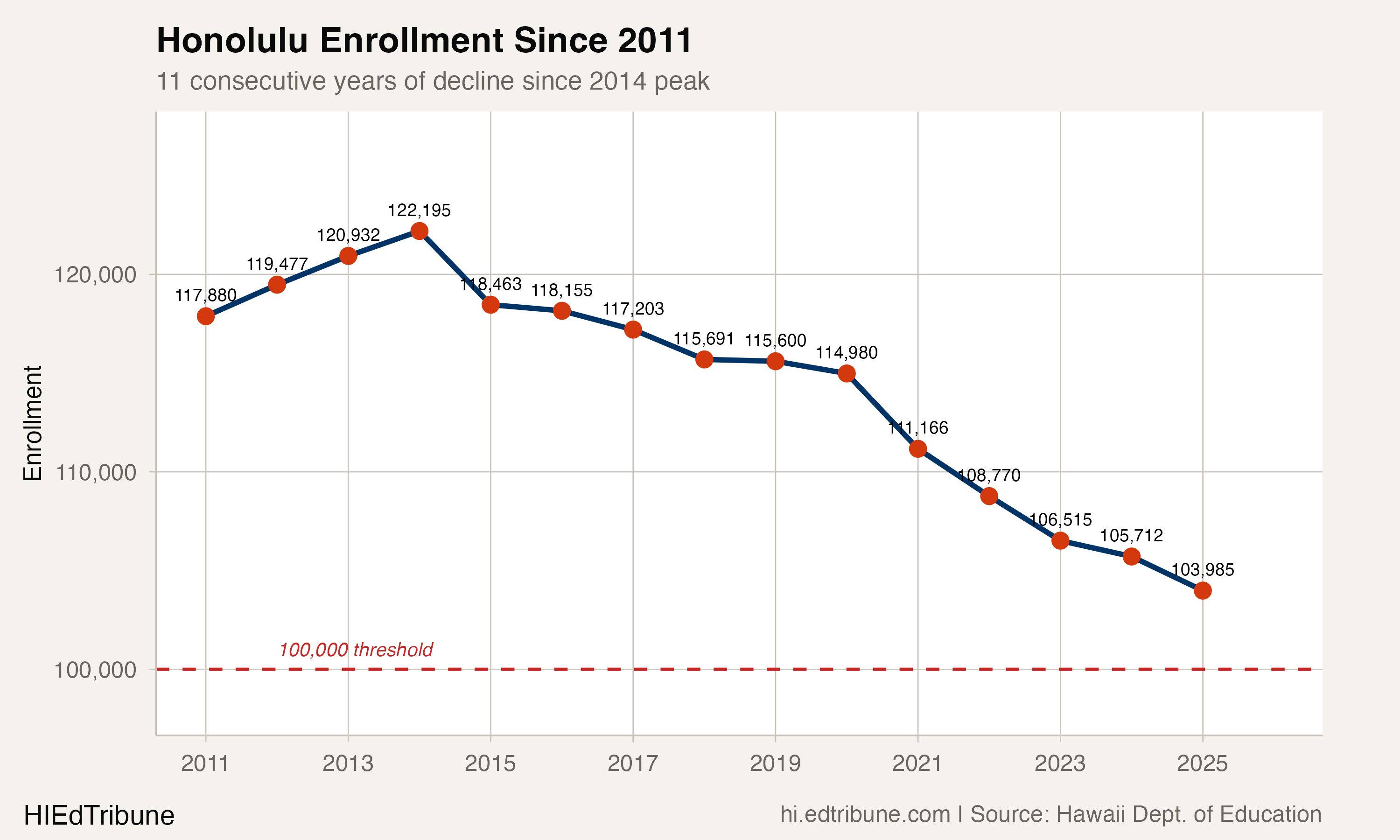
Honolulu↗ET has lost the equivalent of an entire school system. Since peaking at 122,195 students in the 2013-14 school year, the county's public school enrollment has fallen every single year, reaching 103,985 in 2024-25. That 11-year losing streak has erased 18,210 students, a loss nearly equal to the entire enrollment of Maui↗ET County (18,734).
The 2024-25 figure marks the first time Honolulu has dropped below 104,000 students. At the four-year average pace of roughly 1,800 fewer students per year, the county will breach the 100,000 threshold by 2027 or 2028, a symbolic floor that was hard to imagine a decade ago, when Honolulu was still gaining more than 1,000 students annually.
The decline is speeding up
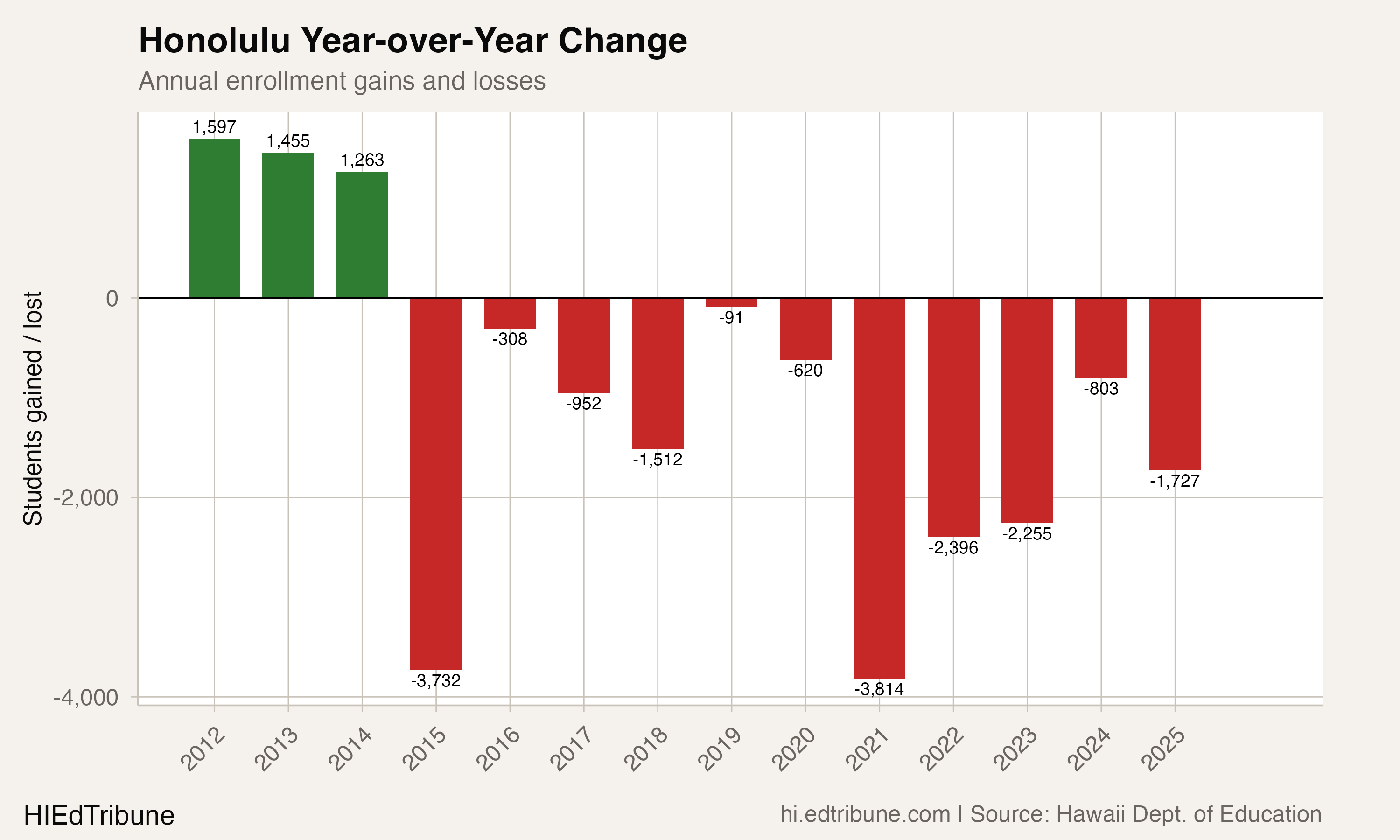
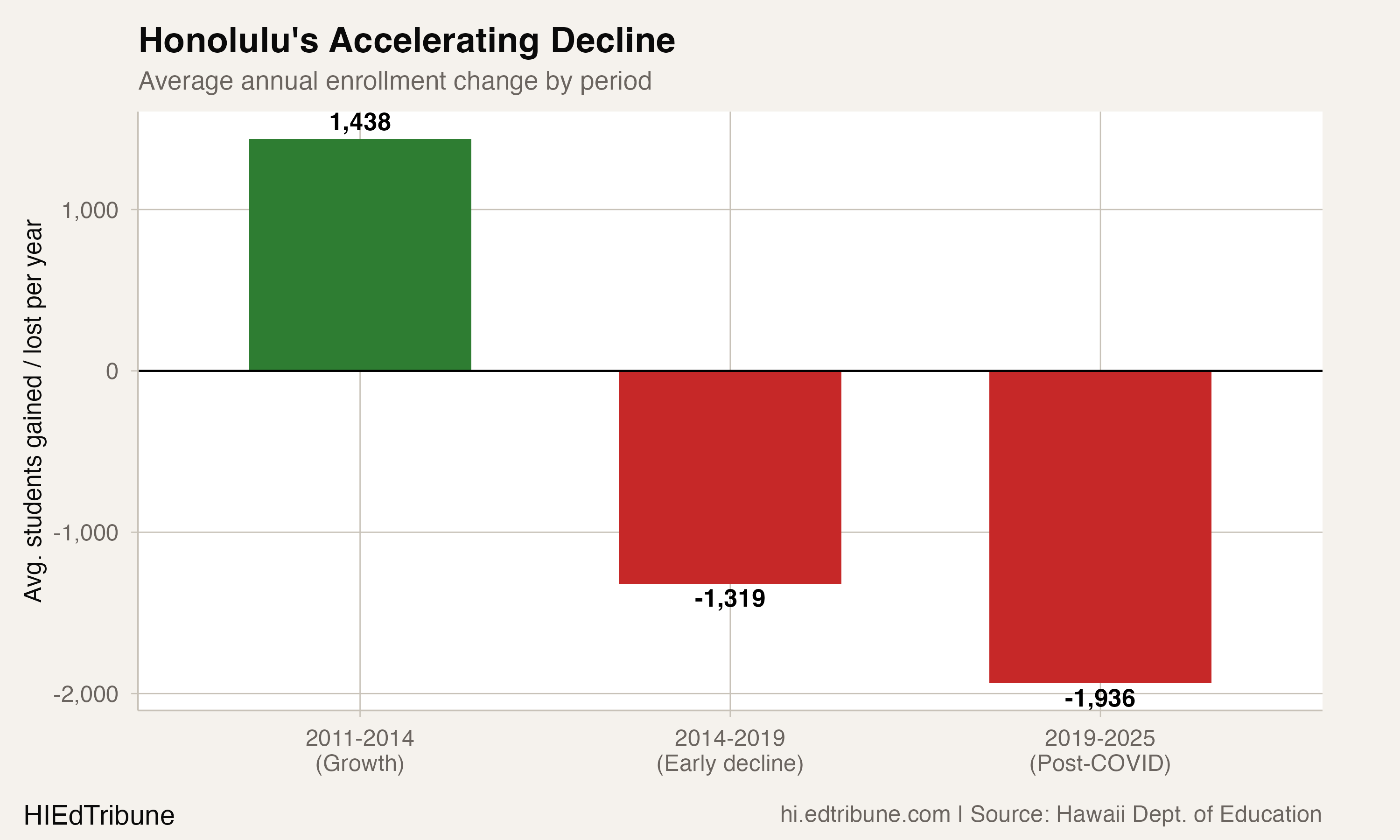
The trajectory has not been steady. Between 2014 and 2019, Honolulu lost an average of 1,319 students per year. Since 2019, that pace has accelerated to 1,936 per year, a 47% increase in the rate of decline. The pandemic year of 2020-21 was the worst single year on record, when 3,814 students disappeared from Honolulu rosters, but the losses never stopped compounding afterward. The county lost another 2,396 in 2021-22, 2,255 in 2022-23, 803 in 2023-24, and 1,727 in 2024-25.
COVID did not cause the decline. It accelerated a pattern already underway. Honolulu was losing students before the pandemic, and the post-pandemic years have not produced even a partial recovery.
Not just Honolulu: every county at an all-time low
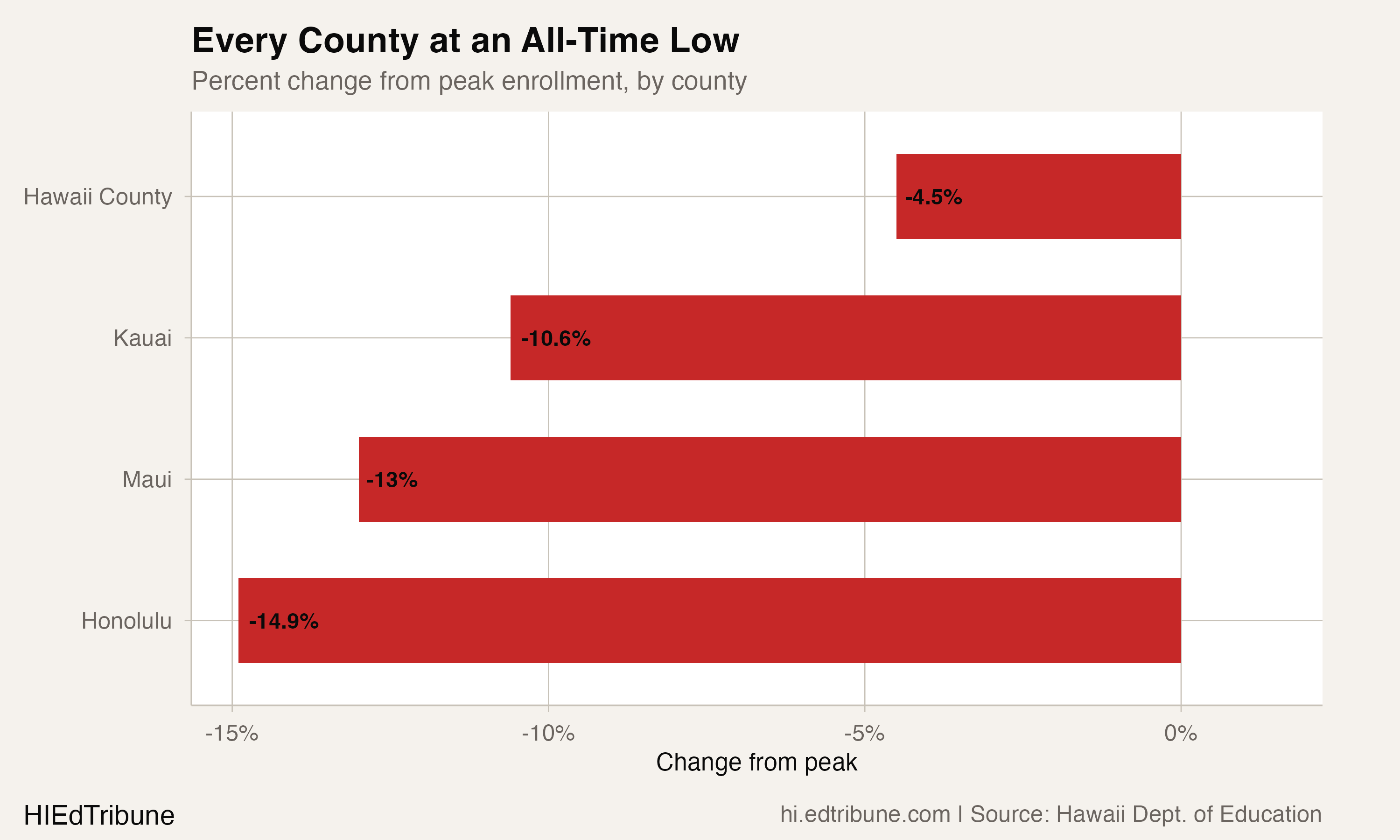
Honolulu's decline is the largest in absolute terms, but it is not unique. All four of Hawaii's county school systems hit record-low enrollment simultaneously in 2024-25: Hawaii County↗ET at 22,715 (down 4.5% from its 2012 peak), Kauai↗ET at 8,548 (down 10.6% from 2014), and Maui at 18,734 (down 13.0% from 2014, a decline accelerated by the August 2023 Lahaina wildfire).
Honolulu's 14.9% decline from peak is the steepest of the four counties. The only sector growing is charter schools, which reached a record 13,094 students in 2024-25, up 56.5% since 2011.
Housing costs and outmigration: the structural squeeze
The most likely driver of Honolulu's enrollment losses is the same force reshaping the county's demographics more broadly: families cannot afford to stay. The University of Hawaii Economic Research Organization (UHERO) identified the pattern in a 2025 analysis, noting that Honolulu's structural constraints, including limited housing, chronic congestion, and concerns about K-12 schools, coexist with a median single-family home price that now exceeds $1.1 million, more than double the national average.
Hawaii has experienced a net migration loss of roughly 20,000 people between 2020 and 2024, with the net flow consistently negative for children under 18. Families who leave are not replaced at the same rate by new arrivals.
Birth rates compound the problem. Hawaii births have fallen 14% since 2016, the sixth-largest decline of any state. Fewer births in 2018 and 2019 will produce smaller kindergarten cohorts in 2024 and 2025, and the even lower birth counts of 2020-2023 will suppress enrollment further through the end of the decade.
A competing explanation is that families are not leaving Honolulu but switching sectors. Hawaii has one of the highest private school enrollment rates in the nation, and charter schools have grown 56.5% since 2011. But the scale of private and charter gains is far smaller than the 18,210-student loss Honolulu has recorded. Migration and birth rate declines are doing the heavier lifting.
Inside Honolulu: a tale of two patterns
The decline within Honolulu County is not evenly distributed. Honolulu Civil Beat reported in September 2025 that 38 campuses statewide had experienced enrollment drops exceeding 20% over five years, far above the 6% statewide average. McKinley High School in urban Honolulu lost nearly a third of its student body, falling from 1,617 to 1,133 students since the 2020-21 school year.
Meanwhile, the Ewa and Kapolei corridor on Oahu's west side tells the opposite story. A 2025 Civil Beat investigation found that the DOE's 2013 Ewa development plan called for 12 new schools by 2030, but only two have been built. Ewa Elementary now enrolls roughly 1,250 students; Campbell High School, at 2,890 students, is the largest public high school in the state, operating well beyond its roughly 2,000-student capacity.
"Closing a school isn't like closing your neighborhood Starbucks." Roy Takumi, Board of Education Chair, Honolulu Civil Beat, March 2025
The DOE has pivoted from closures to redistricting as its primary response, with boundary changes possible as early as fall 2026 and no consolidation decisions expected until spring 2028. The Kaimuki-McKinley-Roosevelt complex in urban Honolulu faces a projected 11% enrollment decrease by decade's end.
Honolulu's shrinking share
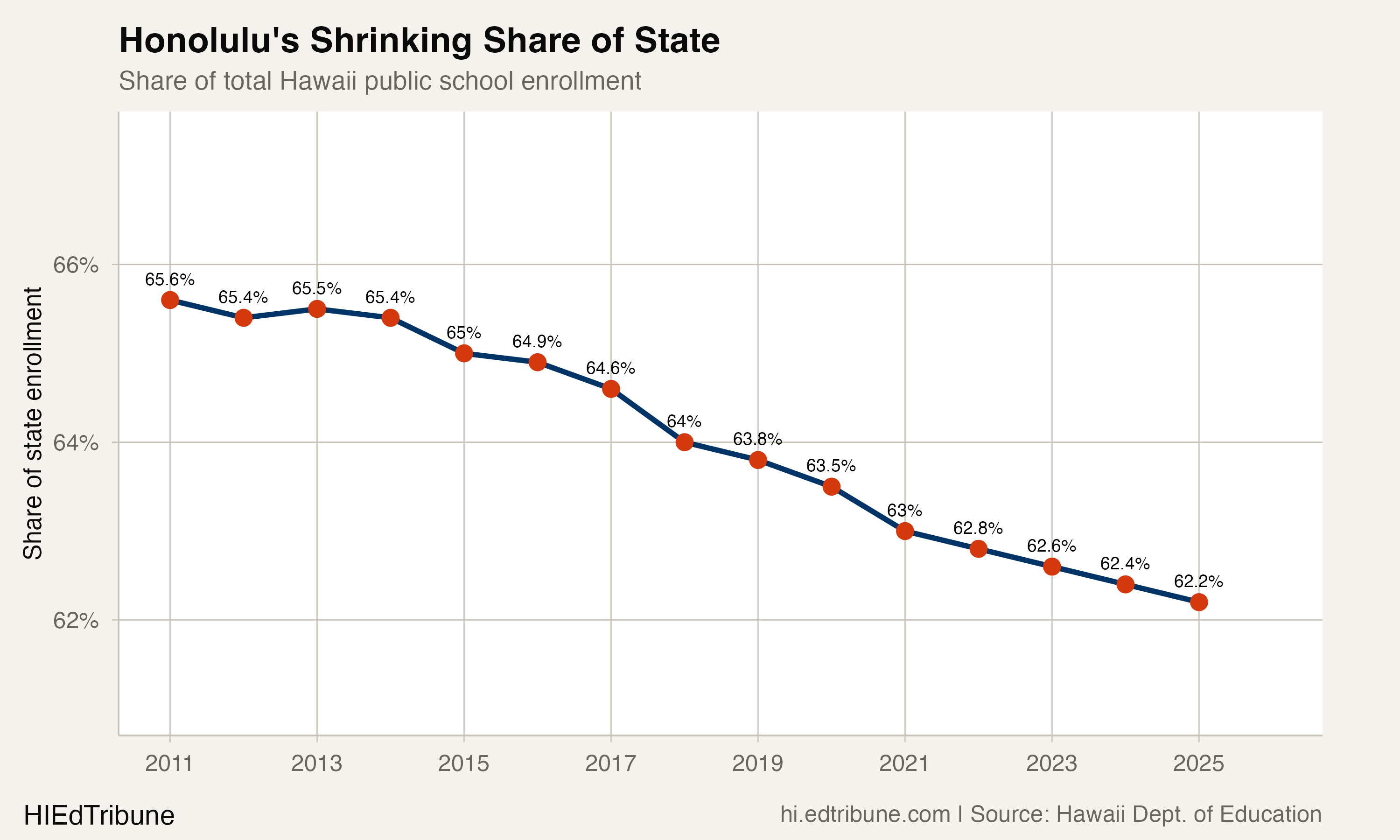
Even within a declining state, Honolulu is losing ground disproportionately. In 2011, Honolulu accounted for 65.6% of all Hawaii public school students. By 2024-25, that share had fallen to 62.2%. The 3.4-percentage-point decline reflects Honolulu's steeper losses relative to the neighbor islands, with charter schools, which draw from across all counties, absorbing an increasing share (4.7% in 2011, 7.8% in 2024-25).
The question is when, not whether
At the current pace, Honolulu will enroll fewer than 100,000 public school students within two to three years. Using the two-year average decline of 1,265 students per year, the threshold falls in 2028. Using the four-year average of 1,795 per year, it arrives in 2027.
The question for the DOE is what a sub-100,000 Honolulu means operationally. With 34 schools statewide already enrolling fewer than 250 students and the redistricting process still in early stages, the gap between enrollment reality and infrastructure continues to widen.
The 100,000 line is a number, not a policy. But it will force a conversation about the size of the system that Honolulu needs, versus the size of the system it has.
Detailed code that reproduces the analysis and figures in this article is available exclusively to EdTribune subscribers.
Discussion
Sign in to join the discussion.
Loading comments...