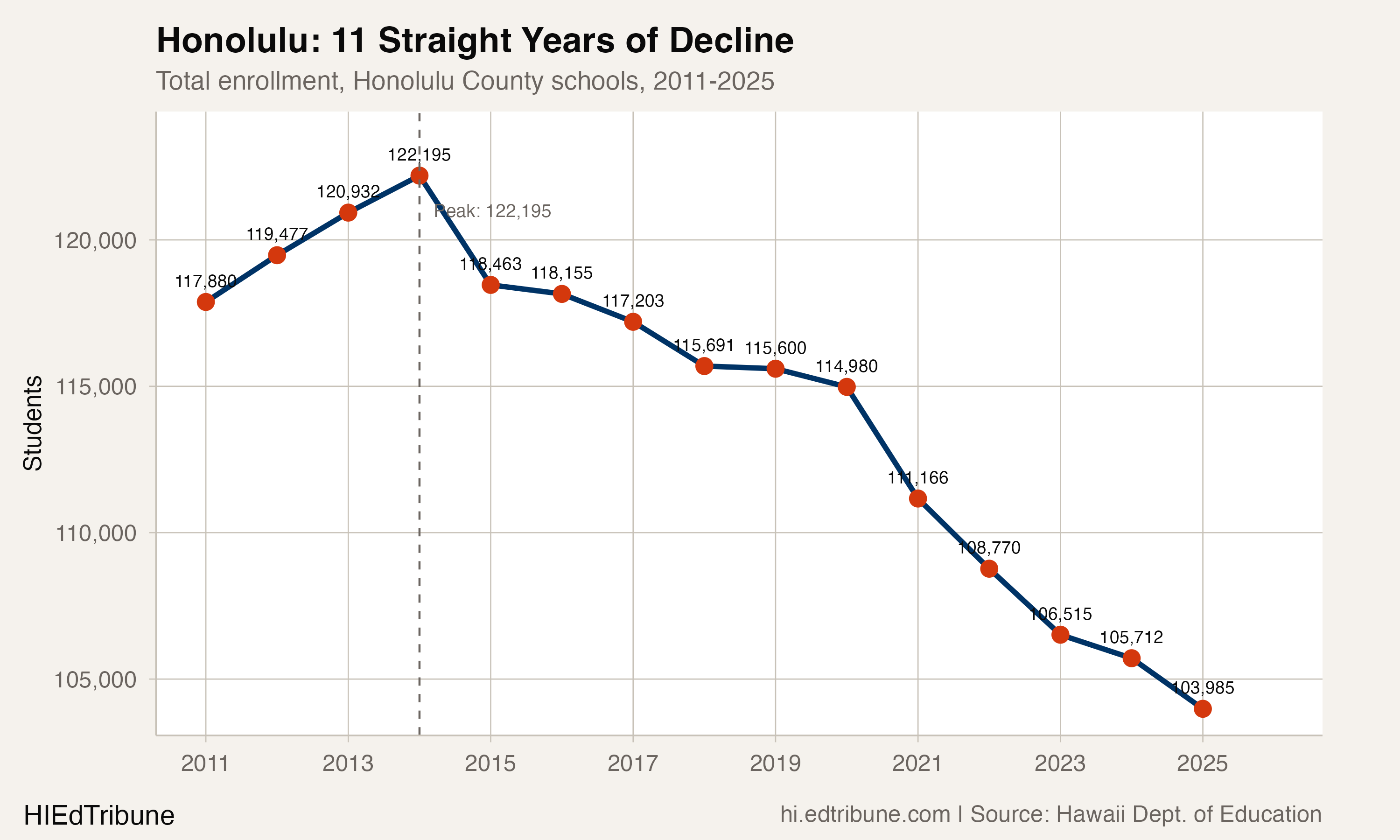
Honolulu↗ET has not gained a single student in 11 years. Since enrollment peaked at 122,195 in 2013-14, the county has lost students every single year, falling to 103,985 in 2024-25. The cumulative loss of 18,210 students is nearly equal to the entire enrollment of Maui↗ET County (18,734). No other county in the state has experienced a decline of this magnitude or duration.
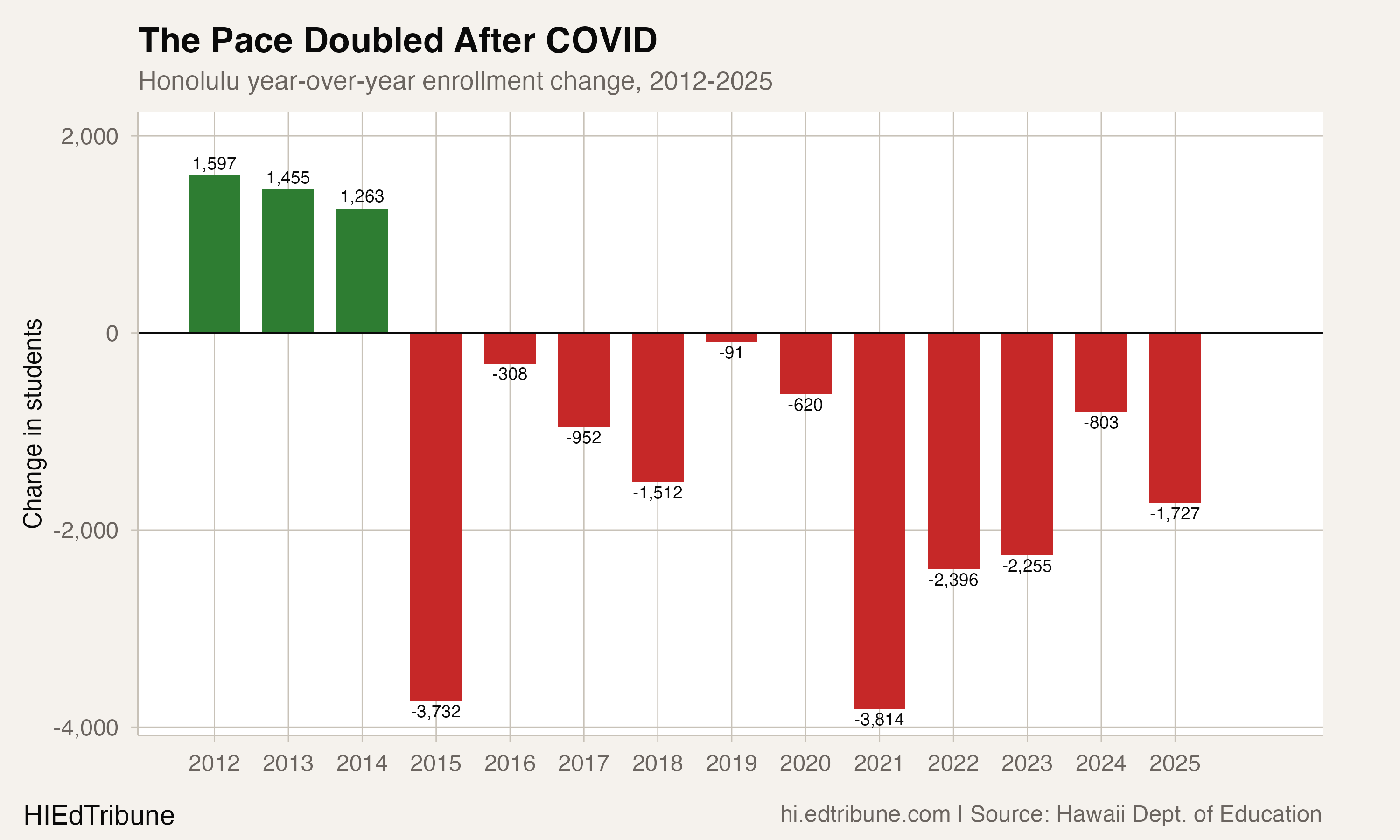
The streak is not merely long. It is accelerating. Before COVID, Honolulu lost an average of 1,202 students per year. Since 2020, the pace has nearly doubled to 2,199 per year.
An island that can't hold its families
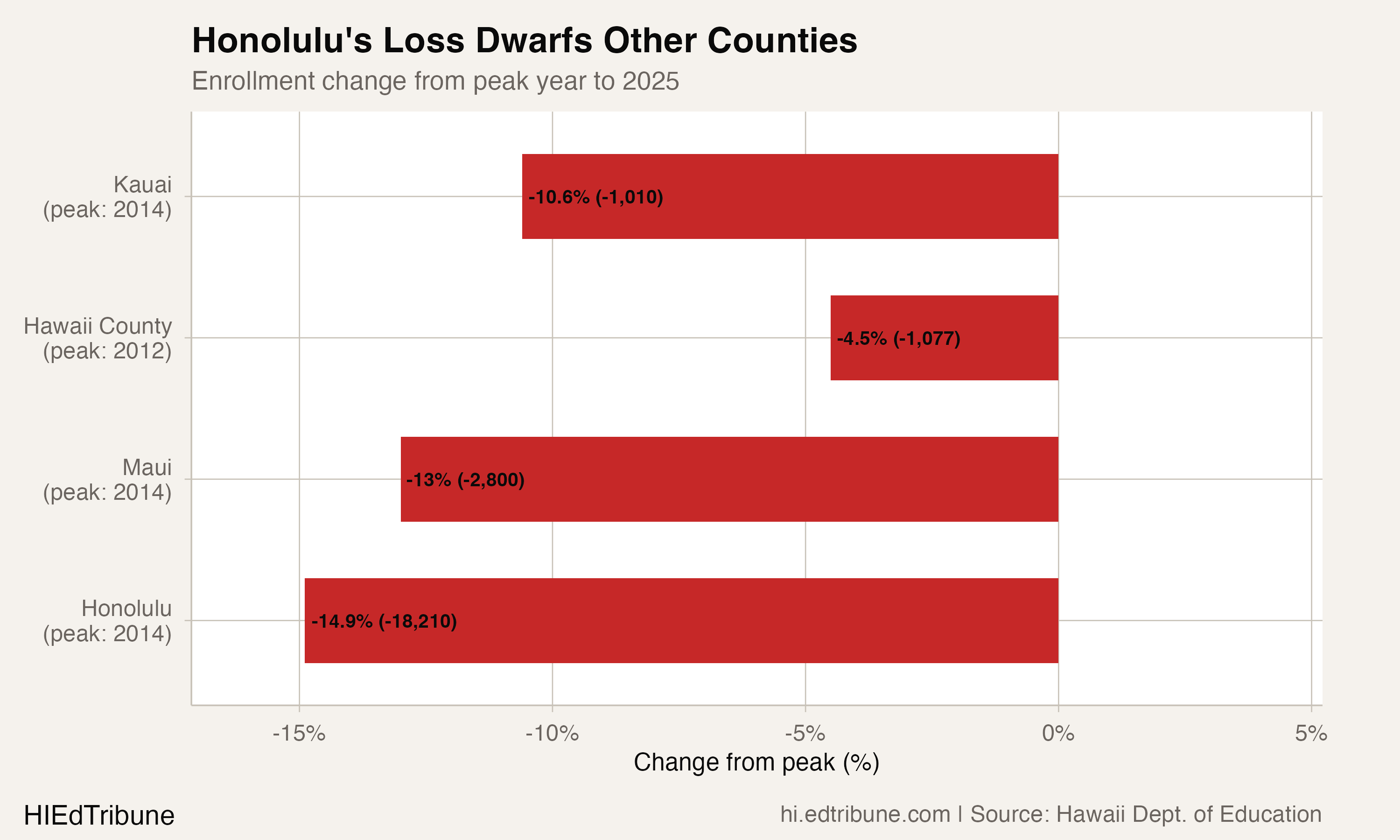
The 14.9% decline from peak is three times larger than Hawaii County↗ET's 4.5% drop over a similar period. Every county in the state has shrunk since 2014, but Honolulu accounts for 18,210 of the statewide 19,774-student loss from peak, or 92.1% of the total. The state's enrollment crisis is, in practical terms, a Honolulu crisis.
The decline played out in two phases. From 2015 to 2020, losses were modest, averaging around 1,200 students per year, with 2019 nearly breaking even at just 91 students lost. Then COVID hit, and Honolulu dropped 3,814 students in a single year. The system never recovered. In the four years since, the county has lost another 7,181 students.
Housing costs as enrollment policy
The most direct driver is families leaving Oahu. An Aloha United Way report released in January 2025 found that 180,000 Hawaii residents were actively considering leaving the state, with younger families and working-age adults making up the bulk of potential movers. The COO of Aloha United Way, Suzanne Skjold, characterized the risk starkly: without intervention, Hawaii faces "this hollow community where our engine is just not there."
Median home prices on Oahu exceed $750,000, and the cost of living has pushed out the families who fill elementary classrooms. Hawaii's birth rate has fallen 14% since 2016, reaching just 14,808 births in 2023, the lowest in over two decades. But birth rates alone do not explain why Honolulu's decline is so much steeper than the other counties. Net domestic out-migration of roughly 20,000 people between 2020 and 2024, concentrated among working-age families, is the likelier mechanism.
A competing explanation is that families are staying on Oahu but choosing private or charter schools. Charter enrollment statewide has grown for three consecutive years, rising 5.2% in 2024-25 to 13,094 students. But the charter sector added only 4,727 students statewide since 2011, while Honolulu alone lost 18,210. Charter growth explains at most a quarter of the total loss, and some of that growth is on neighbor islands.
The consolidation question
Honolulu's shrinking enrollment has forced the Department of Education into an uncomfortable conversation about school closures. A 2017 DOE campus study found more than 60 schools statewide were underutilized while others exceeded maximum capacity. As Honolulu Civil Beat reported in September 2025:
"Put simply, Hawaii has enough school capacity, just not in the right places." -- Honolulu Civil Beat, September 2025
The pattern is visible within Honolulu itself: schools in urban areas like Kaimuki-McKinley-Roosevelt face an 11% enrollment projection decline, while Ewa and Kapolei schools, built for the island's newest housing developments, are overcrowded. The DOE has shifted its approach, prioritizing redistricting over immediate closures, with potential consolidation studies beginning in 2027 and no final decisions before spring 2028.
Board Chair Roy Takumi acknowledged the difficulty: "Closing a school isn't like closing your neighborhood Starbucks."
Every county, the same direction
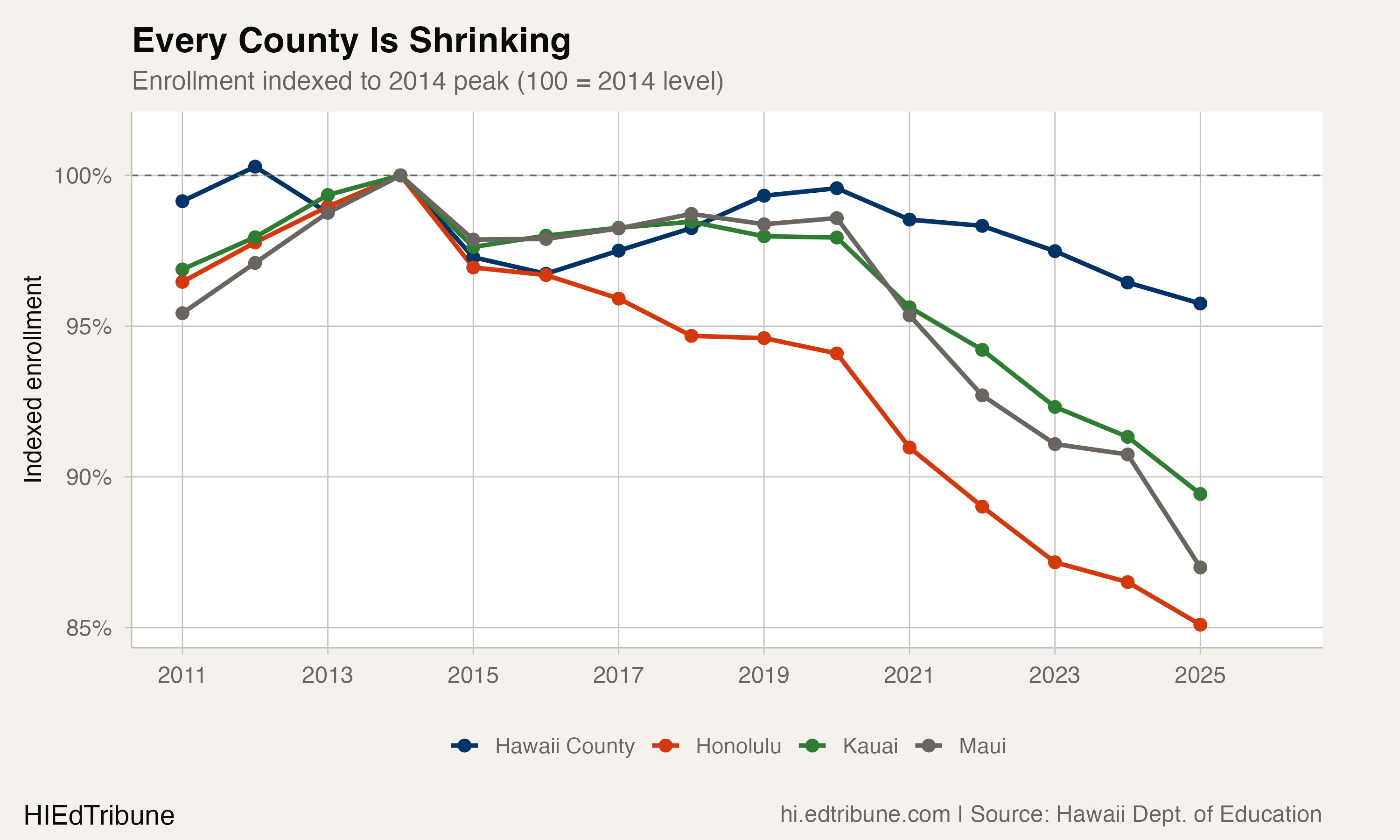
Honolulu's decline dominates the statewide picture, but it is not alone. Kauai↗ET is on a seven-year decline streak. Maui and Hawaii County have each declined for five consecutive years. Since their respective peaks, Maui has lost 13.0%, Kauai 10.6%, and Hawaii County 4.5%.
Maui's 2025 decline of 807 students, the largest single-year drop in its dataset, likely reflects the lingering effects of the August 2023 Lahaina wildfire, which destroyed an entire community and displaced thousands of families. But the decline predates the fire. Maui had already fallen from 21,534 (2014) to 19,615 (2023) before the disaster.
Charters grow, but not enough to offset
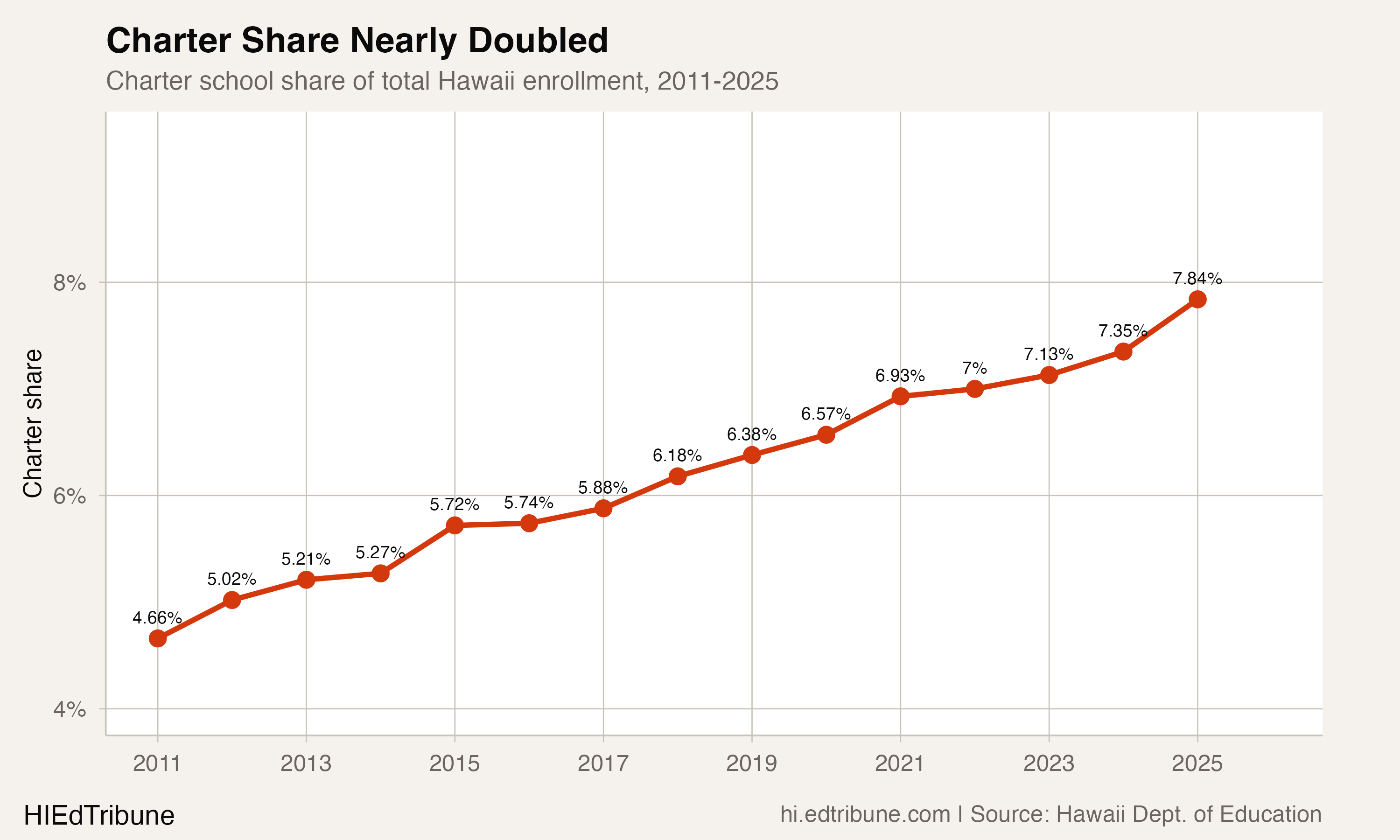
While the traditional system has contracted, charter schools have steadily gained ground. Charter enrollment has risen from 8,367 (4.7% of total) in 2011 to 13,094 (7.8%) in 2025, a 56.5% increase. Traditional school enrollment fell 10.1% over the same period, from 171,210 to 153,982.
The charter sector's growth is real, but it is absorbing a small fraction of the decline. Traditional schools lost 17,228 students statewide since 2011. Charters gained 4,727. The net system loss is 12,501 students, meaning roughly three out of every four students who left traditional schools left the public system entirely.
What the kindergarten pipeline signals
Honolulu's kindergarten enrollment offers a preview of what comes next. K enrollment stood at 10,665 in 2014, then dropped sharply to 6,800 in 2015 when Hawaii changed its kindergarten age cutoff from December 31 to July 31 under Act 76 of 2014. After that one-time structural adjustment, K enrollment stabilized around 9,000 in 2016 but has since fallen to 7,514 in 2025, a 17.1% decline from the post-cutoff baseline. With Hawaii births continuing to fall, those kindergarten classes will keep getting smaller.
The question facing Honolulu is not whether the decline will continue. It is whether the island's school infrastructure can adapt to a permanently smaller student body before the mismatch between empty classrooms in urban cores and overcrowded schools in new suburbs becomes untenable. The DOE projects further losses through the end of the decade, and with 180,000 residents considering leaving the state, the 12th consecutive year of decline appears all but certain.
Detailed code that reproduces the analysis and figures in this article is available exclusively to EdTribune subscribers.
Discussion
Sign in to join the discussion.
Loading comments...