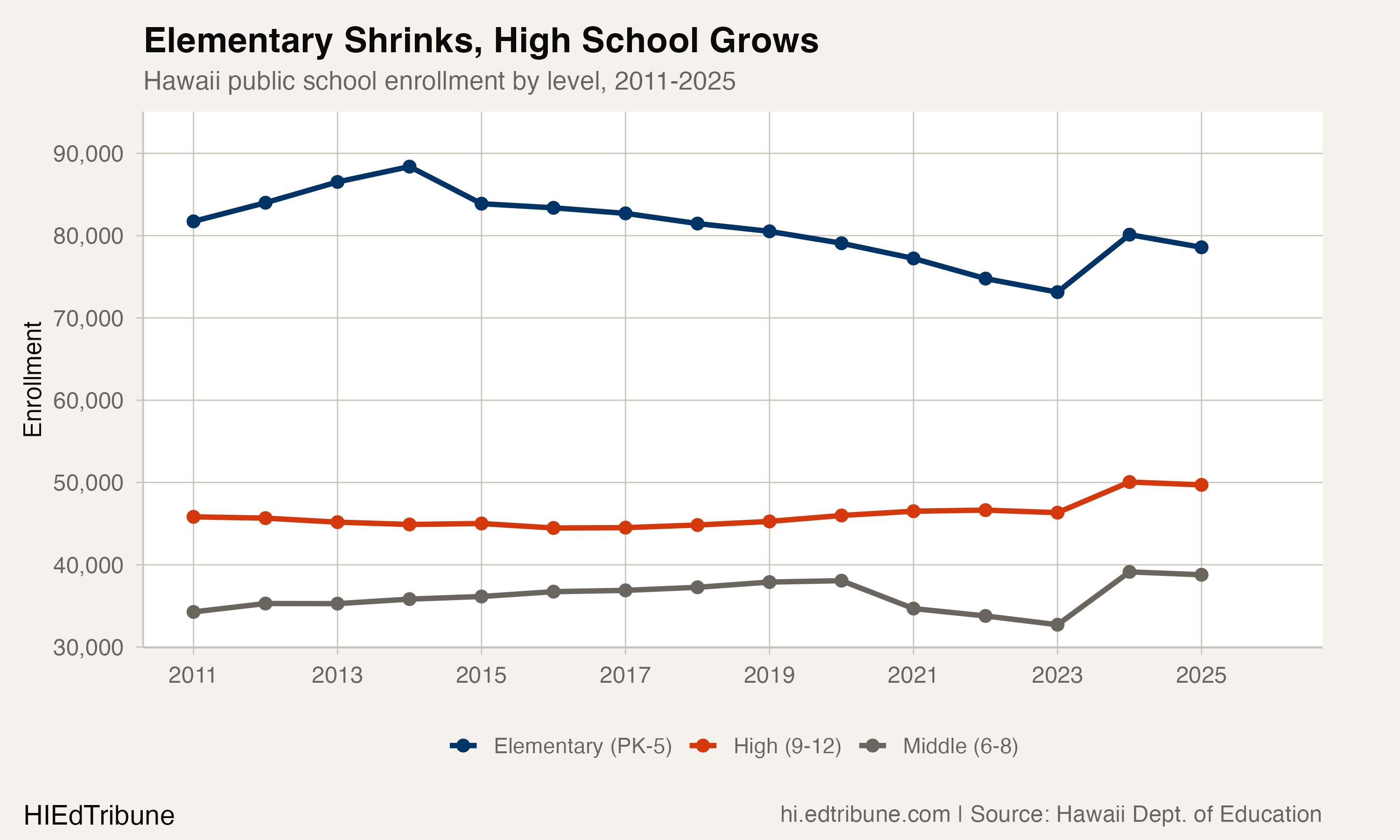
Hawaii's high schools are larger than they were 14 years ago. Its elementary schools are not. Between 2011 and 2023, the last year before a data reporting change, elementary enrollment (PK-5) fell by 8,601 students, a 10.5% decline. Over the same period, high school enrollment (9-12) rose by 505, a 1.1% gain. Middle schools lost 1,555 students, or 4.5%.
The divergence is not random. It is the predictable, grade-by-grade consequence of smaller kindergarten classes working their way through the system while larger pre-cutoff cohorts have yet to graduate. The result: a school system that is simultaneously shrinking at the bottom and, for now, growing at the top.
The pipeline mechanics
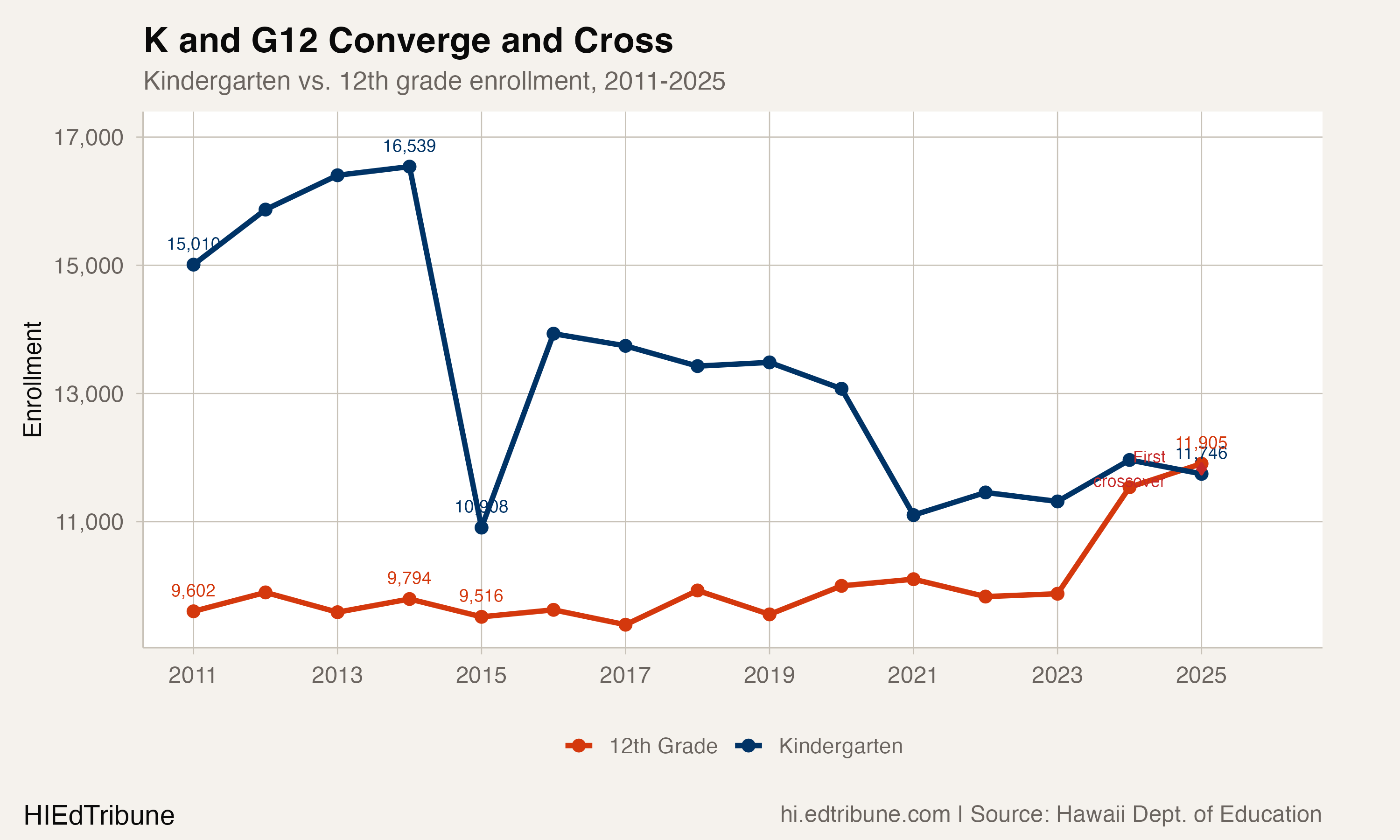
The single largest disruption to Hawaii's grade-level composition has a precise origin: Act 76, signed in 2012, which moved the kindergarten entry cutoff from December 31 to July 31 starting in the 2014-15 school year. Kindergarten enrollment dropped from 16,539 to 10,908 in a single year, a 34.0% collapse. Roughly 5,800 children were excluded from public kindergarten that fall, and 95 kindergarten teachers were reassigned.
That one-year shock was supposed to be temporary. It was not. The highest post-cutoff K enrollment was 13,933 in 2016, still 15.8% below the 2014 peak. By 2025, K enrollment had fallen further to 11,746, down another 15.7% from that 2016 level. The cutoff change did not just remove one cohort. It permanently reset the baseline, and declining birth rates have been eroding it further every year since.
Those shrunken K classes are now moving through the system as a demographic wave. The 2015 K cohort (10,908 students, the smallest in the data) tracked through first grade in 2016, fifth grade in 2020, and reached 10th grade in 2025. Each year it advances, the grade it enters gets smaller while the grade it displaces at the top of high school remains large.
The pre-cutoff K cohorts, by contrast, were enormous. The 2013 K class had 16,404 students. The 2014 K class, the last before the cutoff change, had 16,539, the largest in the dataset. Those cohorts corresponded to the classes of 2025 and 2026, temporarily inflating high school enrollment.
The 2027 cliff
The collision point is 2027. That is when the 2015 cutoff-year K class, with 10,908 students, reaches 12th grade. The 12th-grade class it replaces will have originated from the 2014 K cohort of 16,539, a difference of more than 5,600 students in a single grade.
High school enrollment has been buoyed for years by the fact that the large pre-cutoff cohorts had not yet graduated. When they do, the pipeline effect reverses. High school will begin shrinking in the same direction elementary already has.
The Western Interstate Commission for Higher Education projects a 33% decline in Hawaii high school graduates between 2023 and 2041, from roughly 11,500 to 7,600. That would be the steepest decline of any state in the nation. The pipeline data explains why: the smaller post-cutoff cohorts will cycle through high school graduation for the next 15 years.
Shifting shares
The composition of Hawaii's school system has changed meaningfully even as total enrollment masks the scale. In 2011, elementary students (PK-5) made up 50.5% of the PK-12 student body. By 2025, that share had fallen to 47.0%. High school's share rose from 28.3% to 29.8% over the same period. Middle school held roughly steady, moving from 21.2% to 23.2%.
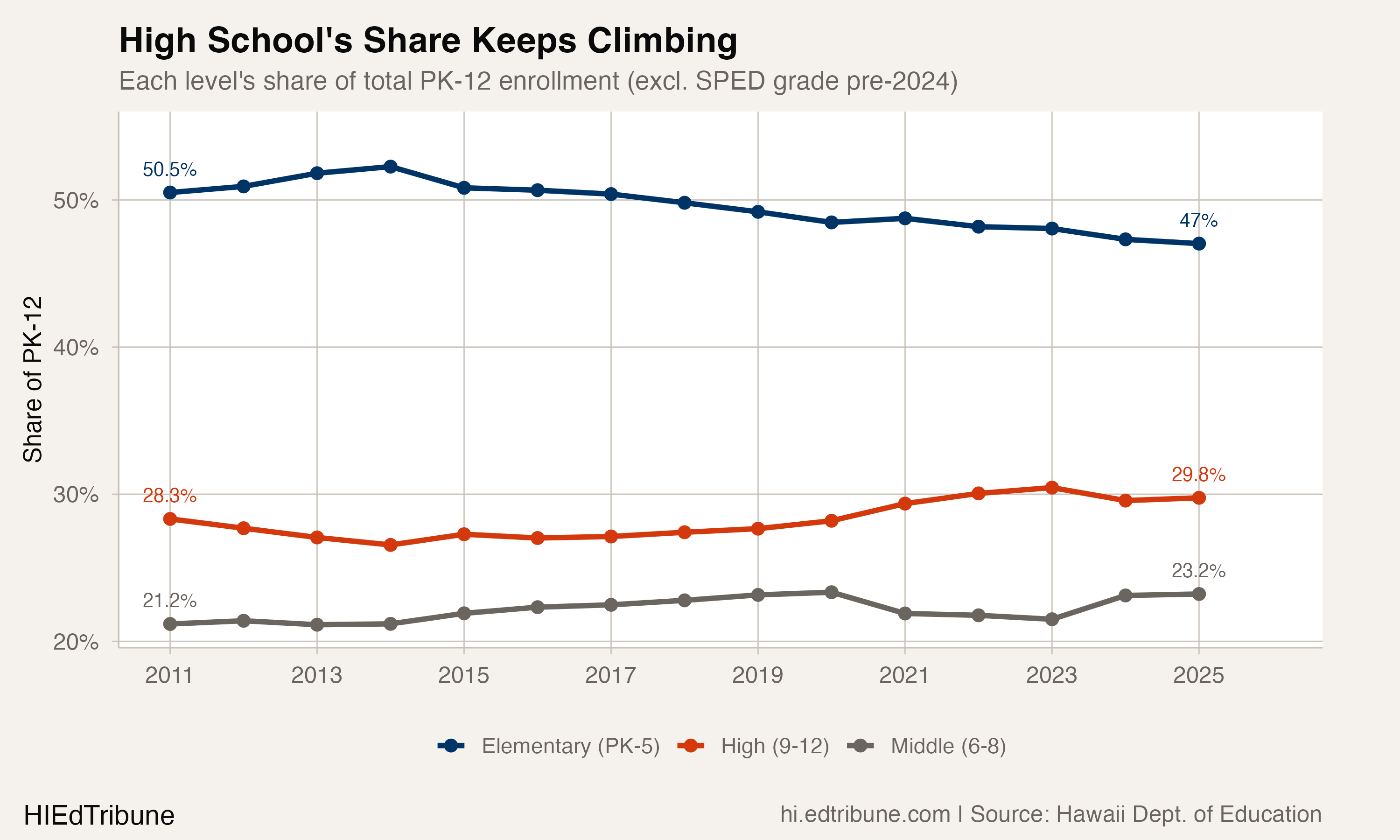
These shifts carry operational weight. Elementary schools need more classrooms per student served because class sizes are smaller. High schools need specialized facilities: labs, gymnasiums, career-technical spaces. A system that built capacity for a 50/50 elementary-heavy split now serves a student body that is closer to 47/30. The mismatch between facility capacity and student distribution has already surfaced in the consolidation debate: 34 schools enroll fewer than 250 students, the threshold the department estimates is needed to adequately fund basic operations. Most of those schools are elementary.
Honolulu carries the loss
The elementary decline is not evenly distributed. Honolulu, which enrolls 62.2% of all public school students statewide, lost 11,577 elementary students between 2014 and 2023, a 20.0% decline. Maui lost 19.2% of its elementary enrollment over the same period. Hawaii County lost 12.9%, and Kauai 17.9%.
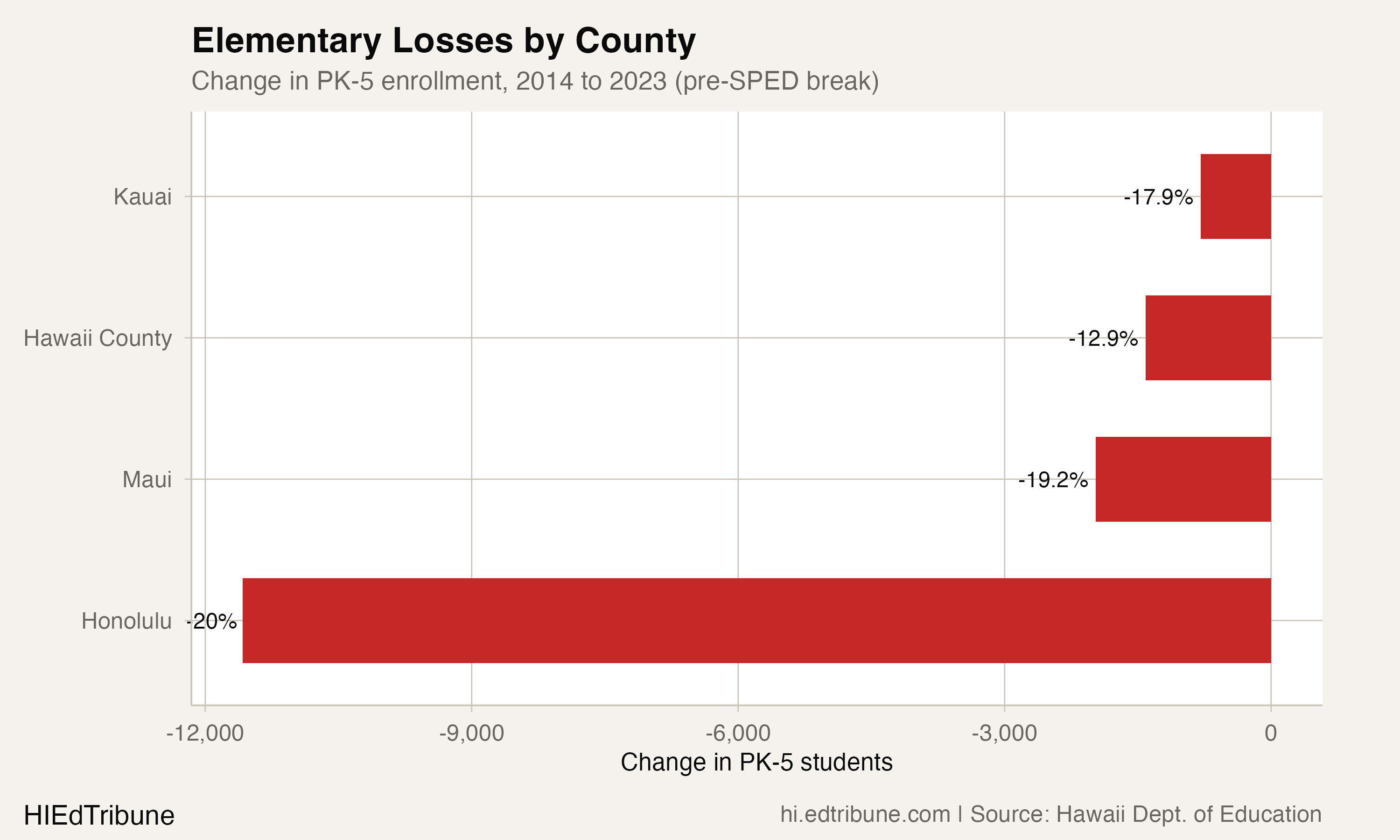
Honolulu's losses are disproportionate both in absolute numbers and percentage terms. The county accounted for 75.9% of the statewide elementary decline despite serving 62% of total enrollment. Housing costs are a plausible accelerant: the Hawaii Department of Education has cited outmigration as a primary driver of enrollment decline, with families leaving the islands entirely rather than relocating within them. The birth rate adds another layer: Hawaii recorded 14,964 births in 2024, lower than every year in the prior two decades except 2023.
The outmigration dynamic hits elementary enrollment first because young families with school-age children are the most likely to move. A family with a kindergartner facing the cost of living in Honolulu makes a different calculation than a family whose teenager is two years from graduation.
A data caveat on 2024-2025
Individual grade-level comparisons between 2023 and 2024-2025 are complicated by a structural change in how Hawaii reports enrollment. Through 2023, roughly 18,000 students classified under a separate SPED grade were counted outside regular grade levels. Starting in 2024, these students were folded into their regular grade placements. The result is that every individual grade from PK through 12 appears to jump in 2024, even though total enrollment continued to decline.
This is visible in the year-over-year chart, where 2024 shows large apparent gains across all three levels. Those gains are an artifact of the reclassification, not a real enrollment increase. Total enrollment, which always included SPED students, fell by 901 in 2024 and 2,232 in 2025.
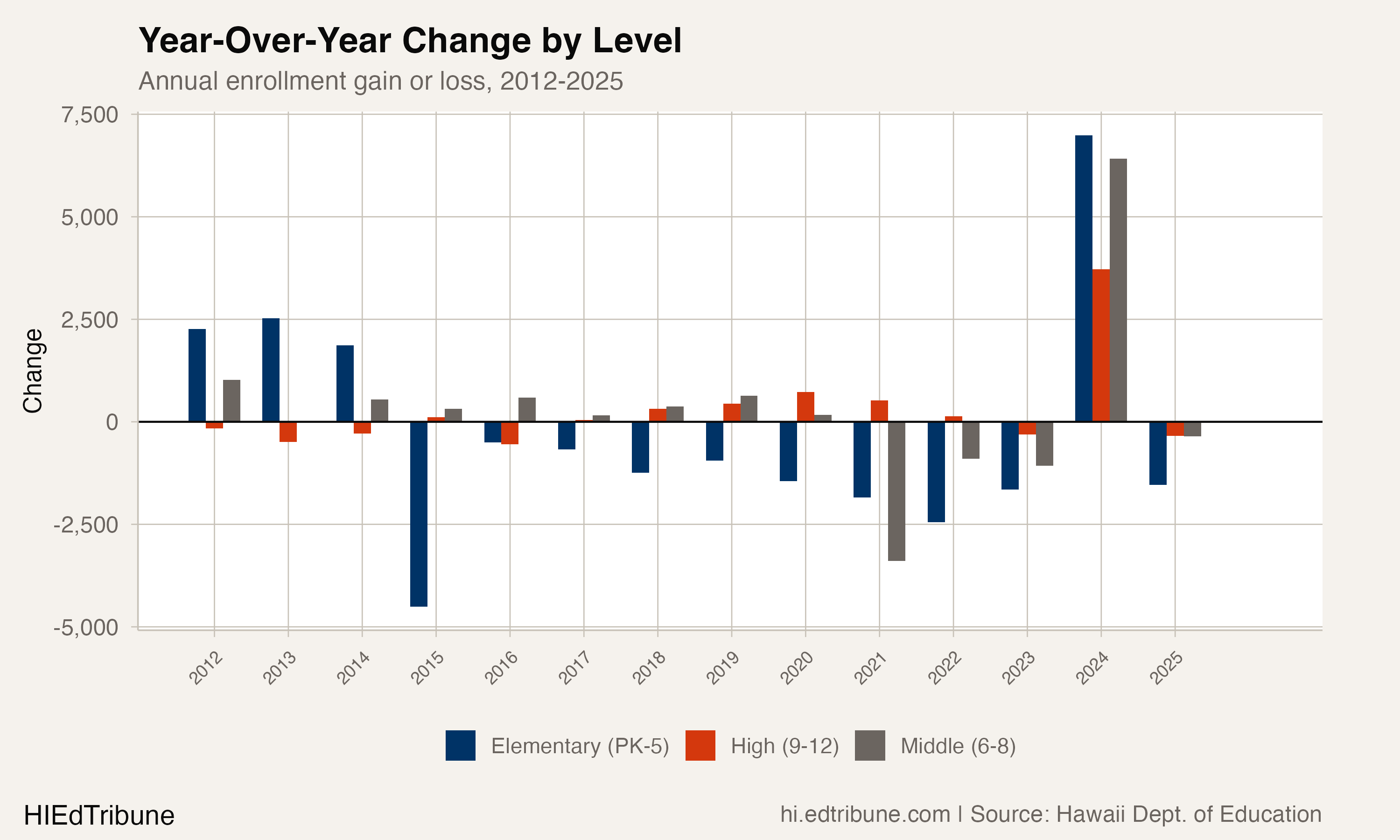
For this reason, all level-to-level comparisons in this article use 2011 and 2023 as endpoints, the longest clean span in the data. The trend lines in the charts include 2024-2025 to show the trajectory, but the SPED redistribution inflates individual grade counts in those two years.
What comes next
The question is not whether high school enrollment will decline. The pipeline guarantees it will. The question is how fast, and what the system does with the buildings and staffing that were built for a larger high school population.
"Decades of enrollment growth led to the construction of new campuses, but the recent and continuing decline in student numbers has left many facilities underutilized." -- Senate Bill 2541, Hawaii State Legislature
When the 2015 K cohort reaches 12th grade in 2027, the pipeline inversion that has sustained high school enrollment will end. Elementary enrollment will have been declining for 13 straight years by then. The high school decline will be newer, and it will be steeper: the gap between the last large pre-cutoff cohort (16,539) and the first post-cutoff cohort to graduate (13,933 from the 2016 K class, reaching G12 in 2028) is 2,606 students in a single grade.
For a state already weighing school consolidation, the timing creates a compounding problem. The elementary schools that were too small in 2024-25 will be joined by high schools that are too large for the students they will serve later.
Detailed code that reproduces the analysis and figures in this article is available exclusively to EdTribune subscribers.
Discussion
Sign in to join the discussion.
Loading comments...