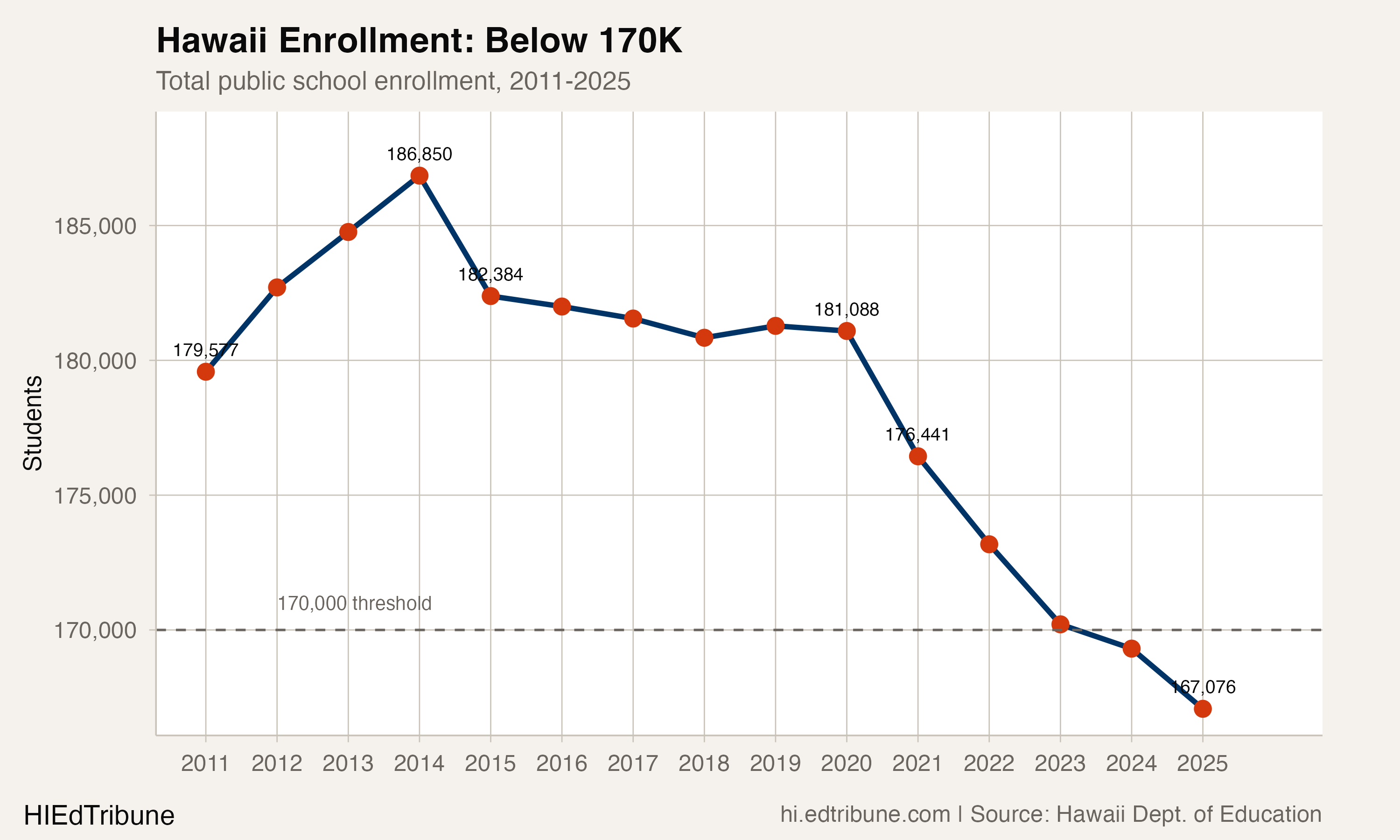
Hawaii's public schools now serve fewer than 170,000 students for the second consecutive year, a threshold the state first crossed in 2023-24. The state enrolled 167,076 students in 2024-25, down 2,232 from the prior year and 19,774 below the 2014 peak of 186,850. That is a 10.6% decline over 11 years in a state with a single school district, no inter-district competition, and a unified budget.
The loss exceeds the entire current enrollment of Maui County. Six consecutive years of decline, stretching from 2020 through 2025, have pushed enrollment below every threshold that once seemed fixed.
A decline in three acts
Hawaii's enrollment trajectory breaks into three distinct periods, each driven by different forces.
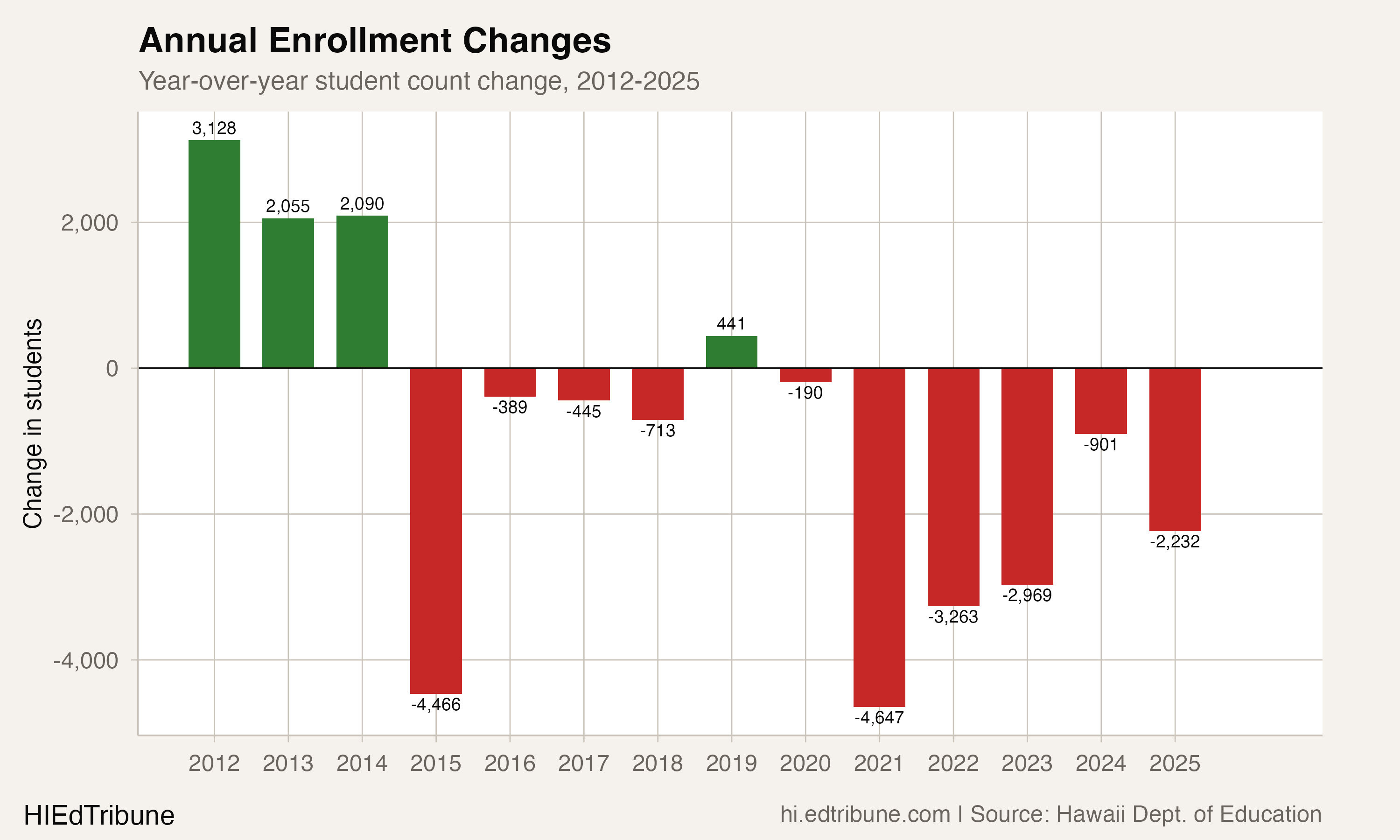
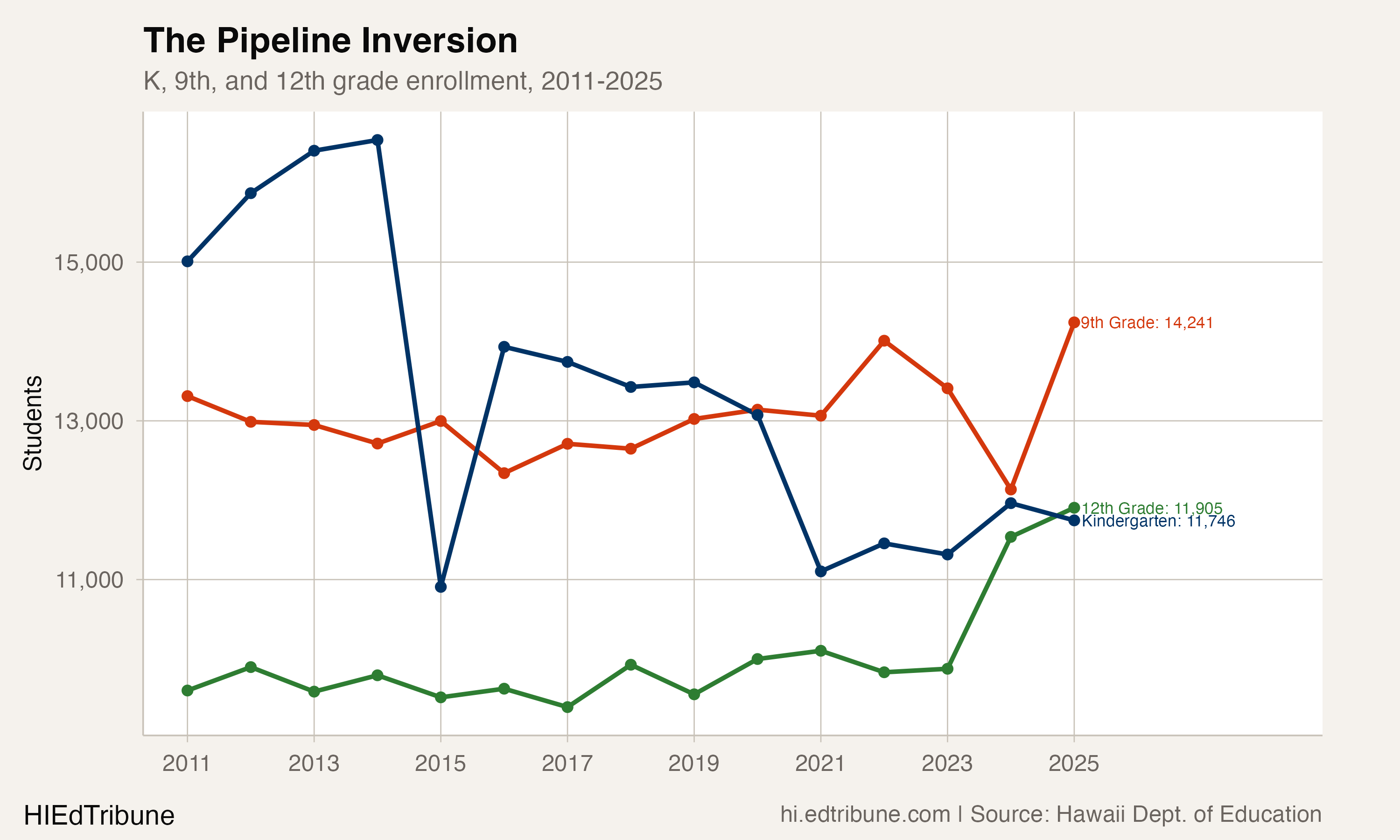
From 2011 to 2014, enrollment grew steadily, adding 7,273 students over three years. Then came the 2015 shock: Hawaii changed its kindergarten age cutoff from December 31 to July 31 under Act 76, instantly disqualifying thousands of children. Kindergarten enrollment plunged 34.0% in a single year, from 16,539 to 10,908. Total enrollment dropped by 4,466.
The years from 2016 to 2019 brought slow erosion. The state lost a few hundred students per year, with 2019 posting a brief uptick of 441. Then COVID hit. The 2020-to-2021 year saw a loss of 4,647, the largest single-year decline in the dataset, and enrollment never recovered. From 2021 to 2025, the state shed an additional 9,365 students, declining at a five-year compound annual rate of -1.6%.
Honolulu carries the weight
The losses are not distributed evenly across the islands. Honolulu↗ET accounts for 92.1% of the statewide decline from peak, despite enrolling 62.2% of the state's students. The county has lost 18,210 students since 2014, a 14.9% decline, falling from 122,195 to 103,985.
Hawaii County↗ET has held up best, losing just 4.5% from its 2012 peak. Kauai↗ET, the smallest county at 8,548 students, has shed 10.6% from its 2014 high. Maui↗ET County fell 13.0% from peak, but its trajectory worsened sharply in 2025.
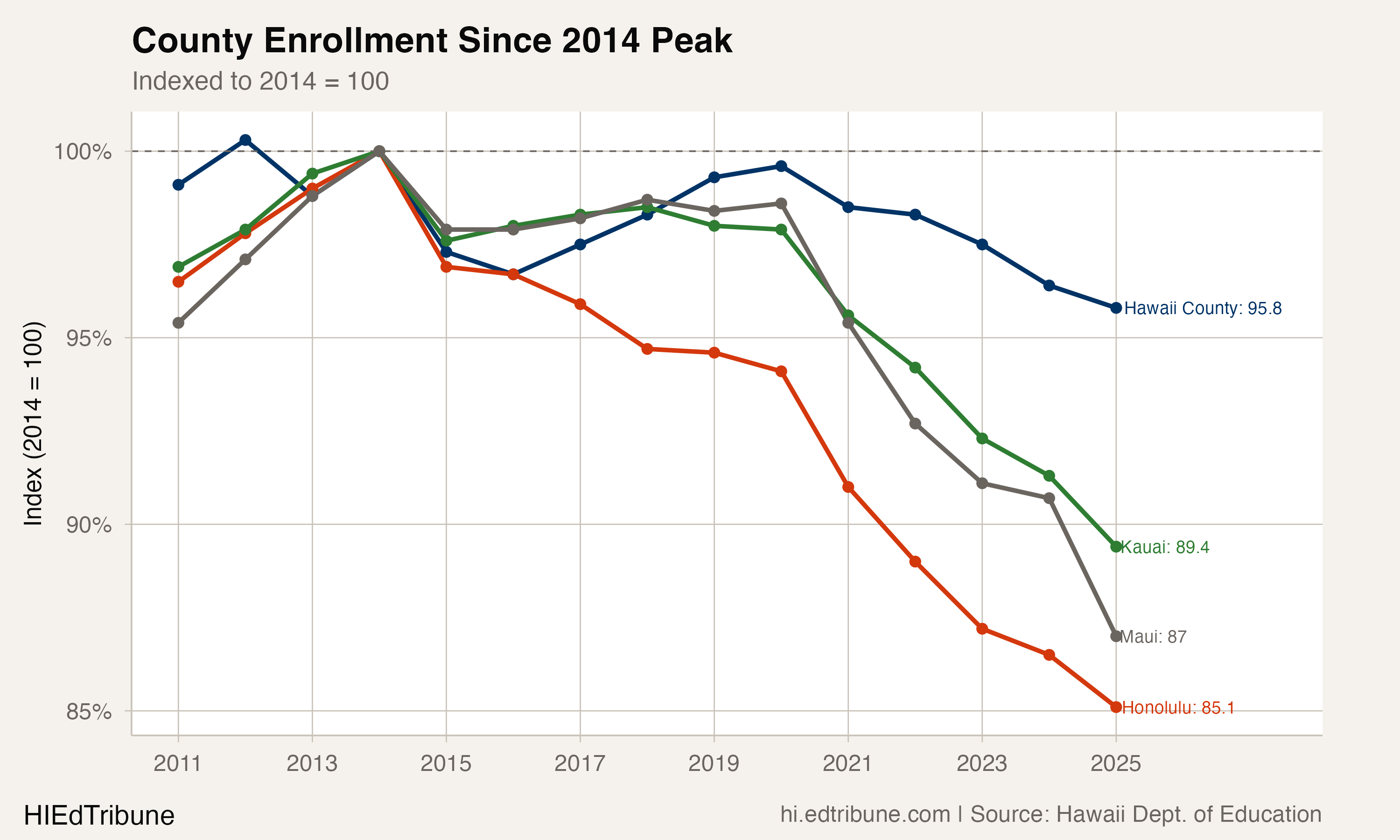
Maui's 2025 loss of 807 students, a 4.1% single-year drop, was the county's largest in the 15-year dataset. The August 2023 Lahaina wildfire displaced thousands of families, and Maui Now reported that Lahainaluna High School enrollment fell 20% in the year after the fire, with principal Richard Carosso noting that families left "going back to the mainland, back to the countries that their families are from." While the 2024 data showed only a modest 74-student Maui decline as fire-displaced students redistributed within the county, the 2025 data suggests many families have not returned.
The price of paradise as enrollment driver
Hawaii's enrollment decline sits inside a broader population loss that makes recovery unlikely. Census data shows the state lost 2,132 residents in fiscal 2025 alone, with 8,876 people migrating to other states. Over the past six years, the state has shed approximately 22,500 residents, with population decreases in five of those six years. Only Vermont and Puerto Rico experienced larger percentage losses over the same period.
The driving force is cost of living, and the data on family intent is stark. A report covered by Hawaii Public Radio found that 37% of Hawaii households have family members considering leaving the state. Among those considering departure, 85% cited the overall cost of living and 73% specifically named housing costs. That amounts to roughly 180,000 people from the state's workforce and younger families weighing an exit.
Falling birth rates compound the outmigration. Hawaii recorded 14,964 births in 2024, fewer than in any of the prior 21 years, continuing a decline that accelerated after the Great Recession. Fewer births mean smaller kindergarten cohorts entering the pipeline, regardless of how many families stay.
Charter schools gain share as traditional schools shrink
One sector is growing. Hawaii's 38 charter schools enrolled 13,094 students in 2024-25, a 5.2% increase of 648 students. The Hawaii State Public Charter School Commission reported the third consecutive year of charter enrollment growth.
Since 2011, charter enrollment has risen 56.5%, from 8,367 to 13,094 students, while traditional school enrollment has fallen 10.1%, from 171,210 to 153,982. Charter market share has grown from 4.7% to 7.8%.
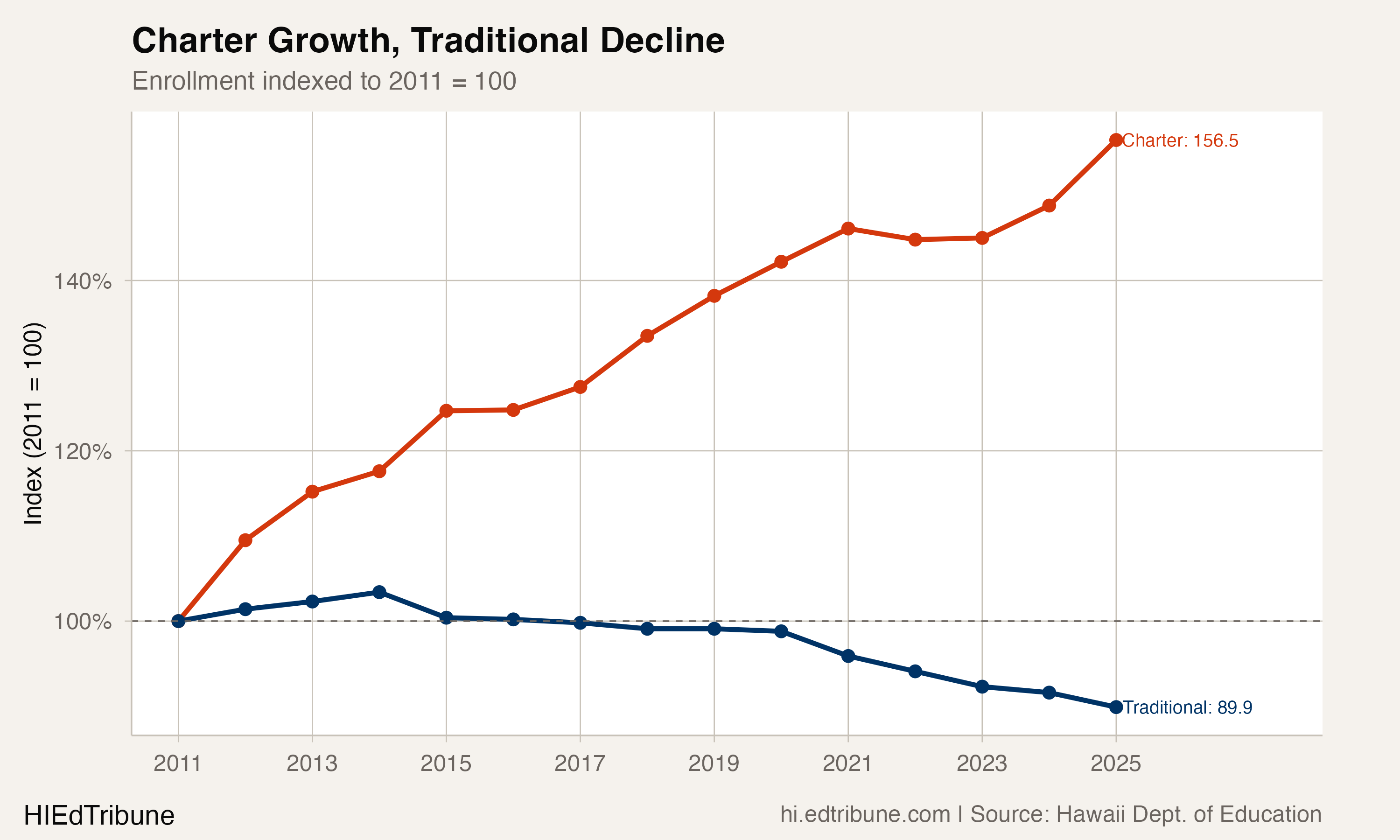
The divergence has limits as context. Charter gains of 4,727 students over 14 years offset less than a quarter of the 17,228-student traditional decline. Even if every charter student had been drawn from traditional schools, the net loss would still be 12,501. In a state losing population, both sectors are competing for a shrinking pool.
Fewer kindergartners, more seniors
The grade-level pipeline signals that the worst of the decline may lie ahead. Kindergarten enrollment in 2025 stood at 11,746, down 15.7% from 13,933 in 2016 (the first post-cutoff-change year). Meanwhile, 12th grade enrollment has climbed 23.7%, from 9,625 to 11,905 over the same period.
The most striking feature of the 2025 data: 9th grade, at 14,241, is now the largest grade in the state, with 2,495 more students than kindergarten. As those large high school cohorts graduate out over the next three years, smaller elementary cohorts will replace them from below.
34 schools below the viability line
The enrollment decline has left dozens of schools undersized. Honolulu Civil Beat reported that 34 schools enroll fewer than 250 students, the threshold the DOE considers necessary for adequate funding. Eight elementary schools operate on budgets below the $1.38 million minimum needed for basic operations.
The Department of Education initially studied outright school closures, but shifted its approach in 2025, prioritizing "district optimization" through redistricting before considering consolidation. The DOE's timeline calls for redistricting changes in the 2026-27 school year, with consolidation studies beginning in 2027 and any mergers not taking effect until at least 2028.
The operational challenge is geographic. Hawaii's most undersized schools often serve isolated communities. Maunaloa Elementary on Molokai enrolls 59 students on a $900,000 budget, but the nearest alternative school is 17 miles away.
What the kindergarten pipeline foretells
With births still falling and outmigration persistent, the direction of enrollment is not in question. The question is pace. The state has lost an average of 2,367 students per year over the past six years. If that rate holds, Hawaii will fall below 160,000 students by 2028. If the rate accelerates as large high school cohorts age out and smaller elementary cohorts move up, the decline could steepen.
The DOE's redistricting and consolidation timeline extends to 2028 at the earliest. The enrollment curve will not wait. Every year of delay means the remaining schools absorb less per-pupil funding while maintaining the same physical infrastructure across 258 schools spread over six islands.
Hawaii's public school system, the only statewide district in the nation, was built for 186,000 students. It now serves 167,000 and is headed lower.
Detailed code that reproduces the analysis and figures in this article is available exclusively to EdTribune subscribers.
Discussion
Sign in to join the discussion.
Loading comments...