In this series: Hawaii 2025-26 Enrollment.
Correction (March 31, 2026): An earlier version of this article identified the last year of enrollment growth as 2019-20. The gain of 441 students occurred in 2018-19. Derived figures have been updated accordingly.
In 2024, Hawaii public schools lost 901 students. That looked like a floor. In 2025-26, they lost 3,425.
Total enrollment fell to 163,651 in 2025-26, the lowest figure in 16 years of state records and the first time Hawaii has dipped below the 165,000 mark. The state has now shed 23,199 students since peaking at 186,850 in 2013-14, a 12.4% decline that erased roughly one of every eight seats in the system. The 2025-26 drop is the largest single-year loss outside of the pandemic, and it arrived after what had appeared to be a stabilization: losses of 2,969 in 2022-23, then just 901 in 2023-24, then 2,232 in 2024-25, and now 3,425.
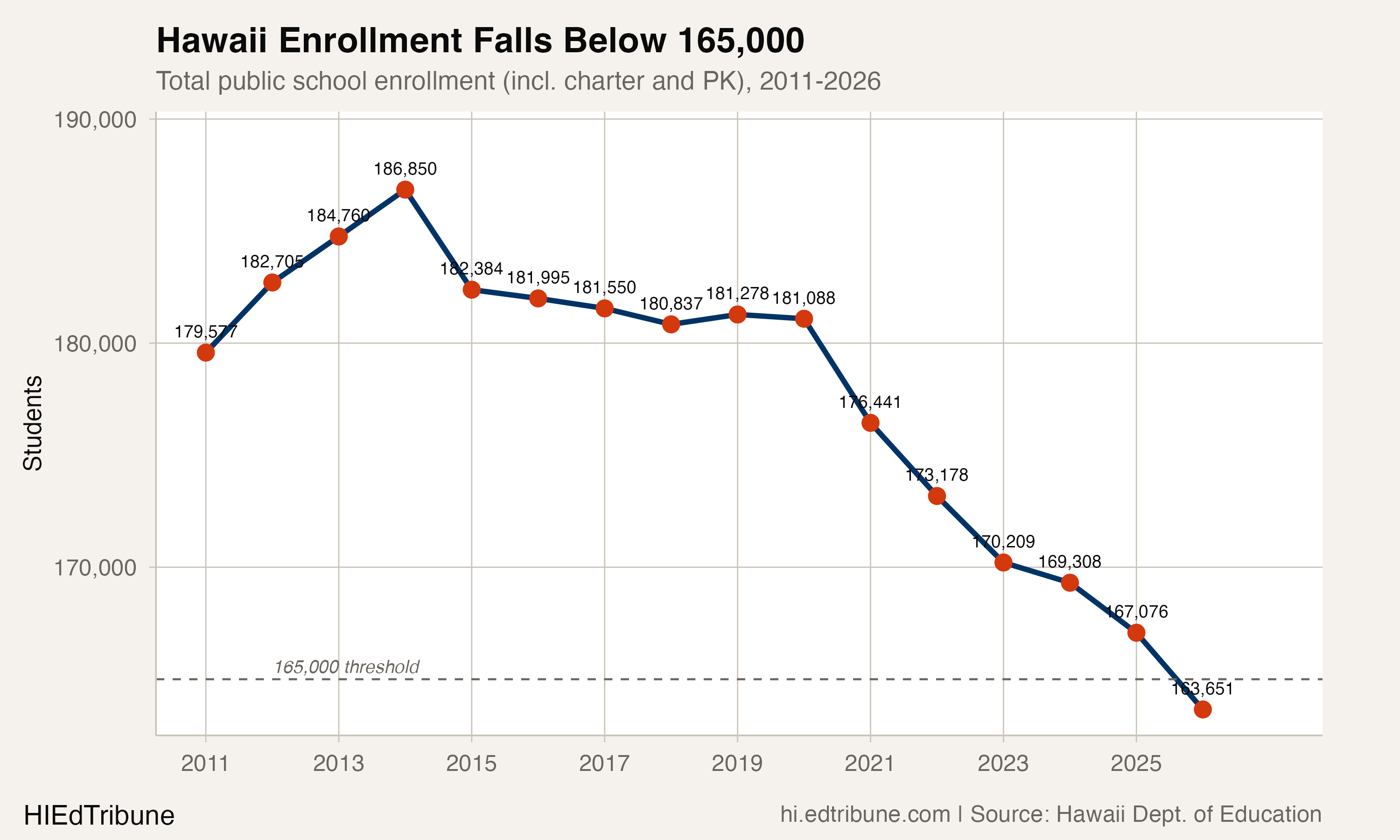
The pattern is not deceleration. It is re-acceleration.
Seven years of unbroken losses
Hawaii has not added students since 2018-19, when a gain of 441 students brought enrollment to 181,278. In the seven years since, the state has lost 17,627 students, a 9.7% contraction. That 2018-19 uptick was a brief exception sandwiched between two eras of decline.
The pre-COVID losses were modest. Between 2015-16 and 2019-20, the state lost a net 1,296 students over five years, an average of 259 per year. Since the pandemic, annual losses have averaged 2,906, more than 11 times the pre-COVID pace. The COVID crash of 2020-21 removed 4,647 students in a single year. What followed was not recovery but continuation: -3,263, then -2,969, a brief pause at -901, and now two consecutive years of deepening losses.
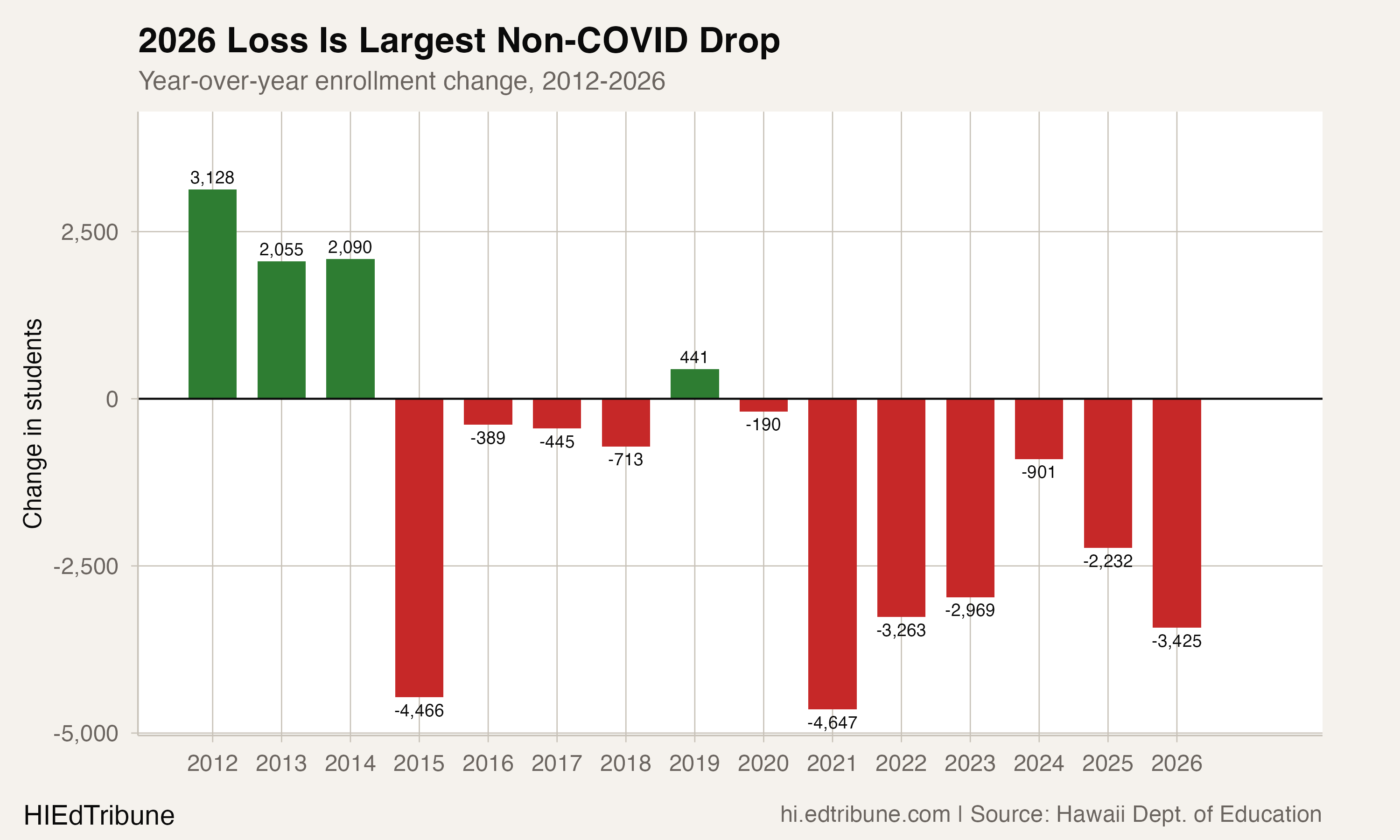
The 2025-26 drop of 3,425 is the third-largest single-year loss in the dataset, behind only the 2020-21 pandemic crash (-4,647) and the 2014-15 drop (-4,466, which is partly a kindergarten counting methodology change). In the post-pandemic era, it stands alone as the worst.
The housing cost exodus
The most direct explanation is that families are leaving. Hawaii's population fell to 1,432,820 as of July 2025, a decline of roughly 22,500 residents since 2020. Domestic outmigration ran at 8,876 people in fiscal 2025 alone, according to Census Bureau estimates.
Housing costs are the dominant push factor. The median single-family home price on Oahu reached $1,160,000 in March 2025, more than double the national average. University of Hawaii Economic Research Organization analysis has found that outmigration from Hawaii skews young, disproportionately pulling away the cohort most likely to be starting families.
"This is yet another sign of the affordability crisis that Hawaii residents deal with every day." -- Grassroot Institute of Hawaii, January 2026
Declining births compound the problem. Hawaii recorded 14,964 births in 2024, a nearly 20% drop from 18,444 a decade earlier. Those shrinking birth cohorts are now arriving at kindergarten age: K enrollment in 2025-26 stood at 11,637, down from 13,933 in 2015-16, a 16.5% decline.
Every island is losing
All four counties sit at record lows. Honolulu↗ET accounts for the bulk of the damage: 20,854 students lost since 2014, a 17.1% decline that represents 90% of the statewide drop from peak. Maui↗ET County lost 3,081 students (-14.3%) over the same period, with the August 2023 Lahaina wildfires accelerating an existing trend.
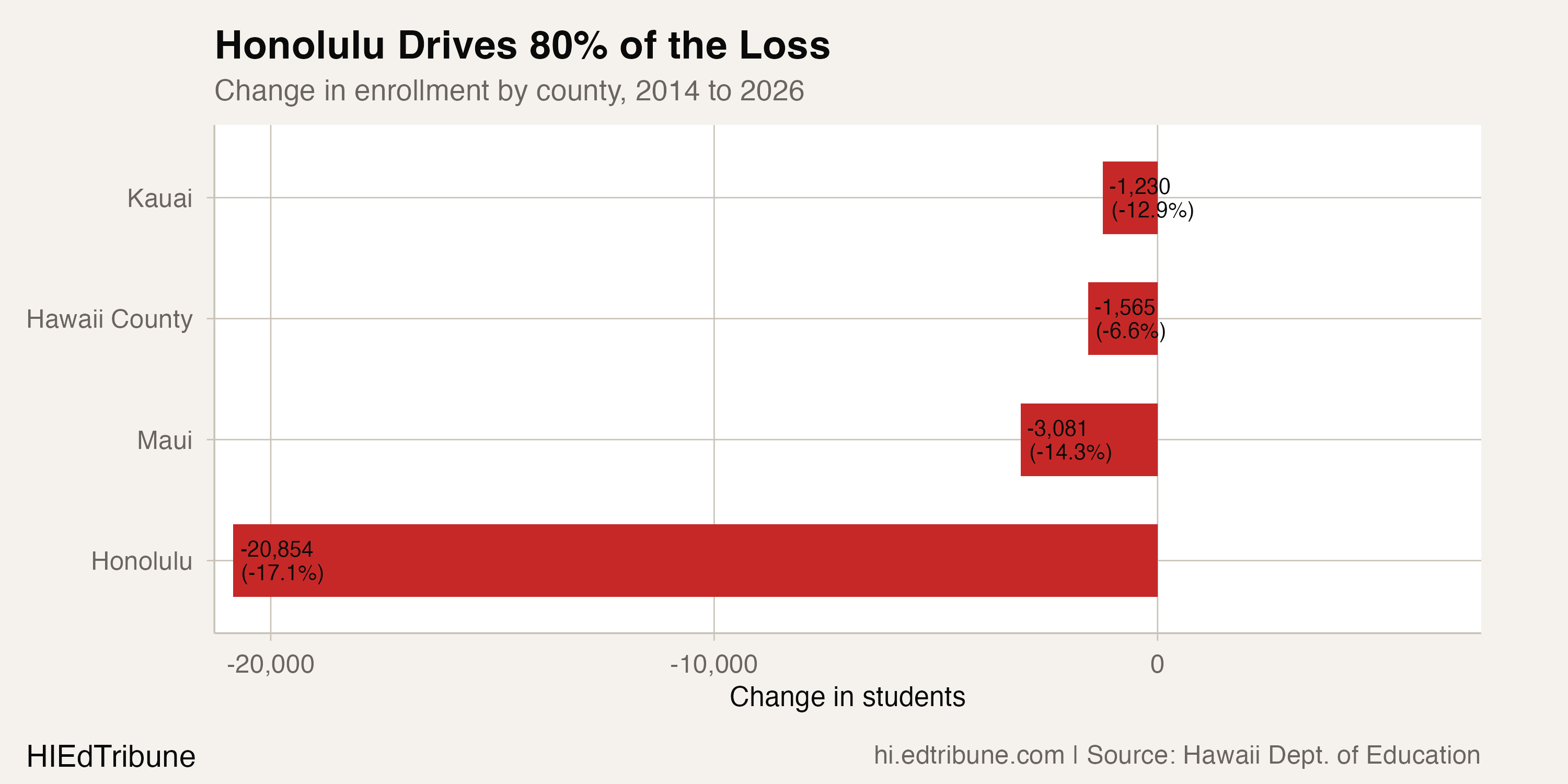
Kauai↗ET County fell 12.9% from its 2014 peak. Hawaii County↗ET, the Big Island, lost the smallest share (-6.6% from 2014) but still sits at its lowest enrollment on record.
In 2025-26, every county lost students. Kauai fell the fastest in percentage terms (-2.6%), followed by Honolulu (-2.5%), Hawaii County (-2.5%), and Maui (-1.5%). The uniformity is notable: no island is growing, and no island is close to flat.
Charter schools grow, traditional schools empty faster
Hawaii's 40 charter schools enrolled 13,371 students in 2025-26, their highest figure in the dataset. Charter share has risen from 4.7% to 8.2% since 2010-11, nearly doubling. The Hawaii State Public Charter School Commission reported three consecutive years of enrollment growth, with a 5.2% increase in 2024-25 alone.
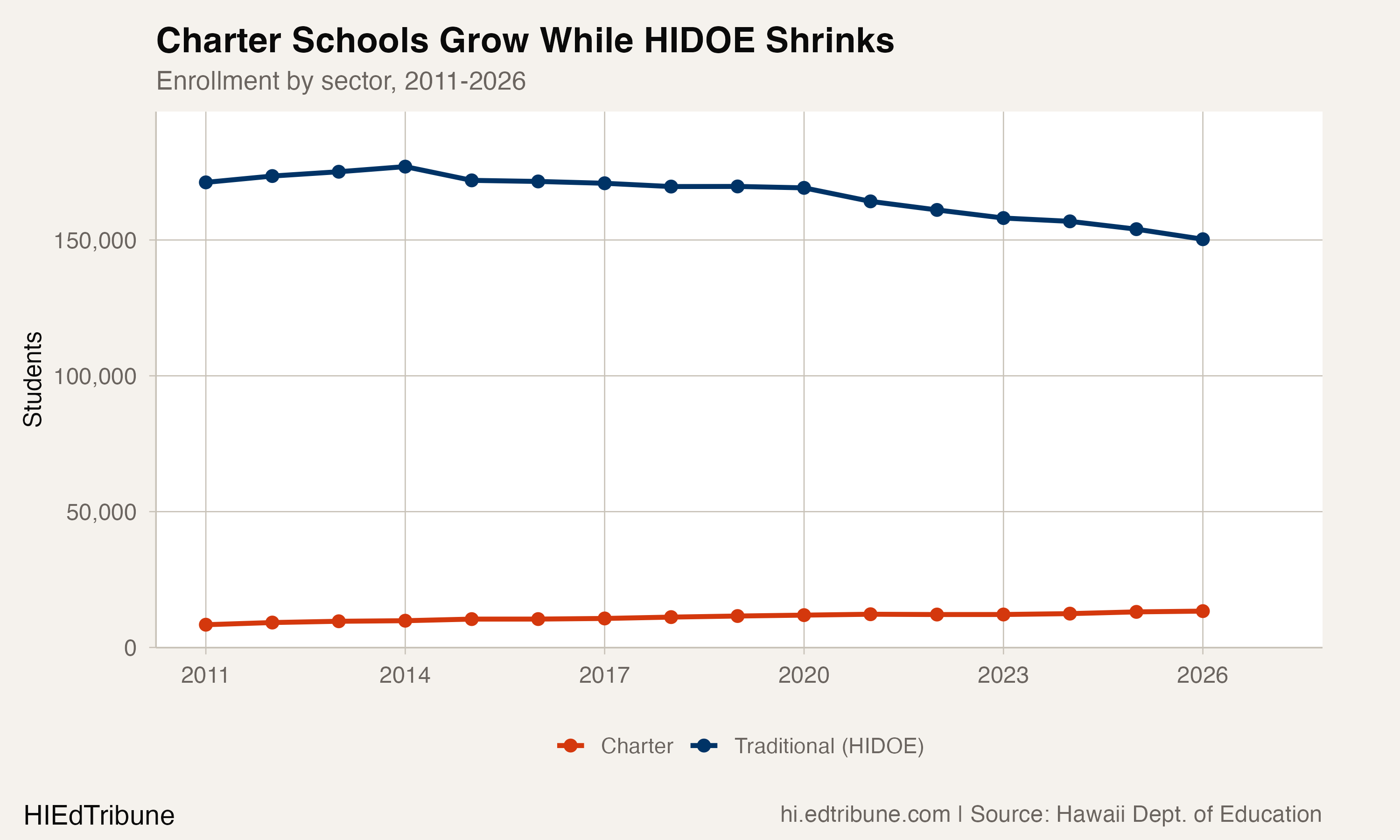
The divergence masks how deep the traditional system's losses run. HIDOE schools (the traditional sector) enrolled 150,280 students in 2025-26, down from 177,010 in 2013-14, a loss of 26,730 students (-15.1%). In 2025-26 alone, traditional schools lost 3,702 students while charters gained 277. The total system is shrinking; the traditional system is shrinking faster.
Charter growth does not fully explain the traditional sector's decline, however. Even if every charter student had remained in a traditional school, HIDOE would still have lost more than 20,000 students from peak. The more likely dynamic: charters are absorbing some families who would otherwise leave the public system entirely, blunting total enrollment loss rather than causing it.
The pipeline is narrowing
Kindergarten enrollment fell to 11,637 in 2025-26 while 12th grade stood at 12,095. The K-to-12th-grade ratio dropped to 96.2, meaning fewer students are entering than leaving. This inversion, which first appeared in 2024-25 (ratio: 98.7), signals that absent a major reversal in birth trends or in-migration, enrollment losses will compound for at least another decade.
The Western Interstate Commission for Higher Education projects that Hawaii will see a 33% decline in high school graduates by 2041, falling from roughly 11,500 graduates in 2023 to just over 7,600. That is the steepest projected drop in the western United States and one of the sharpest nationally. That projection is downstream of the kindergarten numbers Hawaii recorded in 2024-25.
34 schools below the funding threshold
The fiscal consequences are already visible. Thirty-four schools now enroll fewer than 250 students, up from 19 a decade ago. That 250-student mark is the estimated minimum needed to adequately fund basic operations. Eight elementary schools fell below $1.38 million in annual budgets in 2023-24, with Maunaloa Elementary on Molokai operating on roughly $900,000 for 59 students.
The state has not closed a school since 2011, when Queen Liliuokalani Elementary in Kaimuki was shut amid strong community pushback. Rather than pursue closures directly, the DOE announced in September 2025 that it would pursue "district optimization," redrawing attendance boundaries to rebalance enrollment before considering consolidation.
"As a result of the feedback received, the Department will be revising its approach to addressing shifts in enrollment and adjusting the timeline accordingly." -- Deputy Superintendent Tammi Oyadomari-Chun, Honolulu Civil Beat, September 2025
Redistricting changes could take effect as early as fall 2026. The first school consolidation studies are not expected until spring 2028. Rural complexes face the sharpest near-term pressure: enrollment in the area covering Lanai, Molokai, Hana, and West Maui is projected to fall 25% by the end of the decade.
What 2026-27 will test
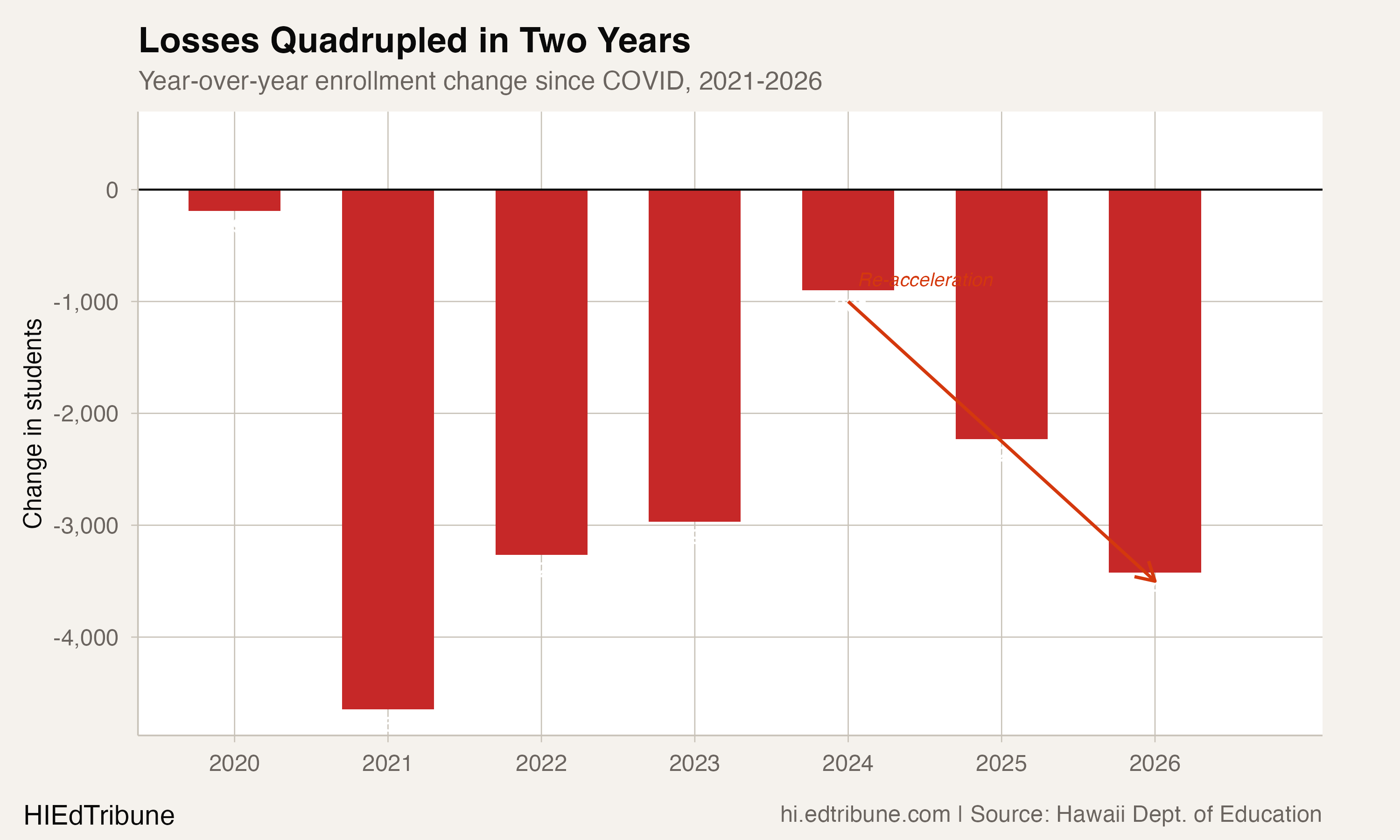
The re-acceleration from -901 to -3,425 in two years raises a question: is 2025-26 a spike or the new baseline? The kindergarten pipeline suggests it is closer to baseline. With births running below 15,000 annually, each incoming cohort is smaller than the one it replaces. The K-to-12th-grade inversion is structural, not cyclical.
Hawaii's enrollment crossed below 165,000 in 2025-26. At the current trajectory, it will cross below 160,000 within two years. Civil Beat has reported that the DOE projects an additional loss of 14,600 students by the end of the decade. If that holds, Hawaii would fall below 150,000 by 2030. The redistricting timeline gives the state until 2028 to act. The enrollment data is not waiting.
Detailed code that reproduces the analysis and figures in this article is available exclusively to EdTribune subscribers.
Discussion
Sign in to join the discussion.
Loading comments...