In this series: Hawaii 2025-26 Enrollment.
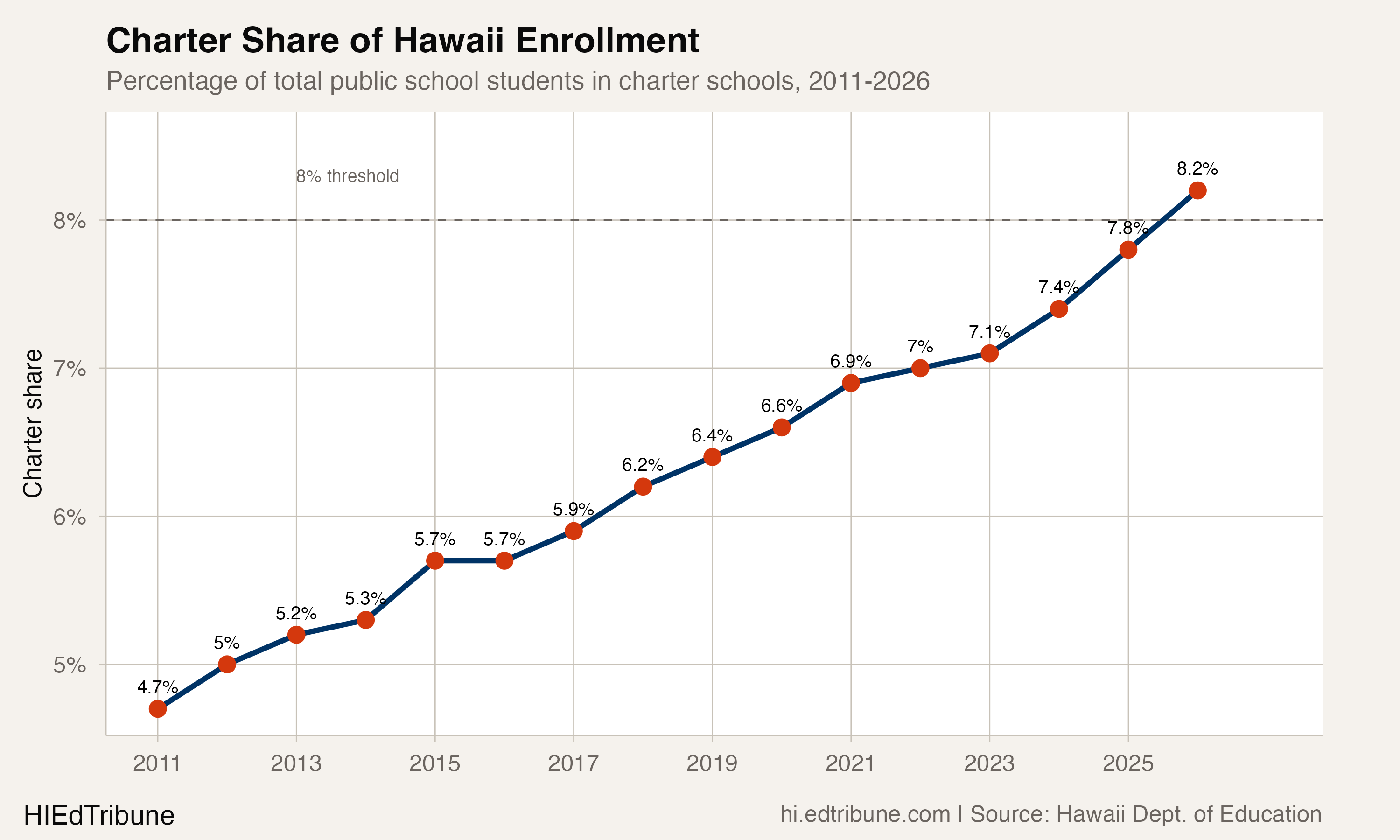
For 15 years, Hawaii's charter sector has been climbing. In 2025-26, it reached a symbolic threshold: 8.2% of all public school students now attend one of the state's 40 charter schools. That is up from 4.7% in 2010-11, a 3.5 percentage-point gain that reflects both a sector adding students and a traditional system losing them.
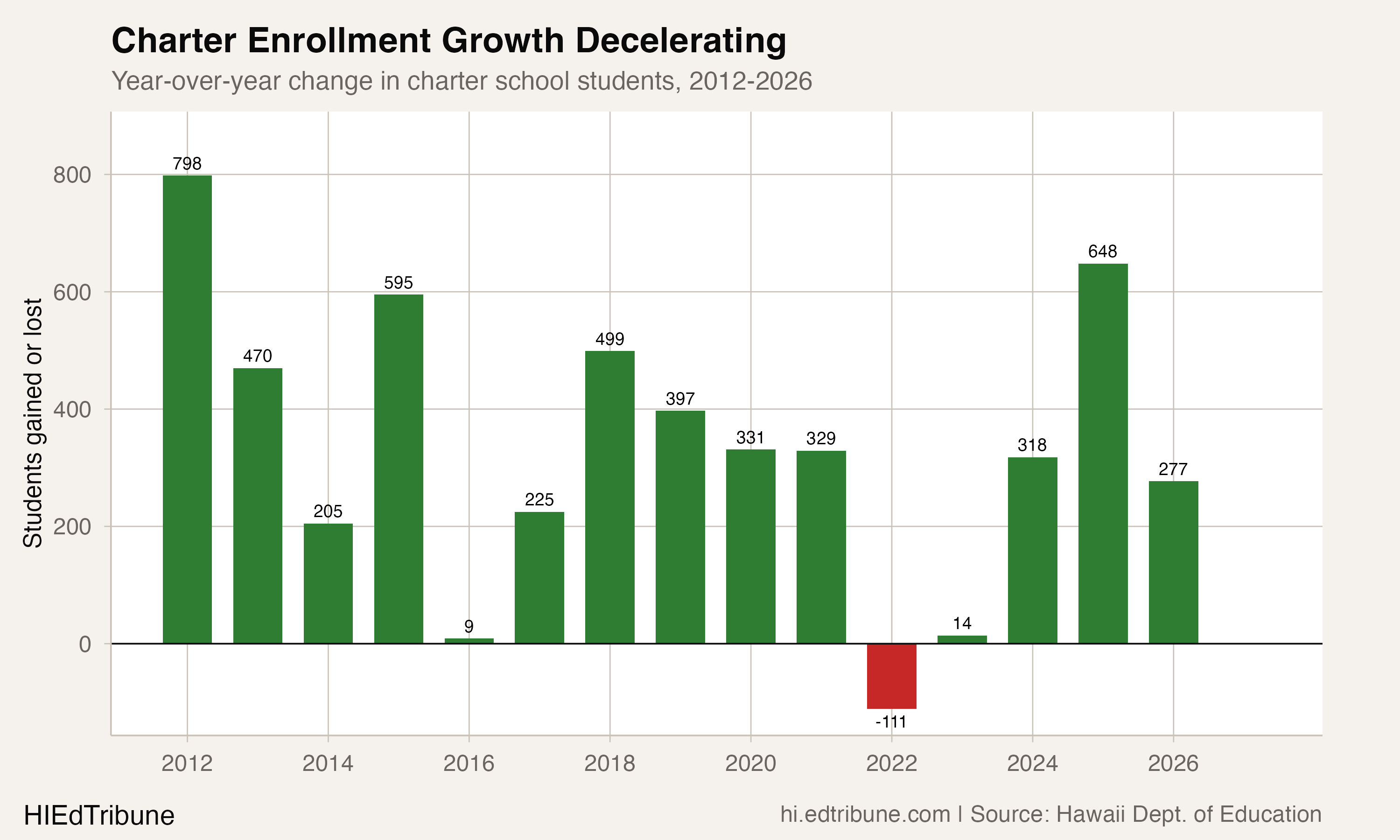
But the milestone arrived quietly. The charter sector added just 277 students this year, less than half the 648 it gained a year earlier and well below the 798-student peak set in 2011-12. The 8% crossing is real, but the engine that got it there is losing power.
A ceiling or a plateau?
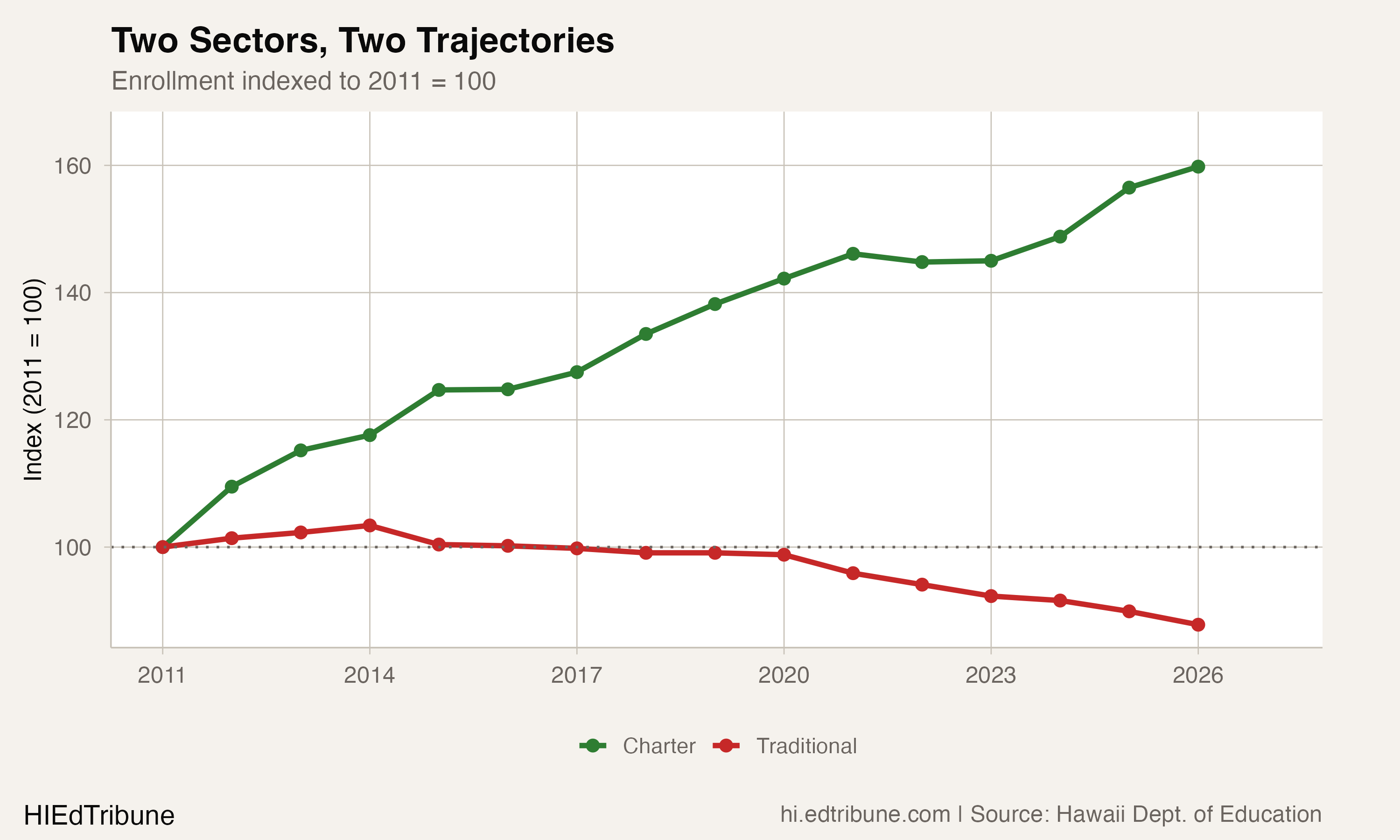
Charter enrollment reached 13,371 in 2025-26, up 59.8% from the 8,367 students enrolled in 2010-11. That growth translates to a compound annual rate of 3.2% over 15 years. Traditional public school enrollment moved in the opposite direction, falling from 171,210 to 150,280 over the same period, a loss of 20,930 students, or 12.2%.
The divergence is stark when indexed to a common baseline. Since 2010-11, charter enrollment has grown to 160% of its starting level while traditional enrollment has fallen to 88%.
The 2026 gain of 277 students is not an anomaly. Charter growth has been uneven for years, with the sector actually losing 111 students in 2021-22 and gaining just 14 in 2022-23. The strongest years came early: 798 new students in 2011-12, 595 in 2014-15, 499 in 2017-18. The post-COVID pattern shows a sector that surged in 2024-25 (+648) and then pulled back sharply.
The denominator problem
Rising market share can signal a sector drawing families in, or it can reflect a shrinking pool inflating every fixed number's proportion. In Hawaii, it is mostly the former, but the denominator matters more with each passing year.
Of the 3.5 percentage-point share gain since 2010-11, the majority came from charter enrollment growth. If charter enrollment had grown at the same rate but the overall student population had stayed flat, the charter share would still have risen from 4.7% to roughly 7.4%. The shrinking denominator accounts for the final stretch to 8.2%.
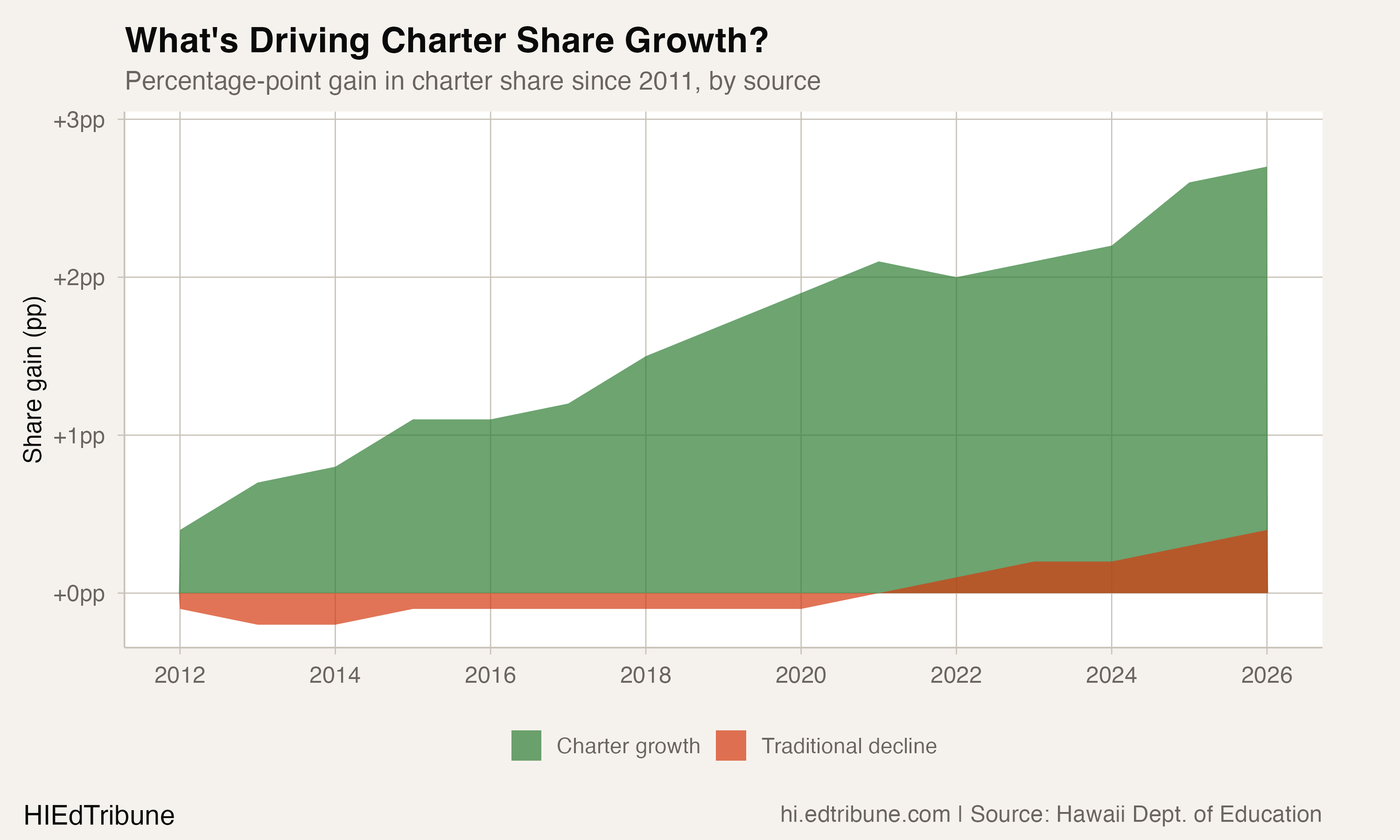
That balance is shifting. Traditional enrollment fell by 3,702 students this year, its largest single-year loss since the COVID drop of 4,976 in 2020-21. If charter enrollment growth continues to decelerate while traditional losses accelerate, the charter share could keep climbing even as the sector itself flatlines.
Facilities and funding as growth constraints
The charter sector's deceleration likely has structural causes beyond simple demand saturation. Charter schools in Hawaii receive substantially less public funding per student than traditional schools: $9,697 per pupil compared to $17,475 for DOE-run schools in the 2019-20 school year, a gap of 44%. Unlike traditional public schools, charters do not receive state repair and maintenance funds. Schools must cover facilities costs out of their operating budgets.
The result is a sector where physical capacity constrains growth. According to the Charter School Commission, schools spend 15% to 30% of their budgets on facilities, with some campuses exceeding that range. Kamalani Academy, the charter that closed permanently in June 2025 after the Commission voted not to renew its contract, had been spending roughly half its budget on rent for a former Catholic school in Wahiawa.
Meanwhile, some charters turn away families. Honolulu Civil Beat reported that Alaka'i O Kaua'i, a charter school on Kaua'i, carried a 180-student waitlist against a 240-student capacity. That demand exists alongside a 2019 DOE report finding a net surplus of nearly 10,000 classroom seats across traditional campuses.
"Charter schools are the only growing sector of Hawaiʻi education, but limited funding and campus space has prevented schools from expanding and meeting families' demands." Source: Honolulu Civil Beat, December 2025
A traditional system under pressure
The other side of the charter story is the accelerating decline in traditional enrollment. HIDOE's traditional schools lost 3,702 students in 2025-26, bringing the six-year post-COVID loss to 18,912 students, or 11.2%. Only one year since 2014-15 saw traditional enrollment hold steady (2018-19, when the change was +44 students). Every other year brought losses.
The drivers extend well beyond charter competition. Hawaii's population has declined in five of the past six years, with 8,876 residents relocating to other states in fiscal 2025 alone. The state's birth rate has been falling at roughly 1-2% annually for decades. The Western Interstate Commission for Higher Education projects a 33% decline in Hawaii's high school graduates between 2023 and 2041, the steepest projected drop in the nation.
Housing costs compound the out-migration pressure. The median single-family home on O'ahu topped $1.1 million in 2025, and working-age families with children represent the largest group leaving the state.
The DOE has begun adapting. Rather than closing schools, the department is pursuing "district optimization" through redistricting, with changes planned for the 2026-27 school year. Consolidation studies would not begin until 2027 at the earliest. Rural areas on Lana'i, Moloka'i, and in West Maui face potential enrollment drops of 25%, while communities in 'Ewa and Kapolei still deal with overcrowded classrooms from new housing developments.
What the threshold does not tell you
An 8.2% charter share, by national standards, is modest. The milestone matters locally because charter schools in Hawaii operate in an unusual structure: the entire state functions as a single school district under HIDOE, meaning charter competition is not distributed across hundreds of districts but concentrated within one system.
That structure also means there is no inter-district transfer market. Families who want a public school alternative to their assigned campus have two options: private school or charter. A 2025 Holomua Collective survey found that 57% of middle-income respondents said they would need to leave within five years, up from 46% the year before. The families who stay may increasingly be the ones who found alternatives within the public system.
The charter sector's 2026-27 year will be a test. Nearly a third of the state's charter schools face contract renewal, a high-stakes process that will determine which schools remain open. A new pre-K charter is opening in Kapolei, potentially adding 80 students. And the traditional sector shows no sign of stabilizing. Whether the charter sector can convert demand into seats, given its funding and facilities constraints, will determine whether 8% is a milestone on the way to 10% or a ceiling the sector cannot push through.
Detailed code that reproduces the analysis and figures in this article is available exclusively to EdTribune subscribers.
Discussion
Sign in to join the discussion.
Loading comments...