In this series: Hawaii 2025-26 Enrollment.
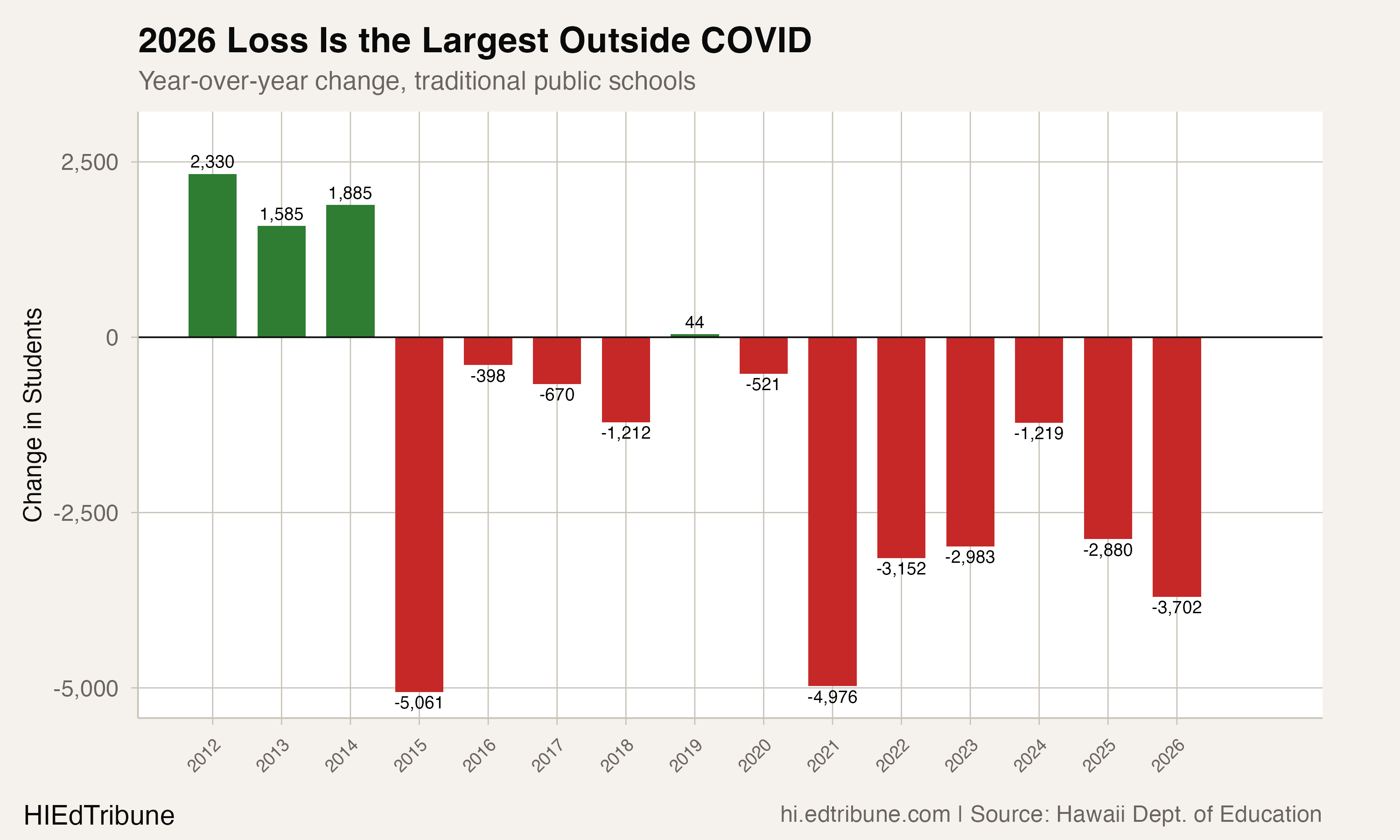
The last time Hawaii's traditional public schools gained students was 2018-19, when county-operated schools added 44 students statewide. It was the only year of growth since 2014. The decline resumed immediately, and this year it accelerated.
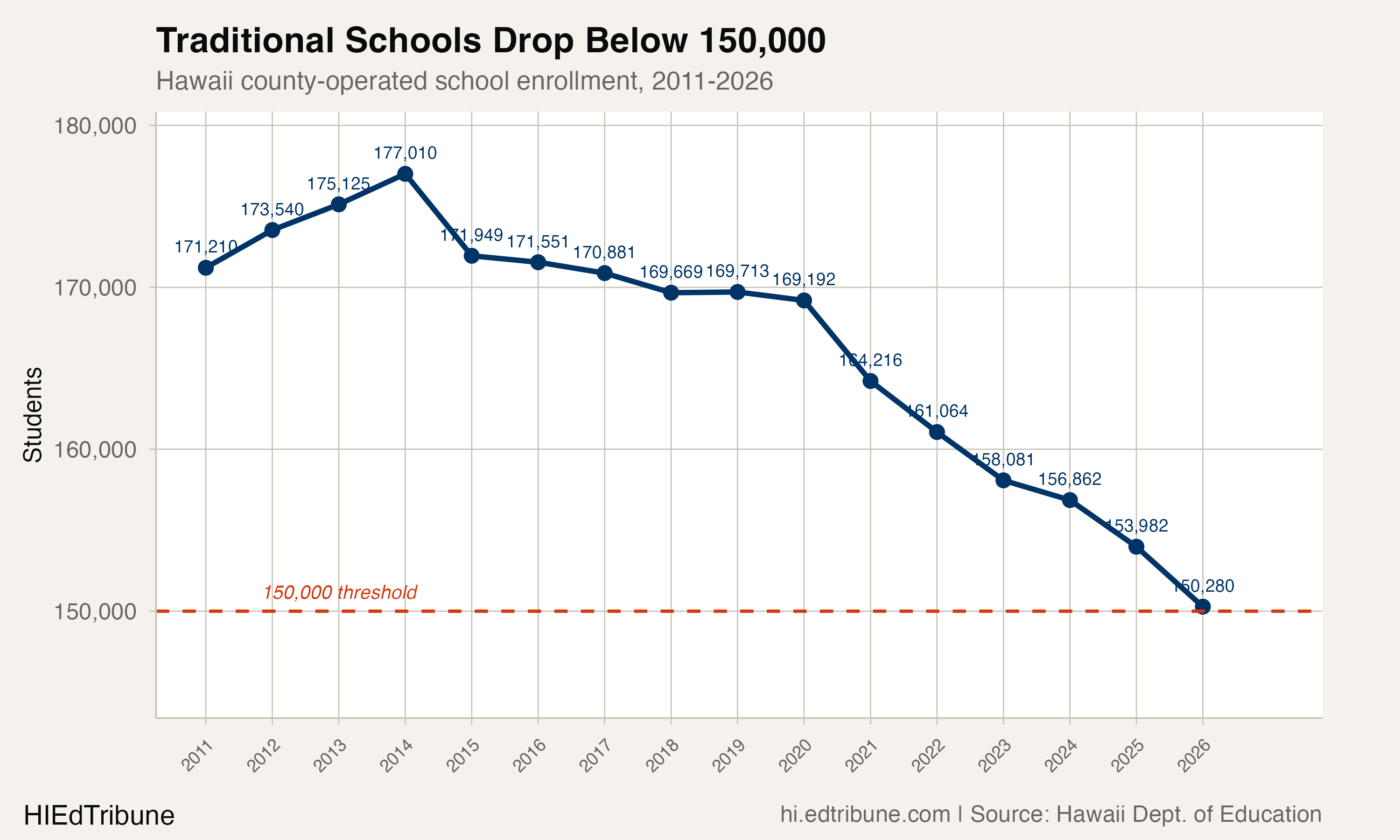
In 2025-26, Hawaii's county-operated schools enrolled 150,280 students, shedding 3,702 in a single year, a 2.4% decline. It is the steepest real loss on record for the traditional sector, exceeding even the post-COVID plunge of 2021 when adjusted for a 2015 data anomaly. Since peaking at 177,010 in 2013-14, traditional schools have lost 26,730 students, a 15.1% reduction in 12 years.
The 150,000 threshold is now less than one year's losses away.

The acceleration nobody planned for
The trajectory had briefly appeared to stabilize. In 2023-24, traditional schools lost 1,219 students, roughly one-third of the prior year's loss. But 2024-25 brought a loss of 2,880, and 2025-26 nearly doubled that to 3,702. The two-year acceleration from -1,219 to -3,702 represents a tripling of the annual decline rate.
This pattern is visible in the year-over-year data. The three pre-pandemic losses (2016 through 2018) averaged -760 students annually. The three post-pandemic, post-recovery losses (2024 through 2026) averaged -2,600, more than three times the earlier pace.

The 2015 bar on the chart demands a note. The 5,061-student drop that year was largely a data artifact: Hawaii changed how it counted kindergartners, and K enrollment fell from 16,539 to 10,908 in a single year, a 34% plunge that no demographic shift could explain. Excluding that anomaly, 2026's loss of 3,702 is the largest genuine decline in at least 16 years of data.
Where the students are not going
Charter schools are growing, but not nearly fast enough to account for the traditional sector's losses. In 2025-26, charters enrolled 13,371 students, gaining 277 over the prior year. The traditional sector lost 13.4 students for every one the charter sector gained.
Since 2014, when traditional enrollment peaked, charters have added 3,531 students, a 35.9% increase. Over the same period, traditional schools lost 26,730. Charters absorbed roughly 13 cents of every dollar the traditional sector shed. The remaining 87% of lost students left the public system entirely.
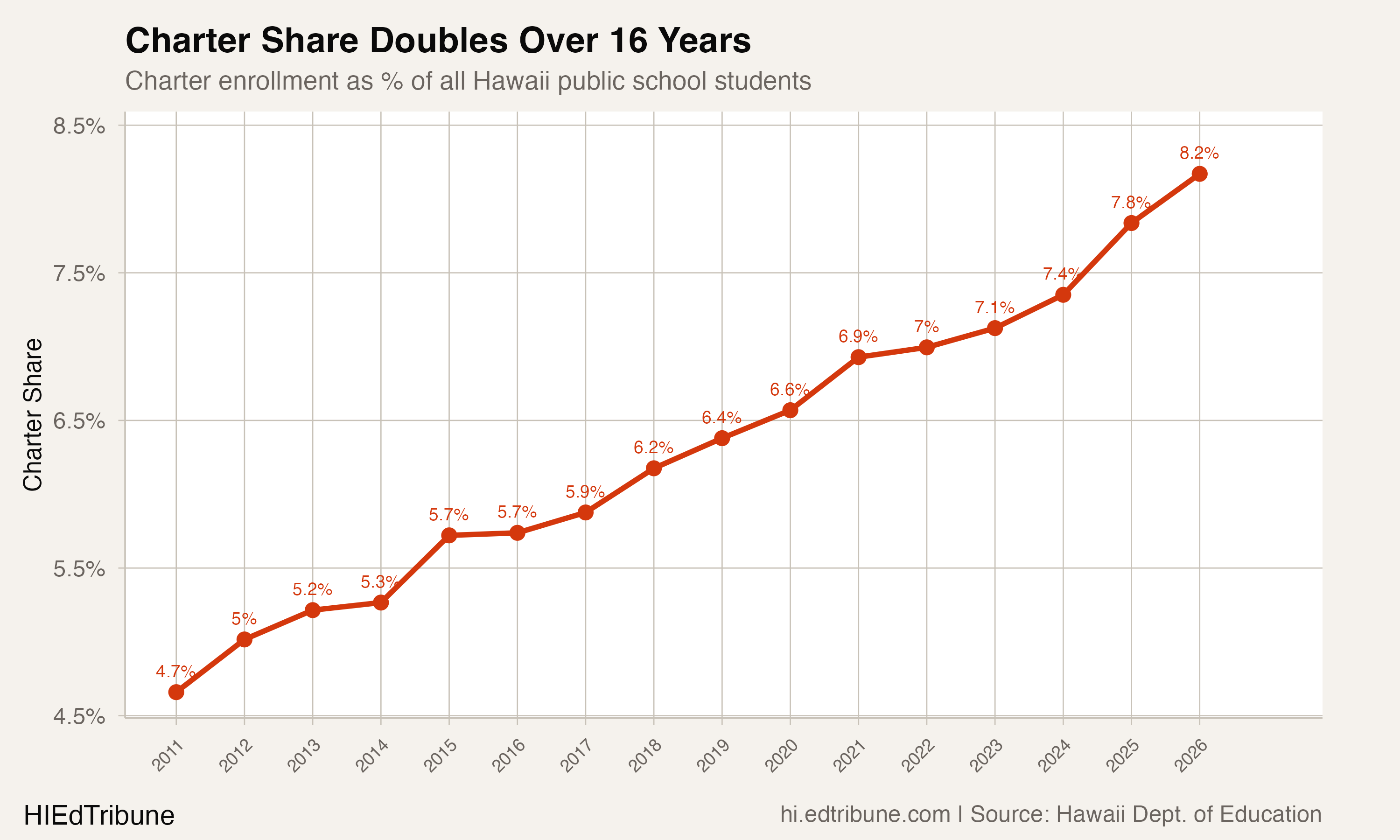
Charter share has grown steadily, from 5.3% in 2014 to 8.2% in 2026. But the growth is more a function of a shrinking denominator than a surging numerator.

The Hawaii State Public Charter School Commission reported that charter enrollment rose for the third consecutive year in 2024-25, with 13,070 K-12 students across 38 schools. Ed Noh, the commission's executive director, told Hawaii Public Radio that "enrollment in the 40 charter schools across the state is trending up, while enrollment in traditional public schools is trending down." That framing is accurate but understates the asymmetry: the charter trend line is a gentle slope upward while the traditional line is a cliff.
Honolulu drives the numbers, but no county is spared
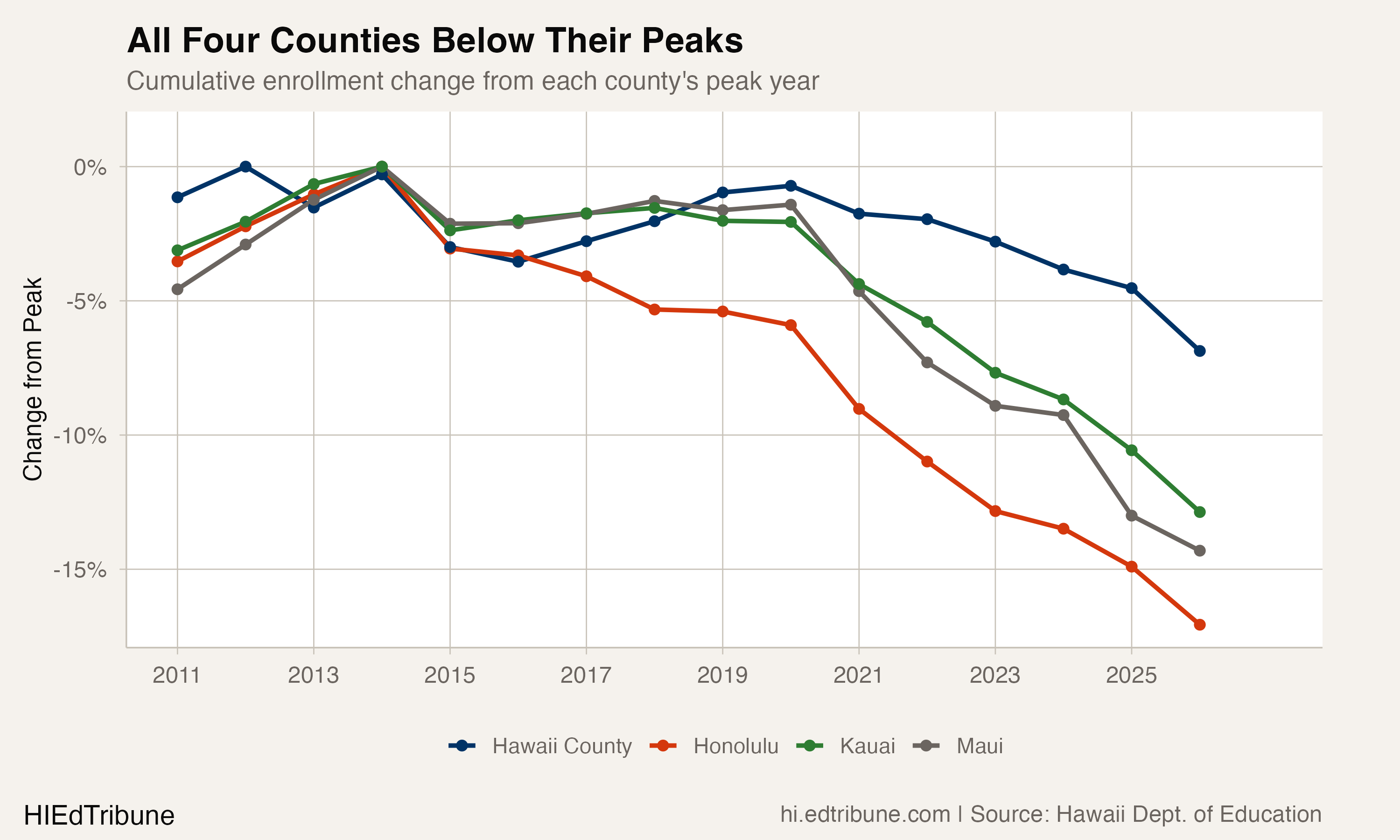
Honolulu↗ET accounts for 71.4% of the traditional sector's 2026 losses, dropping 2,644 students to 101,341. The county has lost 20,854 students since its 2014 peak, a 17.1% decline. It is the only county in the state with more than 100,000 students, and it will not hold that distinction much longer at the current pace.
Hawaii County↗ET lost 557 students (2.5%), Kauai↗ET lost 220 (2.6%), and Maui↗ET lost 281 (1.5%). Maui's relatively smaller decline may reflect a temporary pause after the severe losses of 2024-25, when the county shed 807 students, a 4.1% drop that coincided with continued displacement from the August 2023 Lahaina wildfire.
All four counties are below their enrollment peaks. Hawaii County, which peaked earliest in 2012, has lost the least in percentage terms (6.9%). Honolulu has lost the most (17.1%).

Fewer children, fewer families who can afford to stay
Two structural forces are compressing Hawaii's enrollment pipeline simultaneously.
The first is demographic. Hawaii recorded 15,570 births in 2022, the fewest in 21 years, and preliminary data indicates the number continued to fall in 2023. These shrinking birth cohorts have not yet fully reached kindergarten. When they do, the K pipeline, which has already dropped from over 16,000 (pre-2015 anomaly) to 11,637, will compress further. A Western Interstate Commission for Higher Education report projects Hawaii will see a 33% decline in high school graduates between 2023 and 2041, from roughly 11,500 to 7,600. That is the steepest projected decline of any state in the nation, triple the national average of 10%.
The second force is economic. The Aloha United Way's 2025 ALICE report found that one in three Hawaii households considered moving away in the prior year, with 180,000 people in the workforce actively weighing departure. Hawaii Community Foundation CEO Micah Kane warned that without "disruptive policies that drive down the cost of living," the state risks becoming "hollow," with only very wealthy and very poor residents remaining.
"Our workforce, our younger families, our Hawaiian families" -- Aloha United Way COO Suzanne Skjold, Hawaii News Now, Jan. 2025
The enrollment data does not say where the lost students went. CBS News has reported that more Native Hawaiians now live on the mainland than in Hawaii, with roughly 15,000 leaving each year. On Oahu, where two-thirds of the state's students attend school, the median single-family home price exceeded $1.1 million in 2025.
The K-to-12 pipeline is inverting
One signal buried in the grade-level data: Hawaii now graduates more 12th graders than it enrolls kindergartners. In 2025-26, kindergarten enrolled 11,637 students while grade 12 enrolled 12,095. The K-to-G12 ratio fell below 100 for the first time in 2024-25 (98.7) and dropped further to 96.2 in 2025-26.
This inversion means the system is shrinking from the bottom. Each entering cohort is smaller than the one exiting, guaranteeing continued enrollment decline for years regardless of migration patterns. The 2015 kindergarten counting anomaly complicates the long-term trend, but the post-anomaly trajectory is clear: K enrollment has hovered between 11,300 and 13,900 since 2016, while G12 enrollment surged from around 9,500 to 12,095 as the larger pre-decline cohorts aged through.
Redistricting instead of closures
The Department of Education has responded not with school closures but with a plan to redraw attendance boundaries. Honolulu Civil Beat reported that after pushback from principals, the DOE shifted from a consolidation study to "district optimization," adjusting where students attend rather than shuttering buildings.
"Hawaii has enough school capacity, just not in the right places." -- 2017 DOE utilization study, via Honolulu Civil Beat
That finding is eight years old, and the mismatch has only widened. In 2025-26, the DOE enrolled approximately 150,000 students across 258 campuses. Thirty-four schools enrolled fewer than 250 children, each receiving $250,000 in supplemental funding to offset the operational inefficiency. Rural communities on Lanai, Molokai, Hana, and West Maui face a projected 25% enrollment decline by decade's end, while new developments in Ewa and Kapolei continue to generate overcrowding.
Redistricting changes are expected for the 2026-27 school year. A bill introduced by state Senator Troy Hashimoto would create an independent commission to review school facilities, with consolidation recommendations due by fall 2027. The question is whether boundary adjustments can address a problem that is fundamentally about having fewer students in the system, not about where they sit within it.
What 149,000 looks like
At the current pace, traditional enrollment will cross below 150,000 in 2026-27 and approach 145,000 by 2028. The birth cohorts that will fill those kindergarten seats have already been born, and they are smaller than any in two decades. The cost-of-living pressures that push families to the mainland show no sign of easing.
Hawaii operates a structure unique in American public education: a single statewide district. There are no independent school boards to consolidate, no inter-district competition for students, no funding formula fights between rich and poor jurisdictions. That centralization should, in theory, make adaptation easier. A mainland state with 258 schools spread across dozens of independent districts would face years of political negotiation to close or consolidate. Hawaii needs only one board's approval.
So far, that advantage has produced a redistricting plan, not a consolidation plan. The redistricting changes come in fall 2026. The consolidation studies start in 2027. The first possible school mergers arrive in 2028. Traditional enrollment, meanwhile, is losing 3,700 students a year and accelerating. The structural advantage exists. The clock is running.
Detailed code that reproduces the analysis and figures in this article is available exclusively to EdTribune subscribers.
Discussion
Sign in to join the discussion.
Loading comments...