In this series: Hawaii 2025-26 Enrollment.
In most states, public school enrollment five years after COVID has at least stabilized. In Hawaii, it is accelerating in the wrong direction. All four Hawaiian counties ended the 2025-26 school year further from their pre-pandemic enrollment than they were a year earlier. Not one county recovered. Not one held steady. Every county lost more ground.
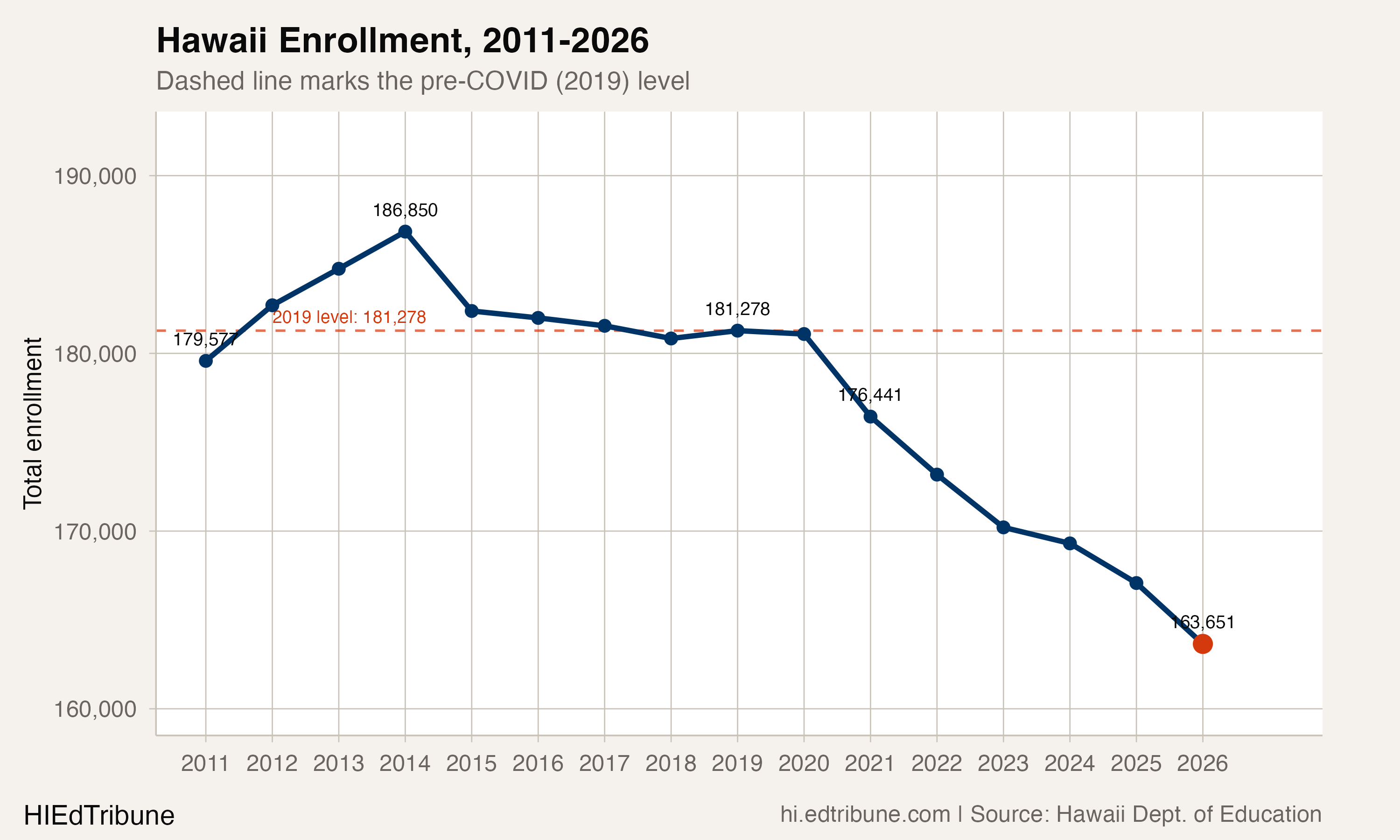
Statewide enrollment fell to 163,651, a loss of 3,425 students from the prior year and 17,627 below the 2019 level. The gap from pre-COVID enrollment grew by 24% in a single year, from 14,202 to 17,627. Hawaii is not recovering from the pandemic enrollment shock. It is compounding it.
The gap widens everywhere
Honolulu↗ET, which enrolls 62% of the state's students, now sits 14,259 below its 2019 level, a 12.3% deficit. That gap widened by 2,644 students in a single year, accounting for 77% of the statewide deterioration. Maui↗ET fell 12.9% below 2019, Kauai↗ET 11.1%, and Hawaii County↗ET, the most resilient county through the post-pandemic period, dropped 6.0% below its pre-COVID mark after losing 557 students.
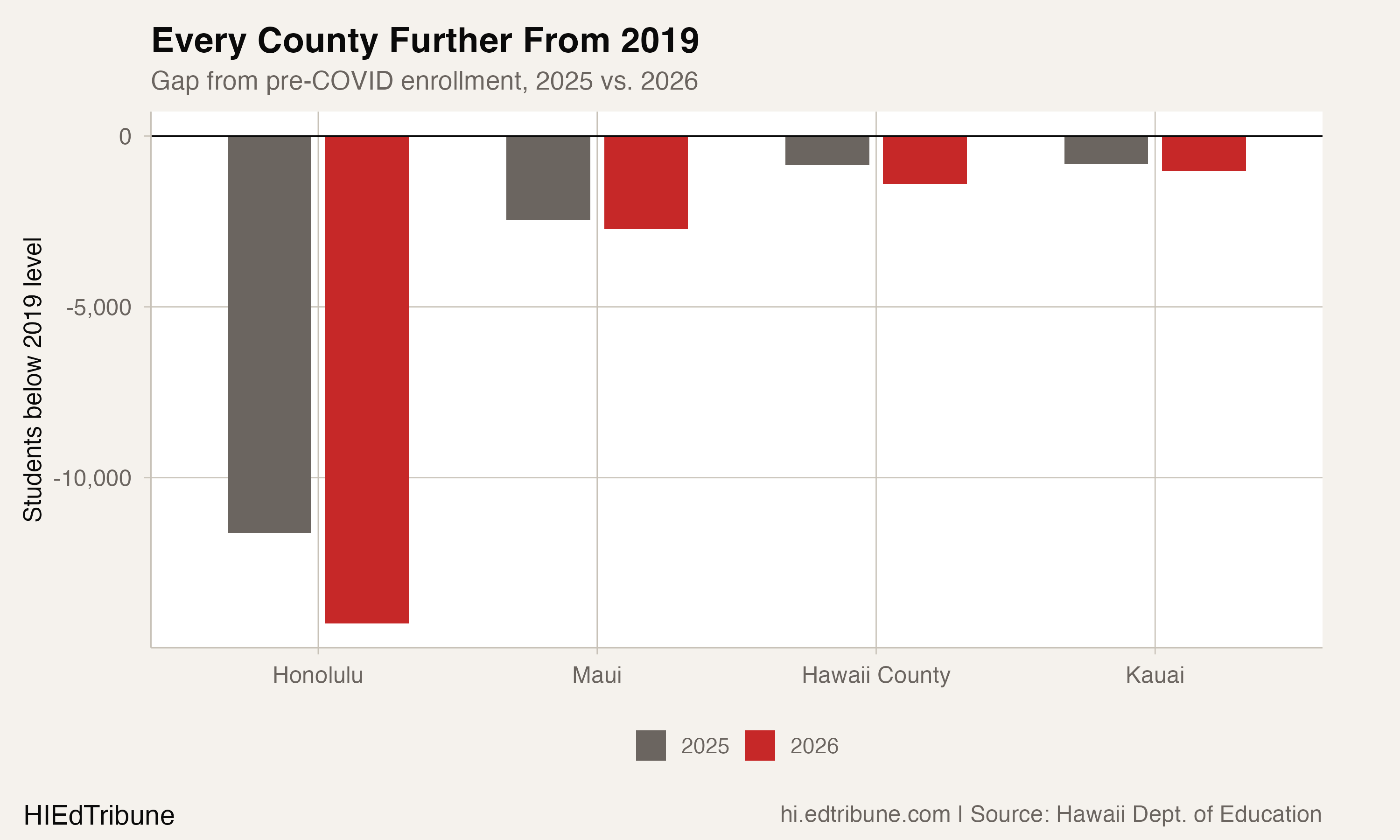
Hawaii County had maintained a relatively stable trajectory through 2024, losing fewer than 200 students per year from its 2019 baseline. In 2026, it lost 557. That tripling moves the Big Island from outlier to participant in the statewide pattern.
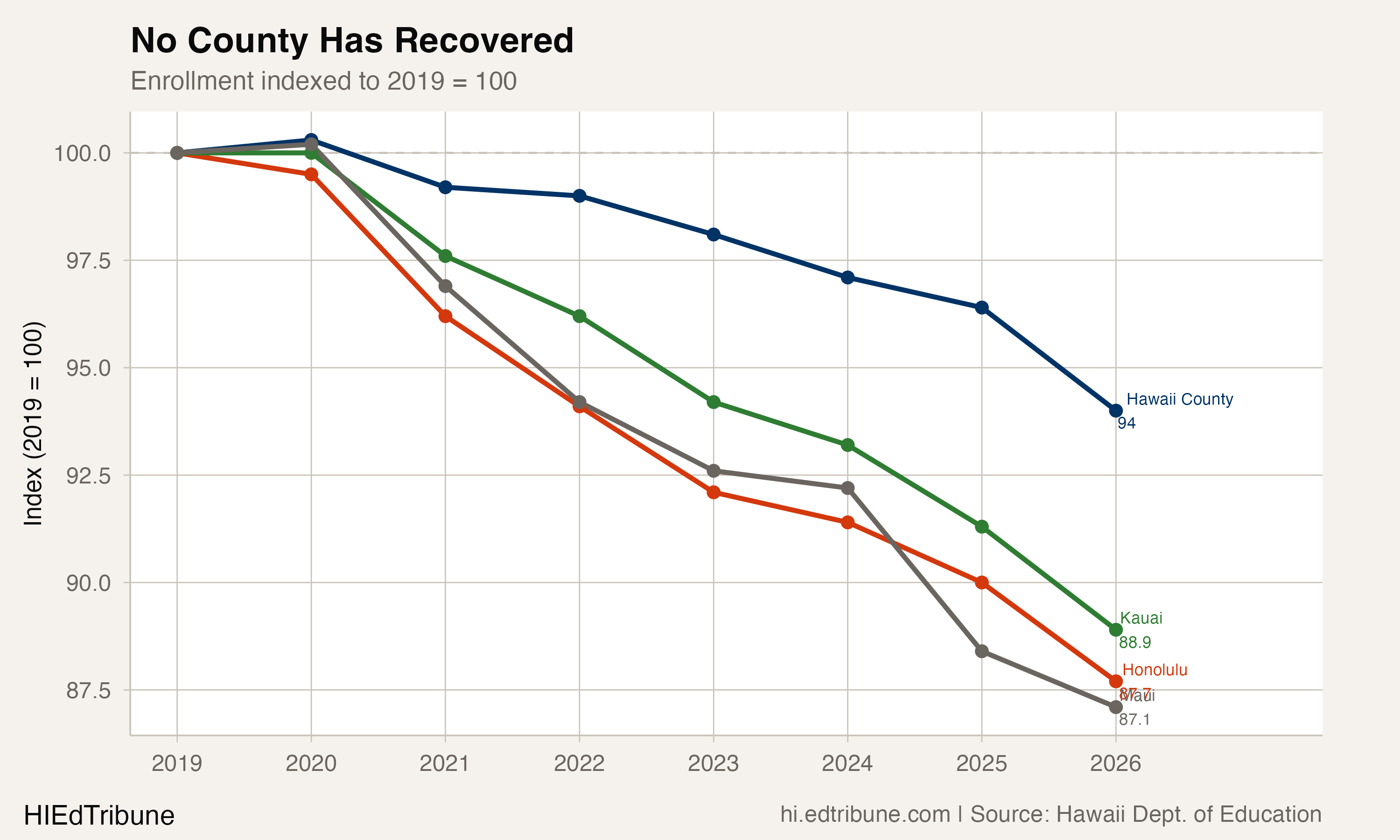
Indexing all four counties to 2019 reveals parallel descents. Maui and Honolulu track each other almost exactly, both landing near 87-88 on a 100-point scale. Kauai sits at 88.9, and Hawaii County at 94.0, the last county above 90.
A re-acceleration, not a plateau
The 2024 school year had offered a faint signal of stabilization. The state lost only 901 students that year, its smallest decline since the pandemic began, and the trajectory appeared to be flattening. That signal was false. The 2025-26 loss of 3,425 students was 3.8 times larger than the prior year and the second-largest non-COVID single-year drop in the 16-year dataset, behind only a 4,466-student decline in 2015.
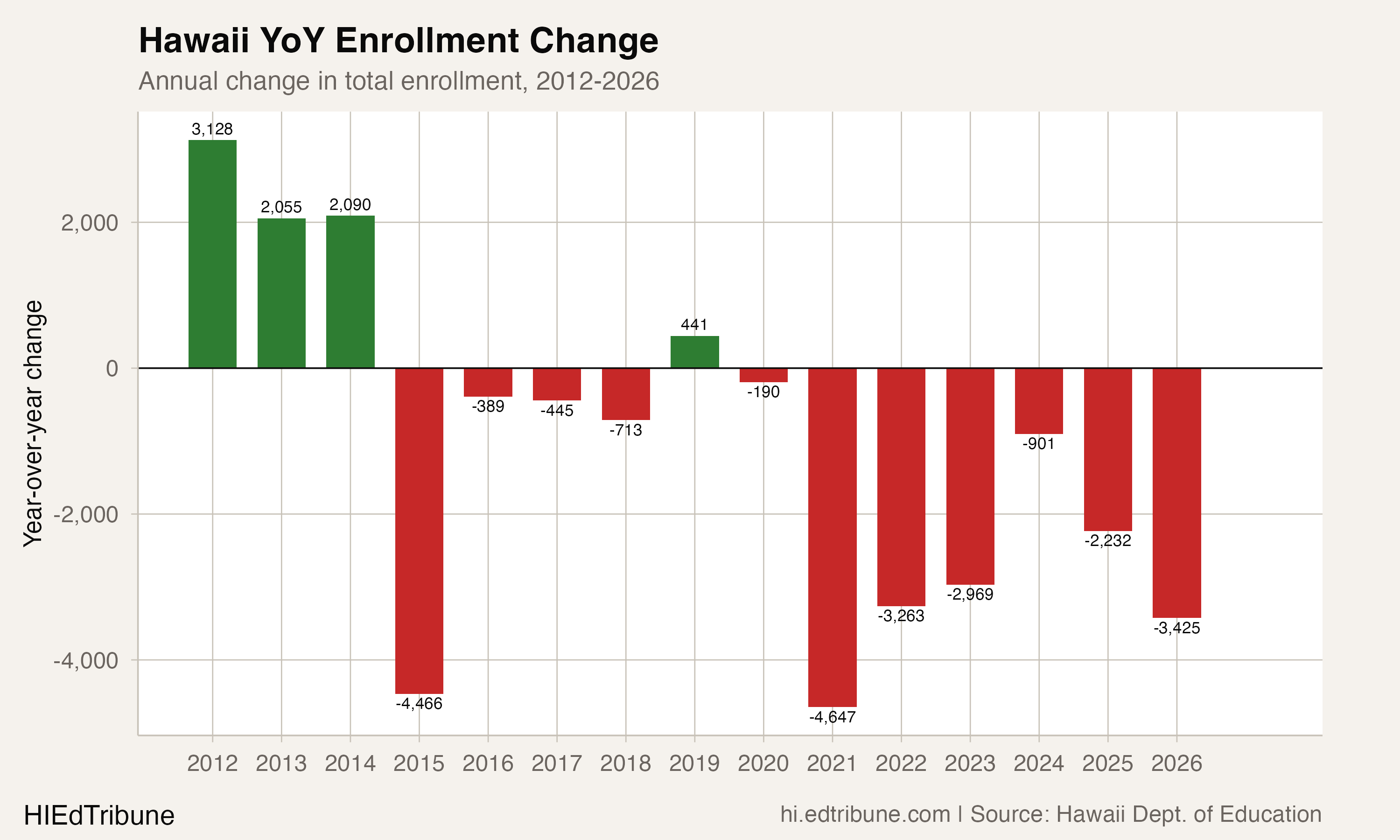
Since COVID, Hawaii has lost 17,437 students from its 2020 baseline, a 9.6% decline in six years. The post-pandemic losses have not been one sharp shock followed by recovery. They have been cumulative: -4,647, -3,263, -2,969, -901, -2,232, -3,425. Five of those six years exceeded 2,000, and 2026 was the worst of the non-COVID years.
Maui after the fires
Maui County presents a layered story. The county was already declining before the August 2023 Lahaina wildfire, losing 694 students in the 2021 COVID year and 572 more in 2022. The fire's enrollment impact was initially muted at the county level: Maui lost just 74 students in the 2024 school year, the first full year after the disaster. Then 2025 brought a sharp 807-student drop, 4.1% of the county's enrollment, as displaced families settled into longer-term arrangements off-island.
The 2026 loss of 281 students is smaller in magnitude but extends the decline to a fifth consecutive year. Lahaina schools have lost more than 20% of their students since the fire, with Lahainaluna High falling from 1,012 to 813 and King Kamehameha III Elementary declining from 543 to roughly 330, still operating from a temporary Army Corps facility near Kapalua Airport. The county-level data does not isolate the fire's impact from the broader decline, but Maui's 12.9% gap from 2019 is the worst of any county.
Where the students are going
Charter schools are the one segment of Hawaii's public education system that is growing. Charter enrollment rose to 13,371 in 2025-26, up 15.6% from 2019, while DOE schools (the county total) fell 11.5% over the same period. Charter schools now enroll 8.2% of the state total, up from 6.4% in 2019.
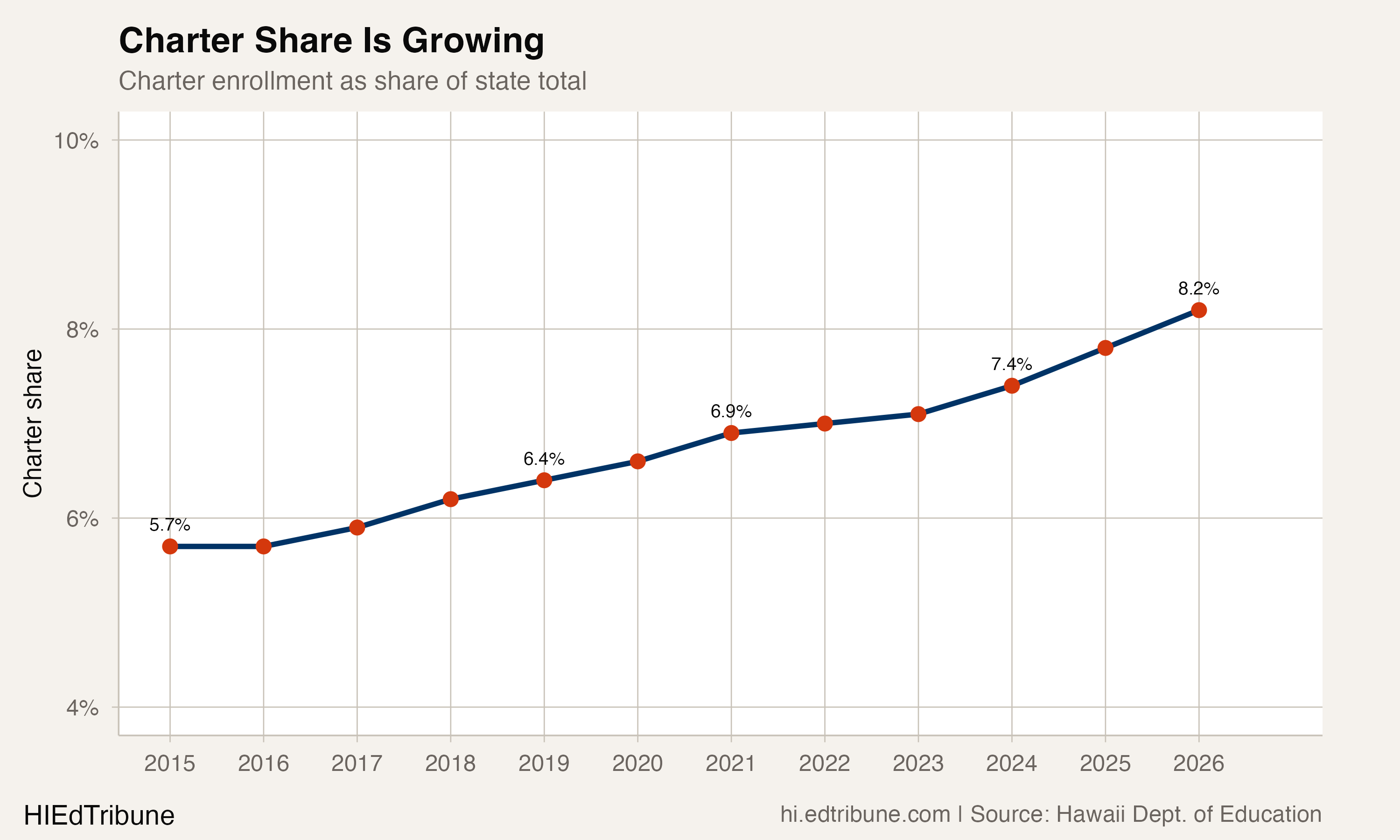
That growth, though, does not explain the overall decline. Charter schools gained 1,806 students since 2019 while DOE schools lost 19,433. The charter sector absorbed roughly 9% of the DOE's losses. The remaining 91% left the public system entirely, through private school enrollment, homeschooling, or families leaving Hawaii.
The out-migration channel is well documented. Census data shows Hawaii lost a net 2,132 residents in 2025, with 8,876 people moving to other states, only partially offset by international arrivals and births. The population stood at 1,432,820 as of July 2025, and the state has logged population declines in five of the past six years.
The cost of living is the most commonly cited driver. A UHERO report found that when adjusted for local prices, Hawaii's incomes rank near the bottom nationally, comparable to Alabama and West Virginia. The combination of high costs and low wage growth, not just high prices alone, is pushing families to the mainland. A 2025 survey by the Holomua Collective found that 79% of workers reported family members who had left the state due to affordability.
The birth rate floor
Even if out-migration stopped tomorrow, Hawaii's enrollment pipeline is shrinking. Annual births have fallen 14% since 2016, the sixth-largest drop of any state, with roughly 200-500 fewer babies born each year. Those children enter kindergarten in 2027 and 2028. The state is projected to see the nation's highest drop in high school graduates over the next 15 years, with a 33% decline between 2023 and 2041, triple the national average of 10%.
"Decades of enrollment growth led to the construction of new campuses, but the recent and continuing decline in student numbers has left many facilities underutilized." -- SB 2541, Hawaii State Legislature, 2026
A 2017 DOE facilities study found more than 60 schools operating below capacity, while others were overcrowded. The finding at the time: "Put simply, Hawaii has enough school capacity, just not in the right places." Eight years later, the mismatch has widened. Rural areas on Lanai, Molokai, and in Hana face projected enrollment drops of up to 25% by the end of the decade, while new housing developments in Ewa and Kapolei generate overcrowding.
Redistricting instead of closures
The DOE reversed its approach in fall 2025, shelving a plan to vote on school closures by spring 2026 and instead pursuing redistricting as a first step. Boundary changes are now targeted for the 2026-27 school year, with consolidation studies pushed to 2027 and no mergers before spring 2028. The department has not closed a school since 2011, when the closure of Queen Liliuokalani Elementary generated significant community opposition.
The redistricting approach moves students on paper without reducing infrastructure costs. Hawaii's per-pupil funding follows students through the Weighted Student Formula, so when enrollment drops at a campus, its budget shrinks proportionally, but the building remains. Schools with fewer than 250 students, 34 campuses statewide as of 2025, face structural budget constraints at any per-pupil funding level.
The paradox of Hawaii's position is that its students are learning more effectively than most of the country. A Harvard-Stanford study ranked Hawaii fourth nationally in math recovery and second in reading recovery since the pandemic. The system is doing better academic work with fewer students. But academic performance does not pay for buildings. Thirty-four campuses already enroll fewer than 250 students, each surviving on supplemental funding that shrinks as the headcount does. Better test scores and emptier classrooms can coexist for a while. Not forever.
Detailed code that reproduces the analysis and figures in this article is available exclusively to EdTribune subscribers.
Discussion
Sign in to join the discussion.
Loading comments...