At 24 Hawaii schools, the published Pacific Islander chronic absence rate was below 20% in 2024-25. A year earlier, under the same measure, 15 schools were below that line. The comparison includes 224 schools with a published Pacific Islander rate in 2024-25.
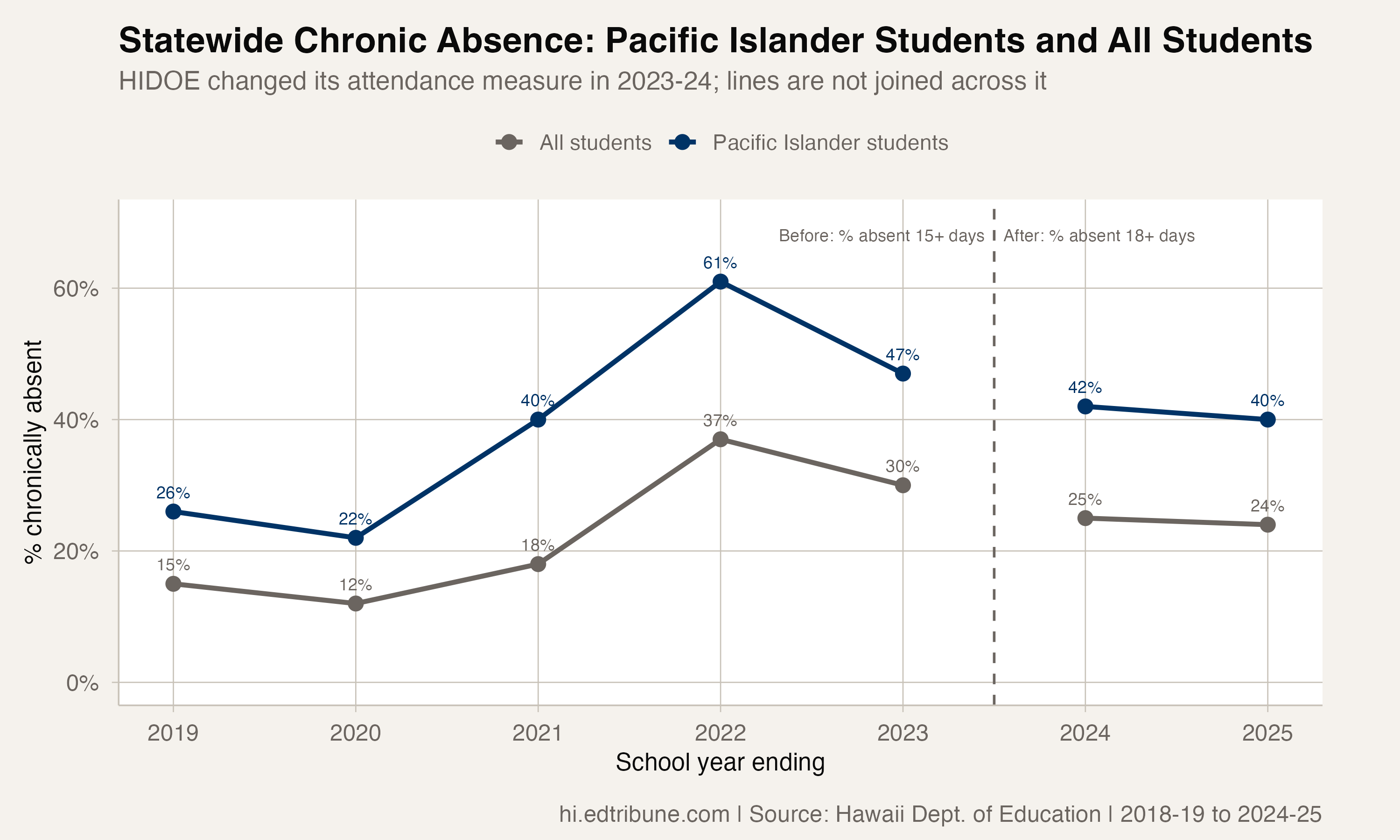
Statewide, 40% of Pacific Islander students were chronically absent, the highest rate of any racial or ethnic group the state reports and 16 points above the rate for all students, 24%. Native Hawaiian students, whom HIDOE counts as a separate group, were next at 36%.
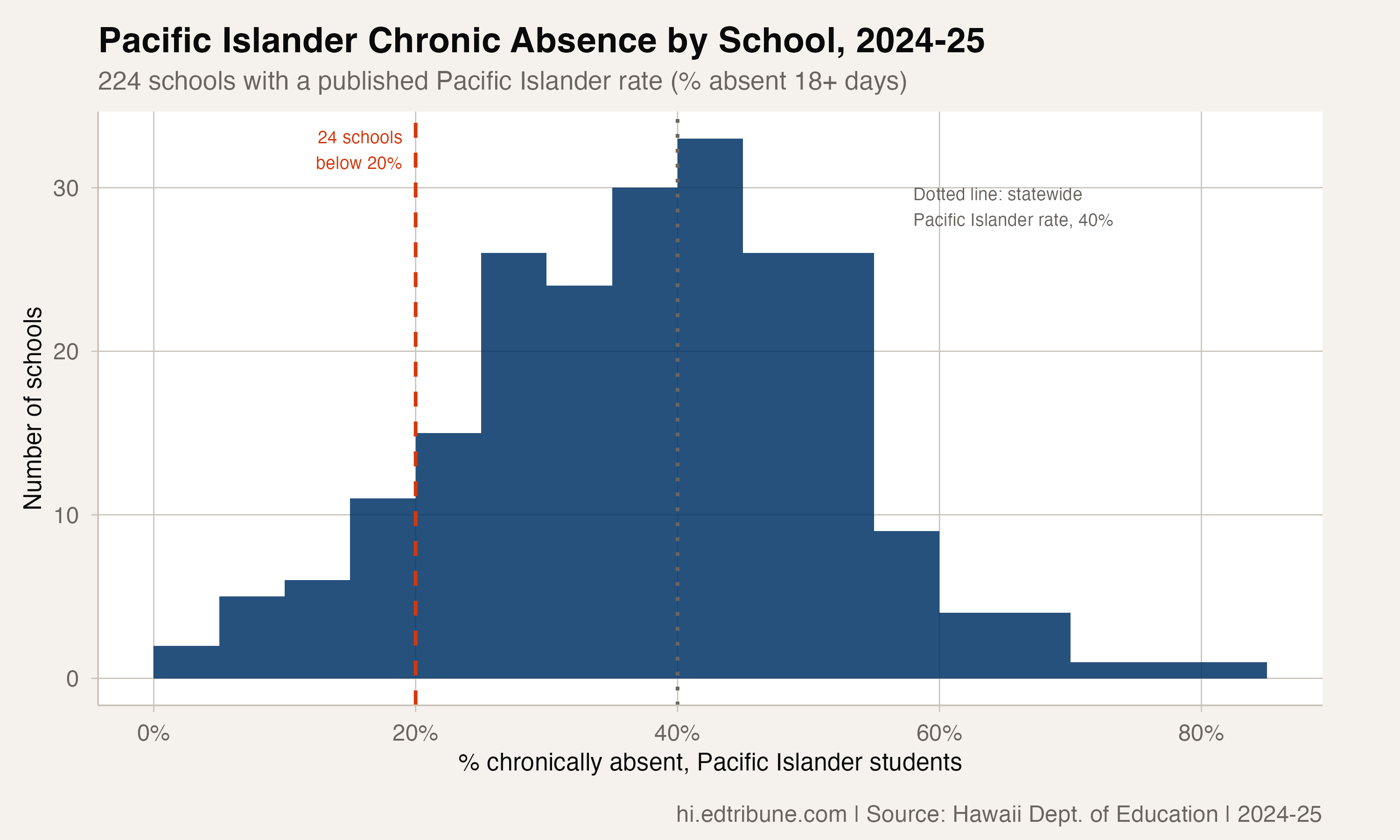
Two schools reported a Pacific Islander rate of 0%: Admiral C.W. Nimitz Elementary and Myron B. Thompson Academy, an online public charter school. Major Sheldon Wheeler Middle School reported 5%, and Niu Valley Middle and Mānana Elementary each reported 8%.
What "chronically absent" means here
HIDOE changed its attendance measure in 2023-24. Through 2022-23, it reported the share of students absent 15 or more days. Since then it reports the share who attend regularly, defined as 17 or fewer days absent. The chronic absence figures for 2024 and 2025 are the remainder: students absent 18 or more days.
The changed cutoff prevents a direct comparison of 2024-25 with years before the change. Every school comparison below uses 2023-24 and 2024-25 only.
Where the rate fell fastest
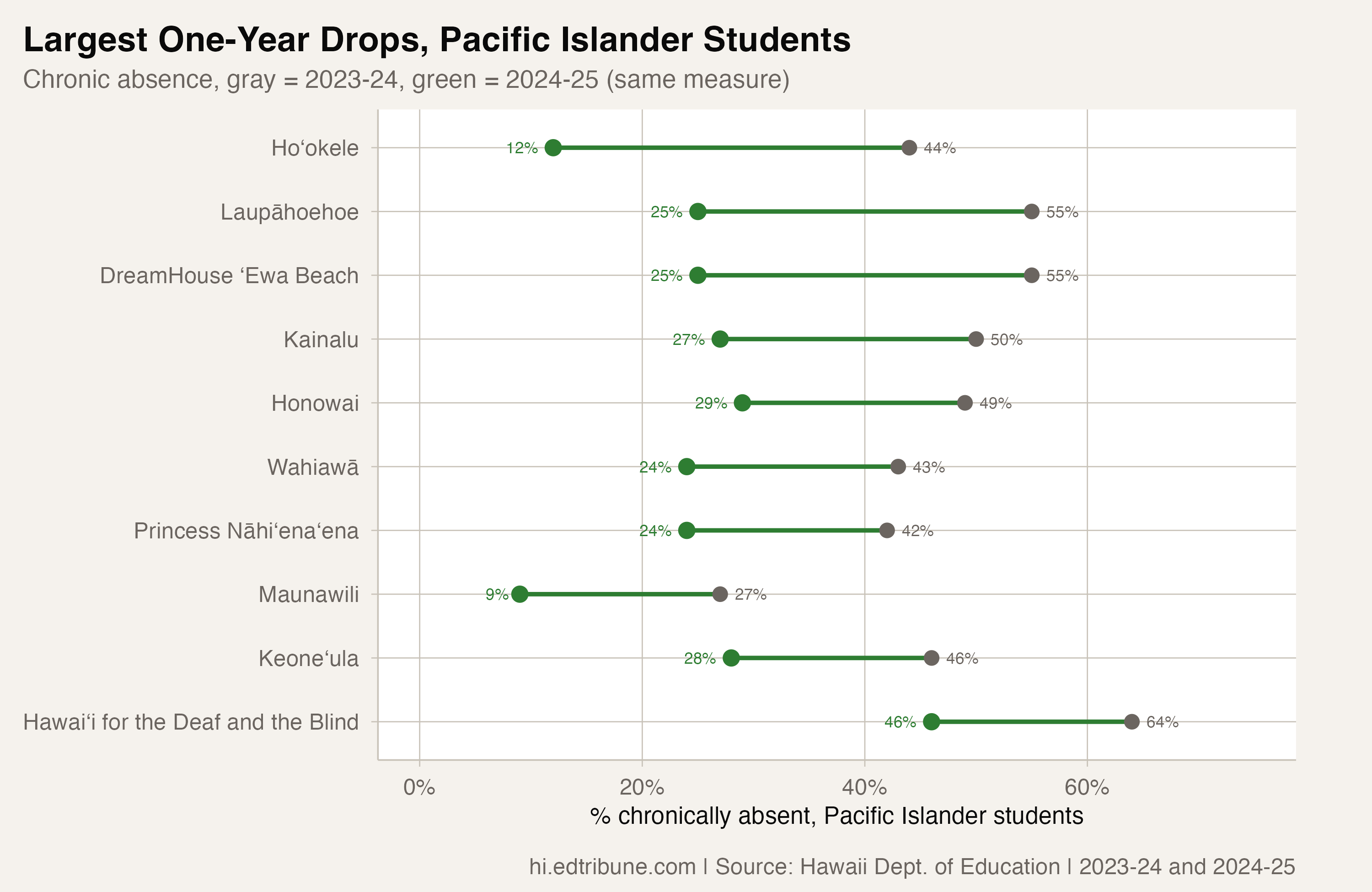
Of the 216 schools with a Pacific Islander rate in both years, 125 saw it fall. The largest drop was at Hoʻokele Elementary, from 44% to 12%, a 32-point change. Laupāhoehoe Community Public Charter School and DreamHouse ʻEwa Beach each went from 55% to 25%.
Eleven schools stayed below 20% in both years, which matters because a single low year at a school with few Pacific Islander students can be a matter of a handful of families. HIDOE withholds rates for the smallest groups, but it does not publish how many students stand behind each rate that it does release, so these figures cannot be weighted by size.
The 20% line is our choice, not a state standard. The pattern holds at other cutoffs: more schools were under 15%, and more were under 25%, in 2024-25 than in 2023-24. At 39 schools, the Pacific Islander rate was at or below 24%, the statewide rate for all students. At 34, it was at or below the same school's rate for all of its students.
The statewide gap
The schools with low rates are the exception. The median school's Pacific Islander rate was 39% in 2024-25, and 105 schools reported 40% or higher.
Under the newer measure, the statewide Pacific Islander rate went from 42% in 2023-24 to 40% in 2024-25, a 2-point change, while the gap with all students narrowed from 17 points to 16. Under the older measure, the rate was 26% in 2019, rose to 61% in 2022 and fell to 47% in 2023. The gap in those years was 11, 24 and 17 points. The two sets of numbers use different cutoffs and cannot be read as one line.
What the data cannot show
The state's attendance data do not identify which practices caused these results. They also do not separate Pacific Islander students by nation or immigration status, so they cannot establish differences within that broad category.
What the numbers do show is that the statewide rate is an average over schools that differ widely, and that the count of schools with low Pacific Islander absence grew between 2023-24 and 2024-25.
Attendance figures come from the Hawaii Department of Education's ESSA school reports, covering 2018-19 through 2024-25.
Detailed code that reproduces the analysis and figures in this article is available exclusively to EdTribune subscribers.
Discussion
Sign in to join the discussion.
Loading comments...