Nā Wai Ola Public Charter School in Mountain View, on Hawaii Island, reported 97% regular attendance in 2024-25, according to the Hawaii Department of Education's school report. The remaining 3% did not meet the state's regular-attendance threshold.
That placed the school among four Hawaii public schools with a reported rate of students not regularly attending of 3% or lower. The statewide figure was 24% in the same school year.
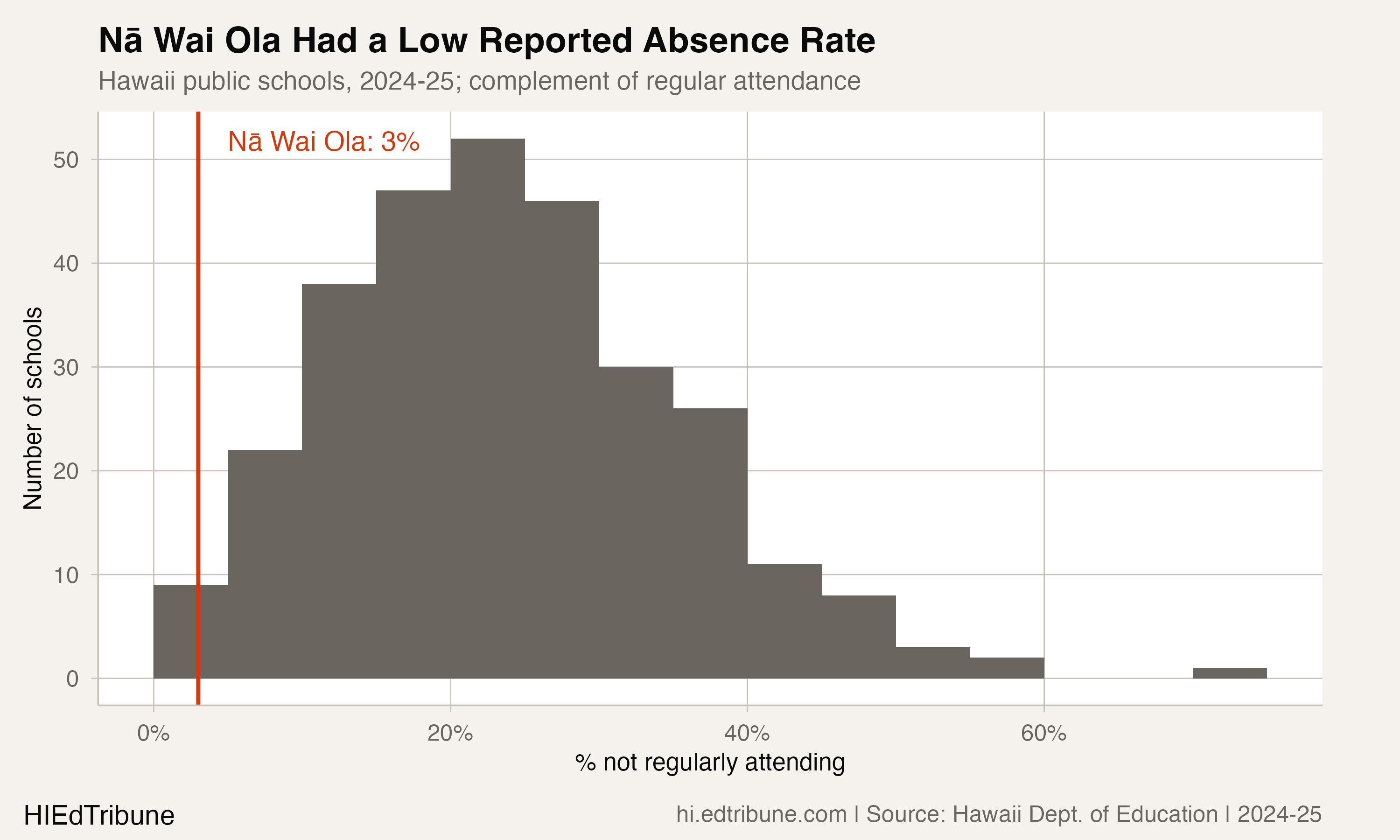
The result is a single-year snapshot. It does not establish how much attendance improved or what produced the school's reported rate.
What the attendance measure tells us
HIDOE's currently posted 2022-23 report defines chronic absenteeism as missing 15 or more days. Its currently posted 2023-24 report and 2024-25 report both define regular attendance as missing 17 or fewer days. The figures for students not regularly attending in this article are the complements of HIDOE's published regular-attendance rates.
The Hawaii State Public Charter School Commission cautioned against a straightforward year-to-year reading in written statements to The HIEdTribune.
On the change in the attendance measure, the Commission wrote: “Hawaii’s attendance measure changed between the two school years, including a change in how chronic absenteeism is defined and reported. Because of that change, year-to-year comparisons should be made with care.”
The Commission added: “The Commission relies on the state’s established attendance definitions and reporting systems. For technical questions about the statewide attendance methodology, we would defer to the Hawaii Department of Education and the state’s published reporting guidance.”
The timing described by the Commission differs from the boundary visible in the currently posted school reports. Those reports alone do not resolve whether other recording or reporting practices changed between the years. This article therefore makes no claim about the size or rank of an attendance improvement.
The published student groups
HIDOE's 2024-25 report also provides rates for these student groups at Nā Wai Ola. The shares not regularly attending were:
- Native Hawaiian students: 0%
- Students eligible for free or reduced-price lunch: 4%
- Students in special education: 0%
- White students: 9%
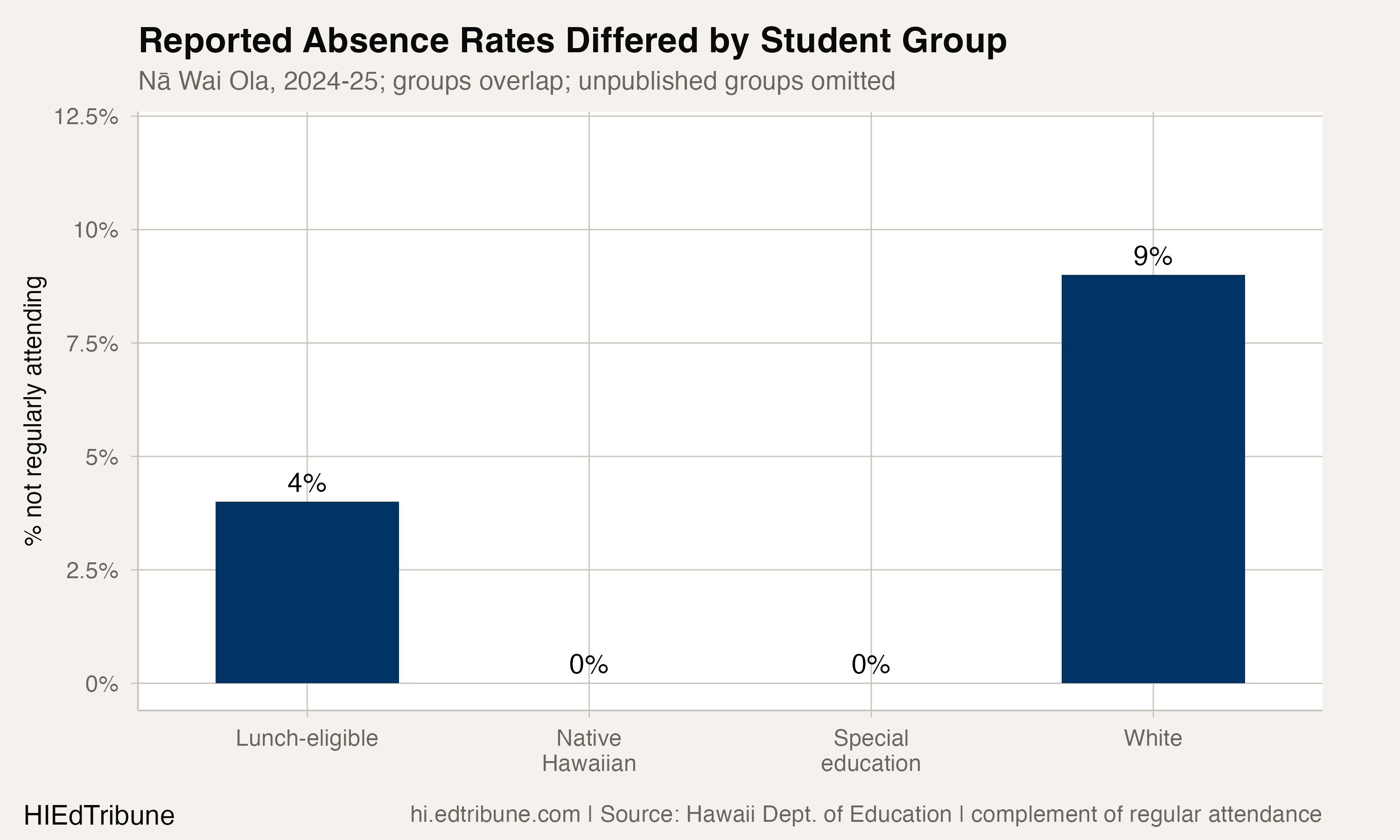
The groups overlap, and the report leaves some groups unpublished. These rates cannot be added together to describe the whole school. Nor do they show which attendance practices produced the result.
School practices and oversight
Kapua Francisco, the school's Poʻokumu or director/principal, described the school's approach in a written response to The HIEdTribune. The school provides free transportation to and from school and describes a project-based learning program that combines Hawaiian cultural knowledge with science and practical projects. Francisco believes those practices help students feel connected to school.
Francisco wrote: “We recognize that the published attendance data cannot independently establish the extent to which transportation, Hawaiian culture-based education, or project-based learning influenced the reported results. Nevertheless, these are intentional and interconnected elements of our educational approach that we believe support student engagement and regular attendance.”
The Commission described its role separately from the school's daily attendance work.
The Commission wrote: “The Hawaii State Public Charter School Commission provides oversight and support to the state’s public charter schools, including monitoring school performance and compliance with applicable requirements, reported annually. Individual charter schools, however, are responsible for their day-to-day operations and for implementing their own approaches to student engagement and attendance.We believe attendance data should be considered in context and monitored over time rather than relying on a single year’s result. The Commission remains committed to monitoring student outcomes, including attendance, as part of our responsibility to support quality public charter schools.”
Attendance figures come from the Hawaii Department of Education's ESSA school reports. The most recent school year available in the attendance series used here is 2024-25; these are not current 2026-27 counts.
Detailed code that reproduces the analysis and figures in this article is available exclusively to EdTribune subscribers.
Discussion
Sign in to join the discussion.
Loading comments...