The August 2023 Lahaina wildfire destroyed King Kamehameha III Elementary on Front Street. Its students finished the 2023-24 school year at a temporary campus near Kapalua Airport, which opened that April.
In 2024-25, the school's first full year on that campus, its chronic absence rate was 24%. The statewide rate was also 24%. Put the other way, about 76% of students attended regularly in 2024-25, a figure Principal Michael McCloskey confirmed to The HIEdTribune. A year earlier, in the first school year after the fire, the school had been 7 points above the state, at 32% against 25%.
That 8-point drop in one year is the part of the story the state's data can support. King Kamehameha III was one of 19 schools, out of 293 with published rates in both years, whose chronic absence rate fell by 8 points or more between 2023-24 and 2024-25. The statewide rate moved 1 point. The school comparison uses stable school codes and requires a published rate in both years; it does not track the same individual students.
Why the story starts in 2024
Hawaii changed how it measures attendance in the same school year the fire hit. Through 2022-23, the Department of Education reported the share of students absent 15 or more days. Starting in 2023-24, it reports the share who attend regularly, defined as 17 or fewer days absent. The chronic absence figures here for 2024 and 2025 are the remainder: students absent 18 or more days.
A higher absent-day cutoff can lower the reported rate even without an improvement in attendance. A drop from a 2022-23 figure to a 2024-25 figure would mix a real change with a change in the ruler. This article compares each year only with years measured the same way.
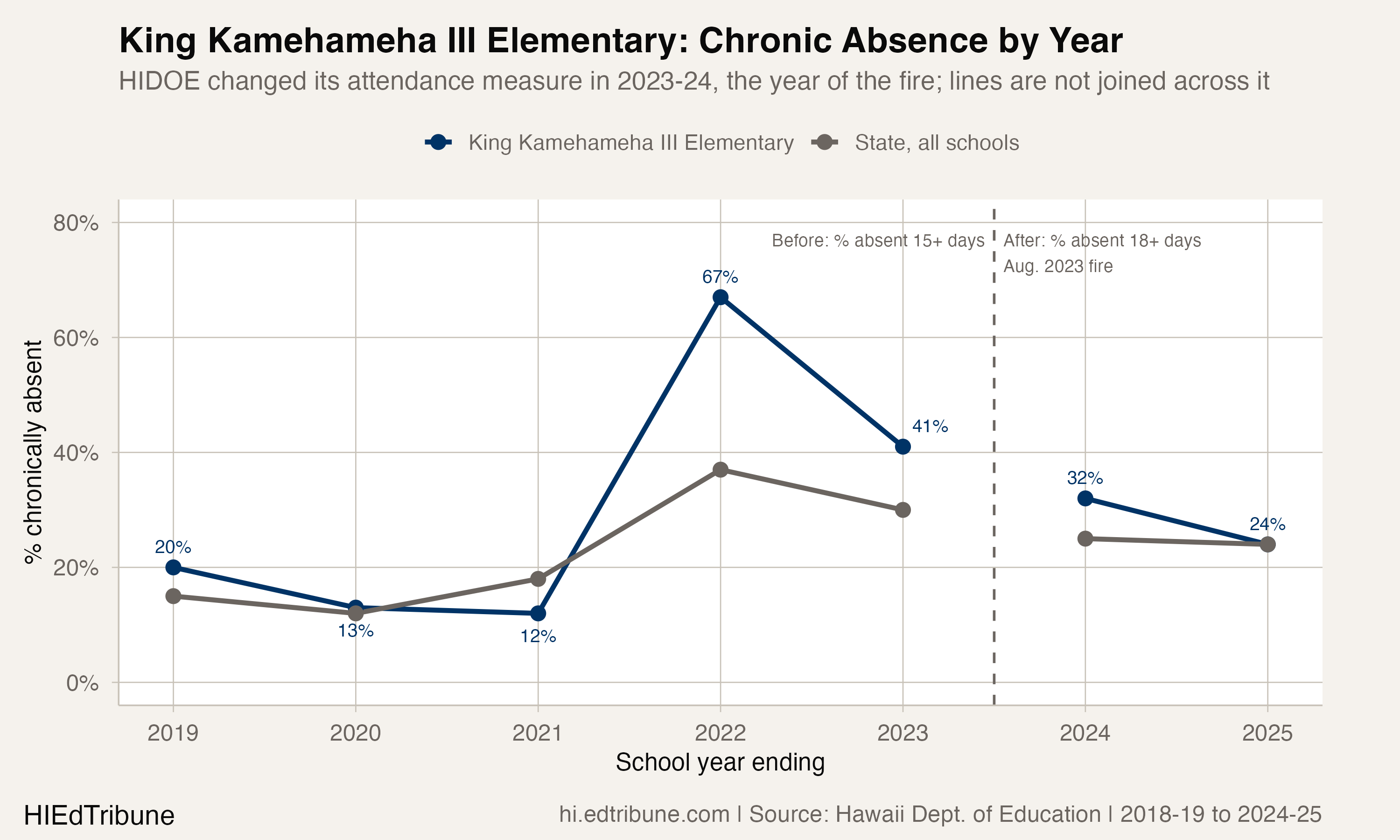
Under the older measure, the school's pandemic spike was steep. Its rate was 20% in 2019 and 67% in 2022, when the state's was 37%. It fell 26 points, to 41%, in 2022-23, the last school year on Front Street. That left it 11 points above the statewide rate of 30%.
Closing the gap after the fire
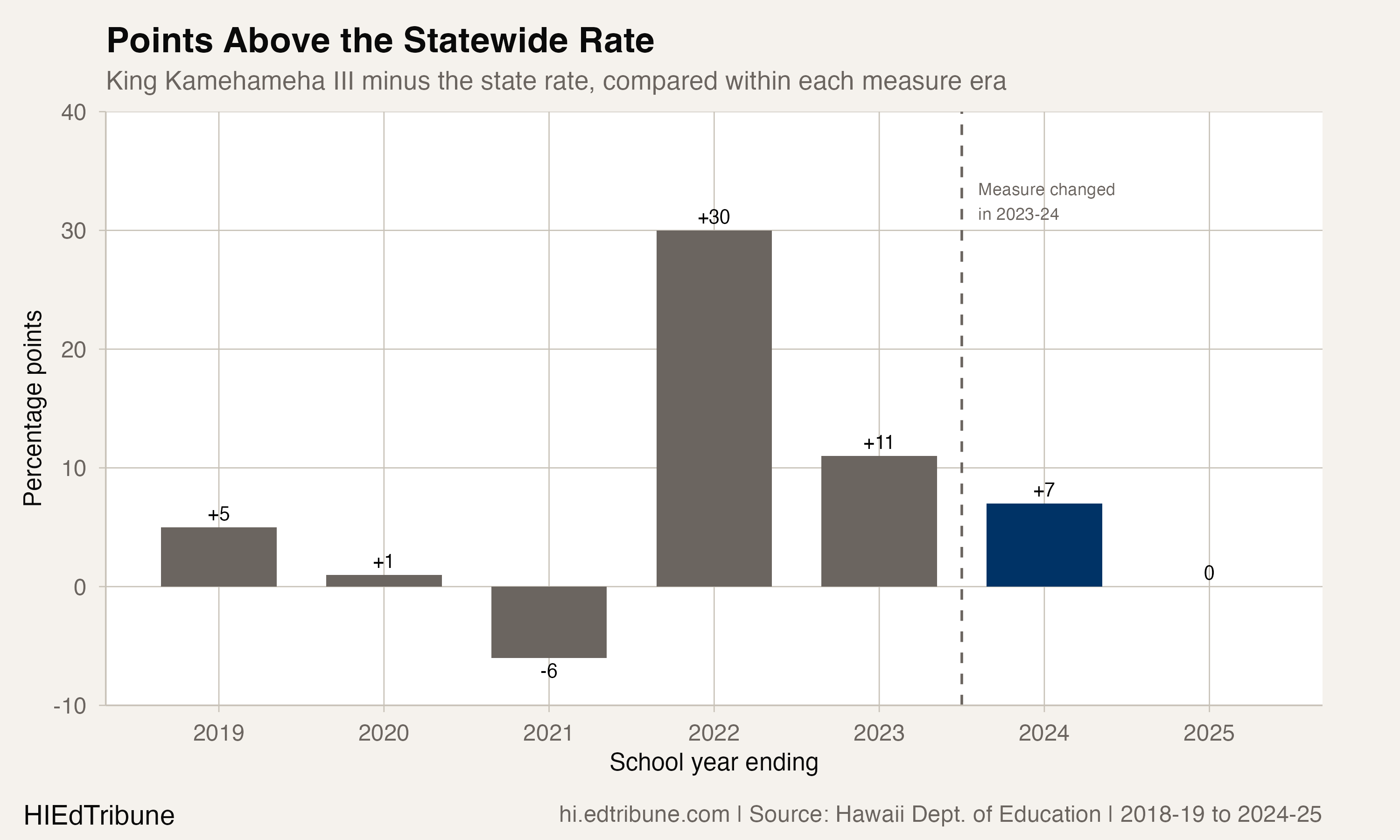
Under the newer measure, the school started 7 points above the state in 2024 and finished level with it in 2025. The chart shows each year's distance from the state rate. Both the school and the state are measured the same way within each era, but the bars on either side of the change still rest on different cutoffs, so the two eras should be read separately.
The state's attendance files do not record why the rate fell. The temporary campus gave students one stable site for all of 2024-25, after a year that began with no building at all. McCloskey said the Army Corps of Engineers and the agencies involved "did an amazing job in getting the site ready in such a short timeframe." Because the campus is built from modular classrooms, he said, "it doesn't have the feel of a traditional Hawaiian school." He credited the steadier setting with giving students structure.
He also said many families still do not have stable housing, and the school, along with state and complex support, is working on those barriers. He has set up regular ways for families and community members to reach him, he said, and has tried to be open with them about the rebuild.
Enrollment grew between the two published snapshots used here: 330 students in kindergarten through grade 5 in 2024-25 and 395 in 2025-26. The latter figure describes last school year, not the current school year. McCloskey said enrollment has come back faster than the state projected. The two enrollment files used here cover those school years, so these counts cannot show how the fire changed the student body. It is possible that the families who stayed on Maui, or returned, differ from those who left.
Most student groups improved
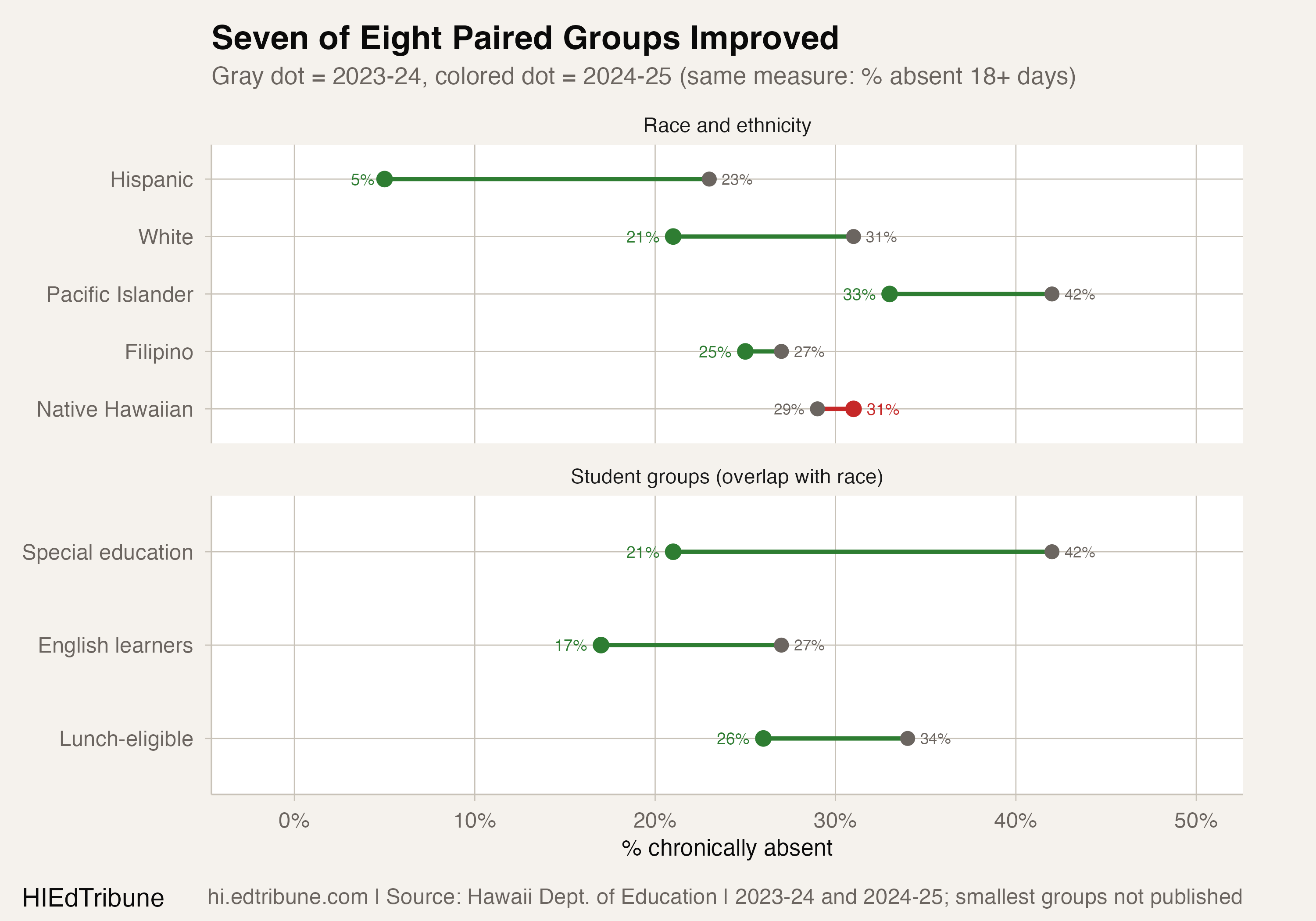
Eight student groups at the school had published rates in both post-fire years. Seven of them improved between 2023-24 and 2024-25.
- Students in special education: 42% to 21%, the largest drop of any group
- Hispanic students: 23% to 5%
- English learners: 27% to 17%
- Pacific Islander students: 42% to 33%
- Students eligible for free or reduced-price lunch: 34% to 26%
- Filipino students: 27% to 25%
Several of these groups are small. The HIDOE school report withholds rates for the smallest groups, but even among the published ones, a few students changing their attendance can move a group's rate by many points. English learners, students in special education and lunch-eligible students also overlap with the racial and ethnic groups, so the groups do not add up to the school.
That is the right way to read the eighth group, Native Hawaiian students, whose rate moved 2 points, from 29% to 31%. McCloskey said Native Hawaiian students are a small share of the school's enrollment, so a few students can shift the group's rate, and that recovery since the fire has not been even across groups. A move that size in a group that small is not a trend.
What the historical figures leave open
The State's rebuilding announcement identifies Kuʻia, inland from the original Front Street campus, as the permanent replacement site. The county recovery tracker lists that selection among the project's milestones.
The 2024-25 rate still means about one in four students missed 18 or more days. The attendance series reviewed here ends in 2024-25 and does not establish whether the match with the statewide rate continued afterward.
Attendance figures come from the Hawaii Department of Education's ESSA school reports, covering 2018-19 through 2024-25. Enrollment counts come from the department's official school enrollment files for 2024-25 and 2025-26.
Detailed code that reproduces the analysis and figures in this article is available exclusively to EdTribune subscribers.
Discussion
Sign in to join the discussion.
Loading comments...